Feng shui is an ancient Chinese practice which claims to use energy forces to harmonise people with their surrounding environment. It is generally used in interior design of homes and workplaces. Dating back to at least 4000 BC, its name literally means “wind-water”.
LUKE: Yeah, [Dad] just wanted me to make sure [Louie] got a proper funeral. You know, respectful, dignified.
LORELAI: No horseshoe carnation wreaths, got it.
Carnations are traditional funeral flowers, symbolising love and remembrance. Horseshoe wreaths at funerals are commonly made, sometimes symbolising good luck, but especially for people with a connection to horses – including gamblers, I suppose. Lorelai’s funeral snobbishness sounds like something of which Emily would approve!
LUKE: No no, he spent most of his life here but retired to Orlando, so I gotta ship the body back here.
Orlando is the seat of Orange County in Central Florida, a city founded in 1838, and with a population of more than 300 000, making it the 67th largest city in the US (the entire metropolitan area is more than 2.5 million).
Orlando is nicknamed “the City Beautiful”, and is heavily visited due to the Walt Disney World Resort, and the Universal Orlando Resort, as well as being extremely popular for conventions. It is a common place to choose for retirement, like Louie did.
Orlando is about 1200 miles from Hartford, and can be more than four hours by air, if that’s how Luke is having him shipped. By road, it’s about 18 hours.
Equal is a brand of artificial sweetener, using aspartame as its primary sweetening ingredient. Its owned by Merisant, headquartered in Chicago. It was one of the first artificial sweeteners to be marketed to the public in the 1980s.
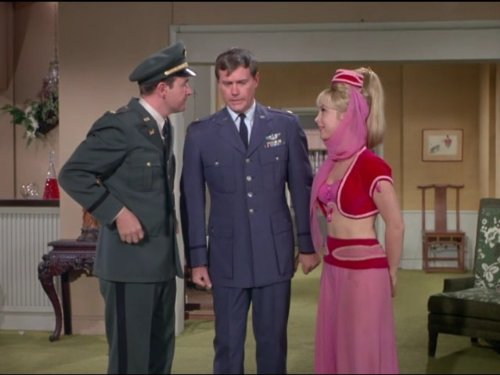
RORY: Just assume that Jeannie’s gonna get Major Healey out of whatever scrape he’s in.
As the theme music playing tells us, Jess is watching I Dream of Jeannie, a fantasy sitcom created by Sidney Sheldon, starring Barbara Eden as a 2000-year-old genie named Jeannie, and Larry Hagman as Major Tony Nelson, the astronaut she falls in love with. Bill Daily played Tony’s best friend, Major Roger Healey, who was girl-crazy and often entered into get-rich-quick schemes, requiring Jeannie’s assistance to sort everything out. The show was originally broadcast from 1965 to 1970, but but often shown in reruns.
I Dream of Jeannie was created as a deliberate rival to Bewitched, both having pretty blonde magical beings as the focus of the show. It is amusing that Jess apparently prefers I Dream of Jeannie, while Lorelai seems to be a fan of Bewitched.
The classic theme music which you hear Jess listening to was composed by Hugo Montenegro with lyrics by Buddy Kaye. It replaced the original Season 1 theme music, a jazz waltz composed by Richard Weiss. Carole King and Gerry Goffin wrote a theme for the show, but it was never used.
LORELAI: Well, then I shall convert them. I am the Jehovah’s coffee girl.
Jehovah’s Witnesses is a non-mainstream Christian denomination which emerged from the Bible Study Movement founded in the 1870s by Charles Taze Russell; after his death, a breakaway group headed by Joseph Franklin Rutherford took control and chose the name Jehovah’s Witnesses in 1931.
Jehovah’s Witnesses are probably best known for their door-to-door preaching, distributing evangelical literature. Lorelai sees herself as similarly working to convert people to strong coffee.
LORELAI: Do I . . . ugh . . . I am Cathy Coffee, mister, the bastard offspring of Mrs. Folger and Juan Valdez.
Cathy Coffee
I think a fictional coffee mascot that Lorelai has invented and is now personifying.
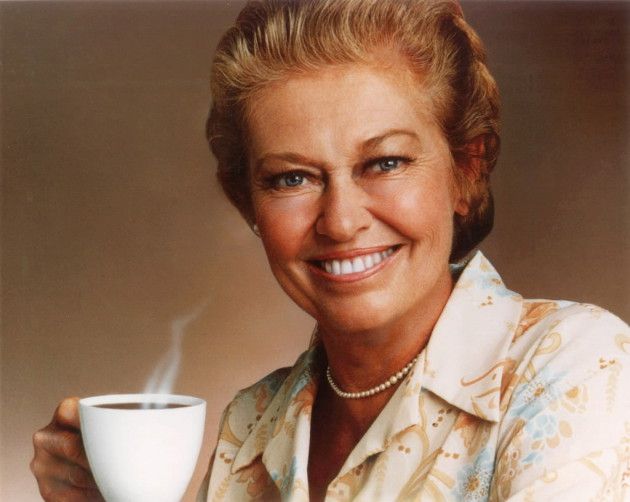
Mrs Folger [pictured]
Mrs Olson, or “The Folgers Coffee Woman” was in a string of television commercials for Folgers Coffee during the 1960s and ’70s. Mrs Olson was a Swedish neighbour who always recommended a cup of Folgers Coffee to other people in the commercial. She was played by an actress named Virginia Christina, born Virginia Ricketts (1920-1996).
Juan Valdez
A fictional character who has appeared in advertisements for the National Federation of Coffee Growers in Colombia since 1958. He is an icon for both coffee and Colombia. He was portrayed by a Cuban actor named José F. Duval until 1969, then by Colombian actor Carlos Sánchez. Since 2006, Juan Valdez has been portrayed by Carlos Castañeda, a coffee grower from a small town in Colombia.
Crank is a term to refer to someone with an unshakeable belief in something that most of their contemporaries believe to be false. The term was popularised in 1872, being applied to Horace Greeley in his campaign for the US presidency. He believed in the settlement of the Old West and a magnanimous Reconstruction of the American South, and was a proponent of socialism, vegetarianism, agrarianism, feminism, and temperance. Cranks today can take comfort in the fact that all Greeley’s cranky ideas were proven very sensible, and are mainstream today.
In North American, a crank can also be slang for a bad-tempered person. I’m not sure which one Luke was applying to Cy, the “crank in a hat”, but Cy seems to believe it’s the second one, because he makes a spirited defence by saying that Luke is the crank – he’s well known around town for being grumpy.
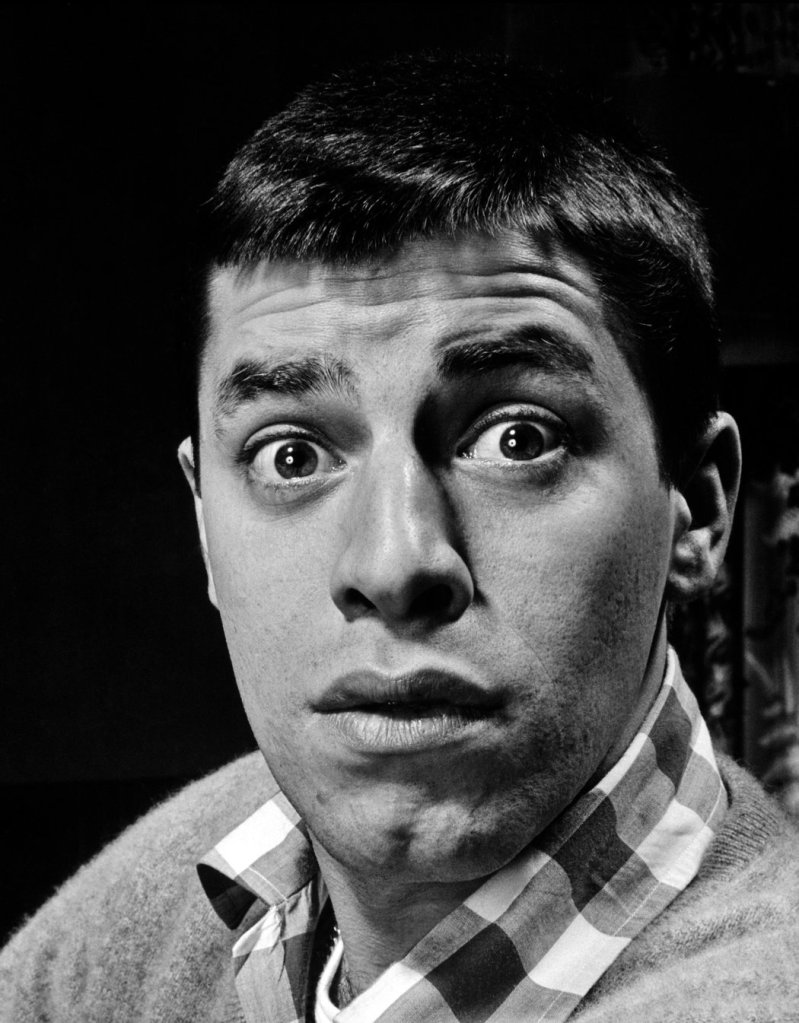
LORELAI: But your reenactment of Jerry Lewis in The Diner Guy is gonna wow the critics.
Jerry Lewis, born Joseph Levitch (1926-2017), comedian, director, actor, screenwriter, singer, humanitarian and producer. Nicknamed “The King of Comedy”, Lewis is regarded as one of the most significant American cultural figures of the 20th century, was widely known for his “kid” and “idiot” persona and his contributions to comedy and charity, making him a global figure in popular culture over an eight-decade career. He debuted professionally in 1946 working with Dean Martin as Martin and Lewis, and they performed together until 1956.
Although Jerry Lewis never did a film called The Diner Guy, several of his films had titles such as The Geisha Boy, The Ladies Man, and The Errand Boy, so The Diner Guy would actually fit right in.






 The Annotated Gilmore Girls