Tutu

LORELAI: OK, I need more tulle here. I need the feeling of a major tutu, OK?

A tutu is a traditional ballet dress, often made from tulle, which is a fabric made from lightweight fine netting.

Amy Sherman-Palladino herself was a ballet dancer, and had the chance to turn professional. She became a writer instead, but there are numerous references to ballet in Gilmore Girls, and her show Bunheads was based around the world of ballet.

Rory and Richard

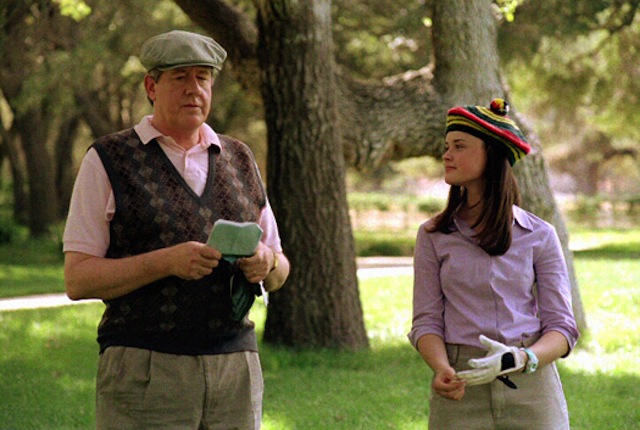
We get to see Rory bond with her grandfather in this episode, as they discover that they share an interest in reading and travel, and find it easy to talk to each other. More than that, Rory seems to respect Richard’s successful career in insurance, which Lorelai has always rather looked down on.

Richard likewise feels proud of Rory when he realises that his peers admire Rory for being pretty and polite, and attending a prestigious school. He does end up “showing her off at the club”, just as Emily instructed.

Travel

RICHARD: I think travelling for a young girl is a very important thing. Your mother never got a chance to travel much.
RORY: I know. She talks about that all the time.

We learn that Rory longs to travel the world, and that, like Harvard, this is another of Lorelai’s dreams which was never fulfilled because she had Rory. We might well begin to wonder if Rory has any dreams of her own, or if they are all second-hand from her mother.

Fez

RORY: I want to go to Fez.

Fez is the second-largest city in Morocco, and is known as the Mecca of the West and the Athens of Africa. Tourists tend to be drawn to it because of its traditional architecture and medieval medina, giving it an old-world atmosphere.

Public access station

MICHEL: If you ask me this union belongs on a public access station.

In the United States, every community that has cable TV access has the right to a public access channel. There are numerous public access channels in Connecticut, usually supplying information from government, colleges, schools, and non-profit organisations. Why a double twin wedding would be featured by one is a mystery to me; it sounds more like a reality TV show.

Post-it

SOOKIE: That one has a Post-it on its back.
MICHEL: Oh, well, then that’s Mark. The one on the right is Matt.

Post-its are small pieces of paper with light adhesive on the back, allowing them to be easily removed and placed elsewhere as needed. They were first brought out by 3M in 1979.

Polaroid

SOOKIE: Can I see these strawberries?
JACKSON: No. …
SOOKIE: How about a Polaroid?

The Polaroid was a popular instant camera which used self-developing film to create a photo shortly after taking a photo, with the resultant photograph also called a Polaroid.

First developed in 1948, Polaroid discontinued production of instant cameras in 2008, digital cameras having superseded them. However, there is still a niche market for instant cameras, and the new brand owners of Polaroid have recently relaunched the product.

Flat earth

JACKSON: Hey, the world was flat until someone took a boat trip.

Jackson is promoting the modern misconception that people in the Middle Ages commonly believed that the Earth is flat. In fact people have known that the Earth is spherical since the Ancient Greeks – the mathematics to prove it aren’t particularly difficult. The myth seems to date from the 17th century, as a Protestant campaign against Catholic teaching.

The idea that it was the voyage of Christopher Columbus to the New World which changed everyone’s mind about the flat Earth comes from Washington Irving’s 1828 biography, A History of the Life and Voyages of Christopher Columbus.

Highly romanticised, it contained fictional scenes where some of the Spanish disagreed that the Earth was spherical. Even Irving pointed out that a flat Earth theory didn’t affect Columbus’ navigation, but rather the limited understanding of Earth’s size and position of the continents.