RORY: You know Mom, I hate to bring this up, but I think there’s a really obvious solution to our problem … LORELAI: I think if I sold you into white slavery, I would miss you.
“White slavery” is a term for sex trafficking dating to the 19th and early 20th centuries, which came to become a blanket term for prostitution, especially that of minors. The name comes from the accounts of white women captured and enslaved in Middle Eastern harems, the so-called “Circassian beauties” from the Caucasus.
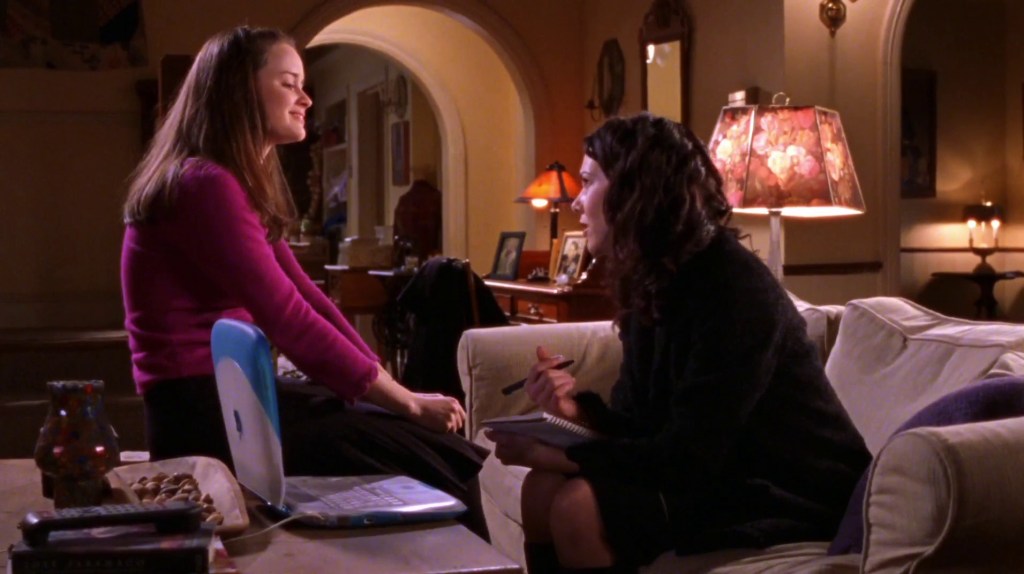
LORELAI: I won’t think about it tonight. I’ll think about it tomorrow – at Tara.
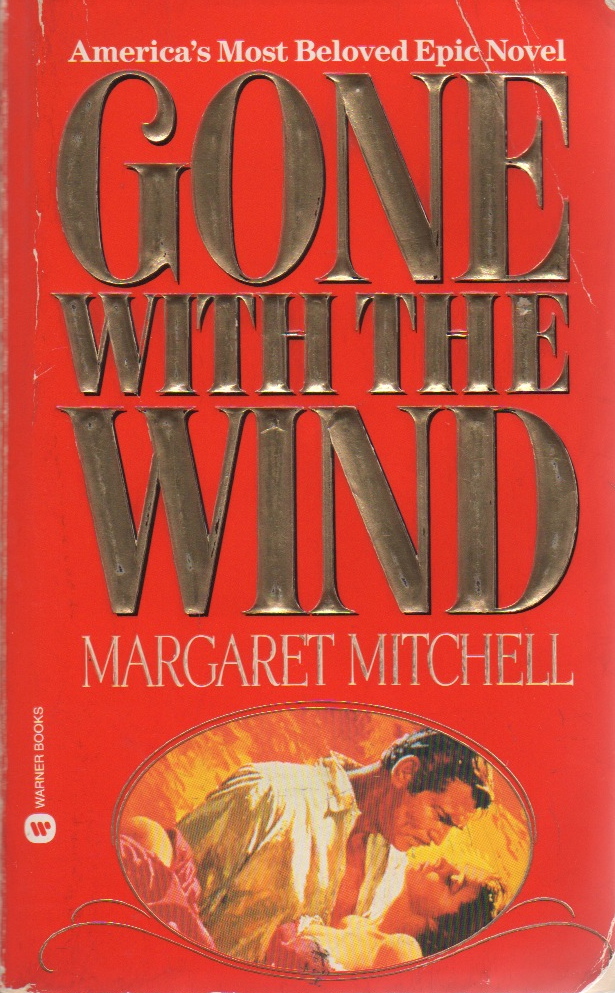
Lorelai slightly misquotes from the 1936 novel Gone with the Wind, by Margaret Mitchell, previously mentioned. Set in the American South at the time of the Civil War and subsequent Reconstruction, the novel’s protagonist is a beautiful, wilful Southern belle named Katie Scarlett O’Hara who is willing to do anything to claw her way out of poverty and save her plantation, named Tara, even while her heart is breaking over her numerous relationship disasters. It takes her too long to discover that the scandalous Rhett Butler is the only man who ever truly loved her.
The full quote is: “I’ll think of it tomorrow, at Tara. I can stand it then. Tomorrow, I’ll think of some way to get him [Rhett] back. After all, tomorrow is another day.” They are the last lines of the novel.
Gone with the Wind was a runaway success, a bestseller before the first reviews of it were even published. Margaret Mitchell won the Pulitzer Prize and the National Book Award, and it was turned into a box-office smash film in 1939, starring Vivien Leigh as Scarlett O’Hara (the film slightly alters the quote from the book). It is the second favourite book of American readers, only beaten by the Bible. It is considered controversial because of its derogatory depiction of African-Americans and romanticisation of white supremacists.
Scarlett O’Hara seems like a forerunner of Lorelai Gilmore – a beautiful, headstrong brunette with a powerful will to survive, and a tendency to mess up all her chances at romantic happiness. Lorelai wanted to give her house a name, like a Southern plantation, and is as deeply attached to it as Scarlett is to Tara. As in Gilmore Girls, blondes tend to be the antagonists in Gone with the Wind. One of the girls at Chilton even suggested to Rory that Lorelai was a Southern belle name. It’s not hard to imagine a teenaged Lorelai reading this novel and identifying with the feisty, rebellious Scarlett.
LORELAI: Aw honey, it’s not the amount of places that turns you down that matters, it’s the quality of the place that turns you down that matters. And when you’ve got Jacko’s Loans and Stuff not wanting your business, you know it’s time to hang out with the Coreys.
The Two Coreys, or The Coreys, are actors Corey Feldman (born 1971) and Corey Haim (1971-2010). In the picture, Feldman is on the left, and Haim on the right.
The Coreys were child actors during the 1980s, and close friends, who appeared in nine films together, including The Lost Boys (1987). They became teen idols, but experienced career downturns in their late teens due to drug use. This is why Lorelai equates “hanging with the Coreys” to being an unsuccessful loser.
After Corey Haim’s death, Corey Feldman became increasingly vocal about the sexual abuse he and Corey Haim were allegedly subjected to as child stars by Hollywood paedophile rings, with Feldman saying he was repeatedly molested and assaulted, but Haim actually raped numerous times. They were each allegedly given drugs before the assaults, the origin of their drug addictions. In 2020, he brought out a documentary called (My) Truth: The Rape of the Two Coreys, identifying the people openly he had earlier only alluded to.
This put their fall from grace in a much darker context, and now unfortunately makes it seem as if Lorelai is calling child sex abuse victims “losers”.
RORY: Four people asked me when we were tenting, two people asked me if we were moving, and one person asked me if we were atheists. LORELAI: See, we have to stop talking to people. We have to stay at home with the curtains drawn collecting stacks of old newspapers, muttering to each other, eating nothing but Cup-a-Soup and Slim Jims.
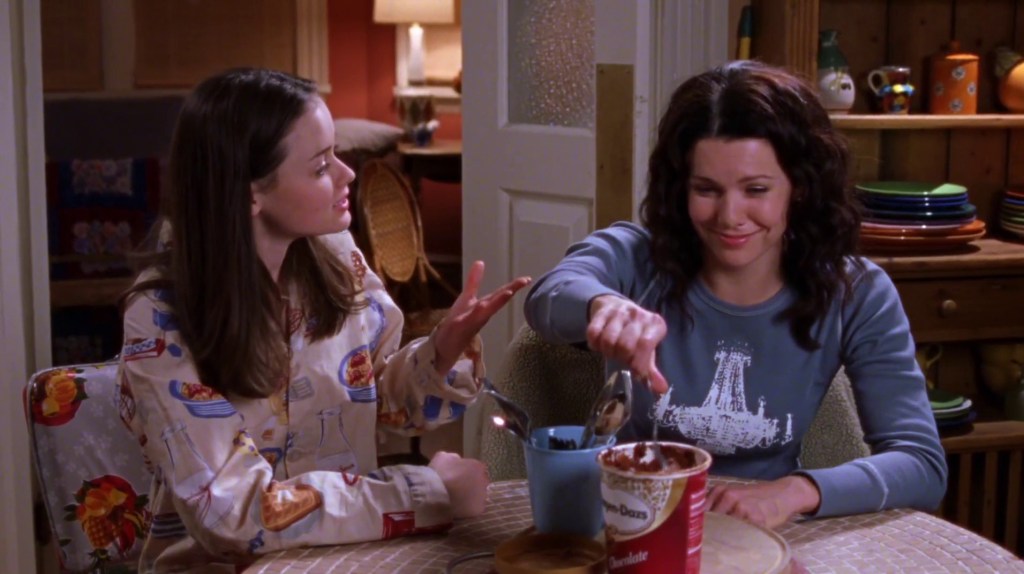
Cup-a-Soup [pictured]: an instant soup mix sold in sachets, added to boiling water and stirred in a cup or mug. Comes in minestrone, chicken noodle, tomato, and chicken and vegetable flavours. In North America, it is made and marketed by Unilever’s Lipton brand.
Slim Jim: a processed meat snack in stick form that is basically a fermented sausage, very popular in the US, manufactured and sold by Conagra. It was invented by Jack Cornella in Philadelphia in 1929, and developed for production in the 1940s.
RORY: And then [Mrs Kim] chased me halfway down the street with the hose. It was like a scene from Silkwood.
Silkwood is a 1983 biographical drama film directed by Mike Nichols and starring Meryl Streep, based on the book Who Killed Karen Silkwood? by Howard Kohn. Karen Silkwood was a nuclear power whistleblower and union activist who died in a car crash in 1974 while investigating unsafe practices at the plutonium plant where she worked. Although the film ends with her death, in real life a 1979 lawsuit ended with the jury awarding $10 million in damages to the Silkwood estate, with the company settling out of court for $1.38 million.
The film was a commercial and critical success, with Meryl Streep receiving praise for her performance, as well as supporting actors Kurt Russell and Cher. Silkwood was released on DVD in 1999, so Lorelai and Rory would have seen it within the last couple of years.
In the film, Karen Silkwood and her fellow workers become contaminated by radiation, which the nuclear plant officials try to blame on Silkwood. The decontamination process is brutal, ending with being blasted in the face with a hose – now known as a “Silkwood shower”. Rory compares her treatment from Mrs Kim with Karen Silkwood’s decontamination, as well as the suggestion that she is being unfairly blamed for the termite infestation.
Mrs Kim’s behaviour is, of course, comically wrong. Rory cannot “carry” termites to Mrs Kim’s store, and spraying someone or something with water won’t get rid of termites.
JACKSON: I have a cousin who owns a Xerox company that specializes in taking pictures and making them into things – calendars, coffee mugs, collector plates, and pajamas.
Xerox is a corporation selling print and digital document products and series, headquartered in Connecticut, and incorporated in New York. They are best known for making photocopiers – so much so that Xerox is often used to mean any photocopier (like Kleenex and tissues), and “xerox” can be used as a verb, meaning “to photocopy”.
Jackson’s cousin owns a photocopying service which puts photos onto gift items. Jackson has a large family, and we learn a lot about them during the course of the show. We also learn that Jackson was on the wrestling team when he was in high school.
Made all the donkey outfits for the 2001 Christmas Festival – we never saw this, but presumably it’s the same festival that the Christmas pageant is a part of. Seems like a lot of people dressed up as donkeys for the festival, in typical quirky Stars Hollow fashion.
Organised the Save the Historic Oak Tree campaign. Apparently Stars Hollow has a historic oak tree, which we haven’t seen, and Lorelai saved it.
Played the role of Tevye in Fiddler on the Rooffor the Stars Hollow Community Theater. Tevye is the father and patriarch in the musical, so Lorelai must have been great to beat any male competitors for the role (unless she was the only candidate, or they were doing a gender-flipped version). Either way, she obviously gave a standout performance. A reminder that Lorelai has to be both mother and father, as a single parent.
I don’t know why Sookie and Rory think any of these things will help Lorelai get a loan – do either of them know how banks work? They don’t give you loans based on how nice and community-minded you are.
LORELAI: I was thinking about opening a Coyote Ugly lemonade stand.
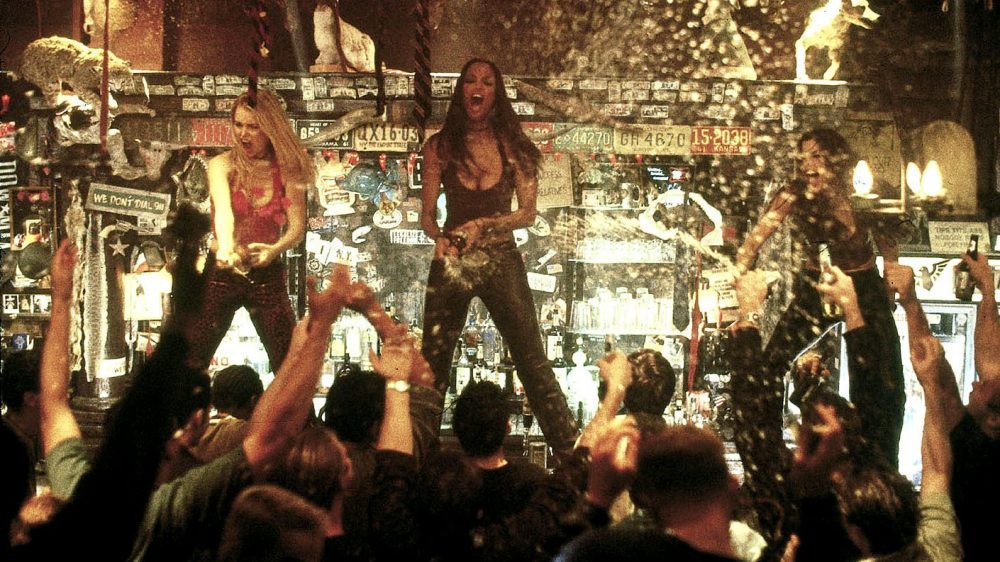
The Coyote Ugly Saloon is a bar which opened in New York in 1993, founded by Lilliana Lovell. It is known for employing female bartenders who entertain the crowd by dancing on tabletops, singing, and giving sass to patrons.
Since then other Coyote Ugly Saloons have opened around the US and internationally, and the bar has inspired a 2000 teen musical comedy-drama film called Coyote Ugly, starring Piper Perabo as an aspiring songwriter who gets a job at the Coyote Ugly Saloon [pictured].
LORELAI: So anyway, I called the bank today. SOOKIE: How did that go? LORELAI: Well, it – wait, yeah, oh, what’s that? Yeah, they’re still laughing.
The plot of this episode revolves around Lorelai’s house getting damaged by termites and her not being able to raise the money to have it fixed. Even though she’s a homeowner, it turns out later in the episode that she has already taken out bank loans using her house as equity twice before, which is why she’s having trouble getting a loan now.
She does say she always pays backs her debts, and she has a good income from working at the inn, so it seems unlikely that banks would give her no help at all. They have loans specifically for renovation and reconstruction, allowing you to pay the loan back as bills come in, so that you don’t pay any interest on the loan until the project is complete.
Lorelai wasn’t even able to get money from a loan shark or predatory lender, which she fictionalises as Jacko’s Loans and Stuff, possibly because she needed more money than they typically loan.
Financial issues rarely seem to add up on Gilmore Girls, and this is an example of a situation which doesn’t seem quite believable.
SOOKIE: When are you going to tent? LORELAI: Next week.
A treatment for drywood termite infestation is to place a tent over the house and fumigate it so that the poison gas can reach every area of the house. It is a measure kept for extreme situations when the termite infestation is severe, widespread, and in areas where normal methods cannot reach.
It can take half a day or up to a week to complete, and the house will need to be vacated, then cleared and aerated afterwards. It is a big inconvenient undertaking, and an expensive one – Lorelai is spending $2000 on her fumigation. She refers to it as a “circus tent”, making this another circus reference.





 The Annotated Gilmore Girls