LORELAI: I have to go call Patty and stop the forced mating process. I feel like Ling Ling the panda bear.
Ling Ling was a giant panda born at Beijing Zoo in China in 1985. In 1992 he was given to Japan and the Ueno Zoo in Tokyo in exchange for a panda born in Japan. He was paired with a female giant panda named Tong Tong, but they were unable to breed successfully and produced no offspring. Tong Tong died in 2000, and from 2001, the zoo began trying to breed him with other giant pandas, using artificial insemination, to no avail. This is the forced mating process that Lorelai refers to. Ling Ling died in 2008.
SOOKIE: Because I’m baking for the picnic tomorrow and it’s supposed to be a surprise. JACKSON: Oh sure, never see a pie before an auction, it’s bad luck.
Jackson is making a joke based on the old superstition that it is unlucky for the groom to see the bride’s wedding dress before their wedding. Not only is it a sign that he is thinking about marriage, it’s a possible foreshadowing of a future episode when a wedding dress is unluckily seen.
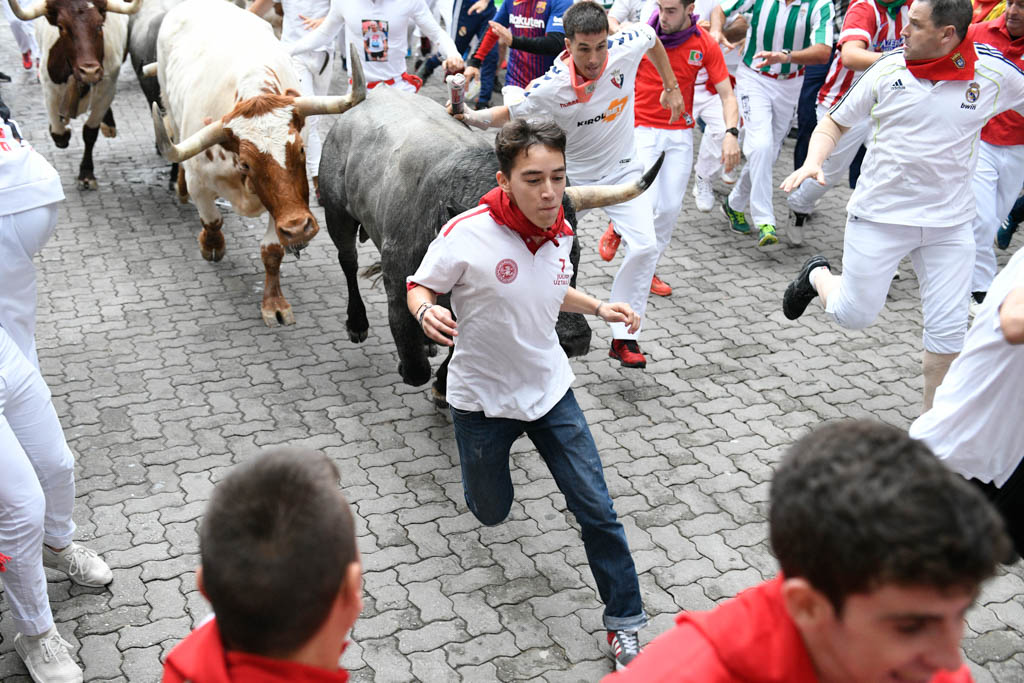
LORELAI: Here in my hand I have the pictures and resumes of the top three contenders. SOOKIE: Anyone good? LORELAI: No, but two of them have run with the bulls.
A running of the bulls is an event where participants run in front of a small group of bulls through sectioned off streets. The most famous one is is Pamplona, Spain, which takes place at the San Fermin Festival in July each year. The running of the bulls begins at 8 am, and participants must be over 18, not incite the bulls, and cannot be influenced by alcohol. By tradition, participants wear white shirts and trousers with a red kerchief. There are six bulls and nine steers to encourage the bulls. Every year, between 50 and 100 people are injured during the running of the bulls. Since 1910, 15 people have been killed, nearly all by being gored to death.
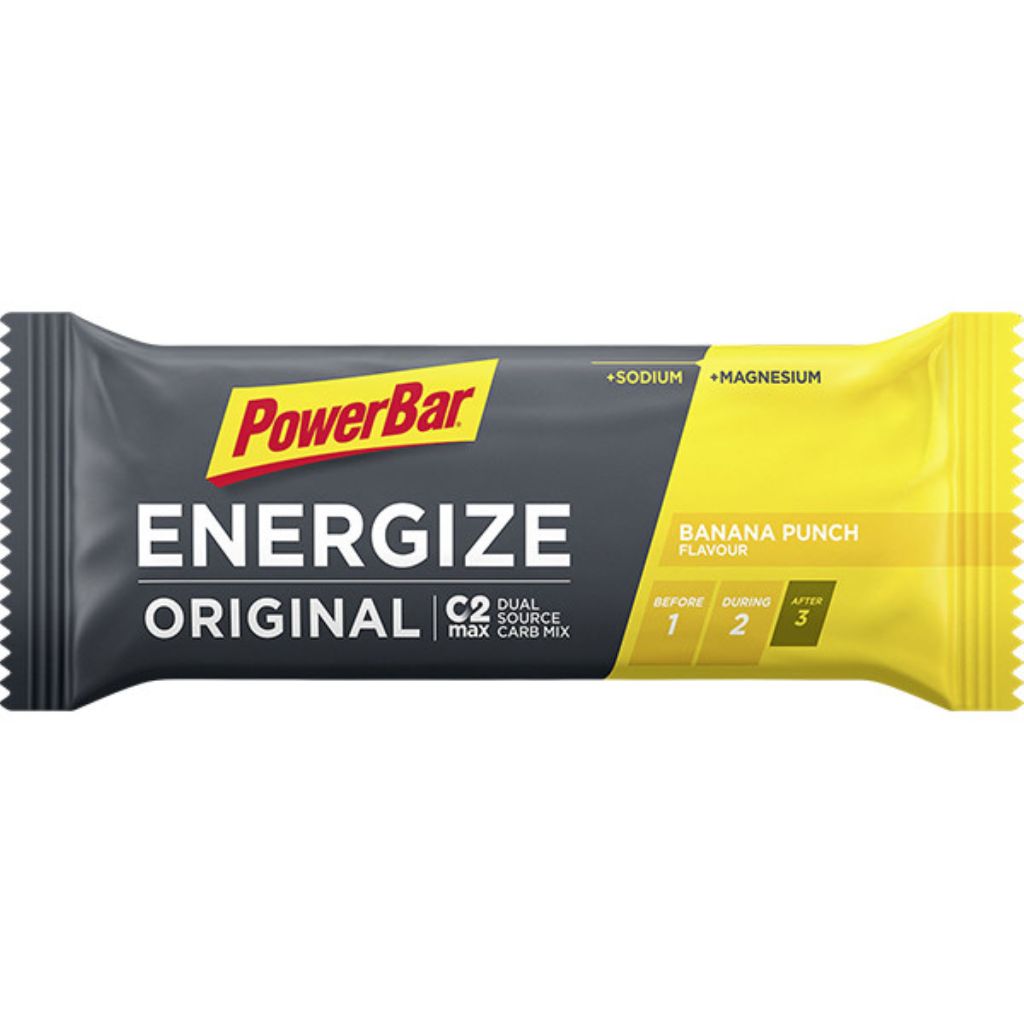
DEAN: I’m fine with the whole hating him thing, thank you. RORY: I just think it’s a waste of energy. DEAN: You know, I’ll have a PowerBar.
The PowerBar was the first “energy bar” made to be used during competitions for endurance athletes. The company was founded by Canadian athlete Brian Maxwell in Berkeley, California, in 1986; the recipe for the bars was formulated by nutritionist Jennifer Biddulph, later Maxwell’s wife. The company was bought by Nestle in 2000.
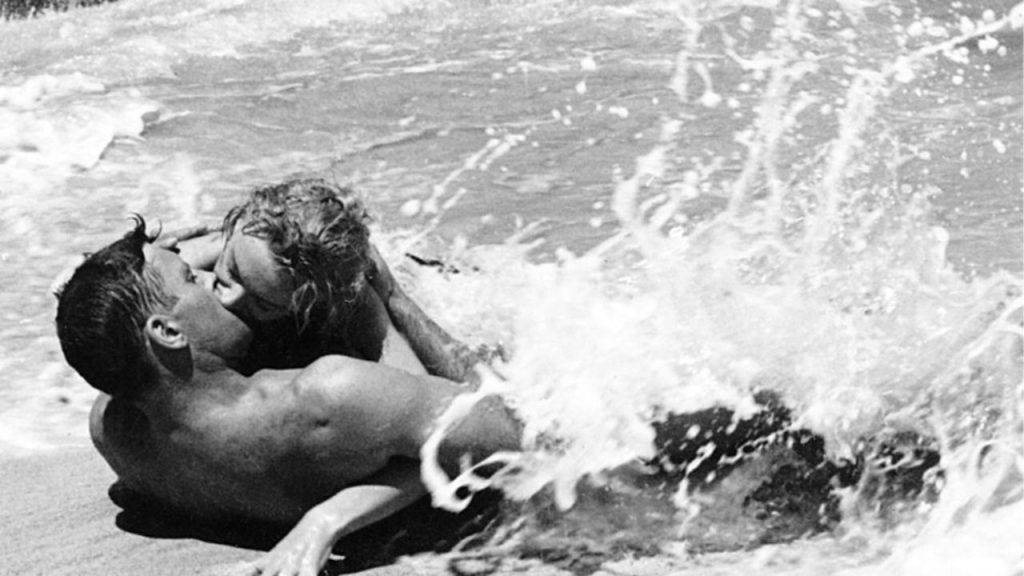
JESS: Sorry to intrude. DEAN: Then why did you? JESS: Well, you’re having your vertical From Here to Eternity moment right in front of the super glue.
From Here to Eternity, 1953 drama-romance war film directed by Frank Zinneman, based on the 1951 novel of the same name by James Jones. The film focuses on three US Army Soldiers, played by Burt Lancaster, Montgomery Clift, and Frank Sinatra, stationed in Hawaii in the months leading up to the attack on Pearl Harbor in 1941. Deborah Kerr and Donna Reed play the women in their lives.
From Here to Eternity was the #3 film of 1953 and won eight Academy Awards, including Best Picture and Best Director (Frank Sinatra and Donna Reed won awards for their supporting roles), as well as numerous other awards. Critics praised it to the skies, but it didn’t go down well with the army and navy. It is considered one of the greatest films ever made.
Jess is referring to the iconic kissing scene where Burt Lancaster and Deborah Kerr roll around on a beach together wearing only swimsuits, as the waves crash over them in mimicry of an orgasm. It’s torrid stuff, made more titillating by the fact that she’s in the role of his commanding officer’s wife.
LORELAI: Ugh, every great relationship has its obstacles. You’d know that if you weren’t dating Andy Hardy.
Andrew “Andy” Hardy, fictional character played by Mickey Rooney in 16 films made by Metro-Goldwyn between 1937 and 1946 (and another in 1958, trying unsuccessfully to continue the series). The Hardy films, enormously popular in their day, were sentimental comedies set in a Midwestern town, celebrating ordinary American life.
The Hardy family first appeared in the 1928 play Skidding by Aurania Rouverol, with Charles Eaton as Andy. The first film was A Family Affair, based on the play, with Mickey Rooney as Andy, and he continued in the role from the ages of 16 to 25.
Andy Hardy soon became the central character, with the films focusing on the relationship between he and his father, Judge Hardy (a bit like Gilmore Girls focusing on Rory and Lorelai). The plot typically involved Andy getting in trouble with money or girls because of selfishness or trying to fudge the truth. He would then have a man-to-man talk with his father, a man of absolute integrity, and end up doing the right thing (very different to Gilmore Girls).
Lorelai seems to be teasing Rory about Dean, suggesting that she’s dating a wholesome, inexperienced teenage boy from the Midwest, like Andy Hardy. Meanwhile, Lorelai is looking for a real man, like William Holden.
Interestingly, the cast of A Family Affair were plucked straight from the 1935 comedy, Ah, Wilderness! The plot involves a well-read teenage boy named Richard (played by Eric Linden) from a Connecticut town, graduating as valedictorian and going to Yale, just like Rory. The film also features a box social!
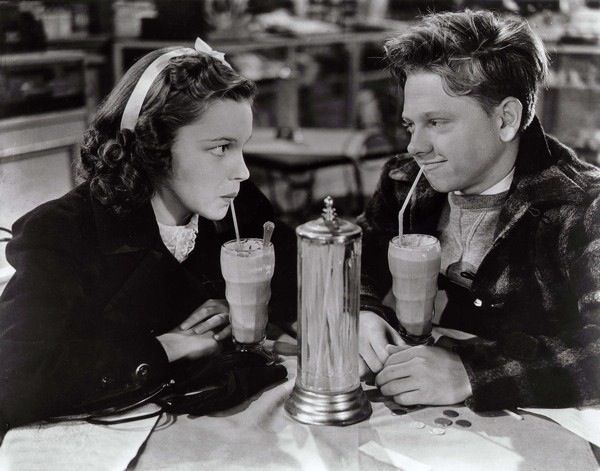
[Picture shows Mickey Rooney and Judy Garland in Love Finds Andy Hardy, 1938].
LORELAI: So I’ve decided I’m saving myself for William Holden … Sunset Boulevard was on last night, and I don’t know…I’ve known him for years – Sabrina, Stalag 17 – and yet last night something snapped.
William Holden, born William Beedle (1918-1981), actor who was one of the biggest box-office draws of the 1950s. Winner of an Academy Award and an Emmy for Best Actor, he starred in some of Hollywood’s most popular and highly-acclaimed films. He was named as one of the biggest stars of the year six times between 1954 and 1961, and is considered one of the greatest male stars of Classic Hollywood Cinema.
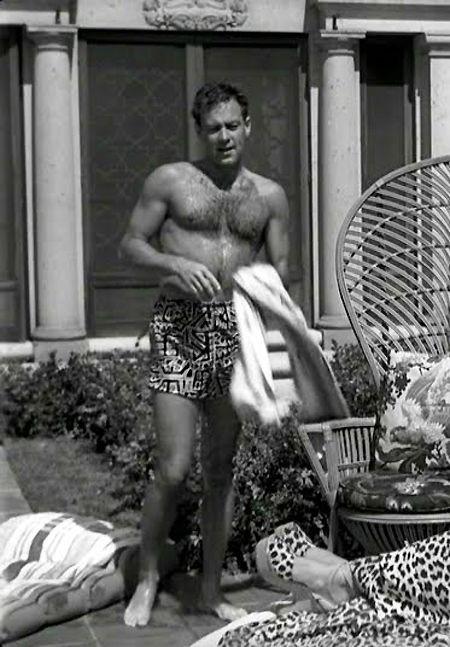
Sunset Boulevard, 1950 black comedy film noir directed by Billy Wilder, starring William Holden as a screenwriter and Gloria Swanson as a former silent film star, who draws him into her demented fantasy world where she dreams of making a triumphant return to the screen. A commercial success, the film was praised by critics and won three Academy Awards. It is regarded as one of the greatest films ever made. William Holden wears a swimsuit in the film [pictured] which has made many others interested in him – it’s not just Lorelai!
Sabrina, 1954 romantic-comedy drama directed by Billy Wilder, starring William Holden as a thrice-married playboy who is the lifelong crush of a young woman named Sabrina, played by Audrey Hepburn. She finds love with his brother, played by Humphrey Bogart. Backstage, it was Holden and Hepburn who got hot and heavy. Sabrina was a box-office success, and won an Academy Award for Best Costumes.
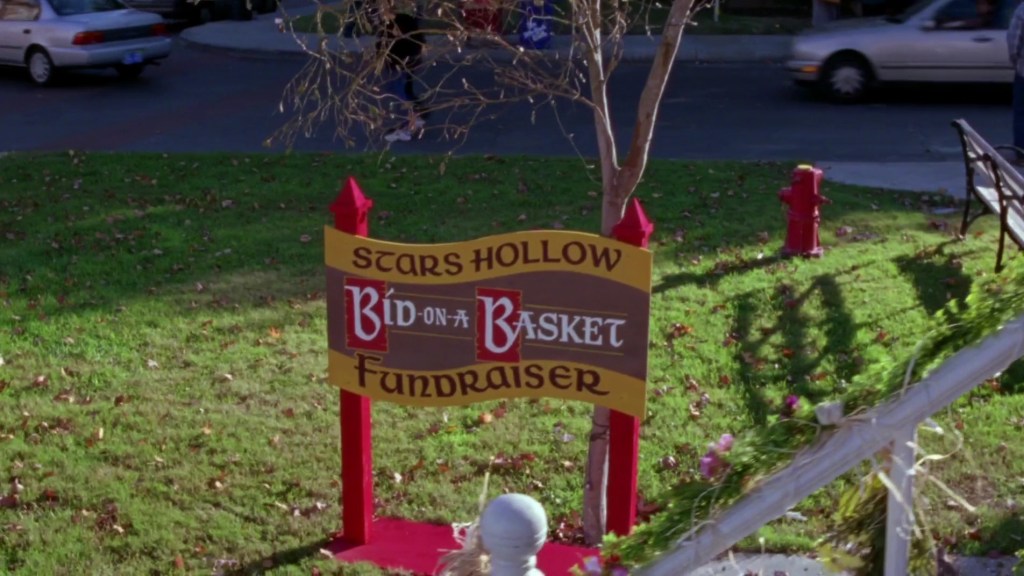
The show opens the day before the Stars Hollow Bid-on-a-Basket Fundraiser, with signs telling the viewer that bidders can win themselves a delicious home-cooked picnic lunch, that it’s held on Sunday at midday, and that all proceeds go to the Stars Hollow Retirement Home (the signs are sponsored by Doose’s Market). Across the street at the market, baskets are on sale, and more signs tell us that it’s also known as the Bid-on-a-Basket Festival. We can see a woman leaving with her new basket.
Inside the market, Lorelai and Rory are shopping for their own baskets, but of course they don’t intend to cook a delicious home-cooked picnic lunch (or even make Sookie do it for them, like they did for the bake sale). They’re just going to put old leftovers in their baskets – as we now know they keep leftovers for a long time, it’s sounding like a Salmonella Festival for anyone bidding on their baskets!
These type of fundraisers are called “box socials” and were common in the 19th century and 1900s, with women cooking the food and packing it into a box or basket, and men bidding for them. Although it was meant to be a “blind” auction, married and attached women would let their husband or sweetheart know which basket was theirs, so they could bid on it – bidding on a woman’s basket was a way to let her know you were interested in more than her home cooking.
Box socials are also low-key dating auctions, with the winning bidder not only getting the basket, but the chance to share the picnic lunch with the lady who provided it. A lunch basket auction of this type features in the 2001 YA novel Flipped by Wendelin Van Draanen (in this case, it is a high school boy who provides the basket, and girls bid on the chance to have lunch with him). This seems like a bit of a coincidence, or perhaps merely zeitgeist.
Although Flipped is set in the 1990s, when it was made into a film in 2010, they set it in the 1960s, as if that scene was deemed too old-fashioned to be believable. They must have agreed with Lorelai, who complained that the concept was “backwards”. In fact there has been a mild resurgence in box socials since the 1990s.
The show never makes it explicit, but according to the timeline, the Bid-on-Basket Fundraiser seems to be held in mid-February, and it would make sense if it was the Sunday after Valentine’s Day. That’s a clear connection with love and romance, although it isn’t practical at all to have a picnic in winter! In real life it would be freezing.
The episode is named for an English nursery rhyme, first recorded in the US in 1879 as a children’s game, to be sung while children danced in a circle. One child would run around the circle and drop a handkerchief; the nearest child to them would then pick it up and chase them. If caught, the child who dropped the handkerchief would either be kissed, join the circle, or had to confess the name of their sweetheart.
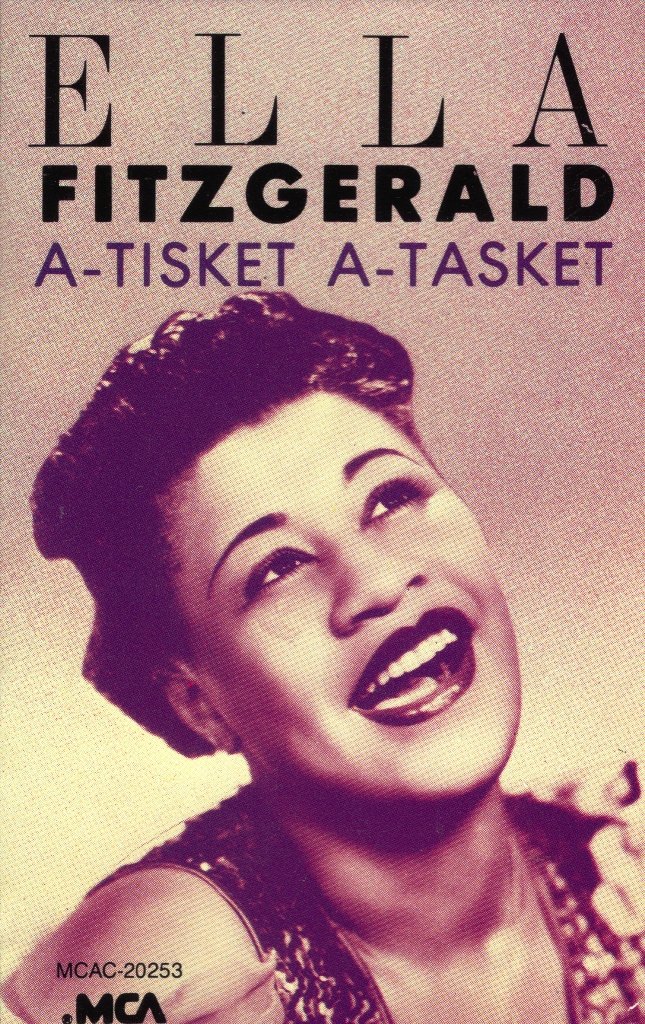
The rhyme was turned into a highly popular 1938 song by Ella Fitzgerald, in conjunction with Al Feldner (later known as Van Alexander). It has since become a jazz standard, often used in film and television soundtracks.
The lyrics to the rhyme are usually given as:
A-tisket, a-tasket A green and yellow basket I wrote a letter to my love And on the way I dropped it, I dropped it, I dropped it, And on the way I dropped it. A little boy he picked it up And put it in his pocket.
It’s suitable for an episode all about baskets, romance, and miscommunication. The episode will also include something being dropped that a “little boy” picks up.


 The Annotated Gilmore Girls