A sly joke against Gilmore Girls itself, which centres around a working single mother – Lorelai. Working mothers featured in 1990s television shows such as Murphy Brown, Judging Amy, Grace Under Fire, and Roseanne (which Amy Sherman-Palladino worked on).
Their group has to find a parent with experience in business to act as an adviser and mentor for the business fair. Chip’s father has scheduling issues. Paris’ father is in Hong Kong for a month, but could possibly video conference – an idea Rory says no to. Madeline says her father is travelling; she doesn’t mention her stepfather, so I’m not sure if she still has one, or if she now refers to him as her dad? Her stepfather was in Japan last time he was mentioned.
Louise’s father is in court for the next six weeks on a mysterious charge. Oddly enough, when Paris’ dad was involved in some shady activity, it was a major, major scandal, she was a laughing stock at school, and her parents separated for a time. But now Louise’s father is in legal trouble, and nobody cares at all. Louise hasn’t even bothered finding out what he did!
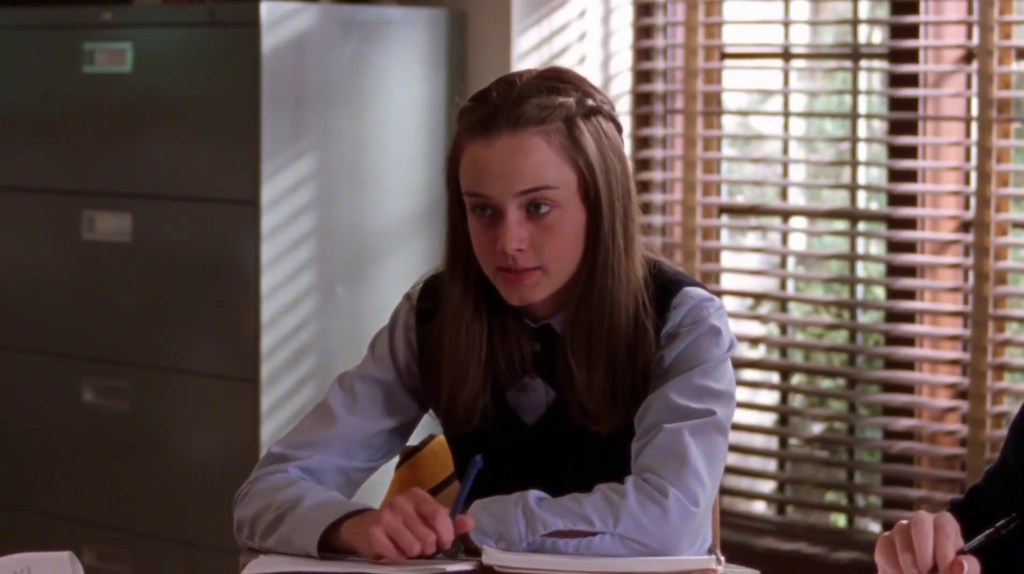
RORY: There’s going to be an intra-school business fair in three weeks. Each group has to come up with a consumer product that’s geared toward high school kids … So we pick our product and we make a prototype of it, then we use our imaginary million dollar budget to mass produce, market, and distribute it, and we’ll present all of this at the fair.
Rory quickly tells their group, and the viewer, what’s happening in this episode. Their Economics class has put them into groups to compete against the other Economics classes at Chilton at a business fair. They have to think of a product that high school students will buy, make a prototype that can be displayed, then use a fictional million dollar budget to manufacture, market, and distribute it, presenting it at the fair to be judged.
And the business fair is only three weeks away, so they need to get started immediately, yet somehow, they don’t seem to do that. A lot must happen behind the scenes.
BRAD: Oh, yeah. My psychiatrist convinced my parents that I should face my fears instead of running away from them and my rabbi agreed, so here I am.
Brad is now back at Chilton, after transferring to Hillside Academy five months ago, due to being bullied by Paris. He told Rory that Hillside Academy was much more relaxed than Chilton, and he’d made tons of friends there.
If that’s true, what kind of sick psychiatrist would tell a teenager they should return to a stressful school environment where they were bullied, rather than one where they supposedly have friends, and are thriving enough to be on the debate team? And what kind of rabbi would back that decision up? And what kind of parents would agree to it, rather than sacking the psychiatrist at once and moving to another synagogue? Poor Brad. I don’t think Paris is his only problem in life.
LOUISE: Just that Rory’s the leader of this group, Napoleon, and you’re not.
Napoleon Bonaparte, born Napoleone di Buonaparte (1769-1821), French military and political leader who rose to prominence during the French Revolution, becoming Emperor of France in the early 19th century. He was one of the greatest military commanders in history, and his wars and campaigns are studied in military schools worldwide.
After Napoleon was forced to abdicate in 1814 he was exiled to the island of Elba, between Corsica and Italy. Louise is saying that now that Rory is leader of their group, Paris is like a great leader forced into the political wilderness.
In fact, Napoleon didn’t waste his time on Elba, improving the island with his usual energy and vision. He escaped from it nine months later and briefly took control of France again before being defeated at Waterloo. Like Napoleon, Paris is unlikely to languish in the background for too long.
[Picture shows Napoleon Crossing the Alps by Jacques-Louis David (1800)]
PARIS: It’s not the Bhagavad Gita, Madeline. It’s simple instructions for the business fair.
The Shrimad Bhagavad Gita, literally meaning “the song by God” in Sanskrit, often referred to as Bhagavad Gita, or just the Gita. It’s a 700-verse Hindu scripture that is part of the epic The Mahābhārata, dated to the first millennium BC.
It is the best known of the holy scriptures of Hinduism, presenting a synthesis of Hindu philosophy and yogic ideals. It was a personal inspiration to Mahatma Ghandi, and has been often read, studied, and appreciated by westerners and non-Hindus. Many Christians, Muslims, Buddhists, and atheists have read the Bhagavad Gita for spiritual advice and life lessons.
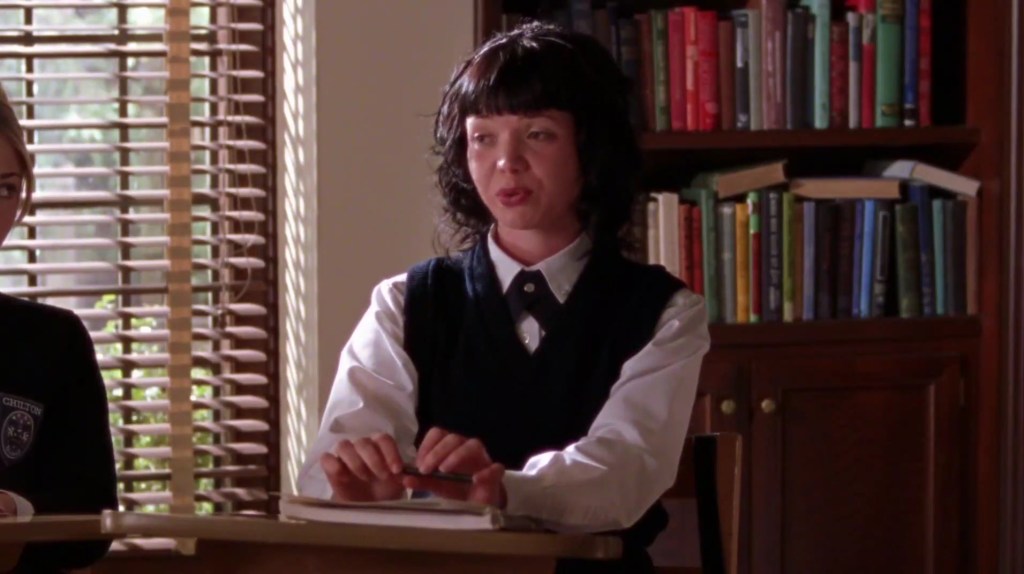
Madeline’s comment suggests that she isn’t stupid – just slow, thorough, and careful in how she absorbs information.
RORY: Yeah, that’s why we’ve all been kind of quiet for the past ten minutes.
LOUISE: I thought it was, like, prayer time or something.
Louise was originally the brighter of the two out of she and Madeline, and quite a good student. She seems to have been getting steadily dimmer, until she now doesn’t seem to understand that she’s meant to read educational materials when they’re handed to her. Chilton isn’t a religious school, so why she thought they’d be opening with a ten-minute private prayer session, I don’t know. Maybe she’s playing dumb so successfully it’s actually turned her brain.
Phoning dozens of times per day and arriving on the doorstep unannounced is no longer enough to satisfy Dean’s stalker instincts – now he’s following Rory to the diner before school starts and hanging around until Lorelai invites him to breakfast. Because all cool moms like to decide for their daughter who she eats with, right?
RORY: No, he didn’t vandalize it. He wrote in the margins, thoughts and stuff.
LORELAI: Like what, like play basketball, eat a sandwich – stuff like that?
RORY: No, stuff, like margin stuff. People like Mark Twain wrote in margins.
LORELAI: Pilot a steamboat, write Huckleberry Finn?
Mark Twain, author of The Adventures of Huckleberry Finn, often mentioned. As a young man, Mark Twain trained to be a pilot on a steamboat on the Mississippi River. His pen name comes from the cry “mark twain”, meaning that the river is twelve foot deep, a safe depth for a steamboat to travel in.
Mark Twain is famed for the barbed comments he wrote in the margins of books he read – his own books, I might add. Saratoga in 1901 by Landon D. Melville seems to have drawn his ire; Twain re-named it Saratoga in 1891, or The Droolings of an Idiot, and wrote in the margin that the author was “little-minded”.
Rory’s comment may suggest that Jess’ scribblings in the margins ofHowl were likewise of a sarcastic nature.
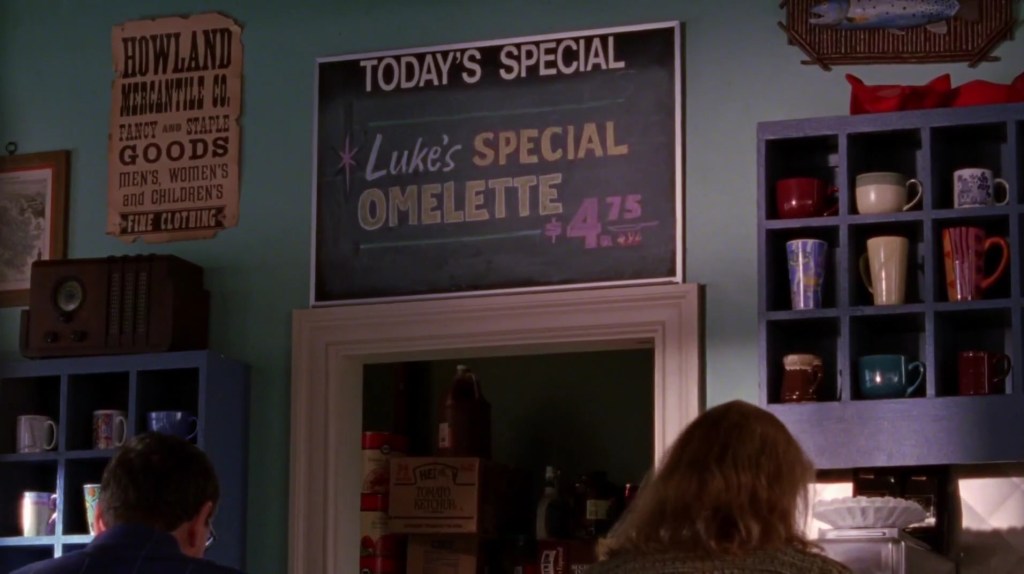
LORELAI: I know. Look how hard he worked on that sign and everything. Look at the handwriting, it’s so precise, so determined. It’s focused-Luke.
RORY: That’s Jess’ handwriting.
LORELAI: Really? How do you know Jess’ writing?
RORY: Oh, well, I lent him a book and he wrote some stuff in it.
Lorelai’s examination of Jess’ handwriting is a sign of how much more careful, focused, and determined Jess really is, deep down. That boy has hidden depths. Is it possible that it was Jess who convinced Luke to put a new special on the board – and if so, was it a tease for Rory, knowing that she usually orders French toast?
Lorelai also discovers that Rory can recognise Jess’ handwriting, and that’s because he wrote in her book – “vandalised it”, as Lorelai says. Rory is careful to say that she “lent” her book to Jess, not that he took it without asking, the very first moment he met her.
Note that the sign next to the chalkboard is for the Howland Mercantile Co., a reminder of Jess writing in the margins of Rory’s copy of Howl and Other Poems.
Surprisingly, Lorelai doesn’t seem to be able to tell Luke’s handwriting from Jess’, even though Luke writes on the chalkboard all the time. Unless Jess and Luke have the same handwriting?





 The Annotated Gilmore Girls