TAYLOR: That boy [Jess] is a walking natural disaster, they should name a tornado after him.
Tornadoes don’t receive personal names, that’s only for hurricanes and tropical cyclones. There has never been a Hurricane Jess, or Tropical Cyclone Jess.
The reference to tornadoes is yet another allusion to The Wizard of Oz [pictured], because it was a tornado that carried Dorothy to the Land of Oz. A possible hint that Jess could provide a gateway to another world for Rory.
RORY: Nobody has, which is a shame because she wrote sixteen amazing novels, nine plays, and there are some who actually claim that it was Powell who made the jokes that Dorothy Parker got credit for.
Dawn Powell, previously discussed. Rory has already read her Selected Letters, and now is reading Novels 1930-42. Published in 2001 and edited by Tim Page, the five novels included in the single volume are Dance Night, Come Back to Sorrento, Turn Magic Wheel, Angels on Toast, and A Time To Be Born.
Powell’s novels are either witty, cynical bohemian works set in New York City, or earnestly sincere stories set in small town Ohio. This has led critics to wonder which was the “real Dawn Powell”, but I can understand Rory both longing for the sweet small town life, while aspiring to the intellectual rigours and fashionable life of the city. Like Powell, she is equal parts cynicism and sincerity, and like Powell, she was a precocious child and avid reader. No wonder Powell is her literary heroine.
It was critic Diana Trilling who reportedly said that Dawn Powell was the “answer to the old question ‘Who really makes the jokes that Dorothy Parker gets credit for?'”.
RICHARD: Done. Now, what else is on the hit parade?
A hit parade is a ranked list of the most popular recordings at a given point in time, usually determined by either sales or airplay. Billboard magazine published its first hit parade on January 4 1936.
It’s possible that Richard is specifically thinking of the radio and television music program Your Hit Parade, broadcast from 1935 to 1953 on radio, and from 1950 to 1959 on television. Each Saturday evening, the program would play the most popular and bestselling songs of the week. It was invariably referred to, incorrectly, as The Hit Parade.
Coffee maker (Lorelai rejects a German-made one because in her mind, Germans are all Nazis!)
Pens
Liquid paper
Paper
Stapler and staples
Post-It notes (Richard buys a pack for Emily, who uses them to remind her of upcoming events)
Hole punch
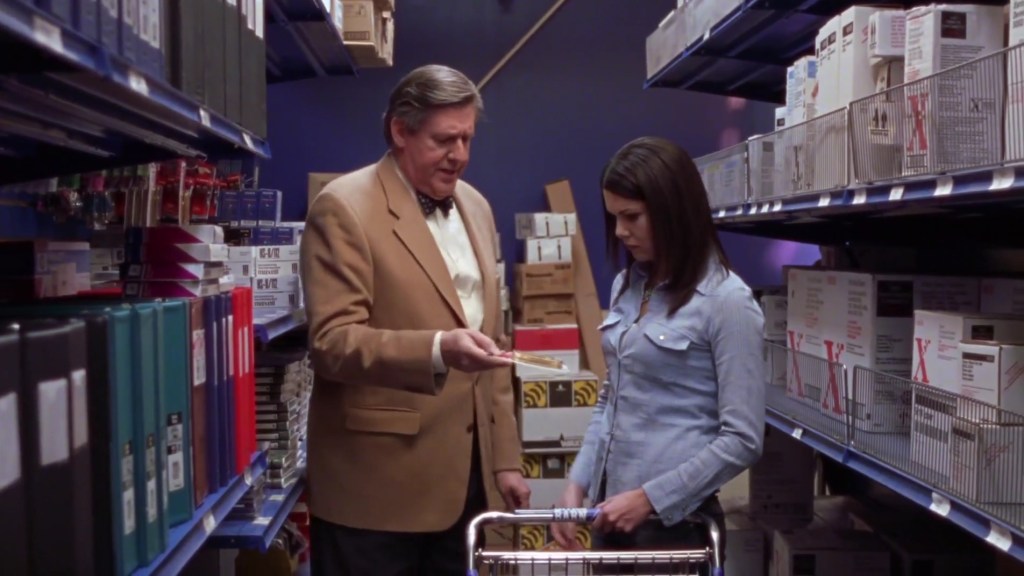
Richard has been in business for over thirty years, but he has no idea what office supplies to buy, or even how to go shopping for essential items. That was a task that women always did for him – his mother, his wife, his secretary, his maid, and now, his daughter is helping him. At least this time Richard is along for the ride so he can see the process in action.
(The fictional business where they buy the office supplies is called Office Barn.)
RICHARD: No, no, they’ve already hung up. [phone stops ringing]
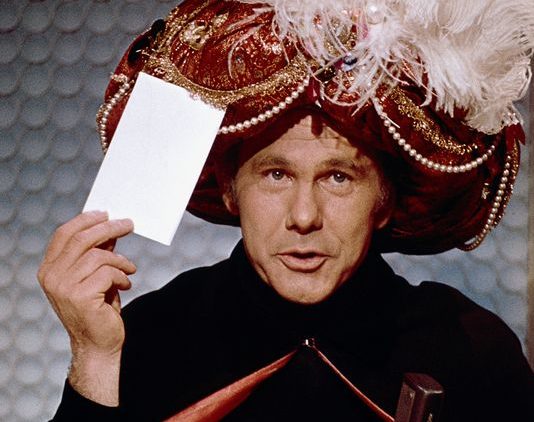
LORELAI: Okay, next time hold an envelope up to your head before you do that.
Lorelai refers to Carnac the Magnificent, a comedy role played by Johnny Carson on The Tonight Show Starring Johnny Carson, previously discussed. Carnac the Magnificent, dressed in a feathered turban and a cape, was a “mystic from the East”. When a sealed envelope with an unseen question was placed against his forehead, he would pretend to psychically give the question to that answer.
The humour would come from an unexpected question which followed a seemingly straightforward answer. For example, Carnac would give the answer, “Sis boom bah”, and the question would be, “Describe the sound made when a sheep explodes”.
LORELAI: So you’ve been just Nanooking it this whole time, just sending out for whale blubber and mukluks? [adjusts thermostat]
Nanook of the North [pictured], a 1922 silent film documentary/docudrama written, produced, and directed by Robert J. Flaherty. The film follows the struggles of an Inuk man named Nanook, his wife Nyla, and their family as they travel, trade and search for food in the Canadian Arctic. They are shown hunting a walrus, building an igloo, and going about their everyday tasks. Nanook and his family are portrayed as fearless heroes, enduring rigours beyond the comprehension of most Westerners.
The film has been criticised for fictionalising events and presenting them as reality. For example, “Nanook” was really named Allakariallak, and Nyla (aka Alice) was not his wife, but one of Flaherty’s common-law wives. The cast were scripted to behave in a more “authentic” Inuit way, such as using traditional hunting weapons rather than guns, and acting as if they had little knowledge of Western culture. Many things had to be staged, because of the difficulties of filming with one fixed camera in a harsh environment.
Nanook of the North was ground-breaking cinema, capturing authentic details of a culture that was then little known to outsiders, and filmed in a remote location. Hailed unanimously by critics, it was also a box-office success, and is still viewed as an enthralling documentary. As the first full-length feature documentary to achieve financial success, it paved the way for the entire genre. Nanook of the North was remastered and released on DVD in 1999, so Lorelai and Rory could have actually seen it.
Whale blubber is an important part of the traditional diet of Inuit people, valued for its high energy value, nutritional content, and availability. Mukluks are soft boots, traditionally made from caribou hide or sealskin, worn by the Indigenous people of the Arctic.
LORELAI: So, let me guess, the Wu-Tang Clan had the office before you?
RICHARD: Yeah, it’s a bit disheveled, I know.
Wu-Tang Clan, a nine-piece hip hop group formed in Staten Island, New York in 1992. Their 1993 debut album Enter the Wu-Tang (36 Chambers) received widespread critical acclaim and is regarded as one of the greatest hip-hop albums of all time. They are considered one of the most influential hip hop groups, and a key developer of East Coast hip hop and hardcore hip hop.
While recording their 2000 album, The W, the Wu-Tang Clan lived together for three months in a mansion on Mulholland Drive (except for Ol’ Dirty Bastard, who was imprisoned at the time). It was probably about as messy as you’d expect for eight men living together, especially as the Wu-Tang Clan are known for their history of internal tensions. Their own recollection is that they turned it into a personal gambling den.
Rather unbelievably, Richard appears to know who the Wu-Tang clan are, and understands what condition their house is in! For someone who didn’t know who Metallica were a few episodes back, he sure has caught up with contemporary music very quickly.
Rory waits for Dean to come home from Chicago that evening, sitting on the porch, in a mirror image of when Dean waited fruitlessly for Rory to come home from Friday Night Dinner. When his dad brings Dean home, presumably from the airport, Rory hands him a letter where she has written down what happened to the car.
It’s a quick way to avoid lots of superfluous dialogue, but it makes Rory look a little cowardly that she couldn’t talk to Dean directly. Are we meant to think that she was too scared to talk to Dean, or that she didn’t feel confident Dean would listen to her all the way through?
Dean does read the letter all the way through, while yelling and kicking a duffle bag, which seems a bit threatening. However, once he is assured that Jess has really and truly left town, he just asks Rory to join he and his family for dinner. Later they watch TV with Dean’s sister, Clara.
It seems odd that Dean doesn’t have any other questions or comments about the accident or about the car – he seems to think the only thing wrong with his relationship with Rory was Jess, and now he’s gone, they can get back to normal.
Rory didn’t seem to have met Dean’s family in the first six months or so of them dating, but she is obviously very familiar with them now.
LORELAI: Okay, Dad, I’ll tell you what. Tomorrow afternoon after my business class, I will come to your office and we’ll get you unpacked, we’ll get you settled, and we’ll find you someone as good as Margie, or at least cheaper.
Realising that Richard has no idea how to set up his office, Lorelai offers to help him get started and find a secretary, kicking off the main event of this episode. We learn that Lorelai’s business class is now on Saturday afternoon.
LORELAI: Whoa, whoa, whoa! There is a baby here desperately in need of some bath water.
A play on the common idiom, “To throw the baby out with the bathwater”, meaning that in the rush to rid oneself of unwanted things, valuable things are being lost as well. It was originally a German proverb, dating to at least the 16th century.
Lorelai means that just because Margie can’t be Richard’s secretary any more, it doesn’t mean he needs to give up on the idea of having his own business as well.




 The Annotated Gilmore Girls