RORY: Thanks again for going with me. DEAN: Tomorrow you start paying. Bye. [leaves]
Dean makes it sound as if Rory will start watching BattleBots the next day, a Sunday, but in real life, the show was broadcast on Wednesdays at this time. Maybe he taped it to watch later – all that ball preparation (tee hee) must have really cut into his television-watching schedule.
It’s a chilly and rather threatening way to end a night out with his girlfriend, and fans could well feel that Dean is also in preparation for being “phased out”.
RORY: So did you know that you’re considered a hot dad? LORELAI: Hah! CHRISTOPHER: Really? RORY: Libby said that it’s too bad you’re my real dad because if you were my stepdad, I could steal you away from Mom.
An incest joke uncomfortably close to Rory’s actual daddy issues.
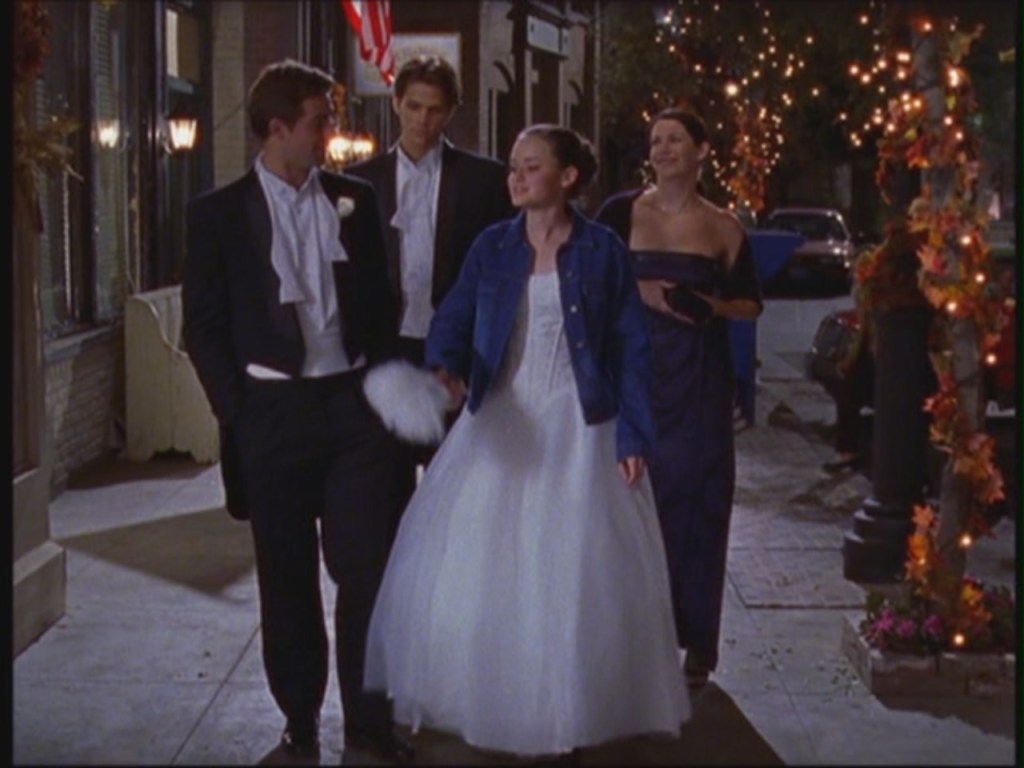
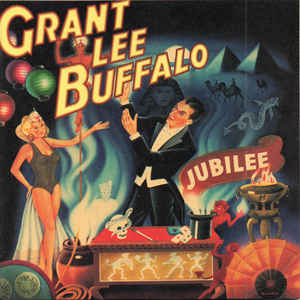
The song playing as Lorelai, Christopher, Rory, and Dean walk down the street on their return to Stars Hollow. It’s the title track from Grant Lee Buffalo’s 1998 album, Jubilee, previously mentioned.
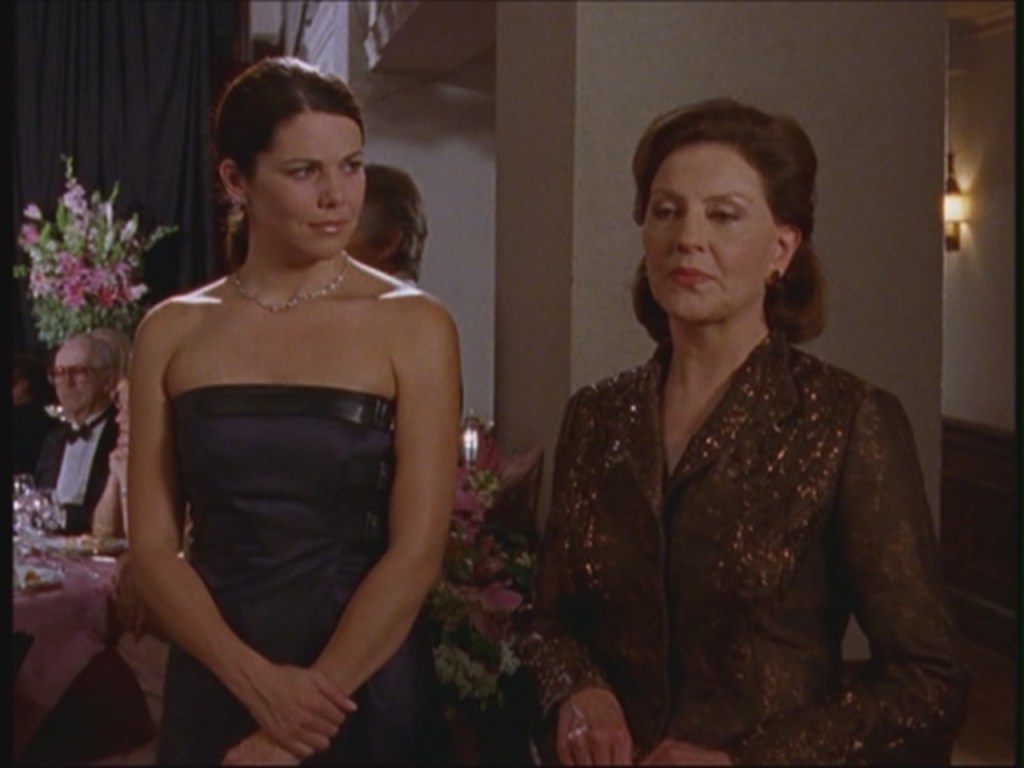
EMILY (to Lorelai): That should’ve been you up there. Nothing’s turning out the way it was supposed to.
From the very first episode, it’s been made clear that Richard and Emily are using Rory as a Lorelai substitute, filling up the big gaping hole of their hurt and disappointment with their daughter with hope and pride in their granddaughter.
It now becomes apparent that it hasn’t been possible to suppress and cover up their feelings so easily. Emily has participated in Rory’s coming out as a replacement for the debut Lorelai was supposed to make when she was sixteen – Rory even wears the same dress Lorelai was going to – and yet it hasn’t helped at all, merely brought into sharper focus all that Lorelai (and by extension, her parents) have missed out on in life.
We know that Emily doesn’t believe in arguing or having intense discussions at social events, so for her to fight with Richard in public and make this angry and emotional remark to Lorelai is very out of character. It’s a sign just how frustrated and miserable she’s been.
Rory’s debutante ball is presented as a counterpart to the school dance she attended with Dean in the previous season. Nine months have gone by, and Rory’s world has widened. Last year, she took hesitant steps towards taking part in Chilton’s social life, this time she is given an entree into Hartford society. In both cases, it was Emily who persuaded her to make an effort and attend – Lorelai may have seen Emily as a stifling influence, but she’s only too keen for Rory to broaden her horizons.
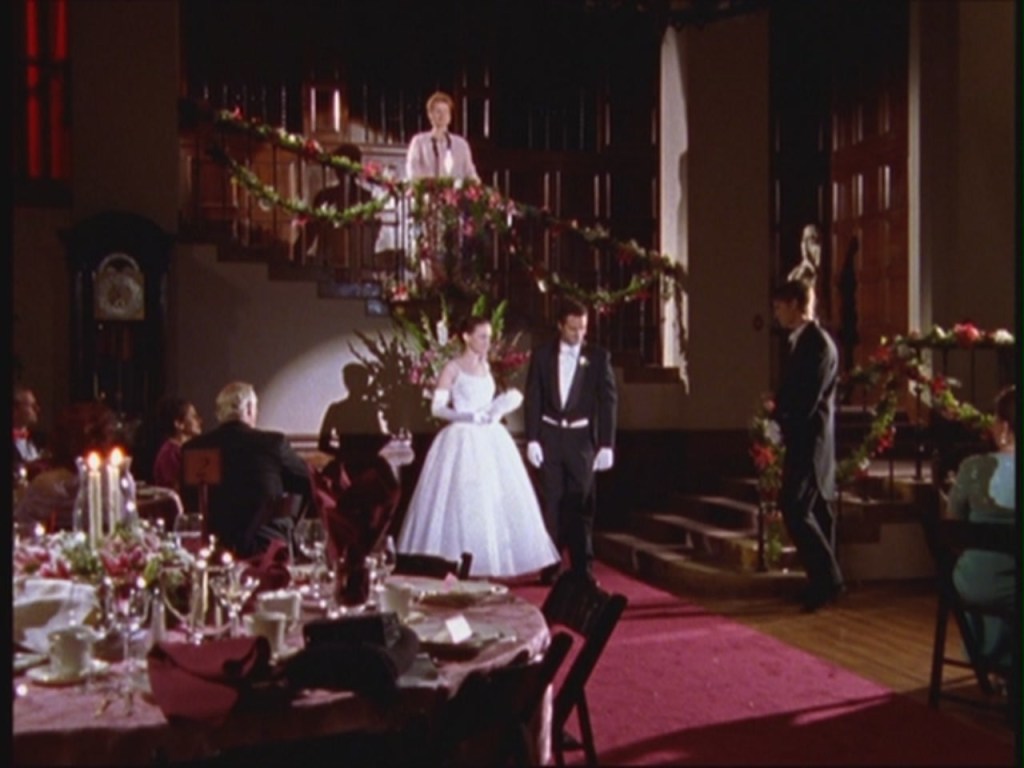
As a key part of making her debut, Rory walks down the stairs with Christopher while Dean waits at the bottom. Christopher kisses his daughter’s hand as Rory curtsies, then leaves her to Dean, who walks her down the aisle. This is a ceremony which some debutante balls still follow, particularly in the American South. It’s overtly nuptial, with the father symbolically “giving away” his daughter to her escort before they walk down the aisle together. (There’s even a white wedding cake!). After all his moaning, Dean looks absolutely overjoyed to be presented with a bridal Rory in a white dress being handed to him.
Lorelai thought debutante balls were creepy and sexist, because they involve displaying yourself to men with the hope they’ll marry you, even though that isn’t what actually happens, and hasn’t happened for about seventy years. Yet here Rory is, getting symbolically married while her father gives her away like she’s his property, and Lorelai’s just happy Christopher is involved, and she doesn’t even bother to mock it, let alone point out how deeply patriarchal it is.
We discover during the course of the ball why Richard has been so stressed and irritable. He is being “phased out” of the insurance company he works for. The process is one whereby a senior employee, like Richard, begins losing responsibilities to begin his path to retirement. Richard is taken off an account he brought to the company, he is given a bigger office upstairs, a new title (we don’t discover what it is), and a better parking space.
Emily sees this as a “promotion”, but Richard knows the bitter truth: the company is softening the blow of his eventual retirement by smoothing his passage out of a useful role and into one of a mere figurehead. To add insult to injury, it’s the very “phasing out” process Richard himself invented to get rid of a man named Alan Parker. (A hint of how cold-blooded and ruthless Richard can be in career matters).
Once this is explained to her, Emily still doesn’t see it as such a big deal, saying that Richard has “other options” (retire or take up some other project). However, Richard has been dreaming of this life since he was ten years old, and doesn’t want other options, feeling that if Emily doesn’t understand, then she hasn’t been listening to him.
Richard throwing a petulant tantrum at a social function his granddaughter is participating in might remind the viewer of some of the meltdowns Rory and Lorelai have had during the course of the show. As Headmaster Charleston said, “You do like to throw fits in your family”. There is a strong emotional streak in the Gilmore clan – perhaps one reason why the more restrained Emily is always trying to rein it in.
The argument is left unresolved for this episode, as Rory tells them it is her turn next. I have no idea how Rory even knows they’re talking in a side room and not already watching her, nor how she managed to get down the staircase, tell everyone she’s on next, then shimmy right back up the stairs again, ready to walk down and be presented. I’m pretty sure in real life someone would have told her to stay exactly she was and not interrupt the proceedings.
There is a poignancy to the fact that just as Rory is being ushered into society and acknowledged as a young woman who is growing up, Richard is at a point in his life where he is being gently shuffled off, ready for retirement. This contrast between them must be at least one reason why Richard has no stomach for Rory’s debutante ball, and expresses such angry disdain for the proceedings.
The song which is played while the debutantes perform their “fan dance” – not the burlesque entertainment the name leads you to believe, but a rather tame affair holding small white fans over their heads. Luckily for Rory, little actual dancing ability seems to be required for it.
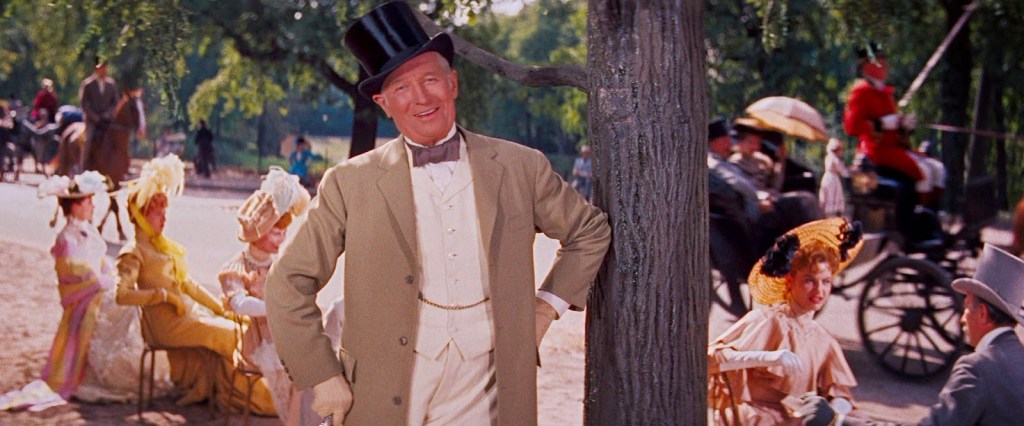
Thanks Heaven for Little Girls is a 1957 song written by Alan Jay Lerner and Frederick Loewe, performed by Maurice Chevalier in the 1958 musical comedy, Gigi, based on the novelette by French author Colette. The film is about a sixteen-year-old girl being trained to be a courtesan in 19th century Paris, who winds up becoming a wife rather than a mistress.
The lyrics describe the pleasure men derive from little girls of “five or six or seven”, knowing that in a decade or so, they will have developed into bigger girls, who “grow up in the most delightful way”.
As a song about the joys of girls developing into nubile young women so you can marry them, it’s on theme for a debutante ball, but also wildly and hilariously inappropriate. The show does seem to agree with Lorelai (big surprise!) that there’s something pretty creepy about coming out parties and debutante balls.
LORELAI: Um, guys, hi, there’s a lady up there with a rock the size of Neptune around her neck talking about the debutantes of ancient Greece. It’s a lot easier to fall asleep if you’re sitting down, trust me.
The planet Neptune, the eighth planet from the Sun, was officially discovered in 1846, although it had been previously sighted and thought to be a star. It has a mass of 1.0243×1026 kg, making it 17 times more massive than the Earth. It is named after the Roman god of the sea, who interestingly, carries a trident, which Rory referenced earlier.
Symbolically, Neptune is associated with dreams and fantasy, suggesting that the debutante ball is creating an illusion, and there is little that is solid or genuine behind it. Notice that Emily despairs that the elegant ballroom is not all that it appears, the debutantes are “false” in that they have artificially changed their appearance, and that there is something insubstantial about the proceedings – which we barely manage to see. Not to mention that the ball itself takes a rather surreal turn, as if it is all just a dream. (Is it pure coincidence that Lorelai immediately talks about falling asleep?).
Lorelai’s statement about “the debutantes of ancient Greece” can be taken as nothing more than a joke – as if the MC’s reminiscences about her own debut must be positively ancient. However, the ancient Greeks did hold puberty rites for girls, of which you could say debutante balls are the spiritual successor. It seems very unlikely the MC would really mention ancient puberty rites, but the ball is just bizarre enough for this to be taken at face value.
LIBBY: Oh my God, is this [Dean] your escort? RORY: Yeah, it is. LIBBY: You are totally getting married.
Obviously, idiot characters like Libby cannot be trusted to give accurate predictions. Although Rory and Dean do get symbolically married at the ball itself.
Note that Emily told Lorelai the girls needed elbow-length white kid gloves for the ball, but they are clearly wearing elbow length white satin gloves instead. Honestly, without Emily supervising everything personally, this ball is going to pot. Also, Emily obviously managed to get Rory to put her hair up.
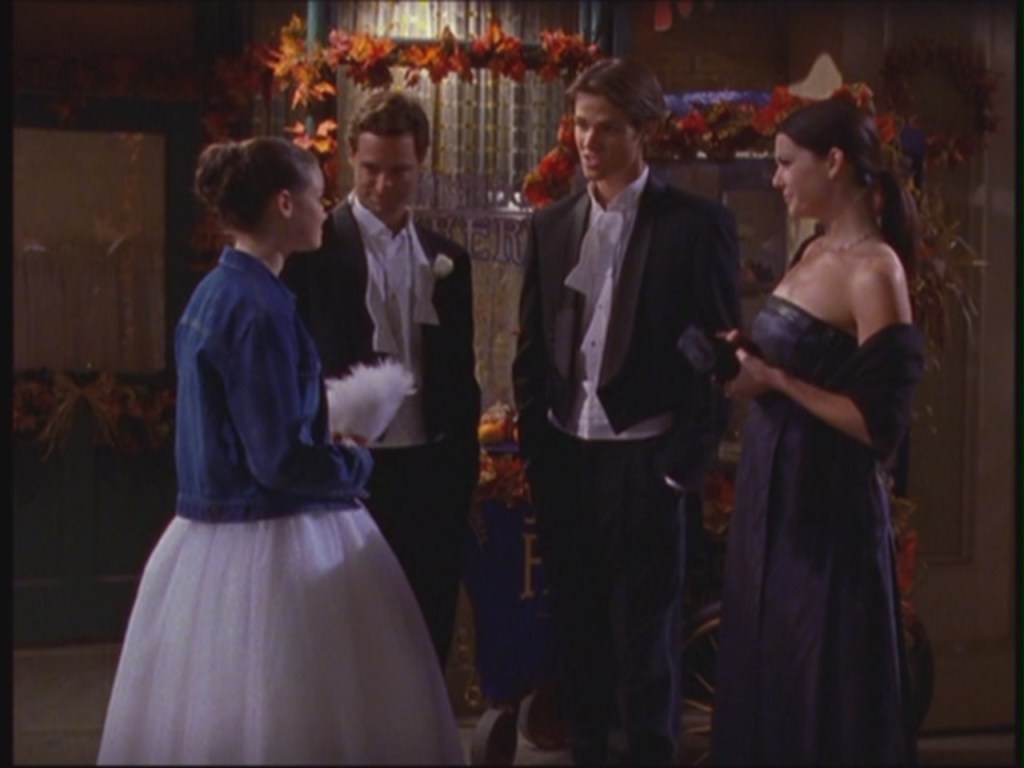
DEAN: I think you look like a cotton ball. RORY: Why, thank you Jeeves.
DEAN: But a really cute cotton ball.
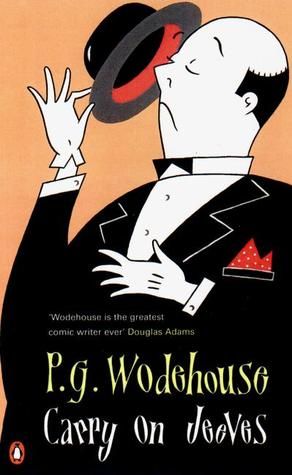
Reginald Jeeves is the valet to Bertie Wooster in the Jeeves stories by English comic writer P.G. Wodehouse. The first Jeeves story appeared in print in 1915, and the last was published in the novel Aunts Aren’t Gentlemen, in 1974. It is not certain, but quite likely, that Rory has read at least one of Wodehouse’s books starring Jeeves.
In the stories, Jeeves is the brilliant mind who helps the more simple Bertie solve his myriad life problems. He is sometimes incorrectly referred to as a butler, although he did occasionally take on butler duties for other characters.
Rory gets back at Dean for comparing her to a cotton ball in her white dress by comparing him to a valet in his formal wear. Incidentally, Rory looks much prettier in her debutante dress than just “a really cute cotton ball”!



 The Annotated Gilmore Girls