“Chickie run down at the salt flats”

LUKE: Go. Stay out of trouble.
JESS: Guess that means calling off the chickie run down at the salt flats.

Jess references the 1955 drama film, Rebel Without a Cause, directed by Nicholas Ray and starring James Dean, previously discussed. It was a groundbreaking attempt to portray the moral decay of American youth and inter-generational conflict, focused on a Los Angeles teenager named Jim Stark. Released less than a month after James Dean’s death in a car accident, and the only film where he received top billing, it is now regarded as a cultural landmark.

At one point, Jim takes on Buzz, the leader of the local gang, in a “chickie run”, where two people drive headlong towards each other, or towards some object of doom – the first one to swerve away to save themselves is the “chickie” (chicken, coward). In the film, the chickie run is headed straight for some seacliffs, so that there is a serious risk of one or both ending up mortally injured, and indeed, it ends tragically for the gang leader, whose jacket becomes entangled with the door when he tries to jump out and save himself.

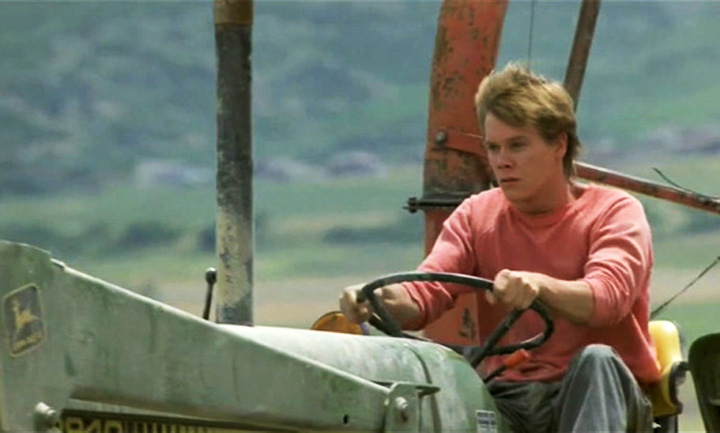
A chickie run at the salt flats is a reference to the 1984 dance movie Footloose, set in salty flat Utah and previously discussed. In a homage to Rebel Without a Cause, the film’s hero Ren takes part in a chickie run on tractors against a rival. Like Buzz, he suffers a technical glitch when his shoelace gets stuck in the vehicle’s pedals. Unlike Buzz, this causes him to win the chickie run and emerge triumphant.

It’s interesting that Jess references Footloose, one of Lorelai’s favourite films. It’s another reminder how much these two characters have in common.

Monticello

LORELAI: Mmm, I’m terrible at coming up with names. When we first bought out house, Rory and I wanted to name it, you know, like Jefferson named his place Monticello, but all we could come up with is The Crap Shack.

Former US President Thomas Jefferson, previously discussed, called his main plantation Monticello, from the Italian for “little mountain”, as it’s situated on a peak of the Southwest Mountains, near Charlottesville, Virginia. The plantation house was first begun in 1768 in a neoclassical style, but extensively remodelled in the 1790s with elements from Parisian homes Jefferson had seen in France and ideas of his own devising, and work continued into the 1820s. Monticello is now a National Historic Landmark and a UNESCO World Heritage Site, and features on the US five cent coin.

Notice that Lorelai wears a black blouse with a red cherry print design on it – Monticello is famous for its orchard, including its cherry trees. You can still buy cherry preserves from the Monticello gift shop. I cannot say if the colour of the blouse is significant in light of the slave labour that was used at Monticello, and even to some extent, in the building of the plantation house itself.

This is the first time we learn that Lorelai and Rory supposedly called their house The Crap Shack when they moved in, when Rory was eleven. Presumably the house was in poor condition, and has needed a lot of work to get it to the standard we see. It can’t be a name they use very often – they’ve always just referred to as “home” or “the house” so far. Perhaps that’s because the house is now far less crappy than when Lorelai bought it and the name doesn’t really apply any more.

Van Gogh

EMILY: The [painter] from Italy had some sort of breakdown.
RORY: Oh my God.
LORELAI: Hey, it didn’t hurt van Gogh, the guy should thank me.

Vincent van Gogh (1853-1890), Dutch post-impressionist painter who posthumously became one of the most famous and influential figures in the history of western art. In only a decade, he created more than two thousand oil paintings, most of them in the last two years of his life, his work becoming brighter, bolder, and more dramatic as his style developed.

Van Gogh suffered from psychotic episodes and delusions, and neglected his physical health, drinking heavily and not eating properly. His friendship with the painter Paul Gauguin ended with a confrontation during which van Gogh partially severed his own ear in a fit of rage. He spent time in psychiatric hospitals, but after being discharged, his depression continued. He is believed to have shot himself in the chest with a revolver, dying two days later.

Van Gogh was commercially unsuccessful during his lifetime, but attained widespread success over the ensuing decades, and today his works are among the world’s most expensive paintings to have ever sold. His legacy is honoured by the Van Gogh Museum in Amsterdam.

Although van Gogh suffered lifelong mental health issues, it is thought he may have had an acute breakdown when he severed his ear, as he had no memory of the event. It certainly did hurt him – he ultimately killed himself. But Lorelai probably means it didn’t do his career any harm, as the mental illness and suicide have only given him an aura of tortured, misunderstood genius in the public imagination. [picture shows a Van Gogh self-portrait].

It’s clear the Italian painter’s Lorelai-caused breakdown also hurt him – a year later, he was apparently homeless or destitute, found rummaging through Emily and Richard’s recyclables. It was typical of Emily not to check that he was okay, or offer him help – after all, it was her daughter that supposedly drove him to madness! Hopefully he was just working on an art installation and looking for materials, or something.

Billy Idol

EMILY: She wouldn’t stop scowling.
LORELAI: I was going for a Billy Idol thing.

Billy Idol (born William Broad in 1955), British-American singer. He first achieved fame in the 1970s as leader of London punk band Generation X, before a subsequent solo career made him a lead artist on MTV in the 1980s. His biggest hits include Dancing With Myself, White Wedding, Rebel Yell, and Eyes Without a Face. Billy Idol took a break from music during the 1990s, making musical comebacks in 2005 and 2014.

Billy Idol was known for his signature scowl, which he came up with as a way of making himself memorable. He could easily have been an artist that Lorelai enjoyed during her teen years.

“What portrait?”

EMILY: Just because your own experience sitting for a portrait was bad doesn’t mean Rory’s has to be.

RORY: What portrait? I haven’t seen this.

Rory actually has seen a portrait of Lorelai – there’s one with her as a young girl with her parents in the living room. Emily is talking about a different portrait, of Lorelai when she was a teenager that never got completed, but it’s surprising that Rory doesn’t think she’s talking about the living room portrait. Young Lorelai actually doesn’t look too impressed in this one, either.

“Warning, warning … Danger, Will Robinson, danger!”

EMILY: So do I. We really ought to do something.
RORY: Yes, I agree.
LORELAI: Warning, warning.
EMILY: I’m glad to hear you say that Rory, because I thought of a wonderful way to cheer him up.
RORY: Cool, what?
LORELAI: Danger, Will Robinson, danger!

Lorelai is referencing the science-fiction television series Lost in Space (1965-1968). Inspired by the 1812 novel The Swiss Family Robinson, it followed the adventures of the Robinson family, pioneering space colonists, struggling to survive in the depths of space.

Will Robinson (played by Bill Mumy) was the youngest member of the family, a precocious nine-year-old who was a whizz with electronics and computers. He was accompanied by a robot (played by Bob May, voiced by Dick Tufeld), who was tasked with protecting Will. His catchphrases to alert Will when faced with potential hazards were, “Warning, warning”, and “Danger, Will Robinson, danger”.

The series received reasonable ratings and its catchphrases became part of popular culture, although never given much respect as a work of science-fiction. It was adapted into a film in 2004, and rebooted as a television series on Netflix (2018-2021).

Akron

RORY: Too bad Grandpa’s not here. He likes weird food.
LORELAI: Yeah, where’s he eating his weird food tonight? Argentina? Morocco?
EMILY: Akron … The amenities are atrociously lacking. He had to eat at a coffee shop last night. The whole thing’s terribly insulting. He’s miserable.

Akron is a city in Ohio, with a population of nearly 200 000, although the Greater Akron area is around 700 000. It has a long history of rubber and tyre manufacturing, earning it the name Rubber Capital of the World. Today it has an economy based on manufacturing, education, healthcare, and biomedical research, with many polymer companies. Racially diverse, it has been the site of several key scenes in African-American race relations, including being the place where Marcus Garvey founded the Universal Negro Improvement Society in 1914. Like many manufacturing centres, it suffers from the effects of air and soil pollution.

It is one of many cities which claims to have invented the hamburger, which might be one reason why Gilmore Girls doesn’t rate it as a place for fine dining. They do seem to be lacking silver service restaurants, although with a selection of delicious-looking steakhouses and grills. I feel as if Richard should have been able to find something decent to eat there, but this is the man who ate chocolate pudding with an expression like it was rat poison. Maybe his hotel wasn’t situated near any good food options.

It is one of the few times that Richard needed to travel for work within his home country. Richard seems to travel overseas an inordinate amount for someone who’s an executive at an insurance firm – is that much European travel really necessary in insurance? (Especially when a problem at their office in China was sorted out with a phone call from Richard). I wonder if being sent to Akron is another symptom of Richard being “phased out” of his job.

“What country is she from?”

LORELAI: Very tasty. New cook?
EMILY: Yes, Marisella. She’s introduced us to some wonderful dishes so charmingly specific to her native country.
LORELAI: What country is she from?
EMILY: One of those little ones next to Mexico.

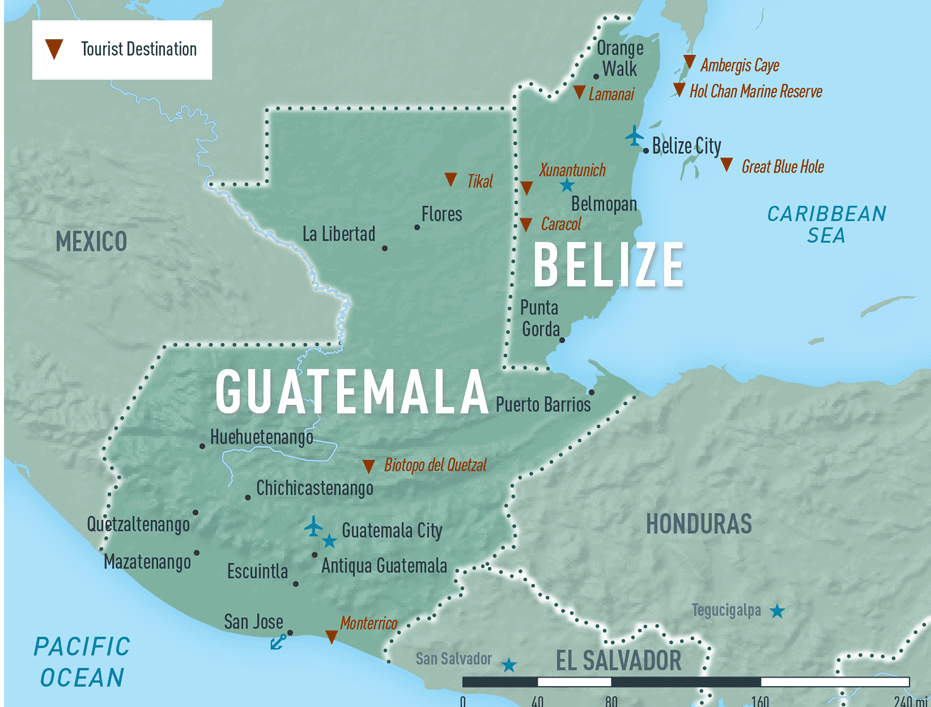
There are two countries which border Mexico to the south – Belize and Guatemala. Belize is the smaller of the two, although I’m not sure if that means it’s more likely as Marisella’s place of origin.

The cuisine of Belize and Guatemala is broadly similar to other countries in Latin America and the Caribbean, but often with their own twist. Dishes specific to Guatemala include pepian (a spicy chicken stew), and relleintos (mashed deep fried plantains mixed with chocolate and sprinkled with sugar). Dishes specific to Belize include chimole (a chunky chicken and potato soup), and fry jacks (soft puffy tortillas filled with beans, cheese, or meat). Garnaches are popular in both countries (fried corn tortillas topped with refried beans, cabbage, and cheese).

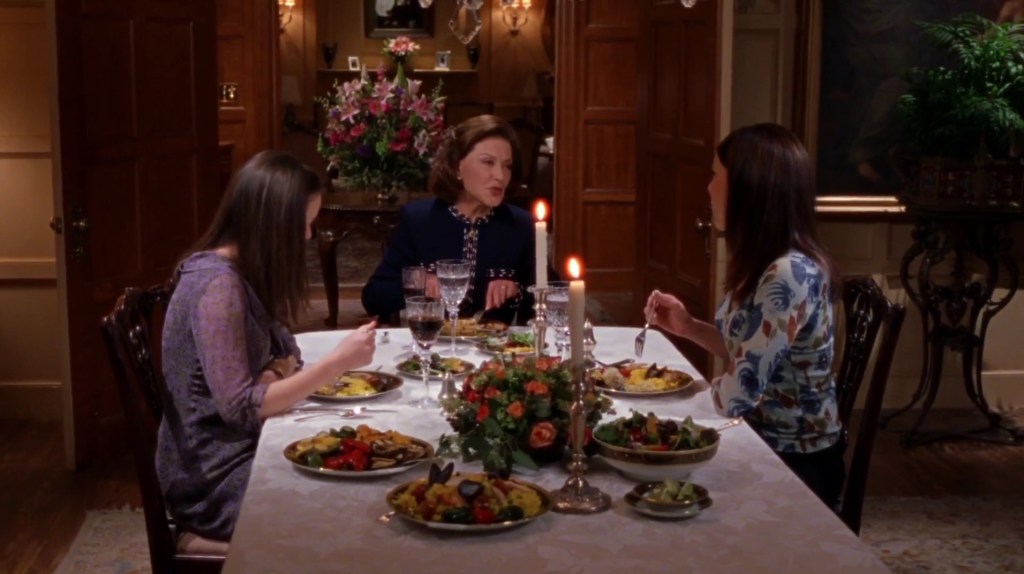
The Gilmores look as if they are eating a selection of grilled vegetables with tortillas (?), yellow rice, and beans, with salad and slices of lime. The food is served on communal dishes, and everyone helps themselves on their individual plate. It looks fairly typical of Central American meals.