PARIS: All right, I’ll push it through … But the next genius who comes up with the brilliant plan to put Elizabeth Arden in the chemistry class can bite my ass.
Elizabeth Arden Inc., major cosmetics, skin care, and fragrance company founded by Canadian-American businesswoman Elizabeth Arden in 1910, first as the Red Door salon on Fifth Avenue in Manhattan. The brand has been owned by Revlon since 2016 and is headquartered in Miami, Florida.
I’m not sure why students would ask for Elizabeth Arden in the chemistry class – maybe for the hand cream? Or for perfume, to cover the chemical smell?
PARIS: You want the first stand I make against the faculty to involve a fashion choice? It would be my ‘gays in the military.’
Paris refers to the “Don’t ask, don’t tell” policy in regard to allowing gay people to serve in the US military. Bill Clinton had campaigned in 1992 on the promise of allowing all citizens to serve in the military, regardless of sexual orientation. However, on being elected to the presidency, he had to settle with a compromise solution, called the “Don’t Ask, Don’t Tell, Don’t Pursue” policy, popularly known by its first four words.
Essentially the policy allowed gay people to serve in the military, provided they remained in the closet, while openly gay military personnel could be dishonourably discharged if they “told” anyone they were gay. It was an offence to ask anyone about their sexual orientation, or to pursue an investigation into anyone who didn’t “tell” (remained closeted). Later they added a “Don’t Harass” to the title, to mean the military would not allow harassment or violence against anyone. The policy was repealed in 2010 under the Obama administration, allowing openly gay personnel to serve in the US military. Former president Clinton welcomed the repeal.
Paris is saying that if the first thing she brings in as president is shorter hemlines, it would look like she was starting out by giving in to Francine straight away, like Clinton gave in to Congress.
FRANCIE: Okay, I guess I can wait . . . for a while.
PARIS: Patience is a virtue.
“Patience is a virtue” is a proverbial saying refering to Patience as one of the seven heavely virtues, dating back to the 5th century epic poem Psychomachia, by the Latin poet Prudentius.
PARIS: How are we going to get a professional photographer?
LOUISE: Helmut Newton is my godfather.
PARIS: Okay, sign him up – and tell him to leave the whips and chains at home.
Helmut Newton, born Helmut Neustädter (1920-2004), German-Australian fashion photographer whose black and white photographs were a mainstay of Vogue, Harper’s Bazaar, and other magazines. His photos were erotic and stylised, often with fetishistic or sado-masochistic overtones – hence Paris’ instructions not to include whips and chains. Clearly Newton is not really appropriate as a school photographer!
It is interesting to speculate how Helmut Newton became Louise’s godfather. Presumably one or both of her parents have a connection with the fashion world. At this stage of his life, Helmut Newton lived in Monaco, but spent his winters in Los Angeles.
LOUISE: Dances help bring in money to pay for those stupid topiaries you want in the quad.
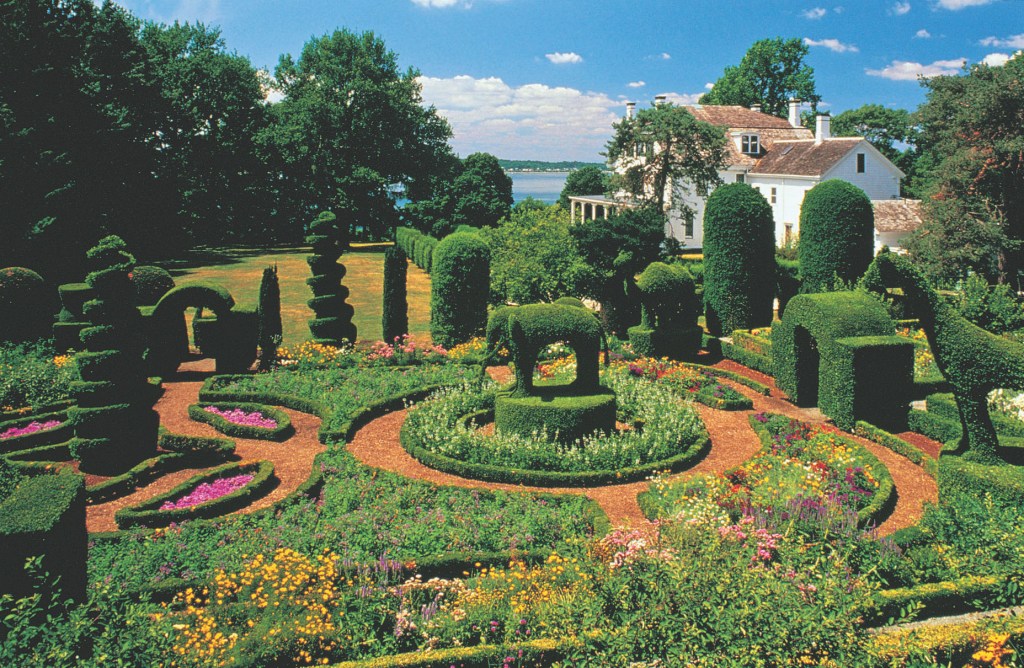
Topiary is the art of clipping evergreen trees and shrubs into clearly defined shapes as a part of landscaping grounds. Common plants used for topiary are box, conifers, laurel, holly, myrtle, yew, and privet. Topiary dates to ancient Roman times, declined in the 18th century, but was revived in the 19th, and became part of what we consider the “classic English garden”. The style was later adopted by wealthy upper-class Americans for their gardens. [Picture is a topiary garden in Newport, Rhode Island].
EMILY: How is your Caesar salad dressing prepared?
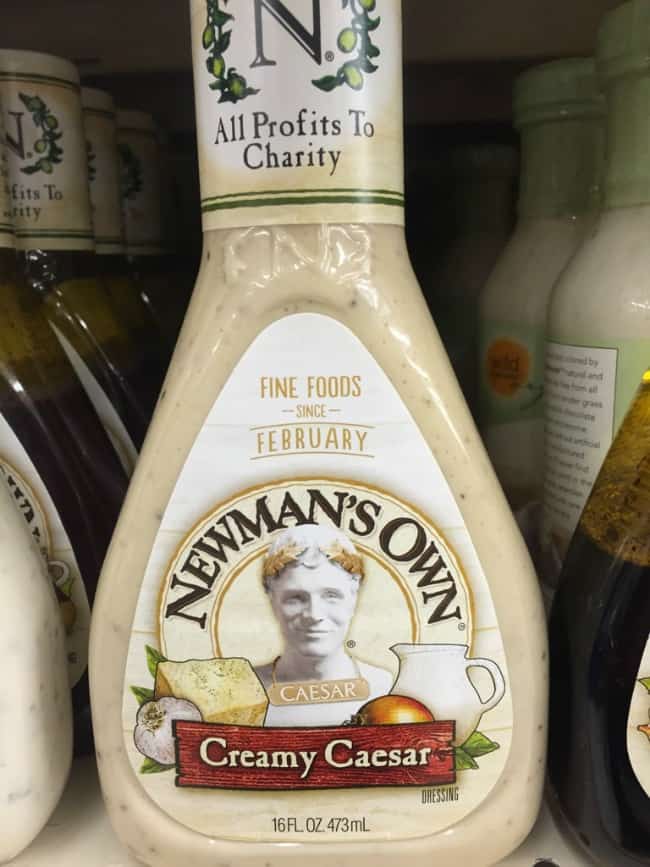
LUKE: I’ll have to call Paul Newman and ask him.
Luke is saying he doesn’t make his own salad dressing, he is using a bottle of Newman’s Own dressing, a brand of condiments and foods founded by Hollywood star Paul Newman and author A.E. Hotchner in 1982. The company, headquartered in Westport, Connecticut, donates 100% of its after-tax profits to the Newman’s Own Foundation, a private non-profit foundation which supports various charitable causes – one of them is the SeriousFun Children’s Network, residential summer camps for seriously ill children all over the world, which Newman co-founded in 1988.
Emily debates whether to order Caesar salad or Cobb salad for lunch at Luke’s diner.
A classic Caesar salad [pictured] consists of whole leaves of romaine lettuce and croutons, dressed with lime juice, olive oil, coddled eggs, Worcestershire sauce, garlic, Dijon mustard, Parmesan cheese, and black pepper. Its creation is attributed to Caesar Cardini, an Italian immigrant who had restaurants in Mexico and the US. He is said to have invented the salad in 1924 at his restaurant Caesar’s in Tijuana, Mexico, when a busy Fourth of July left his kitchen depleted. He used what ingredients he had on hand, adding flair by tossing the salad at the table. In 1946, the salad was introduced to New York by Gilmore’s (!) Steak House, who added anchovies into the mix. Although Cardini disapproved, anchovies are now usually added. Lemon juice is also typically substituted for the lime juice.
Cobb salad is a classic American garden salad usually made from chopped salad greens, tomato, crisp bacon, fried chicken breast, hard-boiled eggs, avocado, chives, blue cheese, and red wine vinaigrette. The ingredients aren’t mixed together, but laid on the plate in neat rows. There are various stories as to how it was created, one being that it was invented in 1938 by Robert Cobb, the owner of the Brown Derby Restaurant in Hollywood, where it became a signature dish. The legend goes that Cobb hadn’t managed to eat until nearly midnight, and made the salad out of leftovers he found in the kitchen.
Coddled eggs are eggs that have been gently poached in a ramekin in a bain-marie, cooked just below boiling point. There is a risk of salmonella from eating them unless you are careful, hence Emily’s concern about ordering the Caesar salad. In the end, she orders the Cobb salad, where the eggs are hard boiled instead.
Note that Emily’s worry about the coddled eggs is basically the same conversation that Lorelai had with Sookie about mussels when they went out to dinner on their double date with Jackson and Rune. In both cases, Lorelai pleads with them to choose something else from the menu, in almost the same words.
This is the song that Luke sings to Lorelai, in order to tease her about being asked out by Kirk. “Love Is in the Air” is a 1977 disco song by Australian singer John Paul Young, written by George Young and Harry Vanda, and released as the lead single from John Paul Young’s album Love Is in the Air. It went to #3 in Australia, and was a world-wide hit, going to #5 in the UK and #7 in the US, but most popular in Norway, Sweden and South Africa, where it went to #2. It went to #1 on the Billboard Adult Contemporary chart.
The song was featured in the 1992 Baz Luhrmann film Strictly Ballroom, remixed with a ’90s dance beat. Re-released as a single from the Strictly Ballroom soundtrack, it went to #3 in Australia, and was most popular in New Zealand at #2.
It is a bit surprising that Luke knows this song, and most likely watched Strictly Ballroom, which doesn’t seem like his sort of film. Maybe he went to it with a girlfriend?
FRANCIE: This is politics. If you’ve got a problem, tell it to Noam Chomsky. I live in the real world, now blow.
Avram Noam Chomsky (born 1928), linguist, philosopher, cognitive scientist, historical essayist, social critic, and political activist. Sometimes called “the father of modern linguistics”, Chomsky is also a major figure in analytic philosophy. He is a Laureate Professor of Linguistics at the University of Arizona and an Institute Professor Emeritus at MIT, and is the author of more than 150 books on topics such as linguistics, war, politics, and mass media. Chomsky’s latest book at that time was Understanding Power, a collection of transcripts about political activism from lectures and seminars given by Chomsky, published in February 2002.
Francie is thinking of Chomsky’s political views, which are broadly anarchy-syndicalist and libertarian socialist. Many of his books and lectures have been critical of the US government, its foreign policies, and its method of democracy – in particular, the way that political power at presidential level is controlled by the privately wealthy and by the public relations industry. In Francie’s view, his ideas are impractical and theoretical, not “the real world”.
Francie refers to the 19th century English fairy tale, Goldilocks and the Three Bears. It was first recorded by the English poet and writer Robert Southey and published anonymously as “The Story of the Three Bears”, in a volume of his writings called The Doctor.
The original story was about an ugly, rude old woman who enters a house and helps herself to the bear’s porridge and their beds, with tragic results for the interloper. Published twelve years later by English writer Joseph Cundall in his Treasury of Pleasure Books for Young Children, the nosy person was changed to a pretty little girl.
Many names were suggested for her over the years as the story was republished, from Silver Hair to Little Golden-Locks, before the name Goldilocks was hit on in 1904, in Nursery Rhymes and Tales (English author Flora Annie Steel is credited for choosing the ultimately successful name). The little girl’s fate has differed in various retellings, but she never ends up as badly as the old woman, usually learning her lesson and vowing never to wander off into the forest again.
Rory reacts with irritation at being compared to a silly little blonde-haired character (she’s extra sensitive about blondes, because of Jess’ girlfriend). However, Francie is most likely comparing Rory to Goldilocks as if she is a naïve little girl, poking her nose into things she doesn’t understand, meddling where she doesn’t belong, and unaware of the dangers she is in. You know, the dangers of all the … hemlines? While Rory has been compared to fairy tale and children’s characters before, this is the first time it’s done to insult her.






 The Annotated Gilmore Girls