Manticore

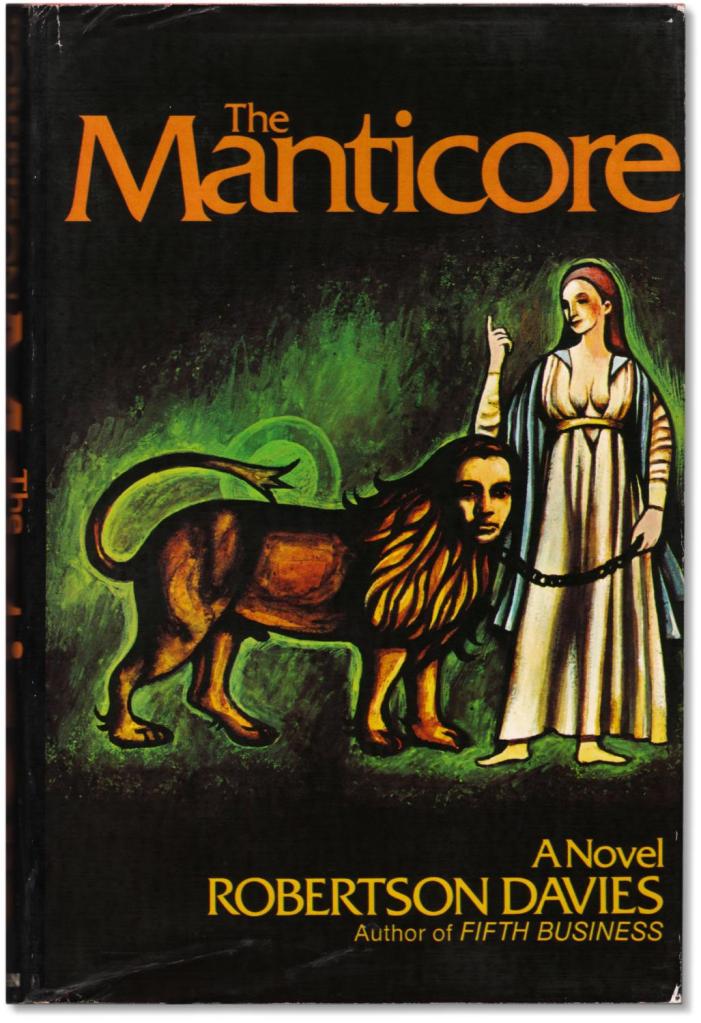
DARREN: Open question – which mythological figure has the head of a man, the body of a lion, and the tail of a scorpion? Here’s a hint – it’s also the title of a novel by Robertson Davies.

RORY: Oh, manticore.

The manticore is a Persian mythological creature with a human head, body of a lion, and a tail of venomous spines – some depict it as like porcupine quills, while others give it a scorpion tail, as Darren says. There are some accounts that the spines can be shot like arrows, making the manticore a lethal predator. It devours its prey whole, using its triple rows of teeth, leaving no traces of its victim behind. Its name comes from the Persian for “man eater”.

The Manticore is a 1972 novel by Canadian author Robertson Davies. It is the second volume in his Deptford Trilogy, three interrelated works set in the fictional town of Deptford, Ontario. The plot of The Manticore revolves around themes of Jungian psychology and psychoanalysis, and the journey towards becoming fully human.
Mesozoic Era

DARREN: Jennifer, can you give me the three sub-classes of the Mesozoic Era?

JENNIFER: Triassic, Jurassic, and Cretaceous … Follow-up – what preceded the Mesozoic Era?

DARREN: Paleozoic.

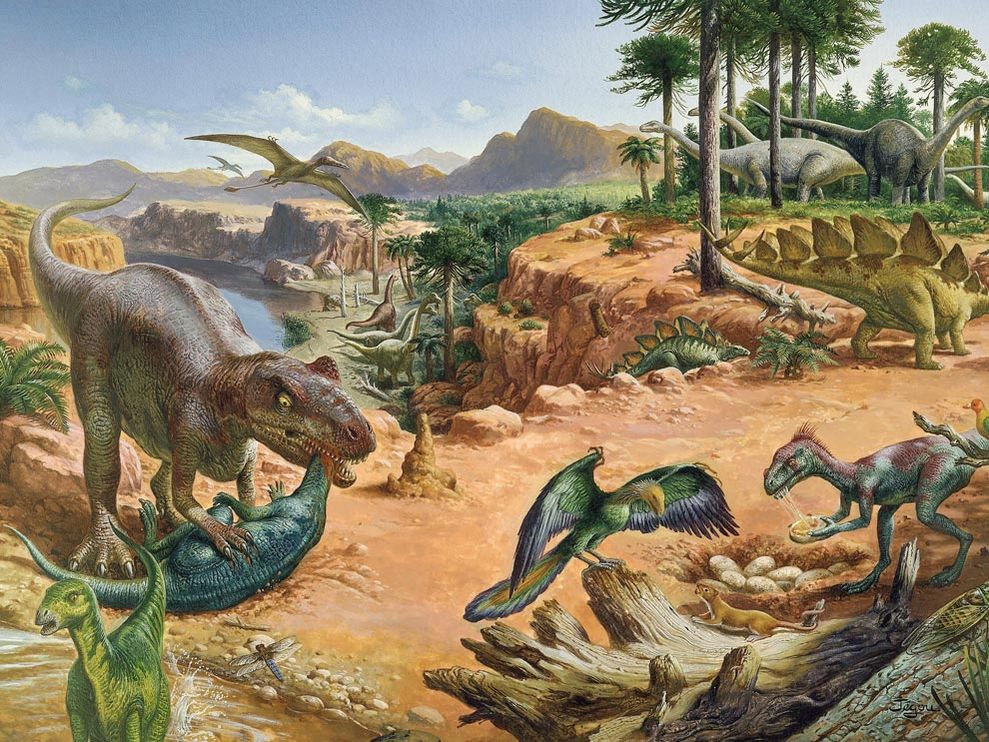
The Mesozoic Era is the second-last era of Earth’s geological history, lasting from 252 to 66 million years ago, and comprising the Triassic, Jurassic, and Cretaceous periods. It is sometimes called the Age of Reptiles of the Age of Conifers, and is characterised by the dominance of dinosaurs, an abundance of conifers and ferns, a hot greenhouse climate, and the tectonic breakup of the supercontinent Pangaea. The name Mesozoic means “middle life” in ancient Greek.

The Paleozoic Era came before the Mesozoic Era, the earliest of the three eras of geological history, with a name meaning “ancient life”. It was a time of dramatic geological, climatic, and evolutionary change, seeing an explosion of new species emerging, and life beginning in the ocean, but transitioning to the land.

Chopin, Padarewski

DARREN: Jack, which Polish composer –

JACK: Chopin!

DARREN: Patience . . . became Prime Minister of his country?

JACK: Paderewski.

Frédéric Chopin, born Fryderyk Chopin (1810-1849), Polish composer and virtuoso pianist of the Romantic period, who wrote primarily for solo piano. He was one of the earliest musical celebrities, and he has maintained his reputation as a poetic genius and one of the great musicians of his generation.

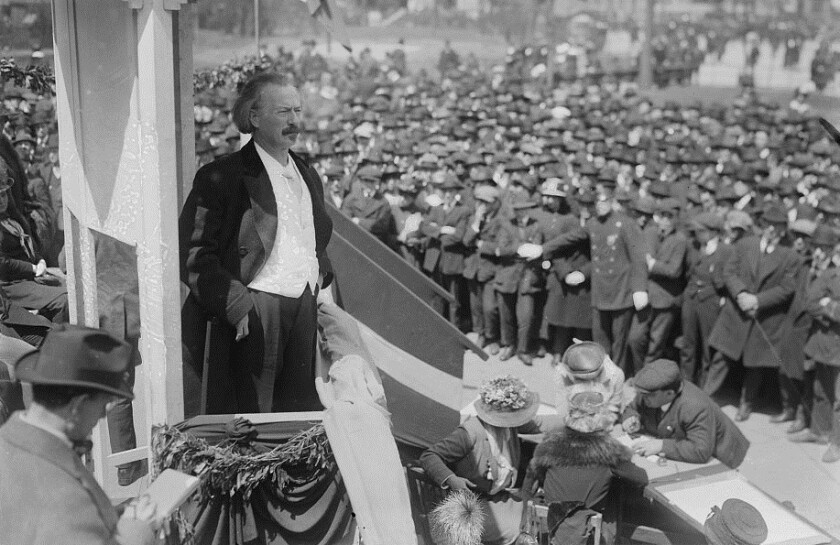
Ignacy Jan Padarewski (1860-1941) [pictured], Polish pianist and composer who became a spokesman for Polish independence. He was appointed prime minister in January 1919, and signed the Treaty of Versailles, which ended World War I. He resigned in November 1919, and continued his musical career, rarely visiting Poland again.

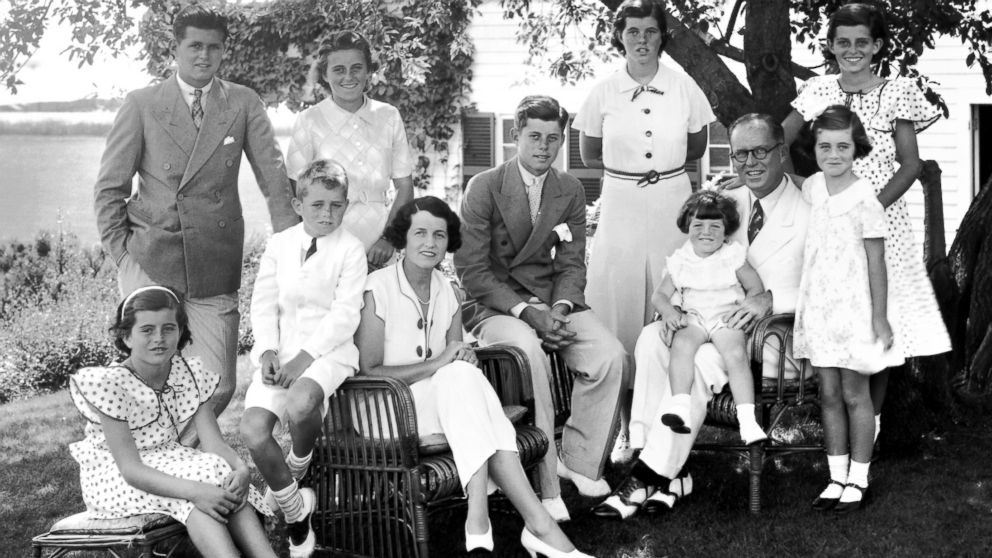
Kennedy-esque

DARREN: This is a little tradition with us, quizzes at meals. It keeps the Springsteens sharp.

LORELAI: Very Kennedy-esque.

JENNIFER: Mm, we love the Kennedys!

LORELAI: As do we all.

A callback to when Emily spoke glowingly of the Kennedy family quizzes in Season 1, wondering why the Gilmores couldn’t do the same. Rory and Lorelai are now getting a taste of what that would be like!

Jennifer says that the Springsteens love the Kennedys, indicating that they are Democrat voters – Connecticut is a Democrat state, and Westport is the most Democrat city of the state. Lorelai is quick to let them know that she is a Democrat voter as well.

Falstaff

DARREN: In which play does Falstaff appear?

JACK: That would be plays … Henry the Fourth, Part One and Two, and The Merry Wives of Windsor.

DARREN: So that was a different Falstaff than Henry the Fifth?

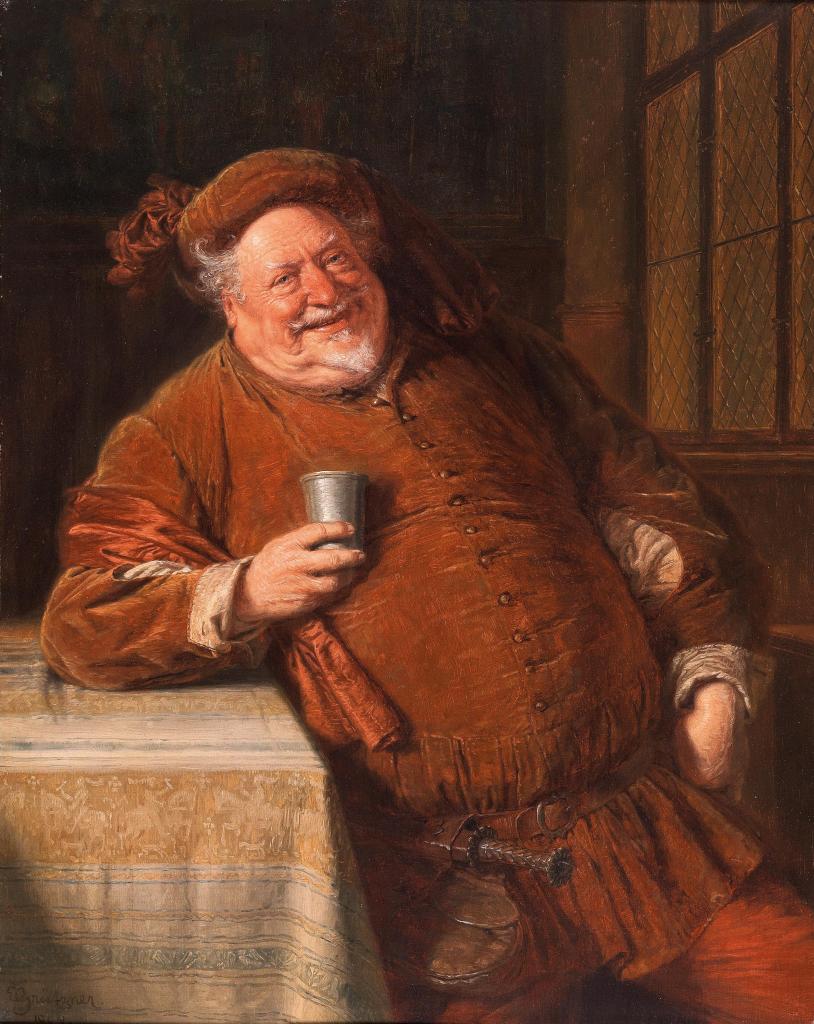
Sir John Falstaff is a comic character created by William Shakespeare. A fat, vain, and boastful knight, he spends most of his time drinking with petty criminals, living on stolen or borrowed money. He is best known from Henry IV, Part 1, where he is the companion of Prince Hal. Although Falstaff is a drunken, corrupt lowlife, he has charisma and a zest for life that the prince enjoys. In Henry IV, Part 2, Prince Hal is on his path to kingship, and ultimately rejects Falstaff as a companion. They meet briefly only twice in the play, and Falstaff is ageing and unwell.

Darren is incorrect that Falstaff appears in Henry V – he dies offstage, but another character memorably describes his death.

Sir John Falstaff appears in the comedy, The Merry Wives of Windsor. He is vaguely recognisable as the same character, but there is otherwise no connection to the earlier plays, and it has been argued that it isn’t the same Sir John Falstaff. Although nominally set during the reign of either Henry IV or Henry V, everything in the play suggests that it actually takes place in Shakespeare’s own time, around the late 1500s. Tradition has it that the play was written at the request of Queen Elizabeth I, who asked Shakespeare to write a play where Falstaff falls in love.

[Painting shown is Falstaff II by Eduard von Grützner, 1904]

“One fell swoop”

DARREN: One fell swoop, interesting phrase … Origin?

JACK: It was coined in Macbeth and derives from Middle English.

At one fell swoop means “suddenly, in a single action”. The fell part is an archaic word dating to the 13th century meaning “fierce, savage, cruel, ruthless”; it’s the root of the word felon and has gone out of use except for this one instance.

The phrase was first used, and most probably invented, by William Shakespeare, in his play Macbeth, previously discussed. In the play, it is said by Macduff when he hears that all his family and household have been killed:

All my pretty ones?
Did you say all? O hell-kite! All?
What, all my pretty chickens and their dam
At one fell swoop?

The “kite” that Macduff refers to is the bird of prey, commonly used as a hunting bird in Tudor England. You can see that the “fell swoop” is the swoop of the kite as it quickly descends to catch its prey.

Somehow “at one fell swoop” went from meaning something terrible happening all at once, to just anything happening all at once. Darren uses it to mean good thing happening all at once, but I am unable to disassociate it from its original context, and to me it still suggests some fearsome unexpected blow from above. Maybe I read too much Shakespeare!

Jack’s answer is actually pretty inadequate, or even misleading. It’s not certain that Shakespeare coined it, although it’s likely – he should have said that it first appeared in Macbeth, and that Shakespeare has been credited with coining it. The phrase itself is not Middle English, and presumably he means that the word fell in this example goes back to Middle English.

“It might even be to Rory’s benefit”

DARREN: In fact, it’s refreshing [that Lorelai doesn’t have an academic background]. It might even be to Rory’s benefit. Good things didn’t come to your family in one fell swoop, you struggled for it.

Darren is suggesting that Rory’s background might be enough to make her stand out from the crowd in the college application process, to make it seem as if she had to struggle for everything she’s attained (it’s really more that Lorelai has had to struggle for most of what Rory’s attained). Lorelai and Rory are carefully leaving Richard and Emily out of the narrative, and not mentioning the financial assistance Rory has had to attend Chilton (a good thing which came in one fell swoop).

You can see that this is the angle Darren himself is probably planning to use in his chat with a Harvard admissions officer – he’ll be putting in a good word for a girl from a middle-class single-parent family in a small town, with a mother who had become pregnant in high school, had to work hard to support them both, and doesn’t have an academic background. Again, the fact that Lorelai went to private school and is from a wealthy upper-middle class family where both parents attended Ivy League universities is not going to be mentioned!

AA Degree

RORY: But [Mom] took night classes and graduated last year. She has an AA degree in Business.

An AA degree is an associate degree, an undergraduate degree awarded after a course of post-secondary study lasting two to three years. It is a level of qualification above a high school diploma, and below a bachelor’s degree.

Associate degrees first began in the US in 1898, and there, completing an associate degree can allow the graduate to transfer to the third year of a bachelor’s degree – you’ll remember that Lorelai’s former classmates Liza and Zach were going to continue their studies at universities after graduating from business class at community college.

Lorelai’s degree is most likely an Associate of Applied Business (AAB).

Alma Mater

DARREN: So, Lorelai, what’s your alma mater?

Alma mater, a Latin phrase used to identify a school, college, or university that one has attended or graduated from. It literally means “nourishing mother”, as if the student has gained intellectual nourishment from their school. It is related to the word alumnus, previously discussed alumnus literally means “one who is nourished”.

The Latin phrase was originally a title for mother goddesses such as Ceres and Cybele, later given as a title to the Virgin Mary. It was first used academically in the English-speaking world in 1600, referring to Cambridge University, as part of the emblem for Cambridge University Press. You can see in the picture it was portrayed quite literally, with milk pouring out from the breasts of Cambridge – the milk of knowledge, I suppose.