This is the book that Rory is reading on her bed when Lorelai comes in before her date with Peyton.
Letters of Ayn Rand is a collection of letters written by the novelist and philosopher Ayn Rand, edited by Michael Berliner with the approval of the Rand estate. It was first published in 1995, 13 years after Rand’s death, and the paperback version that Rory is reading was published in 1997. It received generally positive reviews from Rand scholars and fans, but was judged “tedious” by The Washington Post.
Although Rory said she only liked Ayn Rand because of her novel The Fountainhead, reading her letters seems to suggest a stronger interest in Rand and her ideas than she let on.
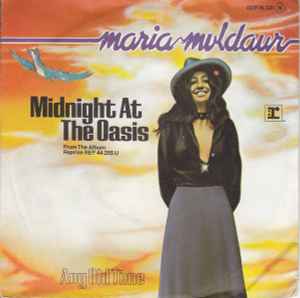
This is the song which plays when Rory looks at the clock at Dwight’s house, while putting the African violets back. It’s a woven basketwork clock that a china figurine pops out of when the hour strikes.
“Midnight at the Oasis” is a 1973 song written by David Nichtern. It was recorded by Maria Muldaur for her self-titled debut album, and released as a single in 1974. It peaked at #6 in the US, and was the #13 song of the year, becoming one of Muldaur’s most popular concert songs.
“Midnight at the Oasis” is about an offer of a love affair in a fantasy desert location, and is considered to be one of the most sensual songs of the 1970s, apparently inspiring numerous sexual encounters. It seems as if Dwight has more than just board games in mind now he’s moved to Stars Hollow! Perhaps he’s even set his sights on Lorelai – the gossipy Babette would have told him Lorelai was single.
The clock reads eight o’clock at this point, providing the name of the episode, “Eight O’clock at the Oasis”. I can’t see how it can be 8 am – Rory is meant to be at school in five minutes! And although they were running slightly late, Lorelai still thought they could have breakfast at Luke’s, as long as she drove Rory to school. Why do the Gilmore girls seem to have all the time in the world sometimes, and at others, time just suddenly disappears? They weren’t at Dwight’s for that long.
LORELAI: He sounds very cool, and not just ’cause he owns his own jet.
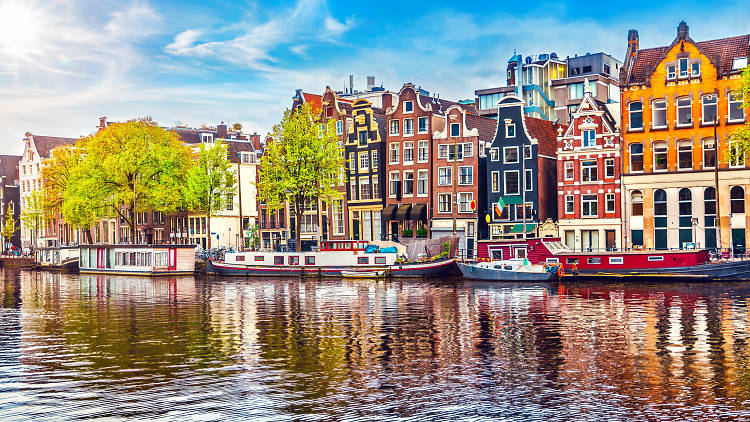
RORY: Well, remember to tell him that the way to get to you is through your daughter, who desperately wants to go to Amsterdam.
Amsterdam, the capital of the Netherlands, famous for its canals, earning it the moniker, “Venice of the North”. Although it has numerous attractions, including the Van Gogh Museum and the Royal Palace, my hunch is that Rory probably most wants to see the Anne Frank House, a museum dedicated to the celebrated Jewish wartime diarist Annelies “Anne” Frank (1929-1945), who hid from the Nazis in an Amsterdam attic for two years, before being arrested with her family and taken to a concentration camp, where she died a few months later.
Not only is Anne Frank’s story tragic and compelling in itself, her dream of becoming a writer was fulfilled when her edited diary was published posthumously in 1947 – in English in 1952, as The Diary of a Young Girl. Rory nearly always seems to be drawn to places which have some literary connection, and I’m guessing that in the case of Amsterdam, it would be the chance to visit the place where lived another bright teenage girl who was a talented writer. In A Year in the Life, Rory becomes a writer herself.
This is now the third city that Rory has said she wants to visit. In Season 1, it was Fez, in Season 2 it was Prague, and now in Season 3, it is Amsterdam.
LORELAI: Well, first, he asked me to the David Bowie concert next week.
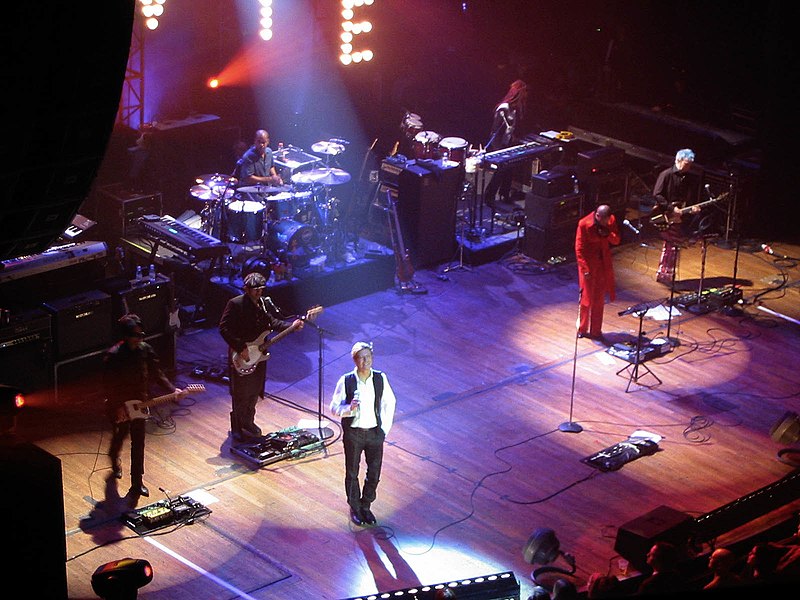
David Bowie’s 2002 concert tour was the Heathen tour, promoting his latest album Heathen, which came out in June that year. It opened in New York City on June 11, before going back and forth through Europe and the US.
By October 11, Bowie was back in New York, with the final concert in the city being Sunday October 20 at the Beacon Theatre on Broadway [pictured]. That is the last possible date Lorelai and Peyton could have gone to his concert – and if that was the week after their first date, it suggests that this scene takes place around the second week of October.
There is no way that this tallies with the timeline within the show, way too much has happened for it only to be early October, so it’s probably best to think of it as a fictional concert date. On the rare occasions when real world events are mentioned as impinging on the action, they rarely match up exactly with the dates within the show. But I think it is safe to say it is now late October, so they only seem to be running about two weeks behind the real world.
LORELAI: [on phone] You just flew back on your jet, huh? . . . From Maui?
Maui is the second largest island of the state of Hawaii, famous for its beautiful beaches, and a very popular tourist destination.
While Lorelai actually says “Maui”, the audio doesn’t seem to quite match up. Apparently, she originally said “Bali”, an island in Indonesia which is also a popular tourist destination. “Eight O’clock at the Oasis” aired on October 22 2002 – just ten days after a bomb attack in Bali which killed 202 people and left 209 injured, on October 12 2002. Because of that, Bali was re-recorded as Maui.
A piña colada is a cocktail made with rum, pineapple juice, and coconut milk or cream, served either blended or shaken with ice. It may be garnished with a pineapple wedge, a maraschino cherry, or both. The cocktail originated in Puerto Rico, is its national drink, and its name means “strained pineapple” in Spanish. One story is that the cocktail was invented by Puerto Rican pirate, Roberto Confresi in the 19th century; the less exciting but more probable version is that it was invented in 1954 at the Caribe Hilton Hotel in Puerto Rico by bartender Ramón “Monchito” Marrero.
Lorelai refers to “Escape (The Piña Colada Song)”, written and recorded by British-American singer Rupert Holmes, released as a single from his 1979 album Partners in Crime. The song is about a man who is bored with his current relationship, and answers a lonely hearts advertisement in the newspaper which begins, “If you like piña coladas …”. When he meets up with the lady, it turns out to be his partner, who was equally bored in their relationship. They realise they had more in common than they realised, and their relationship is now reinvigorated. It was an international hit, and went to #1 in the US and Canada. Ironically, Rupert Holmes has never drunk a piña colada, and the original lyrics were, “If you like Humphrey Bogart”.
Lorelai gets the words slightly wrong. The lyrics are actually:
LORELAI: Well, we are not two wild and crazy guys.
Lorelai is referencing a series of sketches on comedy television show, Saturday Night Live. They feature the Festrunk Brothers, Yortuk (played by Dan Akroyd) and Georg (played by Steve Martin), who have emigrated to the US from Czechoslovakia. Culturally inept, they went to a variety of social venues (bars, dance clubs, art galleries) in an attempt to meet American women – who were invariably put off by their clumsy behaviour. Their catchphrase was, “We are two wild and crazy guys!”. The sketch debuted in 1977, and the last one was in 2013.
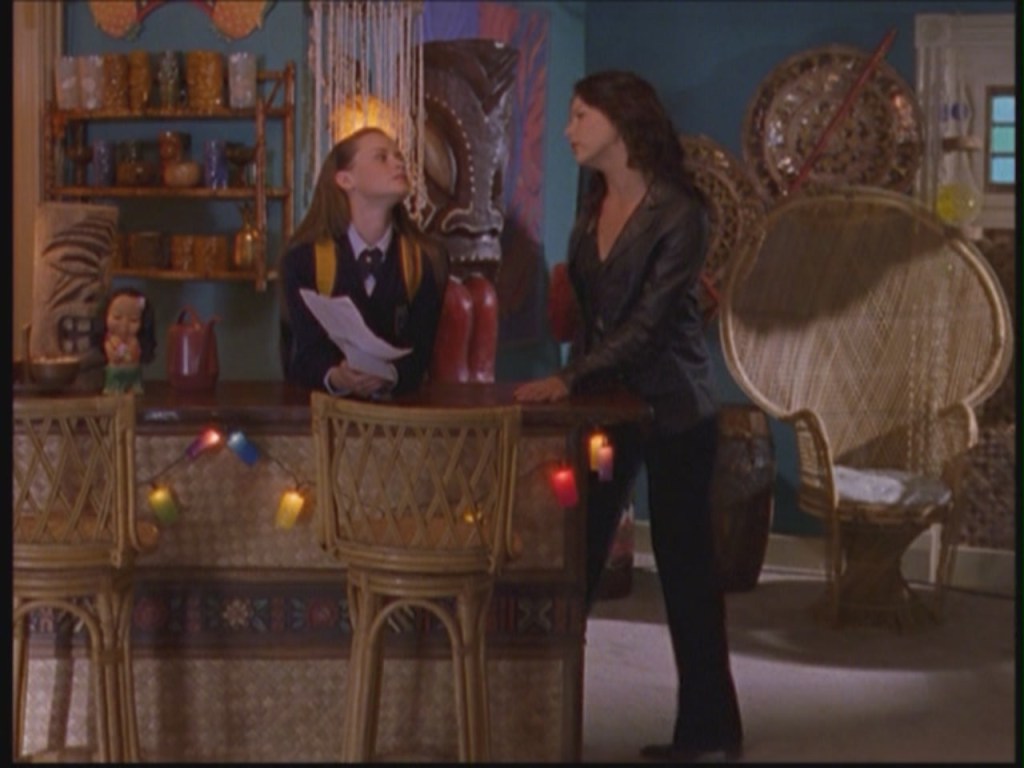
Once inside Dwight’s home, which Lorelai has done her best to turn into a place of imagined horrors, the Gilmore girls naturally love it at once. It has the same kitschy taste that they like, and I think they appreciate that Dwight has decorated the house completely for his own comfort and amusement, a design aesthetic that is in harmony with Lorelai and Rory’s own.
Dwight’s home bar is a tiki bar – that is, a bar inspired by tiki culture décor. Tiki culture is an American movement inspired by a romanticised view of tropical island cultures, mostly Polynesian, catering to American views of the South Pacific. The name comes from Tiki, the Māori name for the first human, often represented in the form of a pendant and frequently appropriated by Europeans as a commercialised good luck charm.
Although tiki bars are generally of broadly South Pacific influence, they tend to serve cocktails from the Caribbean. Because of its colonial nostalgia, and the simplistic view of the Pacific taken by the aesthetic, Tiki culture has been perceived as controversial, culturally insensitive, or racist.
Tiki culture became fashionable during the 1930s as a Hollywood-style image of a leisurely, exotic island lifestyle. It had an explosion of popularity after World War II, as American servicemen returned from tours of duty in the South Pacific, often with souvenirs. It began to decline in the late 1970s but there was a revival in the late 1990s and early twenty-first century, so Dwight is surprisingly on trend in owning a tiki bar.
RORY: He’s got Monopoly from every country in the world …
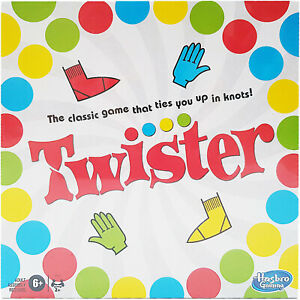
LORELAI: Remember he owns Twister – there’s a great visual awaiting you.
Monopoly, previously discussed. There are numerous international editions, well over a hundred.
Twister, previously mentioned. A game of physical skill played on a large plastic mat which is spread on the floor. The mat has six rows of large coloured circles on it with a different colour in each row: red, yellow, green, and blue. A spinner tells players where they have to place their hand or foot. The game promotes itself as “the game that ties you up in knots”.
It was developed for Milton Bradley, and originally called Pretzel before Milton Bradley changed its name. Twister became a success when actress Eva Gabor played it with Johnny Carson on The Tonight Show in 1966, but was also controversial, as the company was accused of selling “sex in a box” – it was the first well-known game where human bodies are used as the playing pieces. Twister was highly popular in the second half of the twentieth century.
In the film, the deranged murderer kills his own mother, but keeps her in the basement sitting in a rocking chair, treating her as if she were still alive. This seems to be another clue that Lorelai suspects Dwight of murdering Beenie Morrison, or being a serial killer.




 The Annotated Gilmore Girls