RORY: Ooh, we could do a Ruth Gordon film festival. Harold and Maude, Rosemary’s Baby, and that really great episode of Taxi.
Ruth Gordon Jones (1896-1985), actress, screenwriter, and playwright. She was known for her nasal voice and distinctive personality, and became most successful in later life, being chosen for major screen roles in her 70s and 80s, and winning several awards. She seems to be a favourite of Rory.
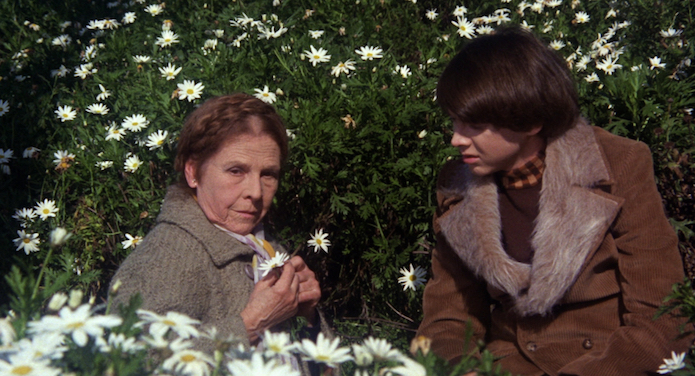
Harold and Maude [pictured], 1971 coming-of-age dark comedy/existentialist drama. Directed by Hal Ashby and written by Colin Higgins, it follows the exploits of Harold (played by Bud Cort), a 19-year-old from a wealthy but emotionally cold family who is obsessed with death. He develops a friendship, later a romance, with 79-year-old Maude (Ruth Gordon), a Holocaust survivor who teaches him about living life to the fullest. It initially received mixed reviews, but became a runaway cult favourite, and is now regarded as one of the best comedies, best romances, and greatest films of all time. Colin Higgins adapted the screenplay into a novel, then a stage play.
Rosemary’s Baby, previously discussed. For this film she won the Academy Award for Best Supporting Actress, as well as a Golden Globe Award and a Kansas City Film Critics Circle Award.
Taxi, award-winning sitcom which aired from 1978 to 1983, focusing on the lives of the employees of the fictional Sunshine Cab Company in Manhattan. Ruth Gordon made a guest appearance in the 1979 episode Sugar Mama, playing a woman who tries to solicit one of the taxi drivers as a male escort. She won an Emmy Award for Outstanding Lead Actress in a Comedy Series.
LORELAI: The three faces of Costner – Bull Durham, Dances with Wolves, The Postman. Tom Petty playing Tom Petty, that great big speech about “Once upon a time there was a thing called mail”. It’ll make you laugh, it’ll make you cry, it’ll make you wanna mail something.
Kevin Costner (born 1955), award-winning actor and filmmaker. The three faces of Costner seem to be the first big success of his career, the greatest success of his career, and what seemed at the time to be the fading of his career with a failed film. In fact, he was to have renewed success with The Open Range in 2003, and received his star on the Hollywood Walk of Fame that same year, so his comeback was just around the corner.
Bull Durham, 1988 romantic comedy sports film. It’s partly based on writer/director Ron Shelton’s experiences in the baseball minor leagues, and depicts the players and fans of the Durham Bulls from Durham, North Carolina. Kevin Costner plays a veteran catcher brought in to teach a rookie pitcher (played by Tim Robbins) about the game in preparation for moving to the major leagues. It was a commercial and critical success, and was named the #1 sports film ever by Sports Illustrated. It’s also considered one of the best comedies. It helped solidify Costner as an A-list celebrity.
Dances with Wolves, 1990 epic western which stars, and was produced and directed by, Kevin Costner, in his directorial debut. It’s based on the 1988 novel of the same name by Michael Blake, and tells the story of a Union Army Lieutenant who travels to the American frontier to find a military post, and his dealings with a group of Lakota (much of the dialogue is in Lakota with English subtitles). It was a box office hit, and the #4 film of the year. It was also favourably reviewed, and won seven Academy Awards, including Best Picture and Best Director. It is credited with revitalising the western genre in film.
The Postman, 1997 post-apocalyptic action adventure film, which was also produced and directed by Kevin Costner, who plays the lead role. It is based on the 1985 novel of the same name by David Brin. Set in a neo-western version of a disestablished US in the near future of 2013, an unspecified apocalyptic event has led to war and plagues, leaving a huge impact on human civilisation and erasing most technology. A nomadic drifter finds an old uniform of a US Postal Services mail carrier, and unwittingly inspires hope, becoming a national hero. It failed at the box office and was heavily criticised in reviews.
Thomas “Tom” Petty (1950-2017), singer, songwriter, and musician. He was the lead vocalist and guitarist for Tom Petty and the Heartbreakers, formed 1976, and was a member of the supergroup The Traveling Wilburys, as well as performing as a solo artist. He sold more than 80 million records worldwide, making him one of the most successful music artists of all time. He was inducted into the Rock and Roll Hall of Fame in 2002.
He seemingly plays himself as the mayor of Bridge City in The Postman, as Kevin Costner’s character immediately recognises him as a famous person. Tom Petty had a post-apocalyptic themed story in his 1982 song I Got Lucky, and mentioned wanting to have a small part in a futuristic postwar movie. He finally got the chance in this film. [Picture shows Petty as the mayor].
LORELAI: How about a triple feature? Three Days of the Condor, Shoah, and The Jerk? RORY: Uh, Shoah’s like nine and a half hours. LORELAI: But The Jerk is short.
Lorelai chooses three well-regarded films that are completely different from each other in subject and tone, in contrast to triple features in real life, which are usually connected in some way.
Three Days of the Condor, 1975 political thriller directed by Sydney Pollack, based on the 1974 novel Six Days of the Condor by James Grady. Robert Redford plays a bookish CIA analyst working covertly at a historical society who has to outwit those responsible for massacring his colleagues while he was at lunch. It was well reviewed and won several awards. It was made into a television series, 2018-2020.
Shoah, 1985 French documentary about the Holocaust (known as “Shoah” in Hebrew), directed by Claude Lanzmann. Over nine hours long and 11 years in the making, the film presents Lanzmann’s interviews with survivors, witnesses and perpetrators during visits to German Holocaust sites across Poland, including extermination camps. Hailed as a masterpiece, it won several prominent awards. It was released on video in 2000.
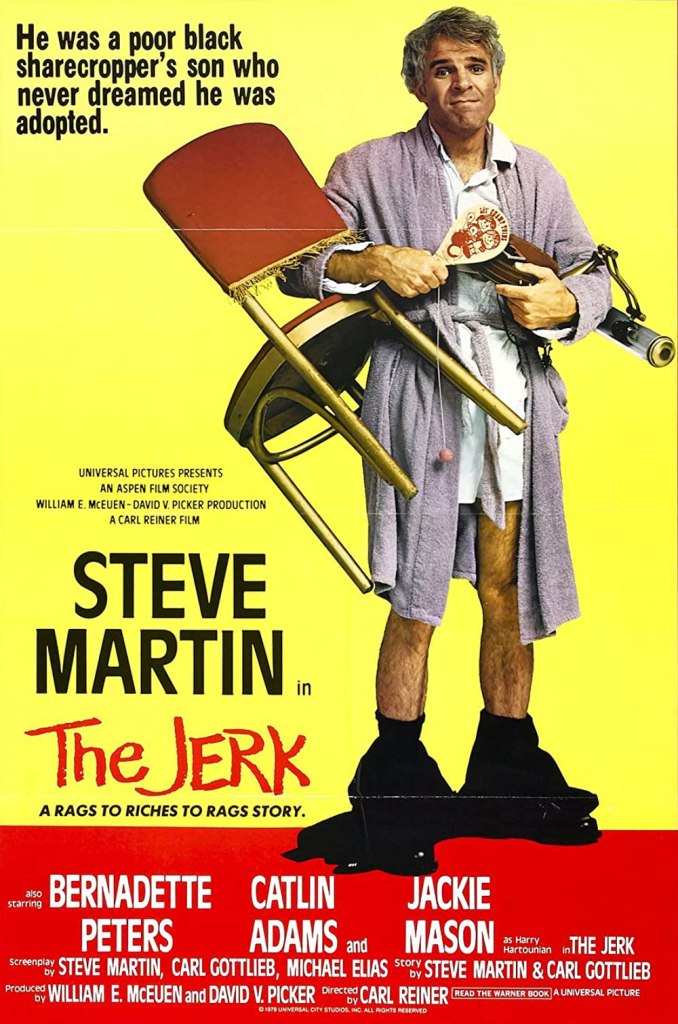
The Jerk, 1979 comedy directed by Carl Reiner, and starring Steve Martin in his debut screen role (he also co-wrote the screenplay). It’s a ludicrous, picaresque tale of rags to riches to rags to riches, with Martin playing a naïve white man who is the adopted son of black sharecroppers, standing out for his skin colour and lack of rhythm. It was a box office smash, becoming the #8 film of the year, was praised by critics, and is considered one of the funniest films of all time. It has a running time of 95 minutes.
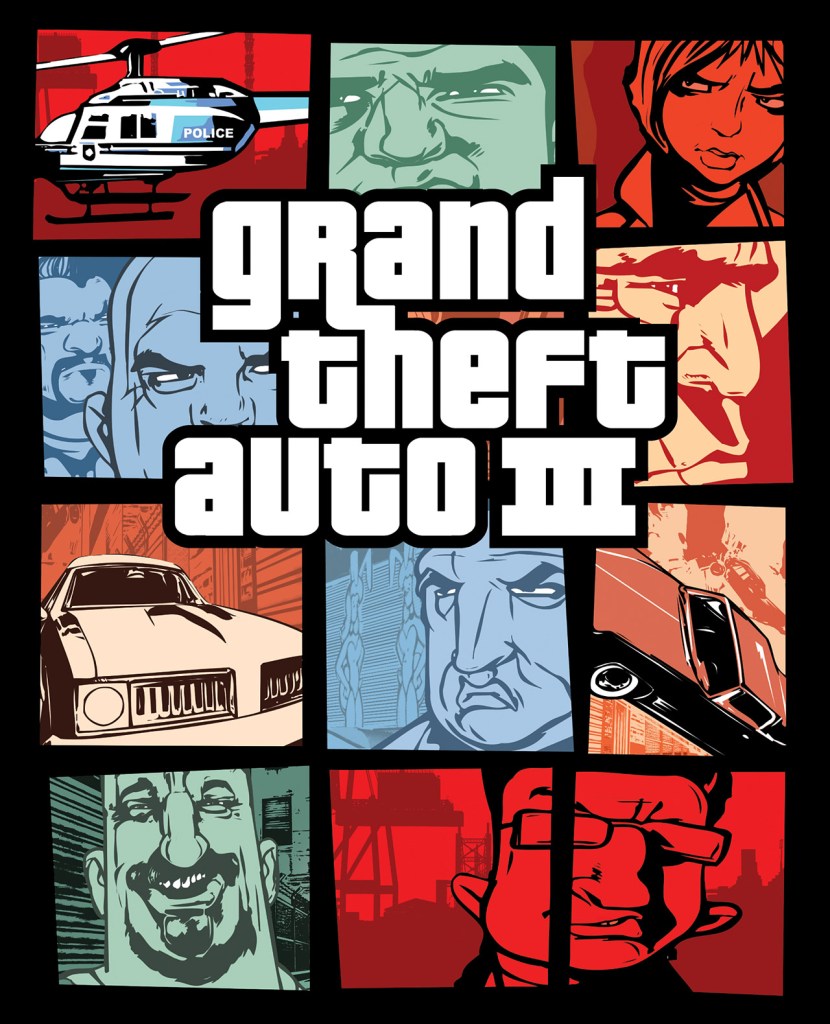
A poster for this video game is displayed in the window of Stars Hollow Video – the store obviously hires out games as well as movies.
Grand Theft Auto III is a 2001 action-adventure game developed by Rockstar. Set in fictional Liberty City (loosely based on New York City), it follows the adventures of Claude, who becomes embroiled in a world of crime, drugs, gangs, and corruption. The game received critical acclaim, was the best-selling game of 2001, was named Game of the Year, and is considered to be one of the greatest video games ever. It was also controversial for its depiction of sex and violence.
It’s possible that this is a foreshadowing of Rory’s own Grand Theft Yacht, but more likely a comment on freedom of speech.
RICHARD: Interesting. I just realised you have three cups of coffee in the morning … EMILY: Well, so what? RICHARD: Nothing. Just an observation, that’s all. That’s a lot of coffee to drink early in the morning.
It seems that Lorelai and Emily have something else in common – they both need their coffee to get through the day. This feels like a callback to the beginning of the Pilot, where Luke asks Lorelai how many coffees she’s had. It’s first thing in the morning, but she’s already had five, and is ordering her sixth.
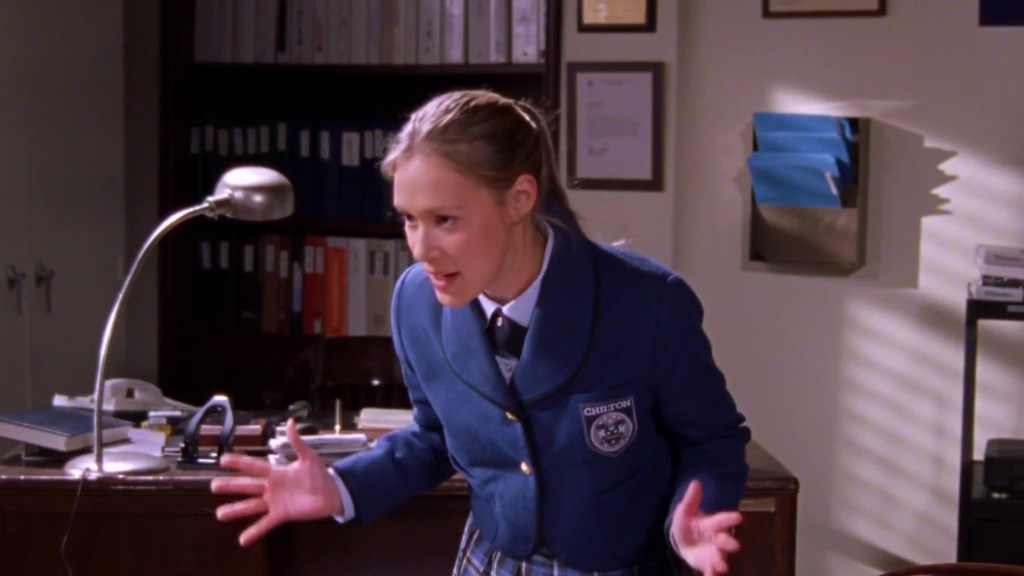
PARIS: Flescher Prep Gazette, Broadmouth Banner, Richmond Heights Chronicle – these publications are not our competition … The New York Times, the Wall Street Journal, the Washington Post – these publications are our competition.
The high school magazines Paris mentions are fictional, while the competition she identifies are major news publications, all previously discussed.
PARIS: The Oppenheimer Award for Excellence in school journalism is not a contest. It’s a statement. It says you’re the best. The best writers, the best reporters, the best editors. It says that you have crushed all others who have dared to take you on. It says that every other single school in the United States of America is feeling nothing but shame and defeat and pain because of the people who won the Oppenheimer plaque. I wanna be those people, I wanna cause that pain.
The Oppenheimer Award for Excellence seems to have been named in honour of Jess Oppenheimer (1913-1988) [pictured], the creator, producer, and head writer of the sitcomI Love Lucy, starring Lucille Ball. Lucille Ball called him “the brains” behind Lucy, and he was the creative driving force of the show. (Jess may also be named after Oppenheimer!).
In real life, there are the National Pacemaker Awards in student journalism, which has a category for high school newspapers. They are administered by the National Scholastic Press Association. Founded in 1927, they are the student equivalent of the Pulitzer Prizes, and for that category the deadline is in June. There is no plaque handed out as a prize.
We never discover whether The Franklin won the award, but it is never mentioned again, suggesting that it didn’t.
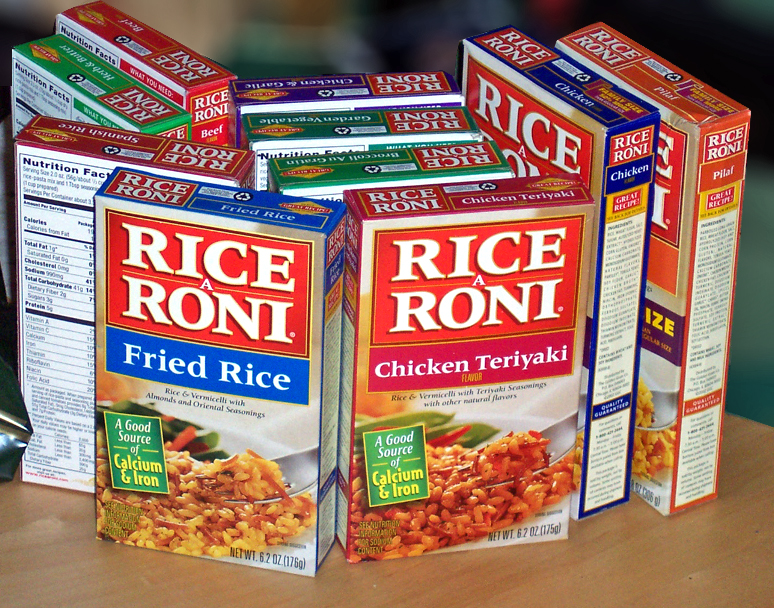
LOUISE: It’s just a contest, Paris. It’s not like you get a car or a lifetime supply of Rice a Roni. MADELINE: God, I love that stuff.
A boxed food mix containing rice, vermicelli pasta, and seasonings. It’s prepared by browning it in butter, then adding water and simmering until cooked, so you end up with something a bit like pilaf. It’s made by Quaker Oats, a subsidiary of PepsiCo.
It was invented by Vince DeDomenico in 1958, inspired by a home recipe of his sister-in-law Lois, who had received it from an Armenian immigrant friend named Pailadzo Captanian. Originally called The San Francisco Treat, and later Pasta Roni, it was bought by Quaker Oats in 1986.
LORELAI: Okay, I give. What is this? EMILY: Sweetbreads. LORELAI: Sweetbreads. So that’s uh . . . EMILY: Pancreas.
Lorelai breaks her own rule never to ask what something unfamiliar yet tasty is, in case the answer puts her off eating it again. Earlier she told Rory that she enjoyed eating snails, until she discovered what they were. Presumably this is another time that a delicious meal is ruined for her.
In cooking, sweetbread is the name for the thymus or pancreas, usually from a calf or lamb (lamb is considered superior). Pancreas sweetbreads can also come from beef or pork. They are often prepared by soaking in salt water, then poaching in milk to remove the outer membrane. Once dried and chilled, they can then be breaded and fried. A squeeze of lemon over them is a classic way to serve, and they match well with mushrooms and truffles, as well as legumes like beans and peas. They are considered to be a delicacy, and the origin of the name is not entirely clear.





 The Annotated Gilmore Girls