EMILY: Just because your own experience sitting for a portrait was bad doesn’t mean Rory’s has to be.
RORY: What portrait? I haven’t seen this.
Rory actually has seen a portrait of Lorelai – there’s one with her as a young girl with her parents in the living room. Emily is talking about a different portrait, of Lorelai when she was a teenager that never got completed, but it’s surprising that Rory doesn’t think she’s talking about the living room portrait. Young Lorelai actually doesn’t look too impressed in this one, either.
EMILY: So do I. We really ought to do something. RORY: Yes, I agree. LORELAI: Warning, warning. EMILY: I’m glad to hear you say that Rory, because I thought of a wonderful way to cheer him up. RORY: Cool, what? LORELAI: Danger, Will Robinson, danger!
Lorelai is referencing the science-fiction television series Lost in Space (1965-1968). Inspired by the 1812 novel The Swiss Family Robinson, it followed the adventures of the Robinson family, pioneering space colonists, struggling to survive in the depths of space.
Will Robinson (played by Bill Mumy) was the youngest member of the family, a precocious nine-year-old who was a whizz with electronics and computers. He was accompanied by a robot (played by Bob May, voiced by Dick Tufeld), who was tasked with protecting Will. His catchphrases to alert Will when faced with potential hazards were, “Warning, warning”, and “Danger, Will Robinson, danger”.
The series received reasonable ratings and its catchphrases became part of popular culture, although never given much respect as a work of science-fiction. It was adapted into a film in 2004, and rebooted as a television series on Netflix (2018-2021).
RORY: Too bad Grandpa’s not here. He likes weird food. LORELAI: Yeah, where’s he eating his weird food tonight? Argentina? Morocco? EMILY: Akron … The amenities are atrociously lacking. He had to eat at a coffee shop last night. The whole thing’s terribly insulting. He’s miserable.
Akron is a city in Ohio, with a population of nearly 200 000, although the Greater Akron area is around 700 000. It has a long history of rubber and tyre manufacturing, earning it the name Rubber Capital of the World. Today it has an economy based on manufacturing, education, healthcare, and biomedical research, with many polymer companies. Racially diverse, it has been the site of several key scenes in African-American race relations, including being the place where Marcus Garvey founded the Universal Negro Improvement Society in 1914. Like many manufacturing centres, it suffers from the effects of air and soil pollution.
It is one of many cities which claims to have invented the hamburger, which might be one reason why Gilmore Girls doesn’t rate it as a place for fine dining. They do seem to be lacking silver service restaurants, although with a selection of delicious-looking steakhouses and grills. I feel as if Richard should have been able to find something decent to eat there, but this is the man who ate chocolate pudding with an expression like it was rat poison. Maybe his hotel wasn’t situated near any good food options.
It is one of the few times that Richard needed to travel for work within his home country. Richard seems to travel overseas an inordinate amount for someone who’s an executive at an insurance firm – is that much European travel really necessary in insurance? (Especially when a problem at their office in China was sorted out with a phone call from Richard). I wonder if being sent to Akron is another symptom of Richard being “phased out” of his job.
LORELAI: Very tasty. New cook? EMILY: Yes, Marisella. She’s introduced us to some wonderful dishes so charmingly specific to her native country. LORELAI: What country is she from? EMILY: One of those little ones next to Mexico.
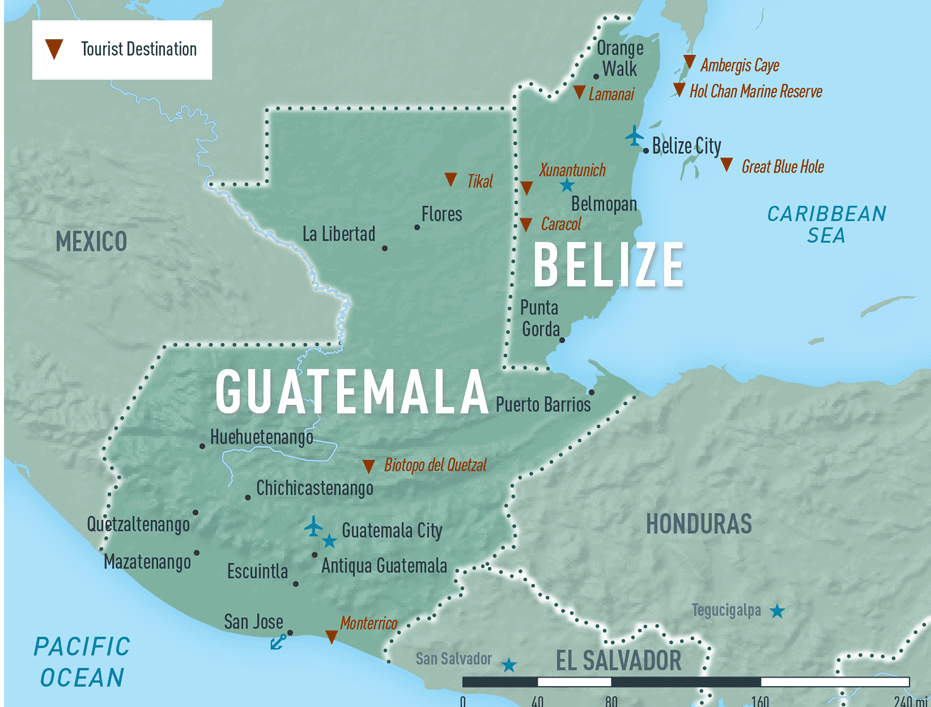
There are two countries which border Mexico to the south – Belize and Guatemala. Belize is the smaller of the two, although I’m not sure if that means it’s more likely as Marisella’s place of origin.
The cuisine of Belize and Guatemala is broadly similar to other countries in Latin America and the Caribbean, but often with their own twist. Dishes specific to Guatemala include pepian (a spicy chicken stew), and relleintos (mashed deep fried plantains mixed with chocolate and sprinkled with sugar). Dishes specific to Belize include chimole (a chunky chicken and potato soup), and fry jacks (soft puffy tortillas filled with beans, cheese, or meat). Garnaches are popular in both countries (fried corn tortillas topped with refried beans, cabbage, and cheese).
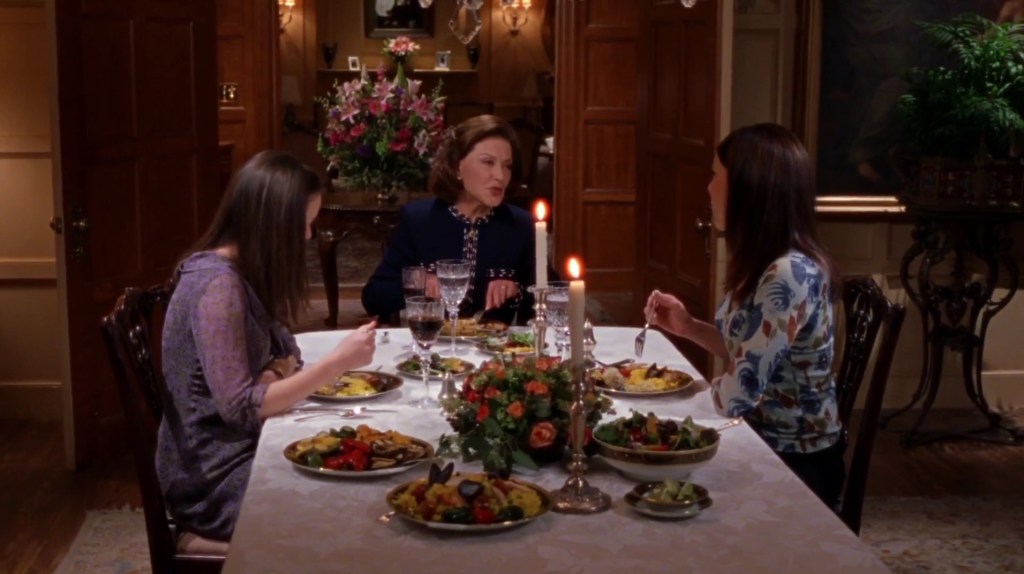
The Gilmores look as if they are eating a selection of grilled vegetables with tortillas (?), yellow rice, and beans, with salad and slices of lime. The food is served on communal dishes, and everyone helps themselves on their individual plate. It looks fairly typical of Central American meals.
This is the song which Rory is listening to her on her Walkman, which takes us out to the end of the episode.
It’s the second track from the 1998 album What Makes It Go?, from Swedish indie pop group Komeda. The album received good reviews, and is now regarded as their best album. The lyrics of the song reassure Rory that everything is alright, even in a “crazy world”. The madness has ended now, and she can return to her normal life.
Komeda was influenced by The Velvet Underground, one of Lane’s favourite bands, and was chosen to support Beck, one of Lane’s favourite musical artists. I don’t think it’s a stretch to imagine Lane recommended this album to Rory, and it might even be borrowed from her.
The episode ends with Rory back in the dining hall at Chilton, peacefully reading and listening to her Walkman. She hasn’t been made to socialise after all, and the headmaster has been forced to back down and realise that Gilmore girls have to follow their own rules.
Another girl asks if she can sit with Rory, and she takes her own book out and starts reading in silence. Rory smiles at this confirmation she is not the only person at Chilton who likes to read at lunchtime, and now she isn’t a weird loner any more. She has a lunch friend, just as Mrs Verdinas insisted she find.
According to the credits, this girl is named Lisa. She’s played by Connecticut actress Madeline Zima, who already had quite a lengthy CV at this stage, and was most famous for playing Grace Sheffield in The Nanny.
Lisa was one of the other girls who was going to be inducted by the Puffs at the same time as Rory and Paris, although she is never introduced to the viewer and never speaks to Rory that we see (they might have spoken off-screen). She is the girl wearing blue and yellow checked pyjama pants with a grey tee shirt and a blue cardigan.
Possibly Lisa was also told to find some friends, rather than sit and read at lunchtime – although if so, couldn’t Headmaster Charleston or Mrs Verdinas have simply introduced Rory and Lisa to each other, suggesting that they have something in common? You know, like a normal school? Lisa was never shown eating lunch with the Puffs, so presumably she was recruited some other way, or that occurred after Rory and Paris joined the table, and was therefore offscreen.
Do not expect to ever see Lisa again, or hear her mentioned. Did she and Rory ever speak to each other and become real friends? Did they show each other the books they were reading? Did they have anything else in common? These questions are never answered.
In an episode that doesn’t make a hell of a lot of sense, it finishes with a character that remains an enigma.
EDIT: This article was heavily edited with the kind assistance of Sarah M, who was able to identify Lisa as one of the girls at the Puffs induction ceremony, something I was unable to do.
LUKE: I was giving her directions for the quickest way back to Hartford. It was very romantic. I said you take a right at Deerfield, and you catch the I-5 and you take it south. Oh man, hot stuff. LORELAI: That is so typical of you. LUKE: What? LORELAI: That is not the quickest way back to Hartford. Everybody knows that you take Main to Cherry to Lynwood and then grab the I-11. Everybody knows that Luke. Everybody, apparently, but you!
Neither of these directions are realistic. The I-5 is the main interstate highway on the west coast of the US, running along the Pacific coast between Mexico and Canada. Luke also says that you travel south to Hartford from Stars Hollow, even though everything in the show suggests that you would travel north-east to reach Hartford from the town. The I-11 is a highway in Nevada, running from the Arizona state line to the city of Henderson.
At least you learn a few street names in Stars Hollow. Main (presumably the main street of town they show all the time), Deerfield, Cherry, and Lynwood.
Worried about the interest Ava showed in Luke at the fashion show, Lorelai tells Luke the next day that she’d prefer he didn’t date Ava, because it would interfere with their friendship, and any possible relationship she might have with Ava via the Booster Club. It’s an almost exact swap for the time Luke advised Lorelai not to date Ian Jack, the Chilton dad she met on the first day she took Rory to school, both taking place over the diner counter. (Ava and Ian even have the same number of letters!).
Luke, quite rightly, tells Lorelai to butt out, because he can date whoever he likes. He then explains that he wasn’t arranging a date with Ava anyway, just giving her directions back to Hartford.
Although both wind up indignant at the other, they must also feel relieved. Lorelai that Luke wasn’t interested in Ava after all, and Luke having been given confirmation that Lorelai does have some feelings for him.
LORELAI: Who do you think you are, the Hunchback of Notre Dame? Are you French, are you circular? I don’t think so.
Lorelai teases Rory for her lame initiation ceremony by comparing her to that other famous bell-ringer, Quasimodo, the Hunchback of Notre Dame, previously discussed.
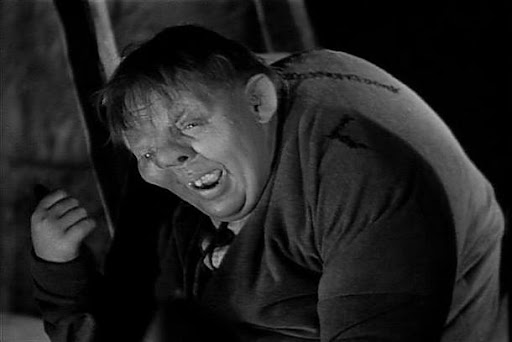
The fact that Lorelai describes the hunchback as “circular” is a possible indication she might be thinking of the 1939 film, starring Charles Laughton as Quasimodo [pictured]. This version gives Quasimodo a very pronounced hump on his back, so that in some scenes he does look almost circular, while later versions tone it down quite a bit.





 The Annotated Gilmore Girls