This is the book that Rory is reading at lunchtime in the cafeteria.
It is the diary of Virginia Woolf, edited by the art scholar Anne Olivier Bell, married to Woolf’s nephew, Quentin Bell. It is in five volumes, with the first volume published in 1977, and the last in 1984 (the year Rory was born). Rory is reading the fourth volume (covering 1931-1935), suggesting she has already read the first three, and has almost finished the entire set. Virginia Woolf has been established as one of Rory’s favourite authors. It has also been shown again and again that Rory (and Lorelai) have a great interest in diaries and biography.
[Rory sits alone in the cafeteria. A paper airplane that says “Leper” lands on her table. She tosses it aside and puts on her headphones.]
Once again, Rory is left to have lunch by herself, listening to music, because of her fight with Paris. Although she tells Lorelai that she doesn’t mind eating by herself, she goes to bed extremely early, because she says that having nobody to talk to all day is “tiring”. I think that Rory really means is that it is “depressing”, and she ends this episode feeling lonely and unhappy.
Notice that the Blood Drive is taking place in the cafeteria behind her – the one which Rory tried to have held elsewhere to get back at Francie. Just another little slap in the face for her, as she has truly given “’til it hurts”.
To kill two birds with one stone is an idiom meaning to solve two problems with a single action. The phrase dates to the 1600s, and probably references using a slingshot to kill two birds at once.
LORELAI: Do you want me to talk to her? You know, arrange a sit-down? … Come on. We’ll have it in an Italian restaurant. You’ll get up, go to the bathroom – thanks – and come out shooting, and then I’ll send you to Italy.
RORY: Well, I do wanna go to Italy.
A reference to a famous scene in The Godfather,previously discussed. After Michael Corleone takes out a corrupt chief of police at the restaurant, his family send him to Sicily for his protection.
Later on, Rory does get to fulfil her dream of going to Italy, travelling there with Lorelai, and then again with Emily.
RORY: I can’t believe I was her best friend. I feel awful. LORELAI: Look, I’ll tell you what. If you wanna make things right, just go back to school tomorrow and let her stab you.
It’s Friday Night Dinner, so why would Rory and Paris go to school the next day, Saturday?
Rory is surprised to discover that Paris considered her her best friend, which seems somewhat oblivious, considering that Paris already told Rory several times that she feels able to ask Rory for help in a way that she can’t with Louise and Madeline. Paris has made it fairly clear that she considers Rory her equal, and relies on her – Rory fulfils a role in her life that nobody else can.
I think Rory is meant to come across as sweet and humble here, but she actually seems too self-absorbed to understand how important she is to Paris.
RORY: I was trying to help you. PARIS: You were? You mean, in between betraying me and selling me out, you were trying to help me? Gee, you are quite the Renaissance woman, aren’t you?
Embodying a basic tenet of Renaissance humanism that humans are limitless in their capacity for development, the concept led to the notion that people should embrace all knowledge and develop their capacities as fully as possible. This is expressed in the term Renaissance man, often applied to the gifted people of that age who sought to develop their abilities in all areas of accomplishment: intellectual, artistic, social, physical, and spiritual.
Rory is therefore a Renaissance woman.
The thing that Paris finds most unforgiveable is that Rory told Francie about Jamie, but in fact Francie had already noticed for herself that Paris had a boyfriend and brought it up with Rory (no matter how implausibly Paris is wandering around her school with her college-aged boyfriend! Anything to keep Rory innocent).
PARIS: Aha, you admit it. RORY: Yes, but it wasn’t what you think. PARIS: Brutus!
Marcus Junius Brutus (c 85BC-42BC), often referred to simply as Brutus, was a Roman politician, orator, and the most famous of the assassins of Julius Caesar. Brutus had been a close friend of Julius Caesar before opposing him, and eventually taking a leading role in his assassination, in 44 BC. Brutus eventually committed suicide rather than face trial for murder.
His name has been condemned for betrayal of his friend and benefactor Caesar. He also has been praised in various narratives, both ancient and modern, as a virtuous and committed republican who fought – however futilely – for freedom and against tyranny.
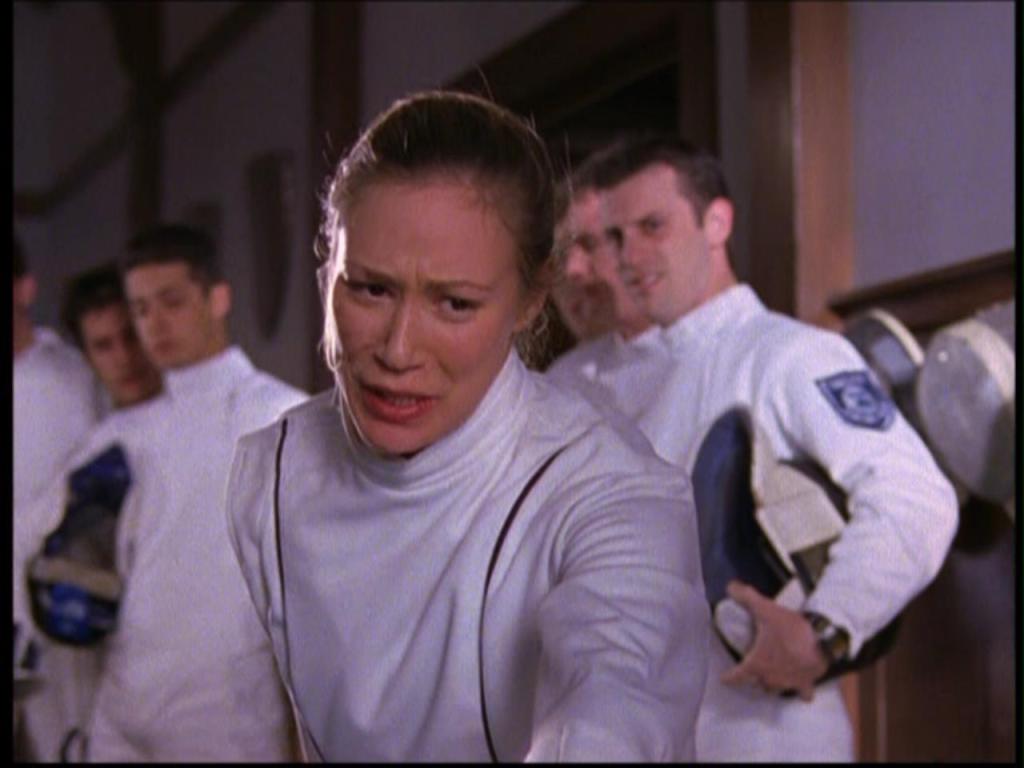
PARIS: We’re fencing Rory, not playing patty cake.
Patty cake or Pat-a-cake, a clapping game which accompanies the nursery rhyme, “Pat-a-cake, Pat-a-cake, Bakers Man”. It alternates between a normal individual clap by one person with two-handed claps with the other person. The hands may be crossed as well. This allows for a possibly complex sequence of clapping that must be coordinated between the two.
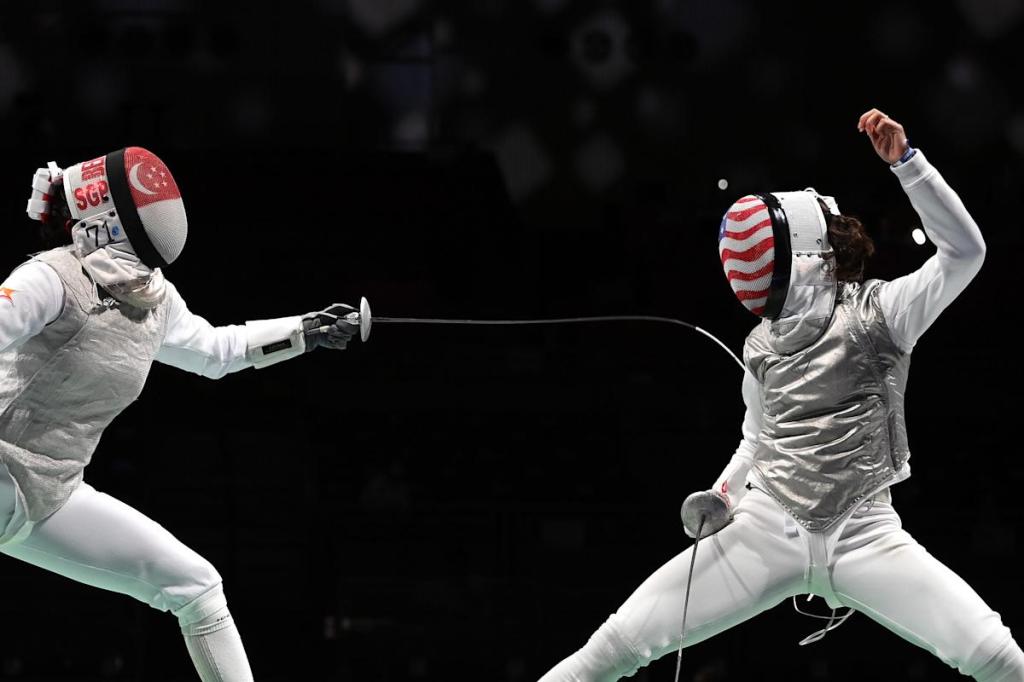
Beginning salute: A blade action performed before a bout or lesson. Indicates respect and good sportsmanship.
En garde: Spoken at outset to alert fencers to take defensive positions. Full commencing phrase is En garde! Prêts? Allez! (‘On guard! Ready? Go!’ For two female fencers, prêts becomes prêtes.)
Advance: The ‘advance’ is the basic forward movement. The front foot moves first, beginning by lifting the toes. The leg is straightened at the knee, pushing the heel out in front. Land on the heel, and then bring the back foot up to en garde stance.
Retreat: The basic backwards movement. Rear foot reaches backwards and is firmly planted, then front leg pushes body weight backwards smoothly into en garde stance.
Lunge: The most basic and common attacking movement in modern fencing. From en garde, push the front heel out by extending the front leg from the knee. Do not bend the front ankle, or lift up on the ball of the front foot. This means that the front foot must move forward prior to the body weight shifting forward. As the front leg extends, energetically push erect body forward with the rear leg. Rear arm extends during forward motion as a counterbalance. Land on the front heel and glide down into final position, with front shin perpendicular to the ground, and both heels on the floor. During this action, the torso should remain relatively erect, and not be thrown forward. Often, the back foot can be pulled along behind during an energetic lunge. It is important, and a fundamental characteristic of the lunge, to fully extend the back leg, obtaining full power from this spring-like extension.
Parry: A simple defensive action designed to deflect an attack, performed with the forte of the blade. A parry is usually only wide enough to allow the attacker’s blade to just miss; any additional motion is wasteful. A well-executed parry should take the foible of the attacker’s blade with the forte and/or guard of the defender’s. This provides the greatest control over the opponent’s blade.
Quarte: Parry #4; blade up and to the inside, wrist supinated. The point is higher than the hand.
Sixte: Parry #6; blade up and to the outside, wrist supinated. The point is higher than the hand.
Riposte: An attack made immediately after a parry of the opponent’s attack.
Counter-riposte: A second, third, or further riposte in a fencing encounter. A counter-riposte is the offensive action following the parry of any riposte.
MADELINE: Oh my God, there’s a hair in mine. LOUISE: Just close your eyes and think of England, honey.
Close your eyes and think of England is a phrase which references unwanted sexual intercourse, specifically advice to an unwilling wife to accept the sexual advances of her husband, as a wifely duty.
The saying is said to come from the 1912 diary of Alice, Lady Hillingdon [pictured], who wrote:
I am happy now that [my husband] Charles calls on my bedchamber less frequently than of old. As it is, I now endure but two calls a week and when I hear his steps outside my door I lie down on my bed, close my eyes, open my legs and think of England.
The diary is not available to the public, so this explanation has to remain speculative. It is often thought of as summing up Victorian attitudes to marital sexuality and sex education for girls, although it the saying itself actually seems to date to the twentieth century.