“Tiny fellow on that M*A*S*H* program”

RICHARD: Hm, maybe we should start a tab with them so we don’t have to pay cash everyday.

LORELAI: Already done.

RICHARD: Amazing. You’re like the tiny fellow on that M*A*S*H* program, always anticipating.

M*A*S*H* (an acronym for Mobile Army Surgical Hospital), a war comedy-drama television series set during the Korean War in the early 1950s which aired from 1972 to 1983. It was adapted from the 1970 film of the same name, which in turn was based on the novel MASH: The Story of Three Doctors by Richard Hooker, based on the author’s own experiences as a doctor in a field hospital in Korea.

Richard refers to the character Corporal Walter “Radar” O’Reilly on the TV sitcom M*A*S*H*, portrayed by Gary Burghoff. He seems to have extra-sensory perception, appearing at his commander’s side, with whatever paperwork is required, before being called, and finishing his sentences before the officer is anywhere near the end of them. Young and naïve, Radar tends to look up to his superiors as father figures, something Richard would probably like from Lorelai.

Although M*A*S*H* took a while to find its feet, by its second season it was one of the top 10 programs of the year, and stayed in the top 20 for the rest of its run. Becoming an allegory for the Vietnam War, it is considered one of the greatest TV shows of all time, and is still broadcast in syndication.
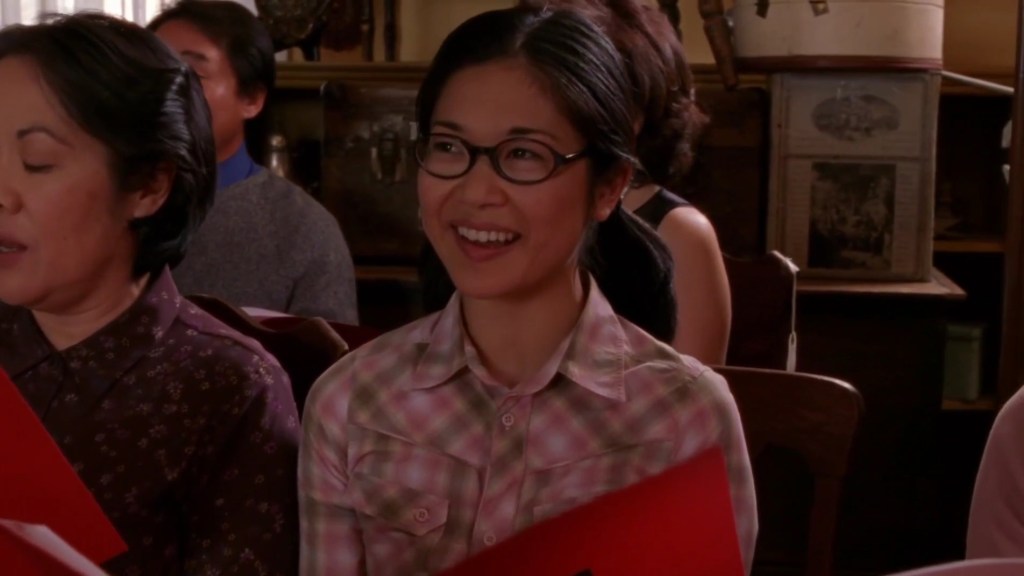
What a Friend We Have in Jesus

The hymn they are singing at the Kim house when Lane arrives.

What a Friend We Have in Jesus is a Christian hymn written by Irish-Canadian poet Joseph M. Scriven, a preacher in the Plymouth Brethren movement. He wrote it in 1855 to comfort his mother back in Ireland after hearing she was terribly ill, and only received credit for it in the 1880s. The tune was composed by American attorney Charles Crozat Converse.

Although sometimes criticised for its sentimentality, the hymn remains popular. It has been recorded many times, including by Bing Crosby, Ella Fitzgerald, Aretha Franklin, Tina Turner, Glen Campbell, and Amy Grant. The song features in the film, Driving Miss Daisy, previously discussed.

Lane looks absolutely flushed with happiness as she joins in with the hymn-singing, thrilled with finding her calling in life. It’s a reminder too that Lane has always grown up around music – just not rock music. It feels as if Mrs Kim has unknowingly been bolstering Lane’s passion all this time!

In “Kiss and Tell”, Lane mentioned that it was Sing Your Favourite Hymn Night at the Kim house on the day that Dean first kissed Rory, again linking hymn night with first love. That seemed to be a Thursday evening, suggesting it is Thursday now, and a week after the car accident that Jess and Rory had. (Of course, the Kims could have changed their hymn night in the interim). It’s clearly not night time, but “hymn night” actually seems to be held in the late afternoon (or early evening in the winter months, as it gets dark earlier then).

Lane’s Drummer Heroes

RORY: And even if you do buy a drum set, where are you gonna play it?

LANE: I don’t know, I don’t know any of this. But I will figure something out, because I am Keith Moon, I am Neil Peart, I am Rick Allen, with and without the arm, because I am rock ‘n’ roll, baby!

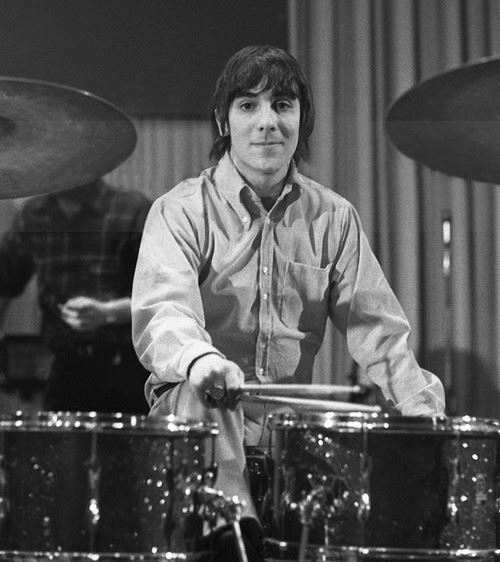
Keith Moon (1946-1978) [pictured], English drummer for rock band The Who. He was noted for his unique style of playing and his eccentric, often self-destructive behaviour, and addiction to drugs and alcohol. His drumming style emphasised tom-tom drums, cymbal crashes and drum fills, and was one of the earliest rock drummers to use double bass drums. He had a reputation for smashing his drum kit on stage. He was posthumously inducted into the Modern Drummer Hall of Fame in 1982, and is regarded as one of the greatest drummers in history. Keith Moon used a DW drum kit with Zildjian cymbals.

Neil Peart (1952-2020) Canadian musician, songwriter, and author, best known as the drummer and lyricist for the rock band Rush. His drumming was renowned for its technical proficiency and his live performances for their exacting nature and stamina. Initially inspired by rock drummers like Keith Moon, Peart became influenced by jazz and swing bands. He was inducted into the Modern Drummers Hall of Fame in 1983, making him the youngest person to receive this honour. He used a DW drum kit.

Richard “Rick” Allen (born 1963), English drummer for the hard rock band Def Leppard since 1978. In 1984 his left arm was amputated after a car accident but decided to continue drumming, although he didn’t perform live again until 1986. He uses Zildjian cymbals.

Lane had already talked about becoming a drummer, but I think we are meant to assume that this dream has solidified for her – not I’d like to be a drummer, but I am a drummer. It does seem slightly odd that her drummer idols are now from classic rock bands, when previously she looked up to drummers in punk and alternative rock bands. The writer seems to have chosen drummers who used the same equipment Sophie has for sale in her store.

Rory gives Lane very little encouragement in her drumming dreams, although the questions she asks Lane are quite reasonable. It’s disappointing though that she tells Jess he can do anything he wants, and to reach for the stars, while Lane gets cold water poured on her ideas. Either she only encourages boys that she’s attracted to (Dean also got a lot of unwanted encouragement to improve himself), or she only encourages academic goals, not creative ones. Happily, Lane’s mood is not dampened one little bit by Rory’s reality check.

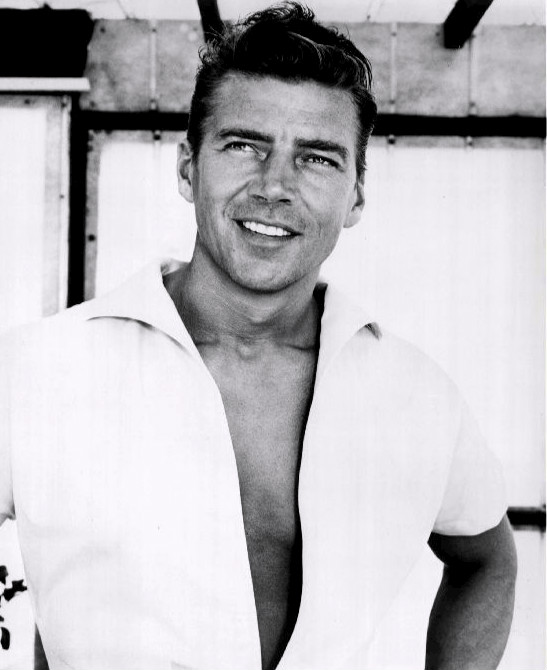
Mickey Hargitay

BABETTE: I met this guy once – gorgeous, tan, looked just like Mickey Hargitay. We had coffee, he gave me a pamphlet. Next thing you know, I’m wearing a muumuu, playing a tambourine, jumping up and down at the airport.

Miklós “Mickey” Hargitay (1926-2006), Hungarian-born bodybuilder, actor and the 1955 Mr Universe. He was married to actress Jayne Mansfield from 1958-1964, and they made four films together, including Will Success Spoil Rock Hunter? (1957). He is the father of actress Mariska Hargitay.

Babette sometimes alludes to the terrible experiences she had with men before fortunately meeting Morey, which she has no compunction about sharing with Rory. The previous season, she told Rory about the time she got pushed out of a car, and this season she tells Rory about how she was lured into a cult! For such a bright and bubbly character, she has a very dark past.

I think the cult that Babette is describing are the Hare Krishnas, who tended to recruit new members at airports in the 1970s, and often used tambourine music and dancing to attract interest. They didn’t actually wear muumuus, but Babette might have thought their orange robes looked like muumuus.

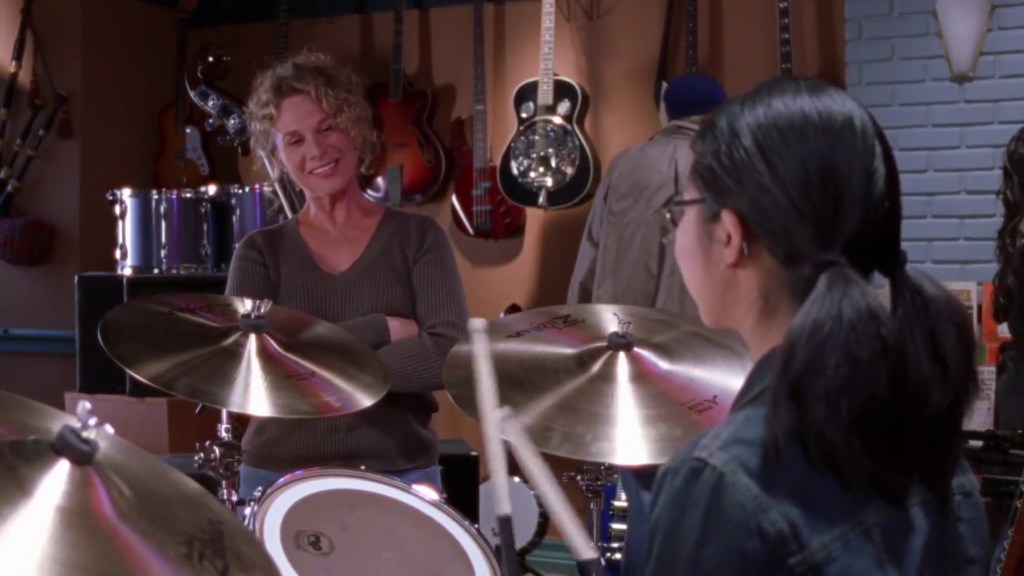
Heavy Metal Drummer

This 2001 song by alternative rock band Wilco plays through the scene when Lane is in the music store. Written by Jeff Tweedy and Jay Bennett, It’s a track from their most recent album from this episode’s perspective, Yankee Hotel Foxtrot. The album was acclaimed by critics, and voted among the best albums of the year, going #13 in the US.

The lyrics talk about a girl falling in love with the drummer in a heavy metal band, but Lane subverts that by falling in love with the idea of being a drummer in a band. These scenes where Lane tries out the drums and phones Rory to tell her about them are played like a girl who’s fallen in love at first sight.

Sophie Bloom (Carole King)

Sophie Bloom is the owner of the new music store that opens in Stars Hollow, Sophie’s Music. The role is played by Carole King, who sings the show’s theme song, “Where You Lead (I Will Follow)”. She is a rather grouchy woman, even quite rude, which seems pretty typical for Stars Hollow customer service!

It does raise some interesting questions – Sophie must know of Carole King and her music, doesn’t she wonder why she and Carole King look and sound exactly the same? Or is it possible that Sophie Bloom is an identity that Carole King has taken on so that she can secretly live and work in Stars Hollow?

Dawn Powell

LANE: Dawn Powell? I’ve never heard of her.

RORY: Nobody has, which is a shame because she wrote sixteen amazing novels, nine plays, and there are some who actually claim that it was Powell who made the jokes that Dorothy Parker got credit for.

Dawn Powell, previously discussed. Rory has already read her Selected Letters, and now is reading Novels 1930-42. Published in 2001 and edited by Tim Page, the five novels included in the single volume are Dance Night, Come Back to Sorrento, Turn Magic Wheel, Angels on Toast, and A Time To Be Born.

Powell’s novels are either witty, cynical bohemian works set in New York City, or earnestly sincere stories set in small town Ohio. This has led critics to wonder which was the “real Dawn Powell”, but I can understand Rory both longing for the sweet small town life, while aspiring to the intellectual rigours and fashionable life of the city. Like Powell, she is equal parts cynicism and sincerity, and like Powell, she was a precocious child and avid reader. No wonder Powell is her literary heroine.

It was critic Diana Trilling who reportedly said that Dawn Powell was the “answer to the old question ‘Who really makes the jokes that Dorothy Parker gets credit for?'”.

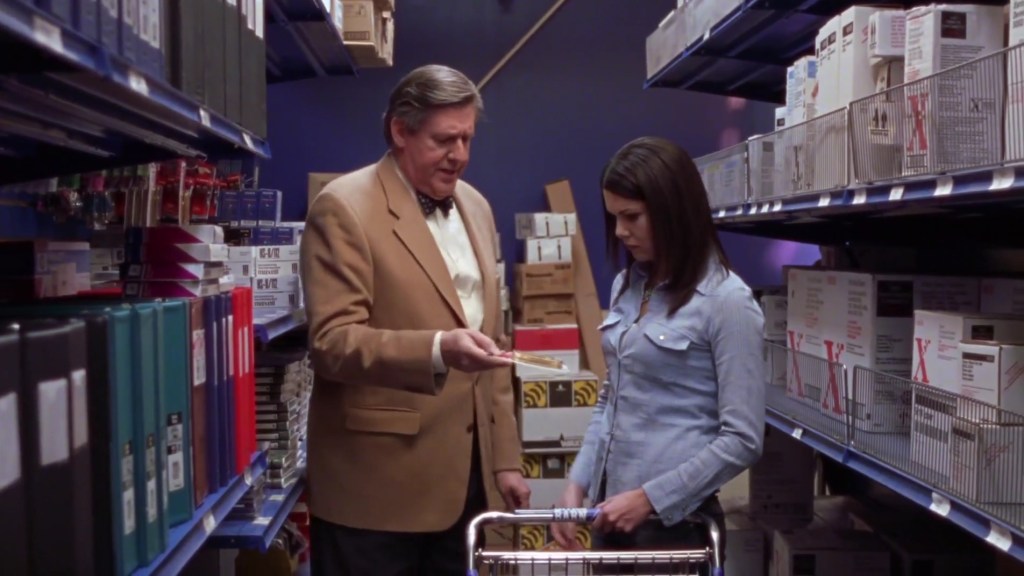
Richard’s Office Supplies Shopping

Paper clips

Coffee maker (Lorelai rejects a German-made one because in her mind, Germans are all Nazis!)

Pens

Liquid paper

Paper

Stapler and staples

Post-It notes (Richard buys a pack for Emily, who uses them to remind her of upcoming events)

Hole punch

Richard has been in business for over thirty years, but he has no idea what office supplies to buy, or even how to go shopping for essential items. That was a task that women always did for him – his mother, his wife, his secretary, his maid, and now, his daughter is helping him. At least this time Richard is along for the ride so he can see the process in action.

(The fictional business where they buy the office supplies is called Office Barn.)

Rory’s Letter to Dean

DEAN: What happened? What’d you do to your arm?

RORY: [hands him an envelope] Here.

DEAN: What is this?

RORY: Just read it.

Rory waits for Dean to come home from Chicago that evening, sitting on the porch, in a mirror image of when Dean waited fruitlessly for Rory to come home from Friday Night Dinner. When his dad brings Dean home, presumably from the airport, Rory hands him a letter where she has written down what happened to the car.

It’s a quick way to avoid lots of superfluous dialogue, but it makes Rory look a little cowardly that she couldn’t talk to Dean directly. Are we meant to think that she was too scared to talk to Dean, or that she didn’t feel confident Dean would listen to her all the way through?

Dean does read the letter all the way through, while yelling and kicking a duffle bag, which seems a bit threatening. However, once he is assured that Jess has really and truly left town, he just asks Rory to join he and his family for dinner. Later they watch TV with Dean’s sister, Clara.

It seems odd that Dean doesn’t have any other questions or comments about the accident or about the car – he seems to think the only thing wrong with his relationship with Rory was Jess, and now he’s gone, they can get back to normal.

Rory didn’t seem to have met Dean’s family in the first six months or so of them dating, but she is obviously very familiar with them now.

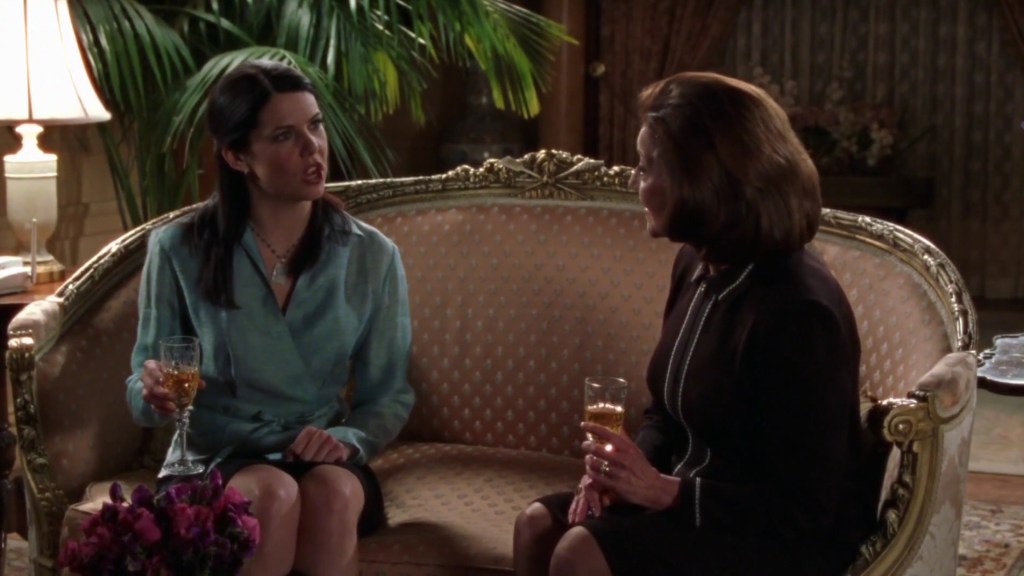
Largie Margie

EMILY: You know very well who Margie is. She’s been your father’s secretary since you were a child.

LORELAI: Oh, Largie Margie . . . very clever when you’re six.

Daniel Palladino didn’t even write this episode, and Lorelai is once again a horrible child. Her joke is moronic even for a six year old. Emily calls Margie a “rotund ingrate”, so you don’t need to look far to see where Lorelai got her attitude from.