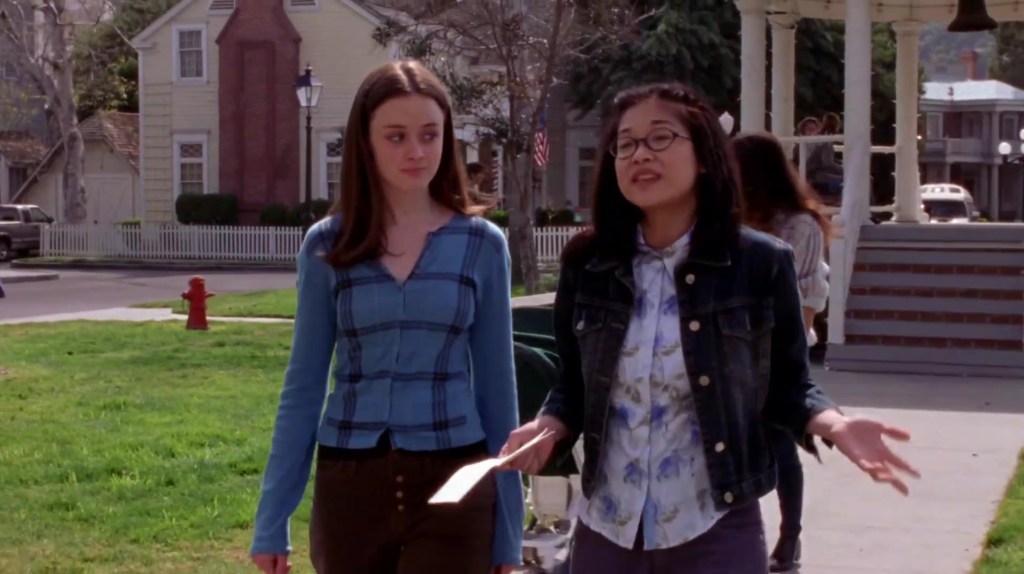
LANE: Lane Kim, you have shown a genuine aptitude for sales.
Lane is dismayed to be told, for the fourth time in a row, that her aptitude test says she has an aptitude for working in retail, like her parents. She is unhappy with the news, but in A Year in the Life, Lane is working in a store, so the test knew where her skills lay.
LORELAI: No, but I would’ve felt guilty about not feeling guilty and you can see how that could just go on forever.
RORY: Miss Gilmore and the vicious circle.
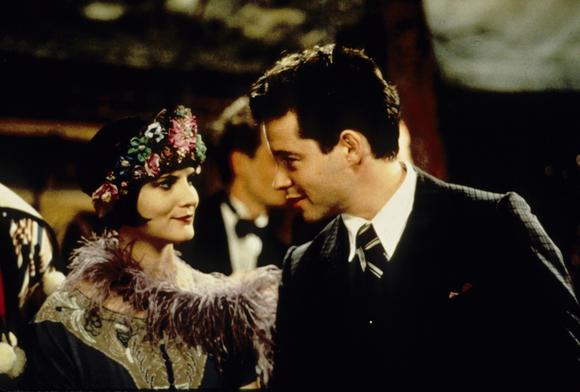
A reference to the 1994 biographical drama film, Mrs. Parker and the Vicious Circle, directed by Alan Rudolph. It stars Jennifer Jason Leigh as the writer and critic Dorothy Parker, and depicts the members of the Algonquin Round Table, otherwise known as the Vicious Circle. The film was a critical success, but not a commercial one.
As a huge Dorothy Parker fan, of course Rory would have watched this film. Matthew Broderick is also in the cast, who is apparently one of Rory’s favourites (or at least was when she was younger).
Candide is a 1759 satirical picaresque novella by the French philosopher Voltaire. It is about a young man named Candide, living a sheltered life in an Eden-like paradise, taught to live a life of optimism by his mentor, Professor Pangloss, who teaches that we live in “the best of all possible worlds”. This life abruptly ceases, and the story details the slow disillusionment of the simple Candide as he witnesses and experienced terrible hardships. By the end, if he has not exactly rejected optimism, he has cautiously adopted a more pragmatic approach to life.
Sharply witty, insightful, fantastical, bitter, and matter-of-fact, Candide parodies the adventure and romance genres, as well as the coming-of-age novel. It is considered Voltaire’s greatest work, and has been often mimicked and parodied. Considered part of the Western canon, it is often taught in high schools and colleges.
You can see Rory as a parallel to Candide – raised in the sheltered Eden-like paradise of Stars Hollow, with the vivacious Lorelai raising her to believe she can do anything with enough self-belief, hard work, and Gilmore ability to argue that the usual rules don’t apply to her. Will Rory become increasingly disillusioned with the difficulties of the outside world once she leaves Stars Hollow?
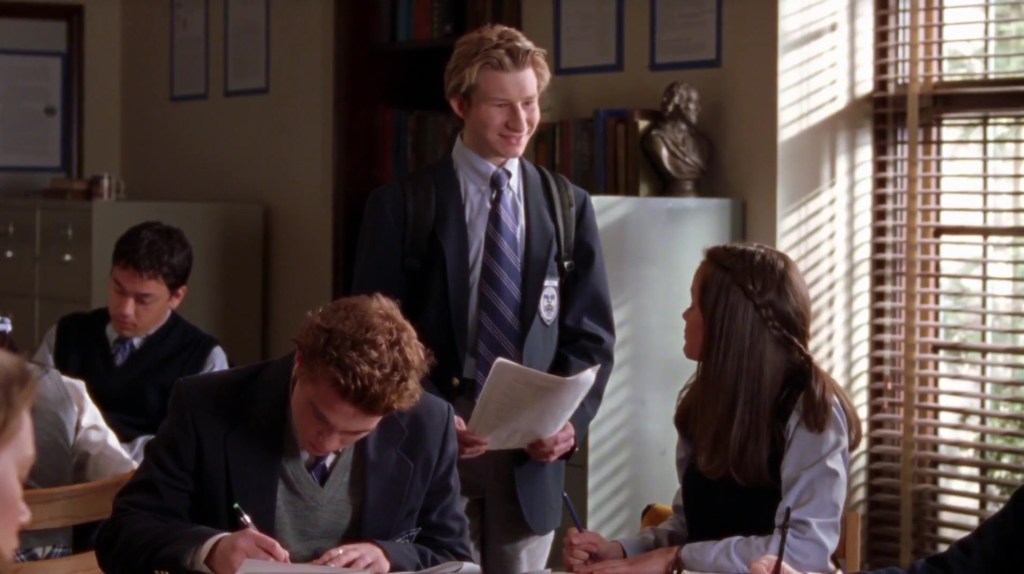
BRAD: Oh, yeah. My psychiatrist convinced my parents that I should face my fears instead of running away from them and my rabbi agreed, so here I am.
Brad is now back at Chilton, after transferring to Hillside Academy five months ago, due to being bullied by Paris. He told Rory that Hillside Academy was much more relaxed than Chilton, and he’d made tons of friends there.
If that’s true, what kind of sick psychiatrist would tell a teenager they should return to a stressful school environment where they were bullied, rather than one where they supposedly have friends, and are thriving enough to be on the debate team? And what kind of rabbi would back that decision up? And what kind of parents would agree to it, rather than sacking the psychiatrist at once and moving to another synagogue? Poor Brad. I don’t think Paris is his only problem in life.
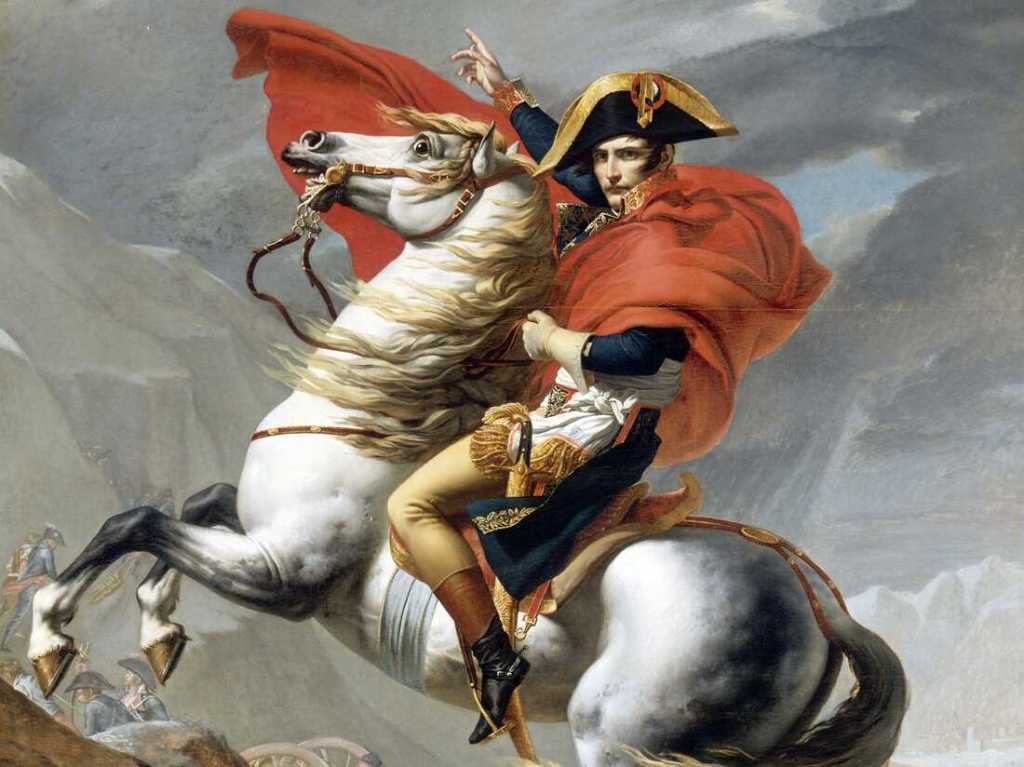
LOUISE: Just that Rory’s the leader of this group, Napoleon, and you’re not.
Napoleon Bonaparte, born Napoleone di Buonaparte (1769-1821), French military and political leader who rose to prominence during the French Revolution, becoming Emperor of France in the early 19th century. He was one of the greatest military commanders in history, and his wars and campaigns are studied in military schools worldwide.
After Napoleon was forced to abdicate in 1814 he was exiled to the island of Elba, between Corsica and Italy. Louise is saying that now that Rory is leader of their group, Paris is like a great leader forced into the political wilderness.
In fact, Napoleon didn’t waste his time on Elba, improving the island with his usual energy and vision. He escaped from it nine months later and briefly took control of France again before being defeated at Waterloo. Like Napoleon, Paris is unlikely to languish in the background for too long.
[Picture shows Napoleon Crossing the Alps by Jacques-Louis David (1800)]
PARIS: It’s not the Bhagavad Gita, Madeline. It’s simple instructions for the business fair.
The Shrimad Bhagavad Gita, literally meaning “the song by God” in Sanskrit, often referred to as Bhagavad Gita, or just the Gita. It’s a 700-verse Hindu scripture that is part of the epic The Mahābhārata, dated to the first millennium BC.
It is the best known of the holy scriptures of Hinduism, presenting a synthesis of Hindu philosophy and yogic ideals. It was a personal inspiration to Mahatma Ghandi, and has been often read, studied, and appreciated by westerners and non-Hindus. Many Christians, Muslims, Buddhists, and atheists have read the Bhagavad Gita for spiritual advice and life lessons.
Madeline’s comment suggests that she isn’t stupid – just slow, thorough, and careful in how she absorbs information.
RORY: Yeah, that’s why we’ve all been kind of quiet for the past ten minutes.
LOUISE: I thought it was, like, prayer time or something.
Louise was originally the brighter of the two out of she and Madeline, and quite a good student. She seems to have been getting steadily dimmer, until she now doesn’t seem to understand that she’s meant to read educational materials when they’re handed to her. Chilton isn’t a religious school, so why she thought they’d be opening with a ten-minute private prayer session, I don’t know. Maybe she’s playing dumb so successfully it’s actually turned her brain.
Phoning dozens of times per day and arriving on the doorstep unannounced is no longer enough to satisfy Dean’s stalker instincts – now he’s following Rory to the diner before school starts and hanging around until Lorelai invites him to breakfast. Because all cool moms like to decide for their daughter who she eats with, right?
RORY: No, he didn’t vandalize it. He wrote in the margins, thoughts and stuff.
LORELAI: Like what, like play basketball, eat a sandwich – stuff like that?
RORY: No, stuff, like margin stuff. People like Mark Twain wrote in margins.
LORELAI: Pilot a steamboat, write Huckleberry Finn?
Mark Twain, author of The Adventures of Huckleberry Finn, often mentioned. As a young man, Mark Twain trained to be a pilot on a steamboat on the Mississippi River. His pen name comes from the cry “mark twain”, meaning that the river is twelve foot deep, a safe depth for a steamboat to travel in.
Mark Twain is famed for the barbed comments he wrote in the margins of books he read – his own books, I might add. Saratoga in 1901 by Landon D. Melville seems to have drawn his ire; Twain re-named it Saratoga in 1891, or The Droolings of an Idiot, and wrote in the margin that the author was “little-minded”.
Rory’s comment may suggest that Jess’ scribblings in the margins ofHowl were likewise of a sarcastic nature.




 The Annotated Gilmore Girls