TAYLOR: Thirty-five going once, thirty-five going twice . . . sold to Kirk for thirty-five dollars. KIRK: Yes, finally! You know, if it hadn’t have been for me I could’ve had it for twenty-five.
After Andrew withdraws from the bidding, Kirk wins Sookie’s basket, spending ten dollars more because he bid against himself. It seems as if Kirk didn’t really want either the food or Sookie, but simply the joy of winning something.
Sookie is naturally devastated, because Jackson didn’t talk about how he felt, but sulked and took petty revenge against her in public.
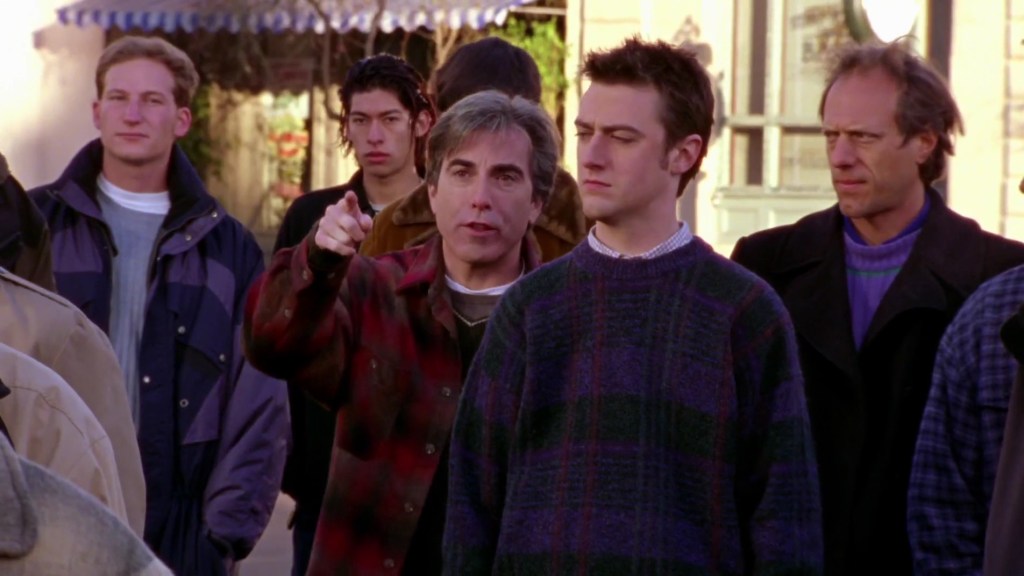
Jackson is piqued because Sookie hasn’t picked up on his hints he wants to move in with her, and petulantly refuses to bid on her basket. With nobody else making a move, Andrew from Stars Hollow Books puts in a bid for it. At this point, Andrew appears to be single, but it’s unclear whether he wants the delicious basket, or Sookie herself. He certainly doesn’t seem worried about upsetting Jackson.
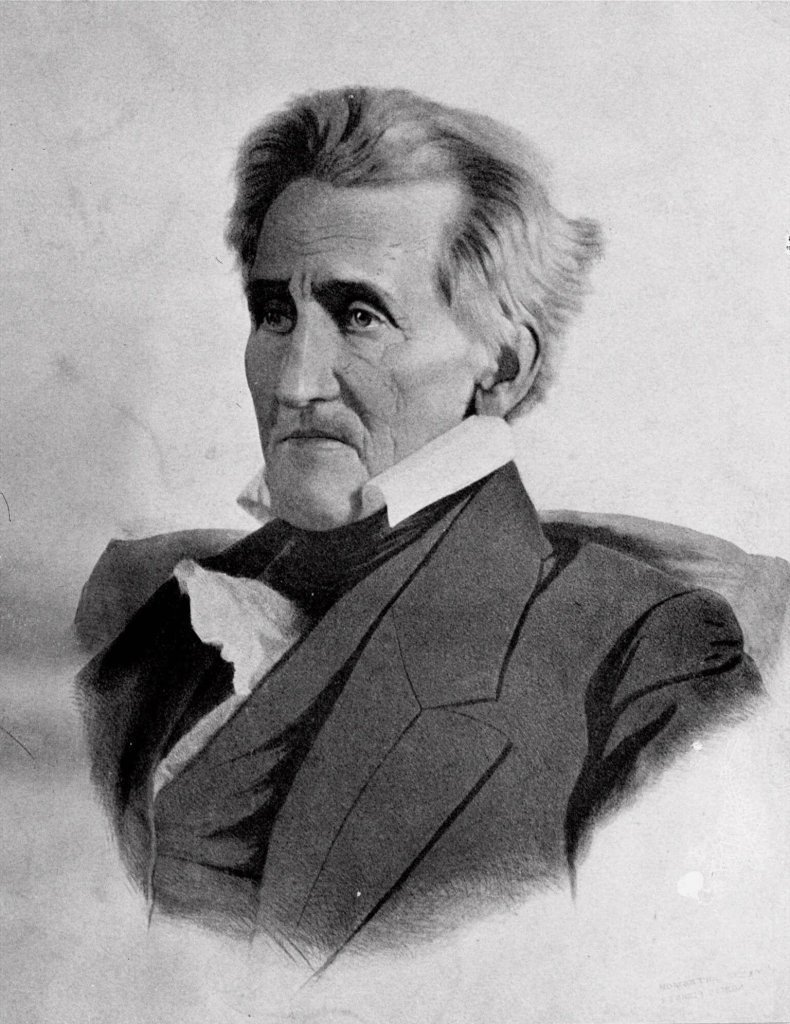
The point where Andrew and Jackson’s names are said together is almost certainly a joking reference to Andrew Jackson (1767-1845), lawyer, soldier, and statesmen who served as the 7th President of the United States, from 1829 to 1837.
RORY: It’s tradition. DEAN: I don’t believe this. RORY: It’s true. My mother and I have been doing this every year since we moved here.
We now know that Lorelai has been taking part in the Bid-a-Basket Fundraiser since 1987, even though she was a maid at the inn at the time, and had only been in Stars Hollow for a few months. It seems she became heavily involved in the town almost immediately.
Rory says she has also been taking part since she arrived in town too, but she was only a toddler. Perhaps she means that she accompanied Lorelai on her picnic lunch dates, as a sort of chaperone to make sure things could never get too romantic, and because Lorelai either didn’t want to leave her with a babysitter, or had no babysitting options.
It’s unclear at what age Rory was deemed old enough to take part in the fundraiser with her own basket, but most likely not until she was sixteen and had a boyfriend to buy her basket. That would be since the previous year, 2001. So Rory’s grand “tradition” has probably been going for a whole twelve months.
It’s also “tradition” for the woman to bake a delicious picnic lunch, but Lorelai and Rory don’t bother sticking to that tradition. There’s so many places that Dean could poke holes in Rory’s narrative or call her out, but he never does.
DEAN: She’s not going with you. JESS: Really, is that true? DEAN: Yes, it’s true. JESS: Excuse me Edgar Bergen, I think I’d like Charlie McCarthy to answer now.
Edgar Bergen, born Edgar Berggren (1903-1978), actor, comedian, vaudeville star, and radio performer. He was best known as a highly skilled and successful ventriloquist, working with a dummy called Charlie McCarthy. Their routines were very witty, and rather cheeky, with Charlie getting away with saying things that a person never could. Incidentally, Edgar was the father of actress Candice Bergen.
Jess is obviously saying that Dean is speaking for Rory, as if she is his puppet.
DEAN: You think this is funny. JESS: Well, it’s no Lenny Bruce routine but it has its moments.
Lenny Bruce, born Leonard Schneider (1925-1966), stand-up comedian, social critic, and satirist. He was known for his open, freestyle, and critical comedy, containing satire, politics, religion, sex, and vulgarity. His 1964 conviction in an obscenity trial was followed by a posthumous pardon, the first in New York state.
Lenny Bruce paved the way for counterculture era comedians, and his trial was a landmark for freedom of speech. He is considered one of the greatest American comedians of all time.
It makes perfect sense for bad boy Jess to be a Lenny Bruce fan. Lenny Bruce also appears as a character in Amy Sherman-Palladino’s television show, The Marvelous Mrs Maisel, played by Luke Kirby.
Dean puts a $5 bid on Rory’s basket, even though Taylor set the bidding at $3. He is expecting that to be the end of the matter, but is shocked when Jess begins bidding against him. Eventually Jess gets Rory’s basket for $90 – Dean, who has only come prepared with a small amount of money, expecting to win the bid straight away, cannot compete.
Rory’s is actually the most expensive basket we see at the auction, even though it’s tiny with only a few leftovers in it. Even Taylor tries to dissuade the boys from bidding so much, despite the fact the money is being raised for charity.
This interaction is an homage to the box social auction scene from the 1955 musical film, Oklahoma!, based on the 1943 stage musical by Rodgers and Hammerstein, which was based on the 1931 play Green Grow the Lilacs by Lynn Riggs.
The film focuses on the love triangle between virginal farm girl Laurey (Shirley Jones), charming cowboy Curly (Gordon MacRae), and unchivalrous farm hand Jud (Rod Steiger). Laurey goes to the box social with Jud to teach Curly a lesson, and the two men end up in a bidding war for Laurey’s picnic hamper at the auction. It seems as if Jud has won, but then Curly sells everything he has in order to raise enough money to get the winning bid.
The clean cut Dean and outsider Jess are clear analogies to Curly and Jud, but unlike the film, Dean has no way of instantly raising the money to get the highest bid. It does suggest that Rory accepts the lunch date with Jess because she’s fed up with Dean, as Laurey accepts Jud’s invitation because she’s tired of the way she’s being match-made with Curly. It also hints at Jess’ obsession with Rory, as Jud becomes obsessed with Laurey.
However, in the film, Laurey and Curly end up married, and Jud is killed in a fight with Curly. Perhaps this is meant reflect a bit of wishful thinking from Dean!
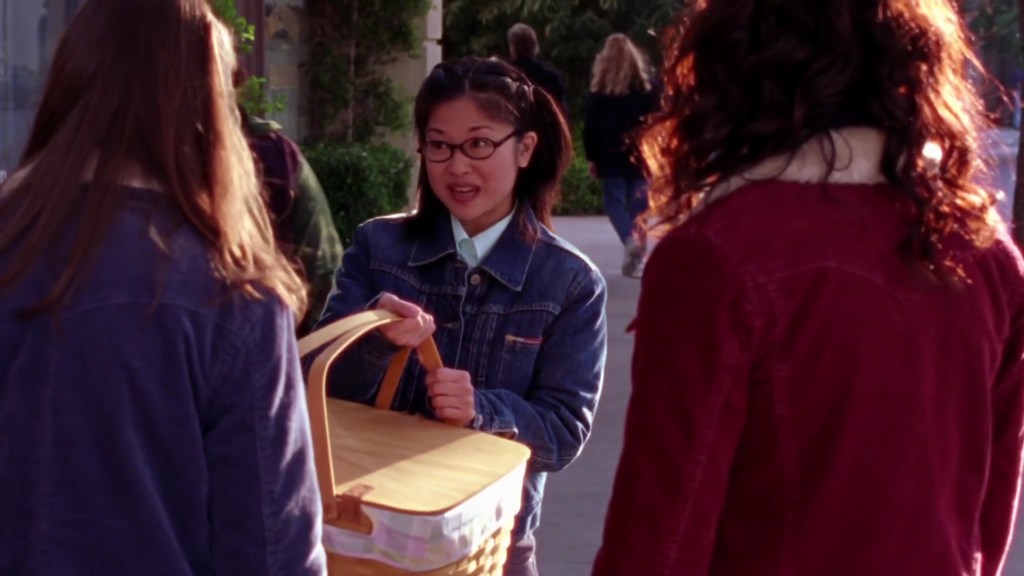
LANE: Well, I invited my cousin David to come and bid on my basket, you know, to keep my mother happy … Then when he gets it, we tell my mom we’re gonna go eat over at the park, where Henry’s gonna call on the pay phone at exactly two o’clock for the ‘all is clear’ sign. Then David, with the twenty bucks I give him, will disappear, Henry will arrive, and we’ll finally have our first official date.
With a dating plan this complex and filled with shenanigans, what could possibly go wrong? Henry met Lane in March 2001, so he’s been waiting nearly a year for his first date! And it’s ridiculously complicated. You have to give him points for incredible patience and understanding with Lane’s situation.
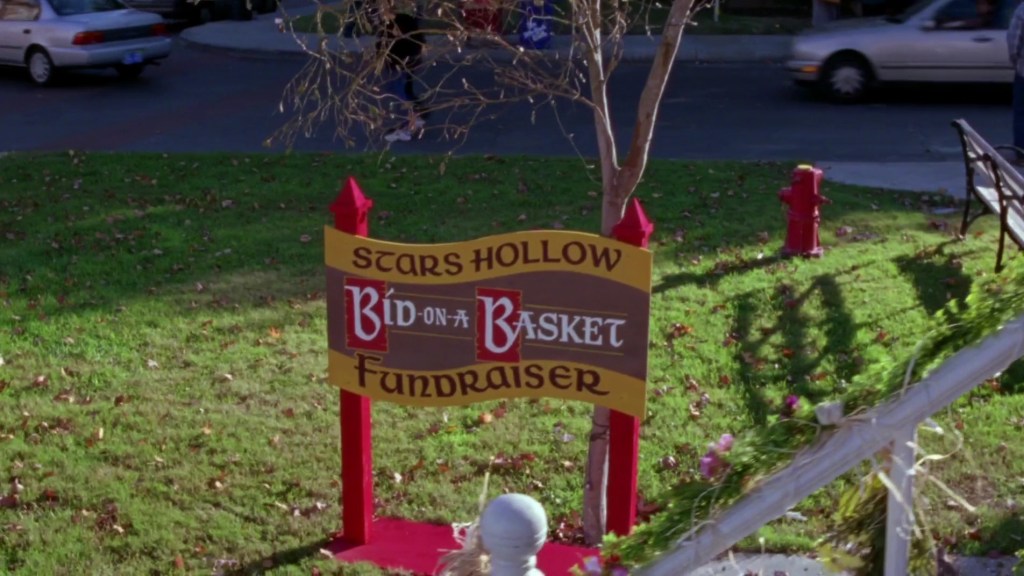
The show opens the day before the Stars Hollow Bid-on-a-Basket Fundraiser, with signs telling the viewer that bidders can win themselves a delicious home-cooked picnic lunch, that it’s held on Sunday at midday, and that all proceeds go to the Stars Hollow Retirement Home (the signs are sponsored by Doose’s Market). Across the street at the market, baskets are on sale, and more signs tell us that it’s also known as the Bid-on-a-Basket Festival. We can see a woman leaving with her new basket.
Inside the market, Lorelai and Rory are shopping for their own baskets, but of course they don’t intend to cook a delicious home-cooked picnic lunch (or even make Sookie do it for them, like they did for the bake sale). They’re just going to put old leftovers in their baskets – as we now know they keep leftovers for a long time, it’s sounding like a Salmonella Festival for anyone bidding on their baskets!
These type of fundraisers are called “box socials” and were common in the 19th century and 1900s, with women cooking the food and packing it into a box or basket, and men bidding for them. Although it was meant to be a “blind” auction, married and attached women would let their husband or sweetheart know which basket was theirs, so they could bid on it – bidding on a woman’s basket was a way to let her know you were interested in more than her home cooking.
Box socials are also low-key dating auctions, with the winning bidder not only getting the basket, but the chance to share the picnic lunch with the lady who provided it. A lunch basket auction of this type features in the 2001 YA novel Flipped by Wendelin Van Draanen (in this case, it is a high school boy who provides the basket, and girls bid on the chance to have lunch with him). This seems like a bit of a coincidence, or perhaps merely zeitgeist.
Although Flipped is set in the 1990s, when it was made into a film in 2010, they set it in the 1960s, as if that scene was deemed too old-fashioned to be believable. They must have agreed with Lorelai, who complained that the concept was “backwards”. In fact there has been a mild resurgence in box socials since the 1990s.
The show never makes it explicit, but according to the timeline, the Bid-on-Basket Fundraiser seems to be held in mid-February, and it would make sense if it was the Sunday after Valentine’s Day. That’s a clear connection with love and romance, although it isn’t practical at all to have a picnic in winter! In real life it would be freezing.
This is the song playing on the stereo when Richard returns home from Stars Hollow. It plays over him looking sad while alone in his study, until the end of the episode.
The opening lyrics are in tune with Richard’s melancholy mood:
I was a stranger in the city Out of town were the people I knew I had that feeling of self pity What to do, what to do, what to do? The outlook was decidedly blue
A Foggy Day was composed by George Gershwin, with lyrics by Ira Gershwin. It was introduced by Fred Astaire in the 1937 musical comedy film A Damsel in Distress, loosely based on the 1919 novel of the same name by P.G. Wodehouse, and the 1928 stage play written by Wodehouse and Ian Hay. Astaire’s recording was very popular in 1937.
The song has been covered numerous times, and Richard listens to a Frank Sinatra version. Richard may be listening to his 1954 album Songs for Young Lovers, produced by Voyle Gilmore (!), or from the 1961 Ring-a-Ding-Ding! The second one, which was well-reviewed and went to #4 in the charts, seems more likely, as Richard would been about eighteen when it came out.
She doesn’t eat grapefruit with breakfast (she has a banana instead)
She doesn’t wear sensible shoes to work
She doesn’t dress appropriately for work (how does Lorelai not have a jacket? It’s winter!)
She didn’t have any tablecloths in the dining room due to an issue with her linen delivery
She spoke flirtatiously to her linen delivery guy in order to get better service
She got out of the car before it had completely come to a stop
She ordered Chinese food that wasn’t authentically Chinese
She buys more food for dinner than she can eat in one sitting (they eat leftovers)
She pushed Rory into wanting to go to Harvard without even investigating Yale
She allowed Rory’s seventeen-year-old boyfriend to rebuild her an old car
A few of Richard’s criticisms are reasonable. The ones about Rory are instigated by genuine concern for his granddaughter, and wanting her to be safe. Many of them are based on an old-fashioned view of the workplace, and a complete lack of understanding of the hospitality industry and female management styles. Some of his criticisms are ridiculous and extremely petty.
None of them are appropriate for him to share with Lorelai on a day that he is coming to visit her home and workplace as her guest. She is a woman in her thirties with a teenage daughter, her own home and car, and a good job. No matter what Richard’s opinions are, he shouldn’t berate Lorelai for her lifestyle choices, and especially not in front of her colleague, Michel.
The show focuses especially on Lorelai’s fraught relationship with Emily, but Richard and Lorelai certainly have their issues.






 The Annotated Gilmore Girls