Emily’s Charities

The Starlight Children’s Foundation

Founded in 1982, it provides clothing, games, and deliveries directly to hospitalised children through a network of more than 700 children’s hospitals and medical centres in the US, Canada, the UK, and Australia.

Emily has been the co-chair on its board for the past eight years, which seems unlikely – the foundation’s headquarters are in Los Angeles, it doesn’t have co-chairs, and its board is made up people with high profiles in medicine, finance, and media. I think we are meant to assume this is a (fictional) local fundraising branch for Hartford.

The Black and White Ball is their main fundraising event. This is a masquerade ball in which everyone is dressed in either black or white. They are intended to be extremely glamorous and exclusive events, with high ticket prices.

Hartford Zoological Silent Auction

A fictional organisation of which Emily is a board member. Hartford doesn’t actually have a zoo. The nearest Zoological Society is in Bridgeport, Connecticut, to support Beardsley’s Zoo.

A silent auction is one where bidders write their bids down on a sheet of paper, with the highest bid winning. They are common at charity events.

The Mark Twain House Restoration Fund

The Mark Twain House is a museum in Hartford, once the home of the author of Huckleberry Finn. Restoration began on the house in 1963, and its fundraising arm is the Friends of the Mark Twain House and Museum. They’ve been fundraising since 1954. This must be the organisation that has Emily as a board member, and is holding the charity luncheon Emily has been forced to turn down.

Harriet Beecher Stowe Literacy Auction

Harriet Beecher Stowe (1811-1896) was an American author and abolitionist, best known for her 1852 anti-slavery novel, Uncle Tom’s Cabin. The Harriet Beecher Stowe House & Center is in Hartford, next door to the Mark Twain House and Museum. Emily seems to be on the board of both these museums.

Emily’s strong community involvement, which is the major part of her social life, is very much like Lorelai’s enthusiastic support of every festival and celebration in Stars Hollow, right down to a cat’s wake. The apple didn’t fall far from the tree in this case.

Oliver Twist

RORY: Goodnight, Dodger.
JESS: Dodger?
RORY: Figure it out.
JESS: Oliver Twist.

Oliver Twist, or the Parish Boy’s Progress, is a 1838 novel by English author Charles Dickens. The titular protagonist is a poor orphan boy who is born in a workhouse and apprenticed to an undertaker. He escapes to London, where he meets the “Artful Dodger”, a boy who belongs to a gang of juvenile pickpockets. It’s an unromantic portrayal of criminals and their sordid lives, and exposes the cruel treatment of orphans in the 19th century.

Rory jokingly refers to Jess as the Artful Dodger, a boy thief who is known for his great skill and cunning as a pickpocket. It’s something of both an insult and a compliment. More interestingly, the Artful Dodger attempts to seduce the innocent Oliver into a life of crime, as if Rory instinctively sees Jess as a corrupting influence.

Rory is not only teasing Jess, she is setting him a little test. Does he only read the Beat poets, or is he also familiar with classic novels? You know, proper literature, as studied at school? Jess passes the test with flying colours, and Rory beams, as if she has found a kindred spirit.

Look out, Non-Reading Dean ….

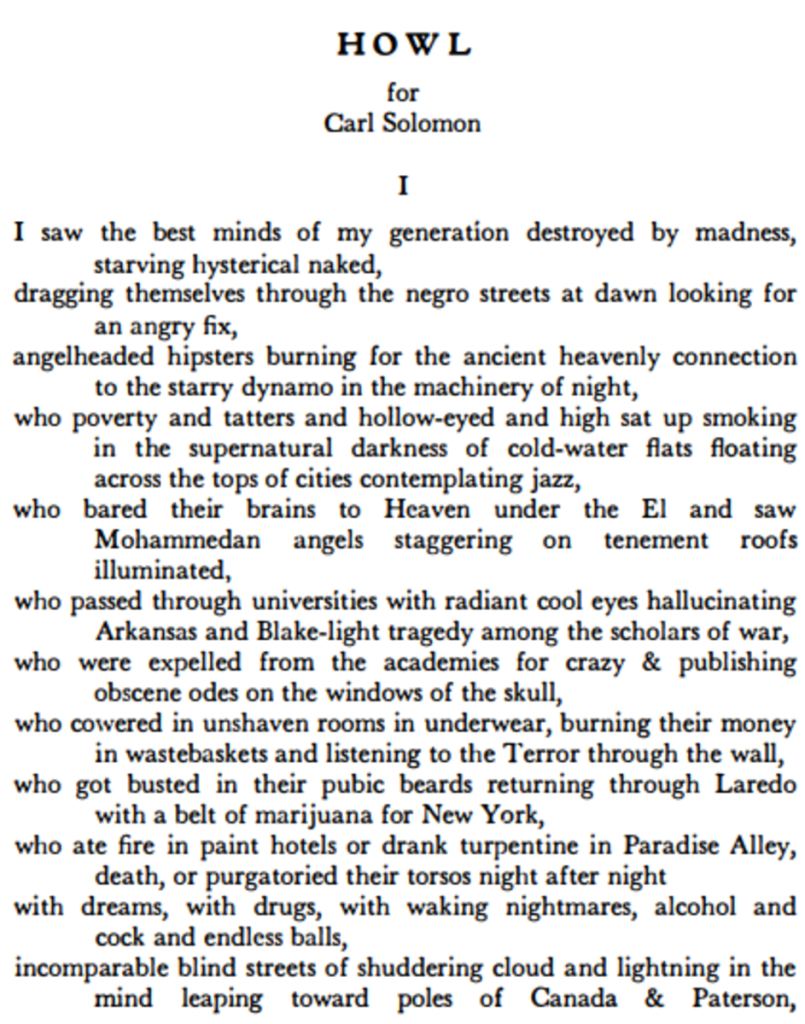
Howl and Other Poems

The book which Jess secretly took from Rory’s bookshelves, even though she had earlier offered to lend it to him.

It’s a poetry collection by American Beat poet Allen Ginsberg, first published in 1956. It contains his most famous poem, “Howl”, a biographical poem originally inspired by a terrifying peyote vision. The publisher of the book, Lawrence Ferlinghetti, another Beat poet, was subsequently arrested and charged with obscenity, but found not guilty at his 1957 trial.

Jess now reveals that even though he said he didn’t read “much”, he has read Howl and Other Poems about forty times. He smoothly implies that “much” is a relative term, after all.

He has also written notes in the margin for Rory to read. The viewer will now either a) be horrified that he took her book without asking and defaced it, or b) sigh over the fact that he took the opportunity to bond with Rory over literature, sharing his innermost thoughts. It is definitely intended as an intimate, seductive move.

It’s interesting to wonder what thoughts Jess had about “Howl”. It’s an intense poem about madness, rebellion, drug-taking, and sex, which could lead to some interesting observations. If Jess knew a lot about the Beats, he might also be able to pick out those parts of the poem which were taken from real life experiences.

Then again, much of the poem is set in New York, and possibly Jess simply compared his own experiences in the locations mentioned. I can definitely imagine Jess taking a day or a weekend to visit all the places around New York in the poem.

Disappearing Act

JESS: Oh this? Nothing. [does an illusion with a coin] Just another little disappearing act.

We now learn that Jess knows at least one basic magic trick, showing that he must be dexterous and quick with his hands. (Something that would be very handy playing poker, as well).

It’s a reminder that he makes other things disappear with his quick hands – books, beer, money, gnomes … And no doubt a major foreshadowing of what is to come.

Clever Jess has already learned how to hook a girl’s attention: make himself unavailable by disappearing (as he did at the dinner). He is careful not to hang around and chat like some regular person after giving Rory her book back, either, but mysteriously pads off into the twilight.

Potlucks and Tupperware Parties

JESS: Potlucks and Tupperware parties aren’t really my thing.

A potluck is American English for a communal meal where everyone brings a dish of food to share. Commonly organised by churches and community groups, the food is rarely of gourmet quality (hence, you’re taking “pot luck” in what you’ll get to eat).

A Tupperware party is one organised to sell Tupperware, a line of plastic storage containers first developed by Earl Silas Tupper in 1946, and sold via multilevel marketing in the home. After being very popular in the 1970s, Tupperware suffered a slump in the mid-1990s, when it began to seem dated, so at this period was considered a rather middle-aged activity.

Quite rudely, Jess equates the lavish dinner Sookie carefully prepared to welcome him to Stars Hollow with community meals suitable for the dull and old-fashioned. This yet another meal prepared by Sookie which gets ruined, as Jess and Luke leave without eating, when the dinner was meant to be for them.

Luke’s Program to Turn Jess Around

Give up smoking

No stealing

Pay people back for what has been taken

Attend school and graduate high school

Work in the diner after school until the diner closes

Homework will be done between the diner closing and bedtime

Weekends are for chores and pre-approved social outings

I wonder whether Luke’s plan of only allowing Jess to attend school, work at the diner, do homework at night, and chores on weekends, is an indication of how his father brought him up. It certainly gave Luke a strong work ethic, although it also drove Liz away. It might explain why Luke seems to lead a rather joyless existence, with a distrust or even dislike of having any fun.

Jess’ response is to immediately make like his mother and leave, and when Luke asks where he is going, he says, “Out”. Yes, he’s done a Liz and gone off to do “God knows what”.

Luke mutters, “Well, at least I asked”, showing that he’s not expecting to become the world’s best parental substitute overnight.

(Note that Jess is wearing a completely different outfit in this scene – because his other clothes got wet when Luke pushed him into a lake).

Luke Freaks Out to Lorelai About Jess

After pushing Jess into a lake, Luke goes straight to Lorelai and admits she was right – he is completely out of his depth, and has no idea has to raise a troubled teenage boy. Lorelai immediately assures Luke that he can do it, but it’s going to take more than buying some new sheets to make it work. Luke did act as though just providing Jess with a safe and stable home environment was going to be enough to change his attitude.

Lorelai doesn’t tell Luke what to do, so she has learned one valuable lesson from their fight. Instead she asks Luke what he is going to do about Jess. It is his choice how he raises Jess. Their fight is made up when they both acknowledge they were wrong, and the end is signalled when Luke tells Lorelai she is allowed back at the diner.

Jess the Thief

In this episode, Luke is dismayed to learn Jess has been indulging in petty theft. Is this the “trouble” he was headed for in New York, or is this something Jess is doing for attention, in defiance of being sent to Stars Hollow, or out of boredom?

Or is it a sort of one-sided joke or prank, where he fulfils the image the town has of him as a criminal by performing mildly illegal acts that do little harm, just to see how upset the townsfolk will become?

Another possibility: Jess only seems to start stealing after he meets Rory. Is he trying to make himself a notorious figure, spoken of everywhere, so she cannot ignore or forget him? After all, there’s no such thing as bad publicity …

It’s also interesting to see where Jess steals from in this episode. He is first caught stealing beer from Lorelai’s fridge. Next he steals a few coins from the bridge repair fund – the same community project that Lorelai and Rory worked on (in a town as gossipy as Stars Hollow, it wouldn’t be hard for the quiet, watchful Jess to learn of that). Then he steals a garden gnome from Babette, Lorelai and Rory’s next door neighbour. Later it transpires that the first thing he took without asking was one of Rory’s books.

The thefts don’t seem to have random victims – they are all connected with Lorelai and Rory. Are they a bit of payback for Lorelai, for trying to give him advice, or are they are an attempt to keep himself within Rory’s orbit, by fair means or foul?

Luke and Lorelai’s Fight

LUKE: Oh, you have a kid, so you know everything, right?
LORELAI: I have a kid, so yeah, I know a little more than you do.
LUKE: You know, you ever think maybe you just got lucky with Rory? I mean, you did get pregnant at sixteen. That doesn’t show the greatest decision making skills, now does it?

Luke is furious to discover that Lorelai has taken it upon herself to start lecturing Jess without him being present, and thus doesn’t take on board the serious information that Lorelai is giving him – that Jess stole beer from her fridge. Maybe Luke should have listened to her, but on the other hand, Lorelai is too angry and upset to handle it very tactfully.

I think Lorelai is correct that Luke could avail himself of what parenting advice she has to offer – she has raised a fairly well-behaved, academically successful child, after all. She must know something about children and teenagers. (And she got pregnant at fifteen, not sixteen).

However, I think Luke has a point that she has got a bit lucky with Rory, who’s a fairly easygoing, compliant child (she takes after Christopher and his mother in that regard, rather than Lorelai). If Lorelai had had a kid more like herself, rebellious and oppositional, particularly a boy, she might have found being a young single mother rather more challenging.

This is the beginning of Jess putting a strain on the relationship between Luke and Lorelai, and serves as yet another obstacle to them getting together (Jess sharing a one-bedroom apartment with Luke would surely make that a bit problematic, even if there were no other issues).

The Breakfast Club

LUKE: Where’s Jess?
LORELAI: Outside, working on his Breakfast Club audition.

The Breakfast Club is a 1985 American coming of age teen comedy, written and directed by John Hughes, in his directorial debut. The story involves five teenagers from different high school cliques who spend a Saturday together in all-day detention, writing on essay on “who you think you are”. In the process, the students share secrets, bond, and learn more about themselves and each other.

The Breakfast Club was a box-office success. It is considered to be a quintessential 80s film, one of Hughes’ most memorable works, and one of the best teen films of all time.

When Lorelai is talking about Jess, she is probably specifically thinking of the character John Bender (Judd Nelson), a rebellious punk known as “The Criminal”. He is the only one of the students to stand up to the harsh Vince-Principal. During the course of the film, John becomes close to a pretty, popular girl called Claire Standish known as “The Princess” (Molly Ringwald), and they share a kiss. Jess has only spoken to Rory for a few minutes, but already the genre-savvy Lorelai is worried they will have a natural good girl/bad boy attraction.