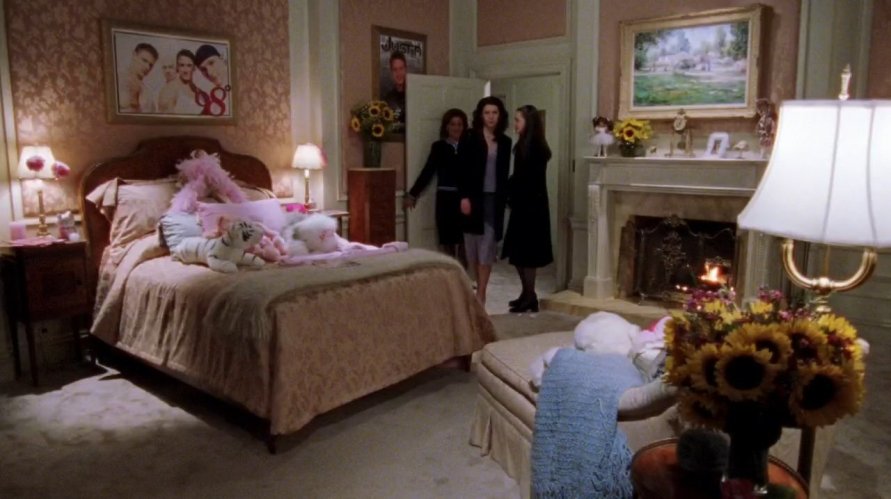
Rory’s Bedroom

Emily shows Rory the guest room she has had redecorated to be Rory’s bedroom any time she stays with her grandparents. Even though Rory said her favourite colour was probably blue, Emily has chosen pink for the accessories (with one blue blanket on a chair), and despite saying that she preferred NSYNC, there is a 98° boy band poster on the wall – there might be another poster on the wall we can’t see, though. From this you can see the very limited choices that Emily allows others to make, and that she is all too ready to override them.

Emily did take notice of the sunflowers, however, which Rory said were her favourite flower. Sunflowers are symbolic of platonic love between family members, and strong bonds between two people, reminiscent of Rory’s relationship with Lorelai. They are happy, positive flowers, and symbols of good luck, which make sense because Rory leads such a charmed life.

The room is obviously Emily’s way of showing how much better cared for Rory would have been had she and Lorelai remained living with Emily and Richard. She is still angry and distressed that Lorelai took Rory to live in a shed rather than with her parents, and believes that Lorelai must have hated them to have chosen a shed over her own home.
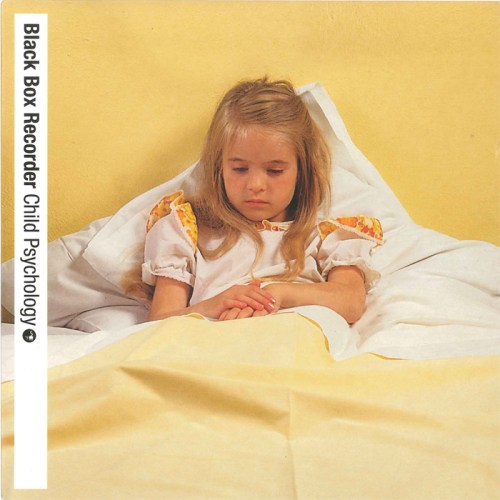

Child Psychology

This 1998 song by English indie rock band Black Box Recorder is the song which Rory and Lane listen to in Rory’s bedroom. Rory says she likes it because it makes her gloomy.

Child Psychology is from the band’s album England Made Me. It features a mixture of spoken word with a sung chorus, and the spoken word part describes negative incidents from childhood, such as refusing to talk, getting expelled from school, and parents arguing at Christmas.

The chorus has the line, “Life is unfair; kill yourself or get over it”, which led to it being banned on radio and on MTV. Released in the US just after the 1999 Columbine school massacre, the “kill yourself” part was played backwards to hide its content.

Once again, this shows Rory gaining satisfaction from the idea of suicide as an artistic and romantic solution, which is really starting to seem quite worrying. Perhaps it is supposed to be a typically teenage reaction to life, or just a streak of black comedy in the show, as suicide seems to be mentioned so often.

911

RORY: Oh, I’m buzzing. [Takes her pager out of her pocket] … It’s Lane. 911. That’s trig. Gotta go.

As commonly known from movies and television, 911 is the emergency phone number in the US. Trigonometry is obviously Lane’s worst subject at school, so when she pages Rory 911, it means she desperately needs help with her Trig homework.

Fergie

TRIX: Raising your voice during high tea, whoever heard of such a thing? It’s like Fergie all over again.

Trix is referring to Sarah, Duchess of York (born Sarah Ferguson in 1959), a British royal known as “Fergie” by the British press. She married Prince Andrew in 1986; after having two daughters, they separated in 1992, and divorced in 1996.

Fergie’s demeanour as a royal was always very casual, and she could be loud and exuberant socially, which people either found a breath of fresh air, or like Trix, rather vulgar. We can see from her comment that Trix has been in high society in London, although the fact that she calls the duchess by her “press name” betrays that she doesn’t really know her at all.

“It’s terrible not to be needed”

Trix offers to set up a trust fund for Rory so that she can pay for Chilton herself, and pay back her grandparents for the first year of tuition. This is because Trix finds borrowing money to be terribly distasteful, which makes you wonder how she manages at banks – are the Gilmores so wealthy they have never needed a bank loan or a mortgage, or are banks different?

Emily does everything she can to convince Lorelai that Rory’s financial independence will ruin her close relationship with her mother. If Rory pays her own way through university, buys her own car, and goes travelling on her own, what will she ever need Lorelai for?

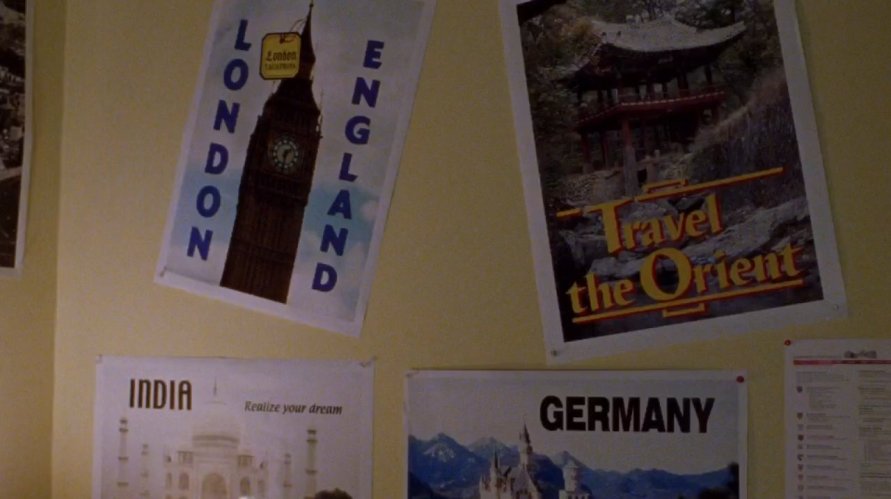
Although Lorelai dismisses Emily’s arguments as the ravings of a madwoman, when she gets home she goes to Rory’s room and finds it full of Harvard brochures, the walls covered in travel posters. It’s clear that Emily now seems a lot more convincing.

Of course, Emily’s real fear is that if she and Richard are no longer paying for Chilton, then Rory won’t need them either, and neither will Lorelai. The thought of losing her daughter and granddaughter all over again is unbearable to her, as her “It’s terrible not to be needed” makes clear.

Nietzsche and Dawson

LOUISE: Those who simply wait for information to find them, spend a lot of time sitting by the phone. Those who go out and find it themselves, have something to say when it rings.
RORY: Nietzsche?
LOUISE: Dawson.

Rory is referring to Friedrich Nietzsche (1844-1900), a German philosopher whose work has been profoundly influential on Western philosophy. Since the 1960s his work has been a major focus in existentialism, postmodernism, art, literature, psychology, politics, and popular culture.

Louise is referring to Dawson Leery (James Van Der Beek), the central character on the teen drama series Dawson’s Creek, which aired on television between 1998 and 2003. I cannot verify if Louise’s quote is genuinely from the show, but it sounds like the sort of thing Dawson might have said.

This is a rather unsubtle example of how much more intellectual Rory is compared to Louise.

Gilmore blood

Trix is pleased that both Lorelai and Rory are taller than average, and after quizzing them on their health, glad to hear they are strong and healthy. She tells them that they must have a majority of “Gilmore blood”, as Gilmores simply never get sick. This must be why Lorelai and Rory remain healthy in spite of their junk food-loving lifestyle – they truly hit the genetic jackpot.

At the time, it doesn’t make much sense that Trix should be so mad keen on “Gilmore blood”, as it was her husband who was a Gilmore. In a later season, we learn that Trix married a distant relative, and she was born a Gilmore as well.

Trix

We finally meet Richard’s mother Lorelai Gilmore (Marion Ross), who he calls Trix as her special pet name. It seems to be a Gilmore tradition to have a nickname that’s unrelated to your real name, as neither Rory nor Trix are actually short for Lorelai. Trix is a stereotypical scary old lady who frightens even Lorelai into good behaviour, and turns Emily to jelly.

It is notable that Trix and Richard are very close, just like Lorelai and Rory, while Trix despises Emily. Trix treats Emily the same way Emily treats Lorelai, which doesn’t quite make sense unless Emily’s mother died when she was fairly young, and Trix is her main “mother type” relationship.

If the family pattern continues through to the next generation, it suggests that Lorelai will dislike the man that Rory marries and constantly give him a hard time for not being good enough for her daughter. This doesn’t seem unlikely, as Lorelai was never a huge fan of any of Rory’s boyfriends.

Furthermore, it suggests that Rory will have a distant relationship with her child, as Richard does with Lorelai. Again, this isn’t implausible, as Rory has a colder personality than her mother, and doesn’t seem to really like children. If Rory’s husband is as hard on the child as Emily is on Lorelai, then we can expect another rebellious teenager to emerge – that only Lorelai can control.

“Diamond pendant”

RORY: Where is she [her great-grandmother] now?
EMILY: In the living room, scratching the diamond pendant I bought her against a mirror.

A common technique in the past to test if a diamond was real or fake was to rub it against glass – if it made a scratch or scrape mark on the glass leaving the jewel untouched, then the diamond was genuine.

Many modern artificial diamonds can actually pass this test, and if you’re unlucky, it is possible to damage a real diamond rubbing it against glass, so it isn’t really helpful. It is probably going to ruin Emily and Richard’s mirror, so it’s inherently selfish as well as rude.