LORELAI: Oh, that must be Pauline Kael rising from the dead.
Pauline Kael (1919-2001), film critic who wrote forThe New Yorker magazine from 1968 to 1991. One of the most influential film critics of her era, she was known for her witty, biting, opinionated reviews which often ran counter to those of her contemporaries, and were highly personal.
Pauline Kael had only died the previous year to this episode, so Lorelai is saying that Pauline Kael must be rising from the dead to sharply critique the films that Taylor has offered her.
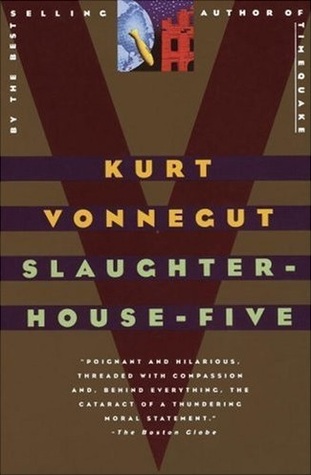
This is the book Jess is reading in this episode, that he tells Luke is not for school.
Slaughterhouse-Five is a 1969 semi-autobiographical science-fiction anti-war novel by Kurt Vonnegut. The story, told in a non-linear fashion by an unreliable narrator, relates the life and experiences of a man from upstate New York named Billy Pilgrim, from his early years to his service during World War II, and post-war years – his experiences include time travel and alien abduction. The book centres on Billy’s capture by the German Army, and his survival of the Allied firebombing of Dresden as a prisoner-of-war.
Categorised as a postmodern, metafictional novel, it is characterised by Vonnegut’s signature style, with simple sentences underpinning a text of irony, sentimentality, black humour, and instruction. The short, declarative sentences give the impression of reading a factual report, while the focus shifts between the writer’s perspective as someone who met Billy Pilgrim to an omniscient third person narrator. The first sentence is, “All this happened, more or less”. It is considered one of the best first lines in American fiction. The sentence, “So it goes”, is used as a repetitive refrain throughout.
Slaughterhouse-Five received mostly positive reviews, and became a bestseller, staying on the New York Times Bestseller List for sixteen weeks. It has been adapted for stage and radio, and been turned into both a film and a graphic novel.
The novel is controversial, with many attempts of censorship against it, especially in school and college libraries. This makes Jess’ reading of it at school seem like a deliberate attempt to draw attention to himself. A story about someone who has been through terrible trauma until they find life meaningless seems to be something which Jess relates to.
LORELAI: Suspense – ice skater falls in love with hired help. Well, at least now I know how Snow Dogs got made.
Snow Dogs, a 2002 adventure comedy film directed by Brian Levant, and inspired by the non-fiction book Winterdance by by Gary Paulsen. It stars Cuba Gooding Jr as an adopted dentist from Miami who travels through the Alaskan wilderness with a pack of sled dogs in search of his inheritance and the truth about his family origins. He finds love with a bar owner, played by Joanna Bacalso.
The film was panned by critics as mediocre, cliched, tiresome, and stale, but was a commercial success. Disney released the film in January that year, so Lorelai and Rory must have seen it within the last few months.
All the films that Lorelai mentions in Taylor’s catalogue are made by Monogram Pictures, a film studio that produced mostly low-budget films between 1931 and 1953, after which they were known as Allied Artists Picture Corporation. Lacking the resources to deliver high production values and big stars, they instead offered plenty of action and adventure. They launched the careers of many actors who went on to become stars, and provided a haven for good actors whose careers had stalled.
Monogram/Allied Artists continued until 1979; their library is now owned by Warner Bros, MGM, and Paramount, while a few are in the public domain – although none of the films listed here.
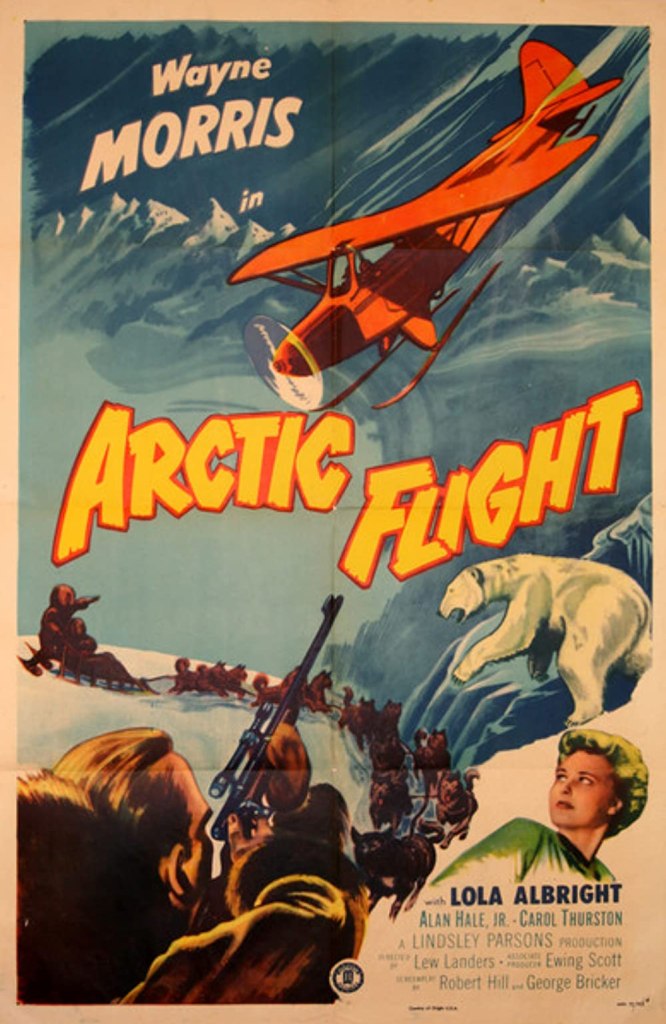
Arctic Flight [pictured] A 1952 drama film directed by Lew Landers, about a bush pilot, played by Mike Wein, flying in the Arctic. There is a Soviet spy adventure involving a polar bear hunter, and romance with a schoolteacher, played by Lola Albright. It’s a B movie, considered unpretentious and well-made.
Killer Shark A 1950 B movie directed by Budd Boetticher, and starring actor Roddy McDowell, who had been a successful child actor in England before moving to America with his family. He went on to star in some major films during the 1960s and 1970s, and had a lengthy career.
Where Are Your Children? A 1943 teenage crime film directed by William Nigh and starring former child star Jackie Cooper. It was more successful than the studio had expected, and they made a sequel the following year called Are These Our Parents?
Sudden Danger A 1955 film noir crime drama directed by Hubert Cornfield and starring Bill Elliot as the police detective investigating a possible murder, and Tom Drake as the man who hopes to clear himself by looking for clues on his own. The movie was part of a five-film series, and is considered a solid effort with a good cast.
Suspense A 1946 film noir ice skating film directed by Frank Tuttle, and starring Barry Sullivan and British former Olympic skater Belita. It was the most expensive film Monogram ever made, costing $1.1 million. It was panned by critics, but a box office success.
Lorelai and Rory love watching “bad” movies, but suddenly they get awfully snobbish about putting a B movie on in the town square. Apparently it’s fun to watch a B movie, but embarrassing to publicly screen one.
None of these films were terrible failures, or considered unwatchable. I’m not sure why they don’t seem like a viable alternative to watching The Yearling for the third year running.
RORY: What about, my mother is two? LORELAI: Never saw it – Angie Dickinson?
RORY: You’re impossible.
LORELAI: You’re right. You’re Impossible was the one with Angie Dickinson.
Angeline “Angie” Dickinson (born Angeline Brown in 1931), actress who began her career on television in the 1950s before making her breakthrough in Western films Gun the Man Down (1956) and Rio Bravo (1959).
In her six-decade career, Dickinson has appeared in more than fifty films, including Ocean’s 11 (1960), Point Blank (1967), and Big Bad Mama (1974). From 1974 to 1978 she starred in the crime series Police Woman, for which she won a Golden Globe and three Emmy Awards. In 1980, she starred in Brian de Palma’s erotic crime thriller Dressed to Kill, for which she received a Best Actress Saturn Award. In her later career, she starred in several TV movies and miniseries, and played supporting roles in films such as Even Cowgirls Get the Blues (1994) and Big Bad Love (2001).
Dickinson often played sultry femmes fatale and provocative roles, becoming known as a sex symbol. She is regarded as one of the sexiest television stars of the twentieth century.
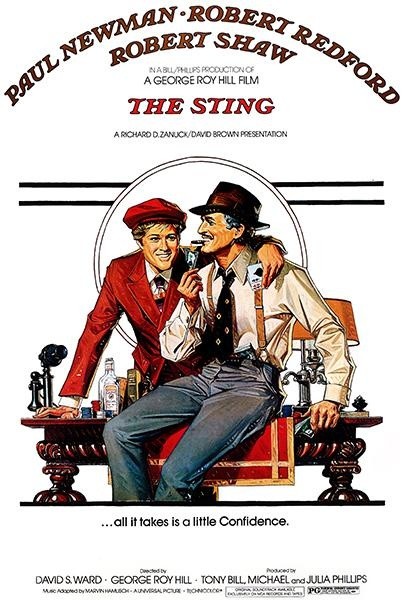
A 1973 caper film directed by George Roy Hill, involving two grifters, played by Paul Newman and Robert Redford, and their plan to con a mob boss, played by Robert Shaw. Set in 1936, it was inspired by real life cons perpetrated by brothers Fred and Charley Gondorff, as told in the 1940 non-fiction book, The Big Con by David Maurer. The Sting received rave reviews and was a box office smash, becoming the #2 film of the year. It won seven Academy Awards, including Best Picture and Best Director.
Rocky
A 1976 sports drama film, directed by John G. Avildsen, with screenplay by Sylvester Stallone, who also stars in the title role as Rocky Balboa. It’s a rags-to-to-riches tale of a working-class small-time boxer in the slums of Philadelphia who gets a shot at a world heavyweight championship. Made on a shoestring budget, it was a sleeper hit, becoming the #1 film of 1976. Critically acclaimed, it solidified Stallone’s career and led to him becoming a major movie star. It won three Academy Awards, including Best Picture, and is regarded as one of the greatest sports films ever made.
Crimes and Misdemeanours
A 1989 existential comedy-drama directed by Woody Allen, who also stars as Clifford Stern, a documentary filmmaker. The other main character is Judah Rosenthal, played by Martin Landau, who commits a very serious crime, and, stricken with guilt, turns to the religious teachings he had rejected. Cliff and Judah only meet once, at the end of the film, which has a philosophical message. A box-office flop, it was lauded by critics, and is regarded as one of Allen’s best films.
The Singing Detective
A 1986 BBC television serial drama, written by Dennis Potter, directed by Jon Amiel, and starring Michael Gambon. It is about a mystery writer, suffering writer’s block and ill in hospital, who enters a fantasy world involving his novel, The Singing Detective. Although ratings were modest, it was highly influential, and greatly praised in America, where it was later shown on PBS and won a Peabody Award. It is regarded as one of the greatest British TV programs ever made. Rory calls it a “mini-series”, but in fact it was six episodes – a normal run on British television.
Arthur
A 1981 comedy written and directed by Steve Gordon. It stars Dudley Moore as Arthur Bach, a drunken New York millionaire about to enter an arranged marriage with an heiress, but who falls for a working-class girl from Queens. The #4 film of 1981, Arthur was critically acclaimed, and considered one of the best films of the year. Its theme song, “Arthur’s Theme”, won an Academy Award for Best Original Song, and Sir John Gielgud won Best Supporting Actor for his role as Arthur’s valet.
Sophie’s Choice
A 1982 psychological drama film written and directed by Alan J. Pakula, adapted from the 1979 novel of the same name by William Styron. Set in 1947, it stars Meryl Streep as Sophie, a Polish immigrant with a dark secret from her past who shares a boarding house in Brooklyn with her lover, played by Kevin Kline, and a young writer, played by Peter MacNichol. It was a commercial and critical success, and Meryl Streep won the Academy Award for Best Actress for her role.
Cabin Boy
A 1994 fantasy comedy film directed by Adam Resnick and co-produced by Tim Burton. It stars comedian Chris Elliot, who co-wrote the screenplay with Resnick. Elliot’s character is a snobbish, unpleasant man who accidentally gets stuck aboard a boat out at sea, and goes on a fantastical voyage of self-discovery. The film received mixed reviews, and it is a matter of opinion whether it’s one of the worst films ever, an underrated work of comedic legend, or so bad that it’s good.
Desperately Seeking Susan
A 1985 comedy-drama film directed by Susan Seidelman, partly inspired by the 1974 French film Céline and Julie Go Boating. Set in New York City, it stars Rosanna Arquette as a bored housewife, who becomes involved with a bohemian drifter named Susan, played by Madonna in her first major screen role. The film was a commercial success, and received mostly positive reviews, with acclaim for both Arquette and Madonna. It’s considered one of the best films of the 1980s.
Fletch
A 1985 neo-noir comedy thriller film directed by Michael Ritchie, based on the 1974 novel Fletch by Gregory Mcdonald. It stars Chevy Chase as undercover reporter Irwin “Fletch” Fletcher who begins investigating a murder scheme that has unexpected links with the story he is working on. The film received positive reviews, and was a commercial success, performing very well on home media, and becoming a cult film.
Urban Cowboy
A 1980 romantic western film directed and co-written by James Bridges and Aaron Latham, adapted from an article of the same name Latham wrote for Esquire magazine. The story revolves around the love-hate relationship between a couple named Buford and Sissy, played by John Travolta and Debra Winger. Set in Pasadena, Texas, much of the action takes place in a honky-tonk bar playing country music. A critical and commercial success, the soundtrack was also a hit.
Lorelai and Rory managed to whittle their list of films down to a trim 75 possibilities!
TAYLOR: It is a fine, wholesome motion picture. Moving story, lovely scenes of nature.
The Yearling, 1946 dramatic family film directed by Clarence Brown, based on the 1938 novel of the same name by Marjorie Kinnan Rawlings. It stars Gregory Peck and Jane Wyman, and was filmed on location in the Ocala National Forest in Florida. The film is about a young boy, played by Claude Jarman Jr, who adopts a troublesome deer, the “yearling” of the title.
The Yearling was praised by critics as a heart-warming family film, and was the #9 film of the year at the box-office. However, high production costs meant that it didn’t actually make a big profit. It won three Academy Awards, including a Juvenile Award for Claude Jarman Jr. A television adaptation was released in 1994.
Note that we later learn in this episode that when Taylor says, “Moving story, lovely scenes of nature”, he is quoting from the description given in the film catalogue.
After Lorelai complains that Taylor has chosen The Yearling for the past three years for Movie Night in the Square, Taylor unexpectedly gives her the job of choosing the movie instead, saying she has never volunteered once to help with this event (which is surprising to learn, since Lorelai loves film, and volunteers for most community festivals).
LORELAI: Just as Marty, aka Eve Harrington, shows up trying to take Dean’s job, Taylor’s ladder mysteriously disappears, suddenly making Dean invaluable no matter what fancy tricks Lon Chaney Junior over there pulls.
Lon Chaney Jr., stage name of Creighton Chaney (1906-1973), actor best known for playing the title character in the 1941 horror film, The Wolf Man. He was the son of Leonidas “Lon” Chaney (1883-1930), a star of silent film and one of the most versatile actors of all time. He was known as “The Man with a Thousand Faces”, due to his ability to completely transform his appearance with make-up.
Creighton Chaney felt overshadowed by his famous father, and Lon Chaney discouraged him from following him into show business. It was only after his father’s death that Creighton began acting in films, often in uncredited roles, or doing stunt work. By 1934 he had a leading role, and the next year was billed as Lon Chaney Jr; by 1942, Universal Studios usually insisted on him being credited as Lon Chaney.
Lorelai is suggesting that now Dean has gone, Marty will be slowly replacing him, just as Creighton Chaney gradually took over his father’s name. Of course, Lorelai isn’t really worried about Marty – all this talk is a replacement for her real fear, that Jess will replace Dean while he’s out of town. She seems to be trying to suggest to Rory that Dean in invaluable and irreplaceable.
LORELAI: Just as Marty, aka Eve Harrington, shows up trying to take Dean’s job, Taylor’s ladder mysteriously disappears …
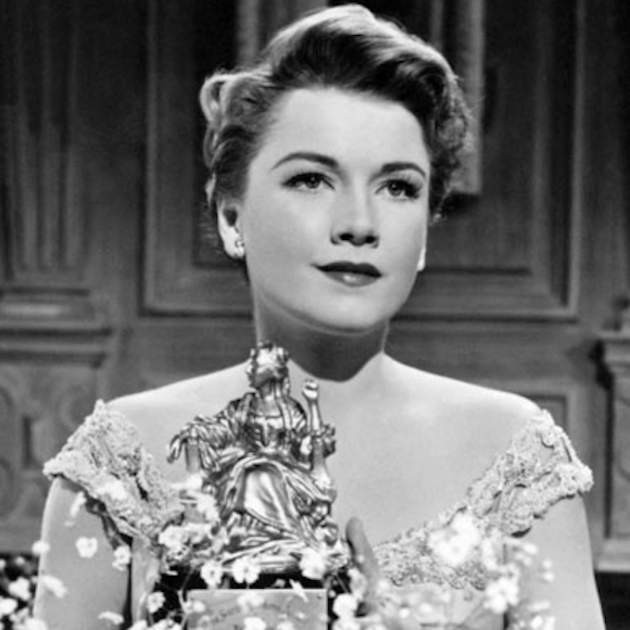
Eve Harrington [pictured] is the title character of the 1950 drama film All About Eve, directed by Joseph F. Mankiewicz, and produced by Daryl F. Zanuck. It is based on the 1946 short story, “The Wisdom of Eve” by Mary Orr, published in Cosmopolitan magazine.
The film stars Bette Davis as Margo Channing, a highly-respected but ageing Broadway star, and Anne Baxter as Eve Harrington, an ambitious young fan who insinuates herself into Margo’s life as her assistant, all the while scheming to take her place. The story was based on the real life experience of Austrian-British actress Elisabeth Bergner, who found herself in the same position as Margo Channing.
All About Eve was overwhelmingly praised by critics, and a box-office success, becoming the #9 film of 1950. It received a record 14 nominations at the Oscars and won six Academy Awards, including Best Picture, Best Director, and Best Screenplay. It is the only film to have ever received four female acting nominations at the Oscars – for Bancroft, Davis, Celeste Holm, and Thelma Ritter. It is regarded as one of the greatest films of all time.
LORELAI: Wow, Marty does the jar twirl before putting the salsa in the bag. Impressive, very Cocktail.
Cocktail, 1988 romantic comedy-drama film directed by Roger Donaldson and written by Heywood Gould; the screenplay was based on his 1984 semi-autobiographical novel of the same name.
It tells the story of a young New York business student, played by Tom Cruise, who takes up bartending in order to make ends meet. An older, more experienced barman, played by Bryan Brown, takes him under his wing and teaches him how to flair – that is, to entertain bar patrons using cocktail shakers and liquor bottles like a juggler. Lorelai suggests that Marty the substitute bag boy is “flairing” the groceries to dazzle the customers.
Cocktail was savaged by critics, who called it “brainless”, “empty”, and “banal”, and it won Worst Picture and Worst Screenplay at the Golden Raspberry Awards. It is generally seen as one of the worst films ever made. Despite this, it was a huge success at the box office, and the #8 film of 1988.






 The Annotated Gilmore Girls