Miami Beach Blue

SOOKIE: And I like your living room. Though that house across the street has sort of that creepy Miami Beach blue, which means that during the day you really can’t look out your window, but at night it’s not so bad.

Miami Beach is a coastal city in Florida, located on natural and artificial islands which separate the beach from Miami. It has a population of around 83 000, and has been one of the most popular resorts in the US since the early twentieth century.

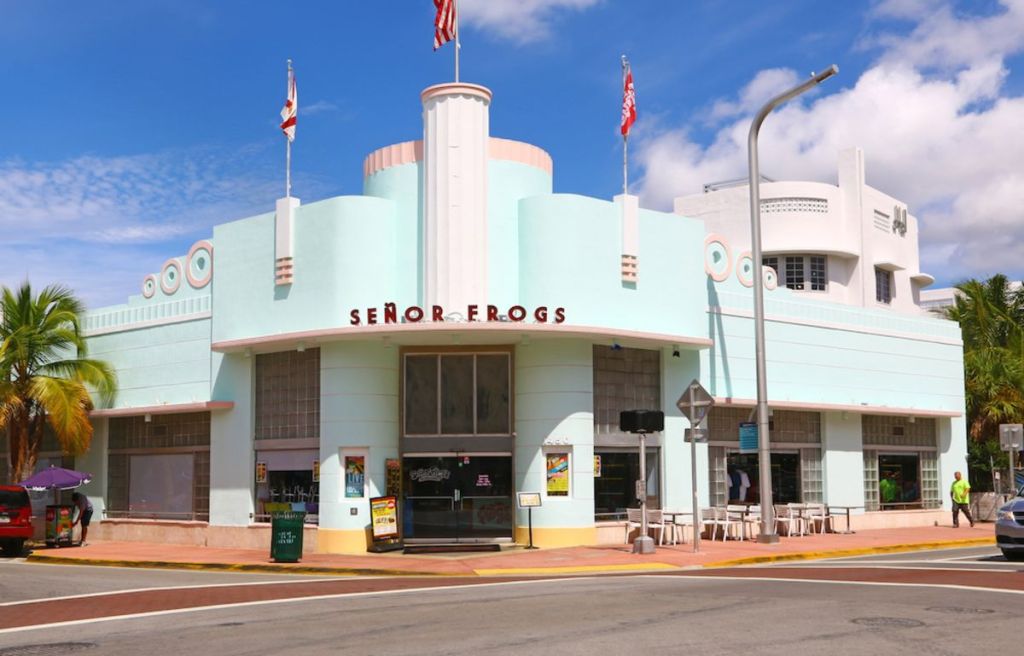
I’m not exactly sure what Sookie means by “Miami Beach blue”, but Miami Beach has a famous Art Deco Heritage District, the largest collection of Art Deco architecture in the world. Many of the buildings are painted or picked out in pale blue, in line with the city’s beachy aesthetic, and she may be thinking of that.

I don’t know why this is considered “creepy”. All I can think of, and it’s really quite a stretch, is that the house in the famous 1991 “Ghostbusters” case of Stambovsky vs Ackley was painted pale blue.

The legal case involved a woman named Helen Ackley selling her house in Nyack, New York, to a man named Jeffrey Stambovsky, without disclosing to him that the house was reputedly haunted – he refused to sign the contract when he found out about the haunting. The courts ruled in favour of Mr Stambovsky.

The only reason I am even mentioning it is because the film Ghostbusters was referenced in the same scene, the mentalist Kreskin, previously discussed, was among those who tried to buy the house, and because when Helen Ackley eventually sold the house to a different buyer, she moved to Florida, so it all seems to fit, in some extremely nebulous way.

It seems possible that Sookie took note of the pale blue house when the story broke nationally, and for ever after, thought any kind of pale blue house was somehow spooky.

Ghostbusters

LORELAI: Oh, hey, one of them’s seen Ghostbusters 124 times.

Ghostbusters is a 1984 supernatural comedy directed by Ivan Reitman, and written by Dan Akroyd and Harold Ramis. It stars Akroyd, Ramis, and Bill Murray as a trio of eccentric parapsychologists who start a ghost-catching business in New York City.

The film was released to critical acclaim, becoming a cultural phenomenon. It was the #2 film of 1984, one of the most successful comedy films of the 1980s, and the highest-grossing comedy ever at the time. It’s theme song, “Ghostbusters” by Ray Parker Jr, was also a #1 hit. It is considered to be an iconic 1980s movie, and one of the most important comedy films ever made.

With its dedicated fan following, it launched a multibillion dollar multimedia franchise, including an animated television series and its sequel, video games, board games, books, comics, clothing, music, and haunted attractions.

The 1989 sequel Ghostbusters II was less successful. It was rebooted in 2016 with an all-female main cast, and amusingly, Melissa McCarthy, who plays Sookie, was chosen as one of the stars of the film; it was a commercial failure and received mixed reviews. A second sequel to the 1984 film, Ghostbusters: Afterlife, was released in 2021.

Watching the film 124 times between 1984 and 2002 doesn’t even seem that out there – it’s less than once a month. As usual, Lorelai’s obsessions with films are seen as cool and quirky, while anyone else’s are sad and pathetic!

From Here to Eternity

JESS: Sorry to intrude.
DEAN: Then why did you?
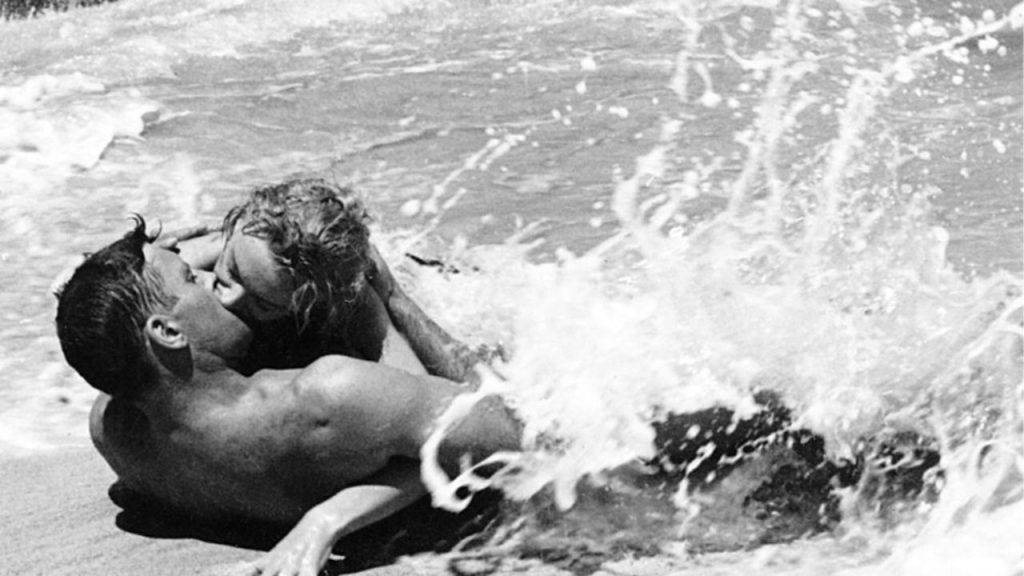
JESS: Well, you’re having your vertical From Here to Eternity moment right in front of the super glue.

From Here to Eternity, 1953 drama-romance war film directed by Frank Zinneman, based on the 1951 novel of the same name by James Jones. The film focuses on three US Army Soldiers, played by Burt Lancaster, Montgomery Clift, and Frank Sinatra, stationed in Hawaii in the months leading up to the attack on Pearl Harbor in 1941. Deborah Kerr and Donna Reed play the women in their lives.

From Here to Eternity was the #3 film of 1953 and won eight Academy Awards, including Best Picture and Best Director (Frank Sinatra and Donna Reed won awards for their supporting roles), as well as numerous other awards. Critics praised it to the skies, but it didn’t go down well with the army and navy. It is considered one of the greatest films ever made.

Jess is referring to the iconic kissing scene where Burt Lancaster and Deborah Kerr roll around on a beach together wearing only swimsuits, as the waves crash over them in mimicry of an orgasm. It’s torrid stuff, made more titillating by the fact that she’s in the role of his commanding officer’s wife.

Andy Hardy

LORELAI: Ugh, every great relationship has its obstacles. You’d know that if you weren’t dating Andy Hardy.

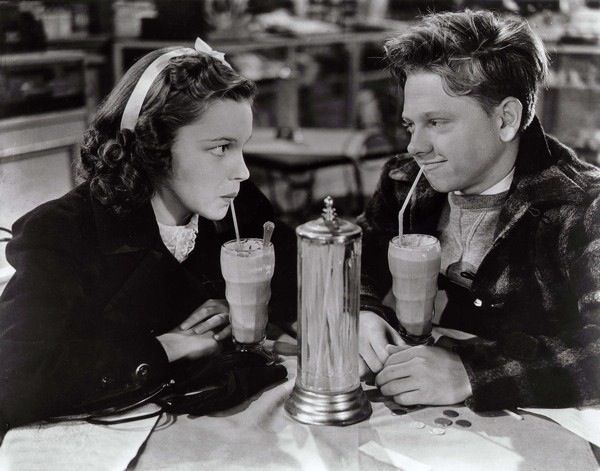
Andrew “Andy” Hardy, fictional character played by Mickey Rooney in 16 films made by Metro-Goldwyn between 1937 and 1946 (and another in 1958, trying unsuccessfully to continue the series). The Hardy films, enormously popular in their day, were sentimental comedies set in a Midwestern town, celebrating ordinary American life.

The Hardy family first appeared in the 1928 play Skidding by Aurania Rouverol, with Charles Eaton as Andy. The first film was A Family Affair, based on the play, with Mickey Rooney as Andy, and he continued in the role from the ages of 16 to 25.

Andy Hardy soon became the central character, with the films focusing on the relationship between he and his father, Judge Hardy (a bit like Gilmore Girls focusing on Rory and Lorelai). The plot typically involved Andy getting in trouble with money or girls because of selfishness or trying to fudge the truth. He would then have a man-to-man talk with his father, a man of absolute integrity, and end up doing the right thing (very different to Gilmore Girls).

Lorelai seems to be teasing Rory about Dean, suggesting that she’s dating a wholesome, inexperienced teenage boy from the Midwest, like Andy Hardy. Meanwhile, Lorelai is looking for a real man, like William Holden.

Interestingly, the cast of A Family Affair were plucked straight from the 1935 comedy, Ah, Wilderness! The plot involves a well-read teenage boy named Richard (played by Eric Linden) from a Connecticut town, graduating as valedictorian and going to Yale, just like Rory. The film also features a box social!

[Picture shows Mickey Rooney and Judy Garland in Love Finds Andy Hardy, 1938].

William Holden

LORELAI: So I’ve decided I’m saving myself for William Holden … Sunset Boulevard was on last night, and I don’t know…I’ve known him for years – Sabrina, Stalag 17 – and yet last night something snapped.

William Holden, born William Beedle (1918-1981), actor who was one of the biggest box-office draws of the 1950s. Winner of an Academy Award and an Emmy for Best Actor, he starred in some of Hollywood’s most popular and highly-acclaimed films. He was named as one of the biggest stars of the year six times between 1954 and 1961, and is considered one of the greatest male stars of Classic Hollywood Cinema.

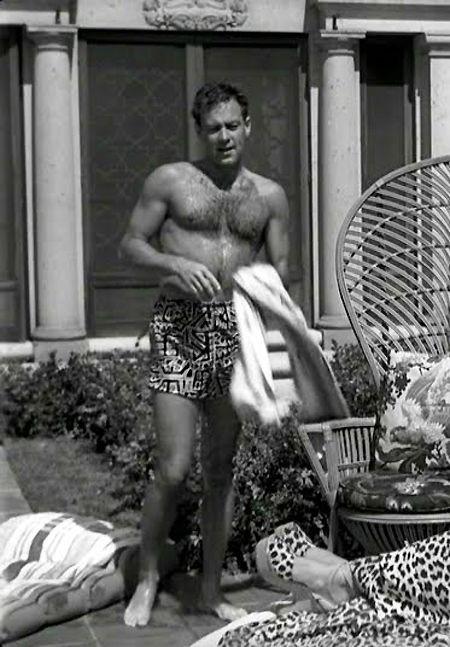
Sunset Boulevard, 1950 black comedy film noir directed by Billy Wilder, starring William Holden as a screenwriter and Gloria Swanson as a former silent film star, who draws him into her demented fantasy world where she dreams of making a triumphant return to the screen. A commercial success, the film was praised by critics and won three Academy Awards. It is regarded as one of the greatest films ever made. William Holden wears a swimsuit in the film [pictured] which has made many others interested in him – it’s not just Lorelai!

Sabrina, 1954 romantic-comedy drama directed by Billy Wilder, starring William Holden as a thrice-married playboy who is the lifelong crush of a young woman named Sabrina, played by Audrey Hepburn. She finds love with his brother, played by Humphrey Bogart. Backstage, it was Holden and Hepburn who got hot and heavy. Sabrina was a box-office success, and won an Academy Award for Best Costumes.

Stalag 17, previously discussed.

Bid-on-a-Basket Fundraiser

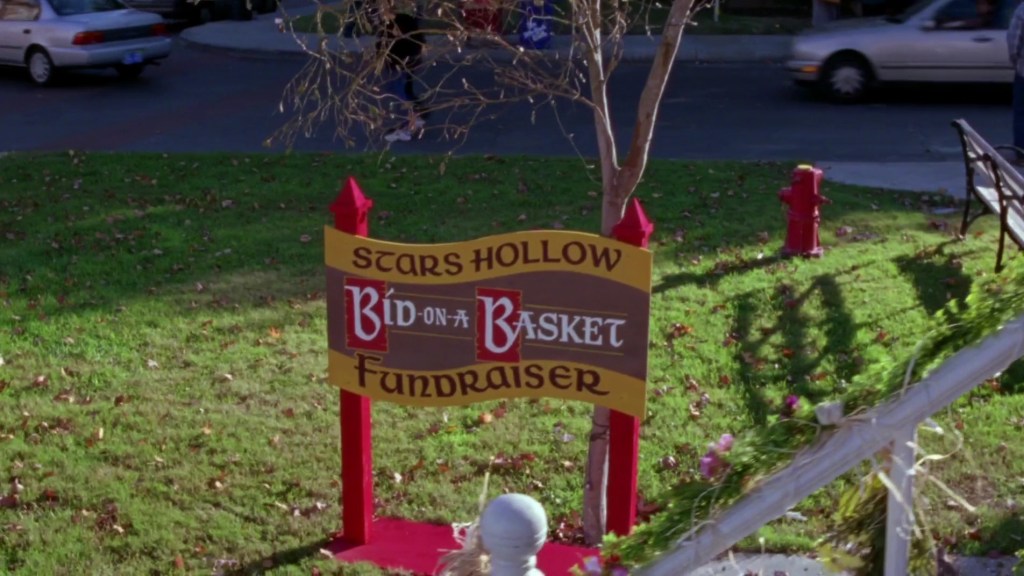
The show opens the day before the Stars Hollow Bid-on-a-Basket Fundraiser, with signs telling the viewer that bidders can win themselves a delicious home-cooked picnic lunch, that it’s held on Sunday at midday, and that all proceeds go to the Stars Hollow Retirement Home (the signs are sponsored by Doose’s Market). Across the street at the market, baskets are on sale, and more signs tell us that it’s also known as the Bid-on-a-Basket Festival. We can see a woman leaving with her new basket.

Inside the market, Lorelai and Rory are shopping for their own baskets, but of course they don’t intend to cook a delicious home-cooked picnic lunch (or even make Sookie do it for them, like they did for the bake sale). They’re just going to put old leftovers in their baskets – as we now know they keep leftovers for a long time, it’s sounding like a Salmonella Festival for anyone bidding on their baskets!

These type of fundraisers are called “box socials” and were common in the 19th century and 1900s, with women cooking the food and packing it into a box or basket, and men bidding for them. Although it was meant to be a “blind” auction, married and attached women would let their husband or sweetheart know which basket was theirs, so they could bid on it – bidding on a woman’s basket was a way to let her know you were interested in more than her home cooking.

Box socials are also low-key dating auctions, with the winning bidder not only getting the basket, but the chance to share the picnic lunch with the lady who provided it. A lunch basket auction of this type features in the 2001 YA novel Flipped by Wendelin Van Draanen (in this case, it is a high school boy who provides the basket, and girls bid on the chance to have lunch with him). This seems like a bit of a coincidence, or perhaps merely zeitgeist.

Although Flipped is set in the 1990s, when it was made into a film in 2010, they set it in the 1960s, as if that scene was deemed too old-fashioned to be believable. They must have agreed with Lorelai, who complained that the concept was “backwards”. In fact there has been a mild resurgence in box socials since the 1990s.

The show never makes it explicit, but according to the timeline, the Bid-on-Basket Fundraiser seems to be held in mid-February, and it would make sense if it was the Sunday after Valentine’s Day. That’s a clear connection with love and romance, although it isn’t practical at all to have a picnic in winter! In real life it would be freezing.

A Foggy Day (In London Town)

This is the song playing on the stereo when Richard returns home from Stars Hollow. It plays over him looking sad while alone in his study, until the end of the episode.

The opening lyrics are in tune with Richard’s melancholy mood:

I was a stranger in the city
Out of town were the people I knew
I had that feeling of self pity
What to do, what to do, what to do?
The outlook was decidedly blue

A Foggy Day was composed by George Gershwin, with lyrics by Ira Gershwin. It was introduced by Fred Astaire in the 1937 musical comedy film A Damsel in Distress, loosely based on the 1919 novel of the same name by P.G. Wodehouse, and the 1928 stage play written by Wodehouse and Ian Hay. Astaire’s recording was very popular in 1937.

The song has been covered numerous times, and Richard listens to a Frank Sinatra version. Richard may be listening to his 1954 album Songs for Young Lovers, produced by Voyle Gilmore (!), or from the 1961 Ring-a-Ding-Ding! The second one, which was well-reviewed and went to #4 in the charts, seems more likely, as Richard would been about eighteen when it came out.

Bambi, Dumbo, Babe

RORY: The only videos not behind that curtain are Bambi and Dumbo. I mean, they actually had a meeting earlier about whether or not Babe should be behind the curtain so as not to offend people who keep kosher.

Bambi, previously discussed.

Dumbo [pictured], 1941 animated fantasy film produced by Walt Disney. It is about a young circus elephant named Jumbo who is bullied with the nickname Dumbo, and mocked for his very large ears. However, it turns out he can actually fly with the help of his ears. It was a financial success and received positive reviews. It won an Academy Award for its musical score. It was the first Disney movie to be released on home video, in 1981. A live-action remake was released in 2019, directed by Tim Burton.

Babe, 1995 comedy-drama directed by Chris Noonan, produced by George Miller, and written by both, based on the 1983 novel The Sheep-Pig, by Dick King-Smith. The human stars of the film are James Cromwell and Magda Szubanski, and the animal characters are played by real animals and animatronic puppets. Christine Cavanaugh provides the voice of Babe, a pig who can talk to sheep and works as a sheep-dog. The film was a box-office success and critically acclaimed, winning numerous awards internationally. It was initially banned in Malaysia in order to avoid upsetting Muslims, but the ban was overturned a year later. The film helped to increase rates of vegetarianism, with star James Cromwell becoming a vegan himself.

“Waving a Flag”

[Dean and Richard get in their cars and drive off.]
LORELAI: Don’t you feel like one of us should’ve been standing between them waving a flag or something?

A reference to the 1978 film Grease, previously mentioned. When Danny Zuko’s (John Travolta’s) gang the T-Birds have a drag race with rival rang the Scorpions, Cha-Cha (played by Annette Charles), one of the Scorpion’s girlfriends, starts the race by standing between the two cars waving a “flag” – actually a scarf or bandana.

A Plane That Looks Like Shamu

LORELAI: Dean, now that you’re done with that, will you build me a plane? One that looks like Shamu?

Shamu is the name given to various killer whales (orcas) at Seaworld parks. The first Shamu was captured in 1965 and died in 1971. Her name means “friend of Namu” – Namu was a male orca captured in 1965, named after a fishing port in British Columbia, Canada, close to his site of capture. The whales named Shamu were always the “star” of the killer whale show.

In 1988, Southwest Airlines designed a plane called Shamu One, a Boeing 737 painted to look like a killer whale, to promote travel to Seaworld in Texas.

Southwest Airlines ended their relationship with Seaworld in 2014, after the release of the 2013 documentary Black Fish focused on the mistreatment of orcas in captivity. In 2016, Seaworld discontinued its orca breeding program.