LORELAI: Giddy up. [the sleigh starts moving] Uh! The horses heard me, I speak horse language! I’m Dr. Dolittle!
Dr Dolittle is the protagonist of the Dr Dolittle children’s book series by British author Hugh Lofting, a doctor who only treats animal patients, and is able to speak all their various languages. The first book was The Story of Dr Dolittle (1920), and it has several times been adapted into other media. The 1967 film version starred Rex Harrison, and most recently at this stage, Eddie Murphy had starred in Dr Dolittle (1998) and its sequel Dr Dolittle 2 (2001) – possibly one of the “disgusting cow” films that Rory mentions seeing that year.
This is the first mention we have of Lorelai liking horses, which we hear more of throughout the show.
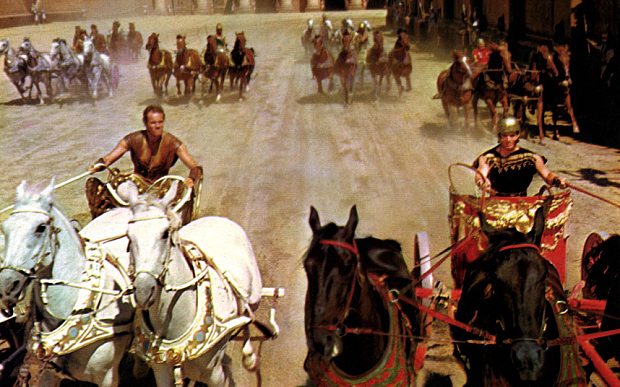
LORELAI: Hey, you in the belt – get in. LUKE: What? Oh, no, I was just sort of checking things out. LORELAI: Come on. We can pull a Ben-Hur and take down Taylor’s sleigh.
Ben-Hur, 1959 religious epic film directed by William Wyler and starring Charlton Heston, previously discussed, in the title role. It’s based on the 1880 novel Ben-Hur: A Tale of the Christ by Lew Wallace, and a remake of the 1925 silent film version.
The film focuses on a Jewish prince named Judah Ben-Hur, living in Jerusalem during the days of Christ’s ministry. Unfairly condemned to the galleys as a slave after an accidental death, Ben-Hur is later freed and becomes a champion charioteer, the film reaching its climax with a thrilling race-to-the-death against the man who sent him to the galleys.
Ben-Hur had the largest budget and the largest sets built of any film produced at the time, leading to the phrase “bigger than Ben-Hur” to describe anything on a grand scale. It was the #1 film of 1959 at the box office, received overwhelming critical acclaim, and was the second-highest grossing film of that time, after Gone With the Wind. It won a record eleven Academy Awards, including Best Picture, Best Director, Best Actor in a Leading Role, and Best Cinematographer. It is considered one of the greatest epics of all time, and one of the best films in cinematic history.
The film was released on DVD in 2001, suggesting the possibility that Lorelai had watched it fairly recently.
LORELAI: They’re here. RORY: Who? LORELAI: The Joy-less Luck Club.
Lorelai references the 1993 drama film, The Joy Luck Club, directed by Wayne Wang, and based on the 1989 novel of the same name by Amy Tan, who co-wrote the screenplay. The film is about a group of older Chinese-American women in San Francisco, all with adult daughters, who meet regularly to play mah-jong. The stories they tell each other reveals their hidden pasts, and how their family dynamics have been shaped by the interplay of Chinese and American culture.
The film was financially successful, and praised by critics for its diverse and nuanced portrayals of the experiences of Chinese-American women. It was only the second Hollywood film to have an all-Asian main cast; the first was Flower Drum Song, in 1961.
RORY: I thought maybe a certain depressed man and his wife could stay there. LORELAI: Woody and Soon-Yi?
Woody Allen (born Allan Konigsberg in 1935), multi award-winning actor and film director, famous for films such as Annie Hall (1977), Manhattan (1979), Hannah and Her Sisters (1986), and Crimes and Misdemeanours (1989). When acting a role in a comedy film, he often played a depressed, anxious, or neurotic character.
Allen had been in a long-term relationship with Mia Farrow since 1979 when, in 1991 or 1992, he embarked on an affair with Farrow’s adopted daughter from a previous marriage, Soon-Yi Previn (born circa 1970), then a college student. There was an immediate scandal when the affair became public knowledge – not only because of the age gap, but due to the perceived familial relationship. Allen denied being Soon-Yi’s stepfather, or being a father figure to her, although he did describe his role in their romantic relationship as “paternal”.
Allen and Previn married in 1997, and have since adopted two children. Woody Allen has continued making films, although his career did founder in the early 2000s – when this episode aired, his most recent offering was the costly failure, The Curse of the Jade Scorpion (2001). However, he went on to make successful films set in Europe later that decade. Recently he has gained acclaim for films such as Blue Jasmine (2013) and Cafe Society (2018), and is regarded as a cinematic genius.
SOOKIE: You know, I could still make up the dinner for the three of us. RORY: Yeah, but then it would be like the three of us, all alone in the dining room. LORELAI: It would be like The Shining, except instead of Jack Nicholson, we have Rune.
The Shining, previously discussed …. and alluded to previously within this same episode! We are now up to three or four references to this film.
LORELAI: I offered to fund the instant invention of a molecular transport device but they just didn’t go for it.
A reference to the 1975 musical comedy horror film, The Rocky Horror Picture Show, based on the 1973 stage musical. In the film, the mad scientist Dr Frank-n-Furter (played by Tim Curry) has a Sonic Transducer in his laboratory – an “audio-vibratory-physio molecular transport device”. It is capable of breaking down solid matter and projecting it through space, and possibly time.
A transducer is something which converts energy from one form to another (such as light into an electrical signal). A microphone is an example of a transducer – indeed, a sonic transducer, since it changes sound waves into electrical signals. In the musical, it’s basically a teleportation device. See Beam me up, Scotty.
(Picture shows Dr Frank-n-Furter standing against the Sonic Transducer).
SOOKIE: We are crazy for doing this. LORELAI: We’re beyond crazy. We are ‘Anne Heche speaking her secret language to God and looking for the spaceship in Fresno’ crazy. SOOKIE: Oh Quiness, Nakka dune notta.
LORELAI: Il el nostra doska don.
Anne Heche (born 1969), actress, director, and screenwriter. First became known as a soap opera actress, before gaining mainstream recognition in the late 1990s in films such as Donnie Brasco (1997) and Six Days, Seven Nights (1998). She was also famous for her high-profile three-year relationship with comedian Ellen De Generes, who came out to the press shortly after she and Anne began dating.
On August 19 2000, the day after her relationship with Ellen ended, Anne drove from Los Angeles to Cantua Creek, near Fresno, parking her vehicle on a roadside. She walked for more than a mile through the desert wearing shorts and a bra before knocking on a stranger’s door and asking for a shower. As she seemed reluctant to leave, the homeowner called the sheriff’s department. When deputies arrived, Heche told them that she was God, and would take everyone up to Heaven in a spaceship (she later said she had taken ecstasy). She was admitted to a psychiatric unit in Fresno, and released after a few hours.
While promoting her 2001 memoir, Call Me Crazy, Anne told interviewers that she had been mentally ill for the first thirty-one years of her life due to horrific sexual abuse by her father (a closeted gay man who died of AIDS when Anne was thirteen), which began when she was only a baby. Her surviving family strongly reject those claims, although even without that, her childhood doesn’t sound like a picnic.
Anne said that she created a fantasy world called The Fourth Dimension and had an alter ego named Celestia who was the daughter and reincarnation of God, spoke her own language, had special powers, and was in contact with extraterrestrials. It seems likely Lorelai read Call Me Crazy, as it is the sort of camp celebrity memoir she could not resist (like Mommie Dearest and Tears and Laughter), although all the information could be gleaned from the press at the time.
Anne Heche stated that she had no further mental health issues after the episode at Cantua Creek, and she has gone on to have a successful career in film and television.
Sookie’s statement means, “Oh God, I cannot do this” in Anne Heche’s invented language. Lorelai replies, “It’s too scary for me now”, in the same language. Anne said this when she believed God wanted her to heal a friend’s injured ankle, however she says she did go on to heal her friend through laying on of hands. Anne shared this information, including the example of her language, with Barbara Walters on 20/20 in early September 2001.
Like Lorelai and Sookie, and many others at the time, Amy Sherman-Palladino mocked Anne Heche mercilessly after going public. Their tone was completely mainstream for the time.
UPDATE: Anne Heche passed away after a car accident on August 12 2022, under the influence of narcotics.
LORELAI: For the Bracebridge Dinner. JACKSON: Geez, you guys are going crazy with this dinner. SOOKIE: Jackson, I told you, this dinner is not just about food. We are recreating an authentic 19th century meal. LORELAI: The servers are all gonna be in period clothing, they’re gonna speak period English. Here, look at the costumes.
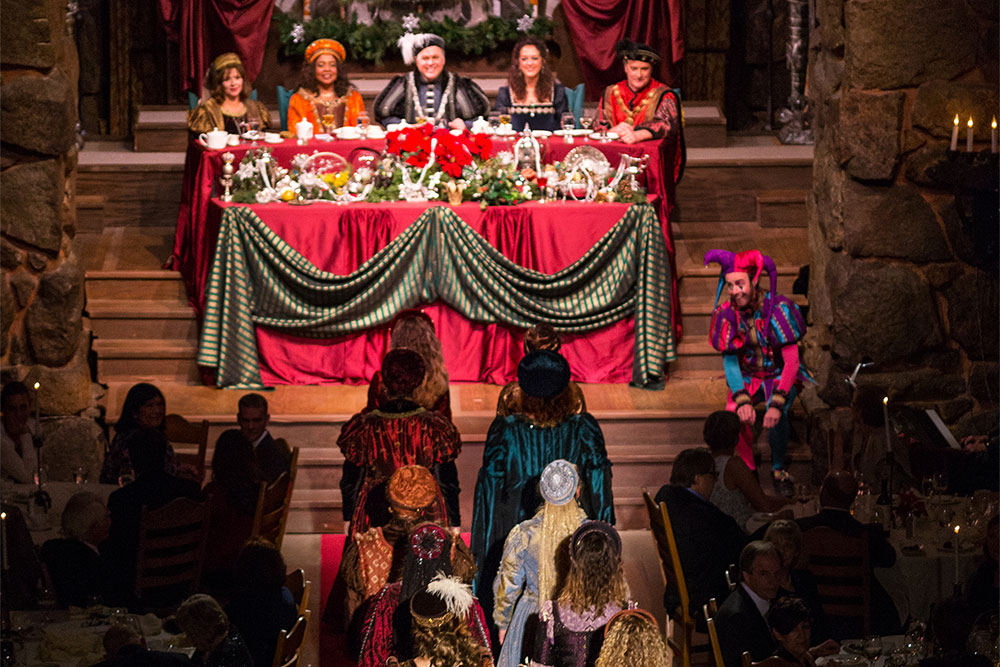
The Bracebridge Dinner is an annual tradition which has been held at the Ahwahnee Hotel in Yosemite National Park, California since 1927, when the hotel opened. The interior of the Ahwahnee was an inspiration for the hotel in Stanley Kubrick’s film, The Shining – a hint as to how Lorelai may have become interested in holding her own Bracebridge Dinner.
The Bracebridge Dinner is a seven-course formal gathering held in the Grand Dining Room and presented as a feast given by a Renaissance-era lord. It was inspired by the fictional Squire Bracebridge’s Yule celebration in a story from the 1820 work, The Sketch Book of Geoffrey Crayon, Gent., by American author Washington Irving. Music and theatrical performances based on Irving’s story accompany the introduction of each course.
Tickets to the Bracebridge Dinner cost around $400 and are generally difficult to obtain, sometimes being awarded in a lottery system. In 1992, there were 60 000 applicants for the 1650 seats available. This could be the reason why the Trelling Paper Company from Chicago have decided to hold their own Bracebridge Dinner at the Independence Inn.
Sookie says they will be serving an authentic 19th century meal, but in fact it is a Renaissance-themed meal. There’s not that much authentic about the dinner really, however I’m pretty sure the 19th century one wasn’t either. It’s a bit of fun and frolic, not a history lesson.
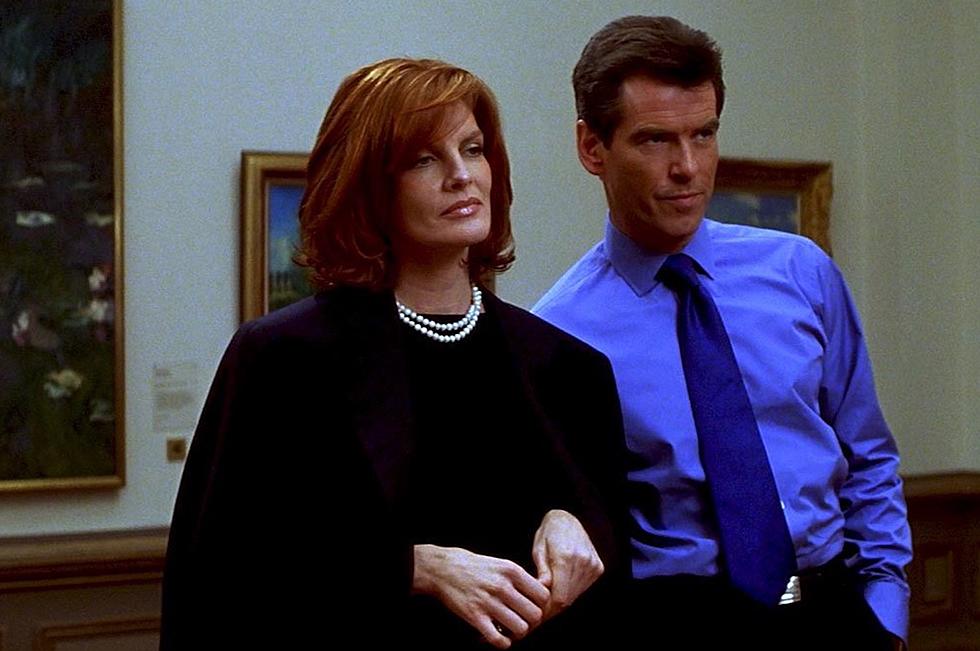
RUNE: I thought an alarm would go off like in The Thomas Crown Affair.
The Thomas Crown Affair, a 1999 romantic thriller that is a remake of the 1968 film of the same name (in the earlier version, paintings are not involved). It stars Pierce Brosnan as Thomas Crown, a billionaire who steals a painting from the Metropolitan Museum of Art of New York, and takes part in a game of cat and mouse with the insurance agent who is investigating him, played by Rene Russo. Faye Dunaway plays Crown’s therapist – in the original version, she was the pursuing insurance agent. The film was successful and well-reviewed.
Lorelai is referring to the Ernest film franchise, starring Jim Varney as a well-meaning simpleton named Ernest P. Worrell. The films came out of a series of advertisements in the 1980s, which then became a television sketch show, then a series of low-budget films, beginning with Ernest Goes to Camp in 1987, and ending with Ernest in the Army in 1998 (by this stage, the films were going direct to video). The films were not critically well-received, but quite profitable.
Although Ernest doesn’t seem to have built a snowman, he did have a winter-themed outing in Ernest Saves Christmas (1988), generally considered one of the best of the Ernest films.




 The Annotated Gilmore Girls