The Elephant Man

SOOKIE: She’s [Rory] like the most unmaterialistic kid in the world.
LORELAI: No, it’s not about what she would buy. I don’t care if she buys a house, or a boat, or The Elephant Man’s bones.

Joseph Merrick, often incorrectly called John Merrick (1862-1890) was an English man with severe facial and physical deformities who was exhibited at freak shows as “The Elephant Man”. He then went to live at London Hospital and became well known in society, even being visited by royalty. It is not known from which medical condition Merrick suffered, and DNA tests have been inconclusive.

His life story was depicted in a 1979 Tony Award-winning stage play, The Elephant Man, by Bernard Pomerance, and David Lynch did a film version in 1980, starring John Hurt in the title role.

In 1987, Michael Jackson, who had apparently related to Joseph Merrick after seeing the film The Elephant Man, reportedly offered the London Hospital one million dollars for Merrick’s bones, but the hospital refused to sell them. It seems to have been a story fabricated by Jackson himself to add to his “Wacko Jacko” persona. For some time, rumours persisted that Jackson actually owned the bones.

Cabaret

SOOKIE: Call her now. Ooh, page her, or page her and have her call my cell phone, and we can sing the money song from Cabaret. You be Liza, I’ll be Joel.

Cabaret is a 1972 musical drama film directed by Bob Fosse, and loosely based on the 1966 Broadway musical Cabaret by John Kander and Fred Ebb; this was adapted from the 1951 play I Am a Camera by John Van Drouten, and the 1939 memoir The Berlin Stories by Christopher Isherwood, which the play was based on.

Set in Berlin during the Weimar Republic of 1931, the film is about a young American named Sally Bowles (Liza Minnelli), and her bohemian life as a cabaret dancer at the Kit Kat Club. The musical shows the growing rise of the Nazi Party, as the club at first harrasses the National Socialists and then eventually allows them to dominate the audience.

The “money song” from the film is Money, Money, containing the refrain, “Money makes the world go round”. It’s sung by Liza Minelli and Joel Grey, who plays the Master of Ceremonies at the club, and acts as the storyteller of the film.

Cabaret was an immediate box office smash, and received rave reviews from critics as a completely different kind of musical – cynical, kinky, political, and bleak. It was the #7 film of 1972 and received eight Academy Awards, including Best Director, Best Actress for Liza Minelli, and Best Supporting Actor for Joel Grey. It holds the record for the most number of Oscars won by a film that did not win Best Picture. Cabaret is regarded as one of the best musical films of all time, and it turned Liza Minelli into a gay icon.

Cabaret was first released on DVD in 1998, so Lorelai and Sookie might have rented it quite recently.

Pink Ladies makeover

LOUISE: Tristan usually likes his girls bad.
MADELINE: Looks like we’re going to have to do the Pink Ladies makeover on you [Paris].
LOUISE: We’ll turn you from a sweet Sandy to a slutty Sandy. Dancing at the school fair with high heels, black spandex, and permed hair.

Madeline and Louise are referring to the 1978 romantic comedy musical film Grease, directed by Randal Kleiser and based on the 1971 stage musical of the same name by Jim Jacobs and Warren Casey. Set in the late 1950s, it is about the relationship between a “greaser” named Danny Zuko (John Travolta) and a “good girl” named Sandy Olsson (Olivia Newton-John).

In the film, Danny and Sandy are genuinely in love, but their relationship keeps hitting problems because Sandy isn’t well accepted by Danny’s friends. The Pink Ladies are a group of popular girls at the local high school who give Sandy a “bad girl makeover” to turn her into a greaser’s dream date for Danny, just as Louise describes.

Grease was a massive box office success, and the #1 film of 1978; at the time it was the highest-grossing musical. It gained good reviews for being fun and imaginative, and is considered one of the best musicals of all time, as well as one of the best high school movies.

“The beginning of a wonderful friendship”

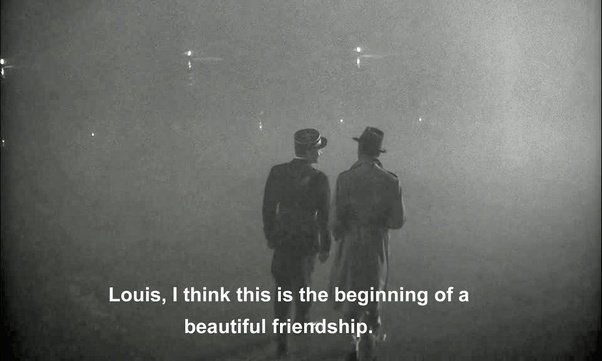
RORY: Louis, I think this is the beginning of a wonderful friendship.
TRISTAN: Who’s Louis?

Rory is referencing the 1942 romantic drama film Casablanca, directed by Michael Curtiz and based on the unproduced stage play Everybody Comes to Rick’s by Murray Burnett and Joan Alison.

Set in Casablanca, Morocco during World War II, it is about an American nightclub owner named Rick Blaine (Humphrey Bogart) who must choose between his lost love Ilsa Lund (Ingrid Bergman) and helping her husband Victor Laszlo (Paul Henreid), a Czech Resistance fugitive, escape from Vichy-controlled Casablanca so he can fight against the Nazis.

When the corrupt prefect of police Louis Renault (Claude Rains) tries to arrest Victor, Rick forces Renault to instead assist Victor and Ilsa to escape by holding him at gunpoint. At the last moment, Rick makes Ilsa leave with her husband. Louis suggests to Rick that they join the Free French in Brazzaville, in the Congo, and in the final scene Rick says, “Louis, I think this is the beginning of a beautiful friendship”.

Rory seems to be suggesting that she and Tristan could form a friendship based on doing the right thing – that is, forgetting all about their kiss (which was apparently mutually enjoyable) and putting others’ needs before their own. Tristan doesn’t recognise the slight misquote, which dooms him as a potential love interest. Even Dean got Rory’s movie references.

Casablanca was the #9 film of 1942, received very good reviews, and won three Academy Awards, including Best Picture. Its reputation has only increased with time, and it continues to be well loved and popular with audiences. Casablanca is generally regarded as one of the best films ever made, and a shining example of the Golden Age of Hollywood.

This is another of Lorelai and Rory’s favourite films.

Hannibal Lecter

RORY: You said you were going to swear off girls – it’s funny.
TRISTAN: You don’t think I can?
RORY: No, I think you can, I just think it would be hard for you. It’d probably involve some kind of lock up facility, one of those Hannibal Lecter masks.

Dr. Hannibal Lecter is a character in a series of suspense novels by Thomas Harris, first appearing in the 1981 Red Dragon as a highly intelligent and cultured cannibalistic serial killer.

Rory is almost certainly thinking of the 1991 horror-thriller film The Silence of the Lambs, directed by Jonathan Demme, and based on the 1988 novel of the same name by Thomas Harris. In the film, Dr. Hannibal Lecter (Anthony Hopkins) is incarcerated for his crimes, and while being tranferred to another psychiatric facility is forced to wear a mask that acts like a muzzle (it doesn’t work).

The Silence of the Lambs was the #4 film of 1991 and won five Academy Awards, including Best Picture and a Best Actor for Hopkins. Hannibal Lecter is often regarded as one of the most frightening villains in cinema history.

Interestingly, the director of the sanitarium where Hannibal Lecter is confined is named Dr. Frederick Chilton, a self-important, incompetent man who is easily outwitted by Lecter. The film strongly suggests that Lecter will eventually murder and eat Chilton in revenge.

This is possibly where the name Chilton came from for Rory’s school, to suggest a strict and pompous confinement, yet with a certain laxness as well, giving the possibility of escape.

“The fish flies at night”

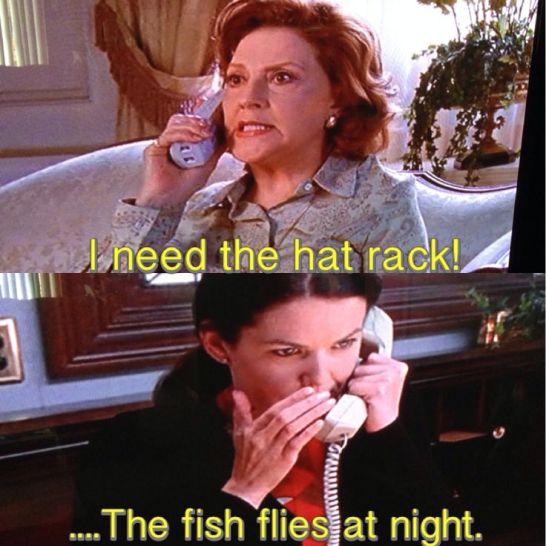
EMILY: [on phone] I need the hat rack.
LORELAI: [whispers mysteriously] The fish flies at night.

A parody of the messages given in code in spy films, such as the James Bond and Mission Impossible series. Lorelai decides her mother’s comment sounds like a code sign, so she jokingly gives the “countersign”. Get Smart often used ridiculous signs and countersigns like this.

It’s rather similar to an exchange in the sitcom Murphy Brown, where Murphy tells someone she’s pregnant by saying in shock, “The stick turned blue!”. The other person thinks it must be code for something, and mutters back, “The dog barks at midnight”.

Marx Brothers

TRISTAN: Uh … you left this [handing Rory her notebook.]
RORY: Oh yeah, I did. Thanks.
TRISTAN: Sure. [both try to go through the doorway together and back up]
RORY: Well, that could have been a potential Marx Brothers moment.

The Marx Brothers were an American family who formed a highly successful comedy act in vaudeville, on Broadway, and in film, from 1905 to 1949. They are generally known by their stage names: Groucho, Chico, Harpo, Zeppo, and Gummo. Considered to be among the greatest comedians of the twentieth century, several of their films are regarded as comedy classics.

During the show, it became apparent that The Marx Brothers made some of Lorelai and Rory’s favourite films. Amy Sherman-Palladino is also a big fan of The Marx Brothers.

“They get all the sex”

LOUISE: I’ll be the lady-in-waiting. The one with the low-cut blue velvet Renaissance dress.
PARIS: Lady-in-waiting is not a political office.
LOUISE: No, but they get all the sex.
PARIS: What?
LOUISE: Watch a movie.

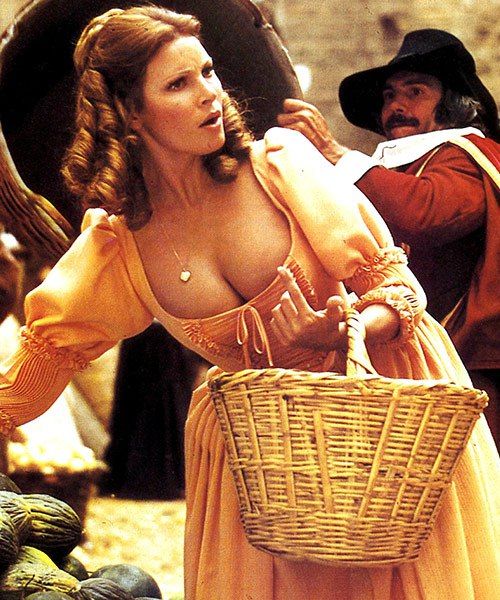
In period films, it is fairly common to have the lady-in-waiting be the “sexy” figure, as compared to the noble, romantic, or dull queen or princess she is companion to. A classic example is Racquel Welch in The Three Musketeers (1973); she plays the lady-in-waiting Constance, and all her gowns are low-cut to display her assets [pictured].

Louise seems to be thinking of a specific lady-in-waiting in a blue velvet dress, but I don’t know which one. The period film Elizabeth came out in 1998, based on the early reign of Elizabeth I; as they are studying her in Government that would seem the most likely candidate. However, there is no dress such as Louise describes, and although one of the ladies-in-waiting does have sex because of a particular dress, it ends in tragedy for her.

“Grumpy McFarland”

RORY: Grandpa says I remind him of her [Richard’s mother].
LORELAI: That is the biggest compliment that can be wrenched out of Grumpy McFarland, believe me.

I think Lorelai is making a play on Spanky McFarland, one of the characters from the Little Rascals movies, earlier discussed. He was played by George McFarland, and in the earliest movies when he just a toddler, did have a rather grumpy demeanour.