LUKE: And even if he does stay, it’ll be only for another year, and then he’ll go off to college or Attica or whatever, and it’ll just be me again.
Attica Correctional Facility, a maximum security state prison located in the town of Attica, New York. Constructed in the 1930s, it has held some of the most dangerous convicts of the times. Prisoners are often here because of disciplinary problems in other institutions.
Some of its past infamous inmates include serial killer David Berkowitz “Son of Sam”, and Mark Chapman, the assassin of John Lennon (both now held elsewhere). Ironically, John Lennon and Yoko Ono released a 1972 song called “Attica State”, lamenting the loss of life in the 1971 Attica State prison riots, as well as the poor living conditions and humans rights abuses in the US prison system. It appears on the album Some Time in New York City.
This is a very harsh comment from Luke about Jess, even as a joke. Before Jess arrived, Luke seemed to think he was nothing more than a slightly wayward teen only in need of a stable home. After six months, he seems to think it’s a toss-up whether Jess will go to college or prison (perhaps under Lorelai’s influence, who was saying that before she even met Jess). In fact, Jess will do neither.
Interestingly, the historic region of Attica in ancient Greece was the location of the city of Athens, a centre for learning and culture during its Golden Age. Jess will end up working in a job where his mind is put to good use. He’ll also live in an American city with a Greek name!
Rory buys several books at the fundraiser, but only a couple of the titles are visible. Gypsy the mechanic is volunteering her time to work at the fundraiser, and she points Rory to the astronomy section, as if Rory has an interest in this area, and Gypsy somehow knows about it. Both quite surprising things to learn! The Buy a Book Fundraiser is held outside the library, and may be raising funds for new books.
Inherit the Wind
A 1955 play by Jerome Lawrence and Robert E. Lee, fictionalising the events of the Scopes “Monkey” Trial. This was a legal trial in July 1925 where schoolteacher John Scopes was taken to court by the state of Tennessee for teaching human evolution. There was intense media scrutiny of the case, with publicity given to the high-profile lawyers who had taken the case. The prosecution had former Secretary of State, William Jennings Bryan, while Clarence Darrow defended Scopes – the same lawyer who had defended child murders Leopold and Loeb, previously discussed. Scopes was fined $100, but the case was overturned on a technicality. The case was seen as both a theological contest, and a test as to whether teachers could teach modern science in schools.
The play gives everyone involved in the Scopes Trial different names, and substantially alters numerous events. It is not meant to be a historical account, and is a means to discuss the McCarthy trials of the 1950s, where left-wing individuals were persecuted as Communist sympathisers, under a regime of political repression and a fear-mongering campaign.
Rory might be particularly interested in the play because of the focus it places on the media, with reporter E.K. Hornbeck covering the case for a fictional Baltimore newspaper. He is based on journalist and author H.L. Mencken, previously discussed as one of Rory’s heroes, who gained attention for his satirical reporting on the Scopes Trial for the Baltimore Morning Herald.
Inherit the Wind premiered in Dallas in 1955 to rave reviews, and opened on Broadway a few months later with Paul Muni, Ed Begley, and Tony Randall in the cast. It’s been revived on Broadway in 1996 and in 2007, as well as in Philadelphia, London, Italy, and India.
It was adapted into film in 1960, directed by Stanley Kramer, and with Spencer Tracey starring as the defence lawyer, Dick York as the schoolteacher, and Gene Kelly as the Baltimore journalist. It received excellent reviews and won awards at the Berlin Film Festival. It’s also been made for television in 1966, 1988, and in 1999 (starring George C. Scott, Jack Lemmon, and Beau Bridges). It seems likely that Rory watched the most recent version on television.
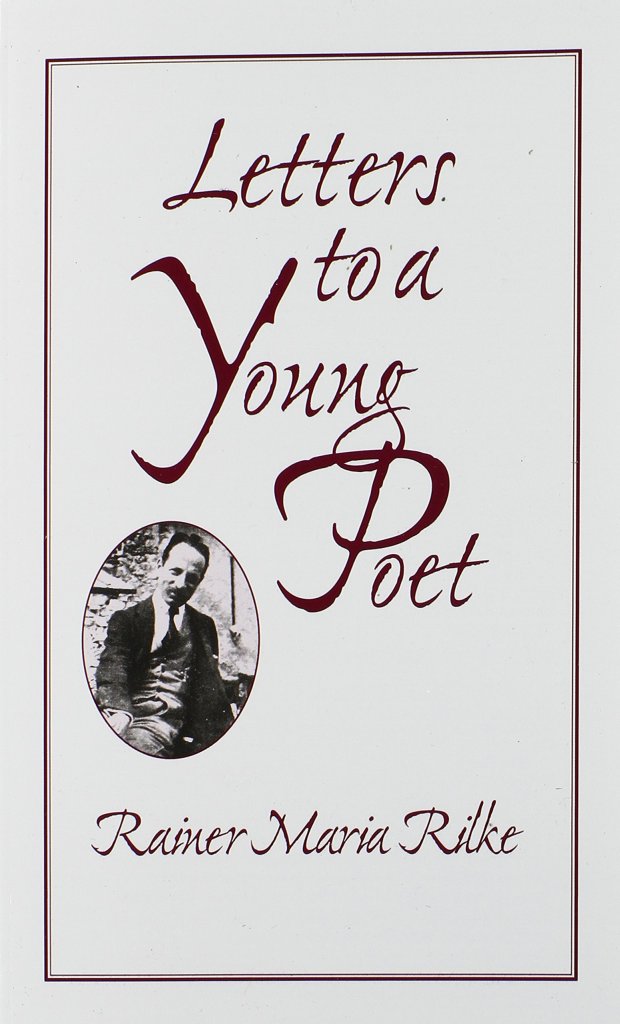
Letters to a Young Poet
A 1929 collection of ten letters written by the Bohemian-Austrian poet Rainer Maria Rilke, to a young officer cadet named Franz Xaver Kappus at the Theresian Military Academy in Wiener Neustadt, Austria between 1902 and 1908.
Kappus had written to Rilke, seeking advice on the quality of his poetry, to help him choose between a literary career, or one as an officer in the Austro-Hungarian Army. Kappus had been reading Rilke’s poetry when he discovered that Rilke had earlier studied at the academy’s lower school in St. Pölten, and decided to write to him for advice.
Rilke gave Kappus very little criticism or suggestions on improving his writing, and said that nobody could advise him or make life decisions for him. Over the course of ten letters, he instead provided essays on how a poet should feel and seek truth in experiencing the world around him. They offer insights into Rilke’s poetic ideas and themes, and his work processes.
Kappus did meet Rilke at least once, and despite his concerns about pursuing a military career, he continued his studies and served for 15 years as an army officer. During the course of his life, he worked as a journalist and reporter, and wrote poems, stories, novels, and screenplays. However, he never achieved lasting fame.
This is a book which features a future journalist – but one who yearns to become a poet. Is it a sign that Rory secretly wishes she could become a creative writer instead? Is she hoping that being successful in journalism will help her become a published author (it’s definitely a help in getting novels published, or at least considered). Is it even a hint that she will become a writer in the future, as she does in A Year in the Life, but is not destined to become famous from her writing? (Most published writers, even quite successful ones, don’t get famous, after all).
And is this correspondence between a poet and a student at a military academy meant to suggest that Rory is still thinking of Tristan, who went away to military school? Are she and Tristan actually writing to each other, or is the show leaving the door open for Tristan to possibly return in a future season, since they didn’t know how long One Tree Hill was going to last?
RORY: And the past couple of years she hasn’t even dated anyone unless she thought that for sure it could be a lasting relationship, and she’s got some specific goals now concerning children. LORELAI: Oh, here we go. RORY: She wants at least two, and before she met Dad she was seriously considering single parenthood.
Later events will seriously call into question this supposed strong desire Sherry has to have children.
RICHARD: There are a lot of nice historical places up there [in Boston]. CHRISTOPHER: Something historical in our price range would be perfect.
Richard might be thinking of the historic Back Bay and Beacon Hill neighbourhoods in Boston, famous for their rows of Victorian brownstone terrace houses. Such brownstones can cost millions today, and no wonder Christopher is quick to qualify it as “in our price range”.
When we eventually see Christopher and Sherry’s apartment in Boston, it does look like it’s supposed to be a historic brownstone-ish sort of building, but in a retail/dining area, so presumably cheaper. (It’s just filmed on the Warner Bros lot, it’s not a real apartment).
RORY: On the bridge, that’s where we’re gonna eat? JESS: Yup.
Jess tells Rory that they will be having sharing their picnic on the bridge over the lake, a place in Stars Hollow that he has grown fond of. Later it will become a special place for he and Rory.
The scene of them having a picnic is a homage to the 1958 Southern Gothic comedy-drama film The Long Hot Summer, directed by Martin Ritter. The screenplay is partially based on the 1955 Tennessee William’s play Cat on a Hot Tin Roof, and three works of William Faulkner, one of Rory’s favourite authors (she can’t resist Southern Gothic).
In the film, Paul Newman plays Ben Quick, a crude, magnetic young man with a bad reputation for burning down barns who is expelled from his town and forced to go elsewhere. Joanne Woodward plays his love interest, rich girl Clara Varner, who fights their sexual tension all the way, but eventually falls in love with him. It turns out the enigmatic drifter’s bad reputation is undeserved, and he is actually very ambitious.
The Long Hot Summer received excellent reviews from critics, but didn’t do well at the box office. Paul Newman won Best Actor at the Cannes Film Festival for his role as Ben. It’s been turned into a television series twice, once in the 1960s, then again in the 1980s.
This is another film with a bidding war over a picnic basket, which the masterful Ben wins, itself a homage to the auction in Oklahoma! There is a scene of Ben and Clara sharing their picnic near a bridge, similar to Jess and Rory on the bridge. In the scene, the icy Clara begins to thaw out to Ben, and reveal some of her true self. In the same way, this is the first time that Rory really begins to open up to Jess. Bridges are symbols of transition, showing that Rory and Jess are moving into a new stage of their relationship.
There is a strong hint from the film that Jess is not as black as he has been painted, and there is a foreshadowing of his hidden ambitious streak.
Paul Newman and Joanne Woodward fell for each other on set, and married shortly after the film. Alexis Bledel and Milo Ventimiglia also dated in real life while filming Gilmore Girls.
SOOKIE: Because I’m baking for the picnic tomorrow and it’s supposed to be a surprise. JACKSON: Oh sure, never see a pie before an auction, it’s bad luck.
Jackson is making a joke based on the old superstition that it is unlucky for the groom to see the bride’s wedding dress before their wedding. Not only is it a sign that he is thinking about marriage, it’s a possible foreshadowing of a future episode when a wedding dress is unluckily seen.
When Rory shows Richard her bedroom, he checks out her bookshelf. Here are some of the books we can see:
Summer of Fear
A 1993 serial killer novel by T. Jefferson Parker, who writes bestselling police procedural novels set in California. Parker is a journalist who turned novelist – perhaps a tiny hint of where Rory’s career is eventually headed.
The Scarecrow of Oz
A 1915 children’s book by L. Frank Baum, the ninth in his series of Oz books. The Wizard of Oz is a touchstone for Gilmore Girls, and this seems to be a little nod to the land of Oz. The Scarecrow from the original story is the magical helper (the one who didn’t have a brain, but was actually quite smart), and the human protagonists are a man and a little girl from California.
Contact
A 1985 science novel by scientist Carl Sagan. The heroine is a scientist named Ellie who showed a strong aptitude for science and mathematics from a young age, and has been left emotionally bereft by the loss of her father, with a problematic relationship with her mother. Contact with an alien civilisation allows Ellie a strange chance to reconnect with her memories of her father. It feels like something that would resonate with Rory. Ellie is also from California. The novel was a bestseller, and made into a film in 1997, starring Jodie Foster. The film might have given Rory an interest in reading the novel.
The Apocalyptics: Cancer and the Big Lie
Edith Efron was a journalist who began her career at the New York Times Magazine, became a member of Ayn Rand’s circle and wrote for her magazine, and then became editor of TV Guide at the height of its popularity. She was critical of what she perceived as “liberal bias in the media”, but provided a strong voice on race relations (Efron had a biracial son during 1950s segregation). She later wrote for the libertarian publication, Reason. The Apocalyptics is a 1984 exposé of the cancer industry and a criticism of environmental policy which Efron saw as being based on “bad science” (basically saying Rachel Carson etc were all a bunch of doom-merchants). It’s an obscure, controversial, and extremely heavy-going work. An intriguing insight into Rory’s interests.
Working: People Talk About What They Do All Day and How They Feel About What They Do
A 1974 non-fiction book by oral historian and radio broadcaster Louis “Studs” Terkel. An exploration of what makes work meaningful for people, based on interviews with people from all walks of life. It was a bestseller, and turned into a Broadway musical in 1977, and a graphic novel in 2009.
A book by “Tobias Allcot”
This seems to be a fictional book which would have been created by the props department as a slightly odd joke. Tobias Allcot is the name of a Pulitzer Prize-winning author in the film The Man from Elysian Fields, directed by George Hinkenlooper; James Coburn portrays Allcot. The film wasn’t released until September 2002, but had been shown at the Toronto Film Festival in September 2001.
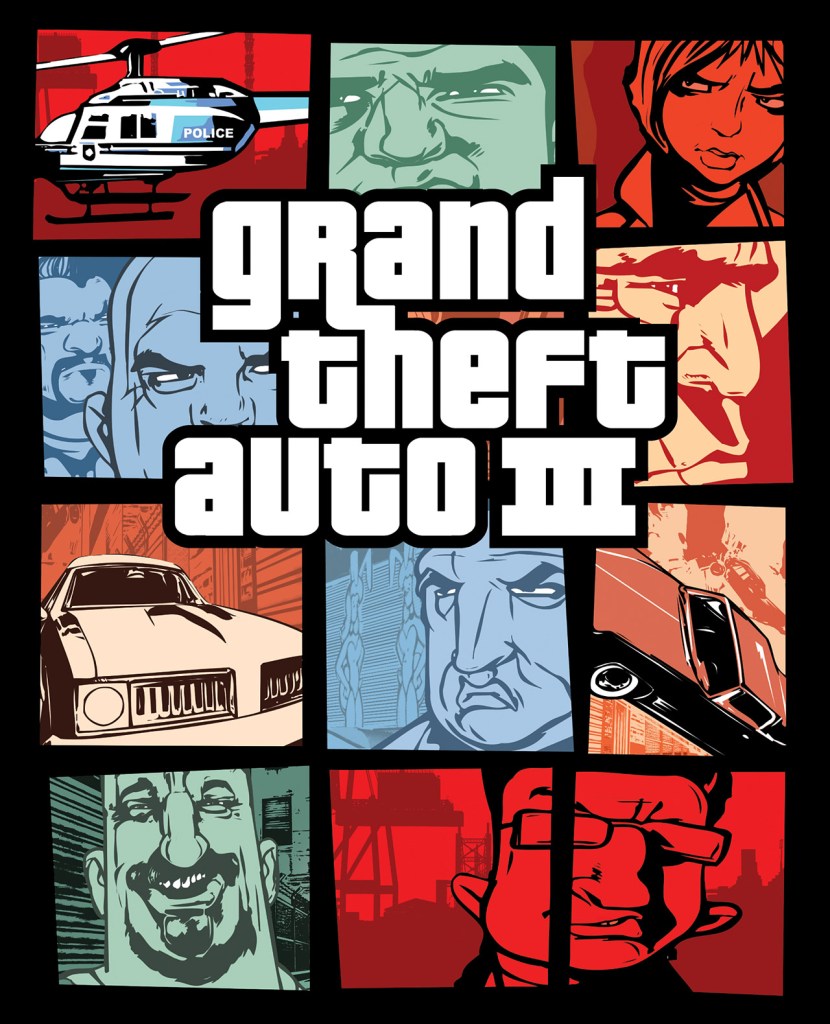
A poster for this video game is displayed in the window of Stars Hollow Video – the store obviously hires out games as well as movies.
Grand Theft Auto III is a 2001 action-adventure game developed by Rockstar. Set in fictional Liberty City (loosely based on New York City), it follows the adventures of Claude, who becomes embroiled in a world of crime, drugs, gangs, and corruption. The game received critical acclaim, was the best-selling game of 2001, was named Game of the Year, and is considered to be one of the greatest video games ever. It was also controversial for its depiction of sex and violence.
It’s possible that this is a foreshadowing of Rory’s own Grand Theft Yacht, but more likely a comment on freedom of speech.
Emily goes to to the kitchen to get more bread (wherever is the cook or the maid during these dramatic kitchen scenes? Do they just happen to be on a break in the middle of a meal, or in the toilet? Is there another food preparation or storage room somewhere? Even weirder, are they just out of shot and actually present the whole time?).
Lorelai apologises to Emily for not trusting her motives in helping, saying that she isn’t used to people doing things without strings attached. Emily immediately realises that Lorelai is talking about her and Richard, but Lorelai continues thanking her, saying she didn’t have anywhere to turn and was all out of ideas, and that she doesn’t know what she would have done without Emily. Hm, maybe she needs to thank and apologise to Rory as well now?
Emily thanks Lorelai, and then gives her parting shot – with a wicked smile, she tells her the DAR will be holding all their meetings at the Independence Inn from now on. She leaves, seemingly without the bread she supposedly came in for. Emily wasn’t joking either. A year later, there is mention of the DAR meetings still being held at the inn.
Of course, the DAR would have been free to book the Independence if they wanted to anyway, and Emily has organised things so that the inn Lorelai manages gets more business. It’s up to the viewer whether she has really taken revenge on Lorelai, or is trying to give her even more help. Or both!
Note how beautifully this scene is composed and shot, and that here is the colour red again to indicate strong emotion. Lorelai in red with a red light on her hair, vase of red flowers, red strawberries on the cake, little red desserts, red grapes, a red pepper in the fruit bowl (slightly oddly). Only Emily remains in cool blue and silver, her emotions under control.





 The Annotated Gilmore Girls