RORY: Yikes. What kind of vibe are you giving her? LANE: Oh, my patented Keith Richards circa 1969 ‘don’t mess with me’ vibe, with a thousand-yard Asian stare thrown in.
The thousand-yard stare is a phrase often used to describe the blank, unfocused gaze of soldiers during wartime who no longer react to the horror they’re living through. More generally, it can apply to any victim of trauma.
The phrase was popularised during World War II after Life magazine published a 1944 painting by Tom Lea, titled The Marines Call It That 2000-Yard Stare [pictured], but became especially known during the Vietnam War, when it decreased to a slimmer, punchier 1000-yard stare.
Lane dramatically compares her life being brought up in a traditional Asian-American household as akin to that of someone with PTSD on a battlefield.
FRAN: Oh, I don’t enjoy vacations. I toured the California Gold Country ten years ago. It was hot and the bus smelled.
The Gold Country (also known as Mother Lode Country) is a historic region in northern California, mostly around the Sierra Nevada and into the Sacramento Valley. It’s famous for the gold mines which attracted immigrants, known as the ’49ers, during the 1849 California Gold Rush. Most of the mines were shut down in 1942 because of World War II, but several gold rush towns are still popular tourist attractions.
Fran would have taken her bus tour around the Gold Country in 1991, presumably in summer since she says it was hot. Summers are hot and dry in this region.
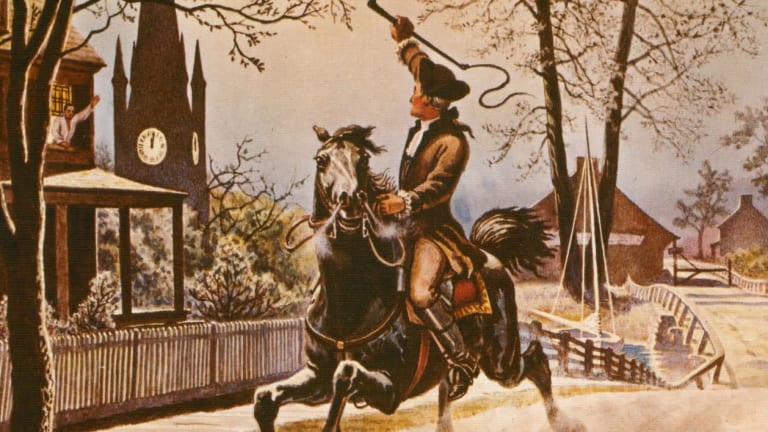
LORELAI: It shouldn’t be too flashy. SOOKIE: How about something historical, like ‘The Paul Revere’?
Paul Revere (1735-1818) was a Boston silversmith and patriot of the American Revolution. He is best known for his midnight ride to alert the colonial militia in 1775 to the approach of the British forces before the battles of Lexington and Concord. It was dramatised in Henry Wadsworth Longfellow’s 1861 poem, Paul Revere’s Ride, which significantly increased Revere’s stature, and made him part of American legend.
LORELAI: Mmm, I’m terrible at coming up with names. When we first bought out house, Rory and I wanted to name it, you know, like Jefferson named his place Monticello, but all we could come up with is The Crap Shack.
Former US President Thomas Jefferson, previously discussed, called his main plantation Monticello, from the Italian for “little mountain”, as it’s situated on a peak of the Southwest Mountains, near Charlottesville, Virginia. The plantation house was first begun in 1768 in a neoclassical style, but extensively remodelled in the 1790s with elements from Parisian homes Jefferson had seen in France and ideas of his own devising, and work continued into the 1820s. Monticello is now a National Historic Landmark and a UNESCO World Heritage Site, and features on the US five cent coin.
Notice that Lorelai wears a black blouse with a red cherry print design on it – Monticello is famous for its orchard, including its cherry trees. You can still buy cherry preserves from the Monticello gift shop. I cannot say if the colour of the blouse is significant in light of the slave labour that was used at Monticello, and even to some extent, in the building of the plantation house itself.
This is the first time we learn that Lorelai and Rory supposedly called their house The Crap Shack when they moved in, when Rory was eleven. Presumably the house was in poor condition, and has needed a lot of work to get it to the standard we see. It can’t be a name they use very often – they’ve always just referred to as “home” or “the house” so far. Perhaps that’s because the house is now far less crappy than when Lorelai bought it and the name doesn’t really apply any more.
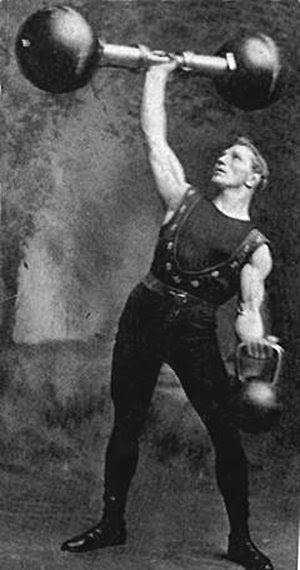
AVA: Oh, he’s adorable. And he [Luke] looks strong, is he strong? LORELAI: Oh I don’t know. I don’t think he’s gonna be in a sideshow anytime soon, but he can get the lid off a pickle jar.
The Strongman, a man performing amazing feats of strength, was a circus sideshow attraction in the 19th and early 20th centuries. Yep, another circus reference! These days, Strongman events have become athletic competitions.
Ava’s later comment about hoping Luke is unattached is a sign that she is a single mother, like Lorelai. It seems as if Lorelai might have more in common with some of the Chilton moms than she thought. However, Ava’s interest in Luke has doomed her chances of becoming Lorelai’s friend, which is a shame as they seemed like they could have got on well together, and been allies in the Chilton world. Romantic and sexual attraction pretty much ruins everything in Gilmore Girls.
LORELAI: I want Luke to look at it. MAN: Hey, I put this thing together. LORELAI: Yes, and I loved your work in Pisa. Now get out of the way, please.
The Leaning Tower of Pisa, a freestanding bell tower of the cathedral in the Italian city of Pisa. It began leaning during its construction in the 12th century, due to unstable foundations, and is famous worldwide. Numerous efforts have been made to restore it to its vertical position: most failed, several have made it worse. It has been straightened slightly and stabilised since the 1990s, but it’s such a tourist attraction as a tilting tower that nobody really wants it corrected.
RORY: I’m jumpy. On the Fourth of July, forget it, I’m a wreck. And when the Stars Hollow orchestra begins to play in the gazebo, the guy banging the cymbals, I’m . . . it drives me nuts.
Fourth of July is the date of Independence Day, and often used colloquially as its name. It’s a federal holiday in the US, commemorating the signing of the Declaration of Independence from Britain on July 4th 1776. A day of patriotic display, music, fireworks, and mid-summer picnics and barbecues.
We never get to see the Fourth of July in Stars Hollow, but of course they would have the same sort of celebrations as elsewhere. Presumably it is the fireworks which make her “jumpy”. Rory tells us that there is a town orchestra who plays in the gazebo on this date – which means the orchestra must be small, that they all fit in the gazebo.
LORELAI: Um, guys, hi, there’s a lady up there with a rock the size of Neptune around her neck talking about the debutantes of ancient Greece. It’s a lot easier to fall asleep if you’re sitting down, trust me.
The planet Neptune, the eighth planet from the Sun, was officially discovered in 1846, although it had been previously sighted and thought to be a star. It has a mass of 1.0243×1026 kg, making it 17 times more massive than the Earth. It is named after the Roman god of the sea, who interestingly, carries a trident, which Rory referenced earlier.
Symbolically, Neptune is associated with dreams and fantasy, suggesting that the debutante ball is creating an illusion, and there is little that is solid or genuine behind it. Notice that Emily despairs that the elegant ballroom is not all that it appears, the debutantes are “false” in that they have artificially changed their appearance, and that there is something insubstantial about the proceedings – which we barely manage to see. Not to mention that the ball itself takes a rather surreal turn, as if it is all just a dream. (Is it pure coincidence that Lorelai immediately talks about falling asleep?).
Lorelai’s statement about “the debutantes of ancient Greece” can be taken as nothing more than a joke – as if the MC’s reminiscences about her own debut must be positively ancient. However, the ancient Greeks did hold puberty rites for girls, of which you could say debutante balls are the spiritual successor. It seems very unlikely the MC would really mention ancient puberty rites, but the ball is just bizarre enough for this to be taken at face value.
While discussing preparations for the ball, it transpires that Rory will be wearing a crinoline under her dress, and Dean will need to wear a cummerbund.
A crinoline is another word for a hoop skirt, previously discussed.
A cummerbund is a broad sash worn around the waist, these days usually with a dinner jacket or tuxedo. Originating in Persia, they were adopted by British officers stationed in India, and adopted as an alternative to the waistcoat. A cummerbund is worn for black tie events in North America.
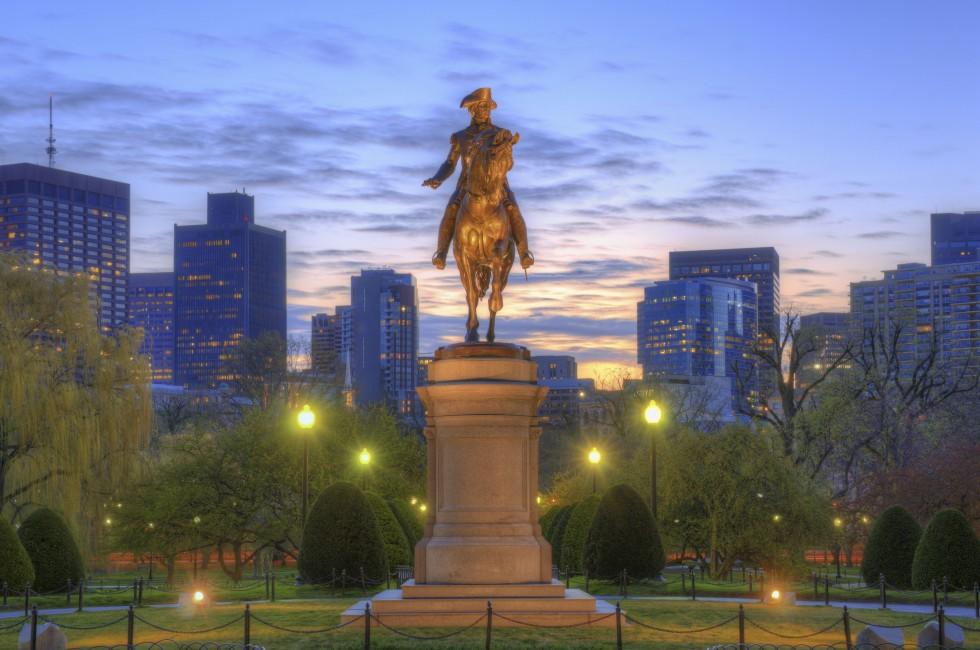
Boston is the capital of, and largest city in, the state of Massachusetts. It was founded by Puritan colonists in 1630. It has a population of more than 600 000 people, is one of the economically most dominant cities in the world, and is known for its diversity of neighbourhoods. It’s about two and a half hours drive from where Stars Hollow would be, so Christopher is significantly closer to them now. It’s also 15 minutes drive from Harvard University ….
Note that Christopher has moved to Boston without letting Lorelai and Rory know, or even giving them the landline number for his new apartment. It seems he hasn’t spoken to them since Lorelai’s bachelorette party, with the excuse that he was giving Lorelai space after she broke her engagement. Which might be reasonable, except he has a daughter, and there’s no excuse for not phoning her. Once again, Rory is an afterthought in Christopher’s relationship with Lorelai, rather than the focal point she should be.
Christopher quickly rattles off a few associations for Boston:
Boston baked beans
Baked beans sweetened with molasses and flavoured with salt pork or bacon. It’s been a speciality of Boston since colonial times, and baked beans with frankfurters is a favourite dish. Boston is sometimes known as Beantown.
Boston cream pie
A sponge cake with custard or cream filling, glazed with chocolate. It’s said to have been created in 1881 at the Parker House Hotel in Boston by a French chef. It’s the official dessert of Massachusetts.
Boston Tea Party
A political protest by the an organisation called the Sons of Liberty in Boston on December 16 1773. It was in protest of the Tea Act, which allowed the British East India Company to sell tea from China in American colonies without paying taxes apart from those imposed by British parliament. The Sons of Liberty strongly opposed the taxes as a violation of their rights, with the slogan “no taxation without representation”. Protesters destroyed an entire shipment of tea sent by the East India Company, boarding the ships and throwing chests of tea into Boston Harbor. The British government responded harshly, and the episode escalated into the American Revolution. The Tea Party became an iconic event of American history.
Boston Strangler
The name given to the murderer of thirteen women in Boston in the early 1960s; most were sexually assaulted and strangled in their apartments with no signs of forced entry. In 1967 a man named Albert DeSalvo confessed to being the Boston Strangler while serving life imprisonment for a series of rapes; he was found stabbed to death in prison in 1973. Although his confession revealed some details of the crimes unknown to the public, and DNA evidence has linked him with the Strangler’s final victim, doubts remain as to whether he committed all the Boston murders. George Nassar, the prison inmate DeSalvo reportedly confessed to, is the major suspect; he is currently serving life in prison for murder. Several films have been made about the case, most notably The Boston Strangler (1968), starring Tony Curtis.
Christopher’s glib associations for the city bring to mind the way Rory summed up Chicago to Dean as “Windy. Oprah”.







 The Annotated Gilmore Girls