LORELAI: I know. He’s been sitting there like the final days of Dick Nixon for almost an hour.
Richard Nixon (1913-1994), 37th President of the US from 1969 to 1974. The Watergate Affair, the name used to describe the secret and illegal activities undertaken by members of the Nixon administration, was brought to light by reporters Carl Bernstein and Bob Woodward in The Washington Post in 1972.
Nixon had hoped to weather the storm by refusing to leave, but impeachment hearings against him opened in May 1974. With loss of political support, and the near-certainty he would be impeached and removed from office, Nixon resigned on August 9 1974.
Lorelai may be specifically referring to the 1976 non-fiction book, The Final Days, by Carl Bernstein and Bob Woodward, describing the last months of Richard Nixon’s presidency. It was a major commercial success, and was made into a television movie of the same name in 1989, with Lane Smith as Richard Nixon.
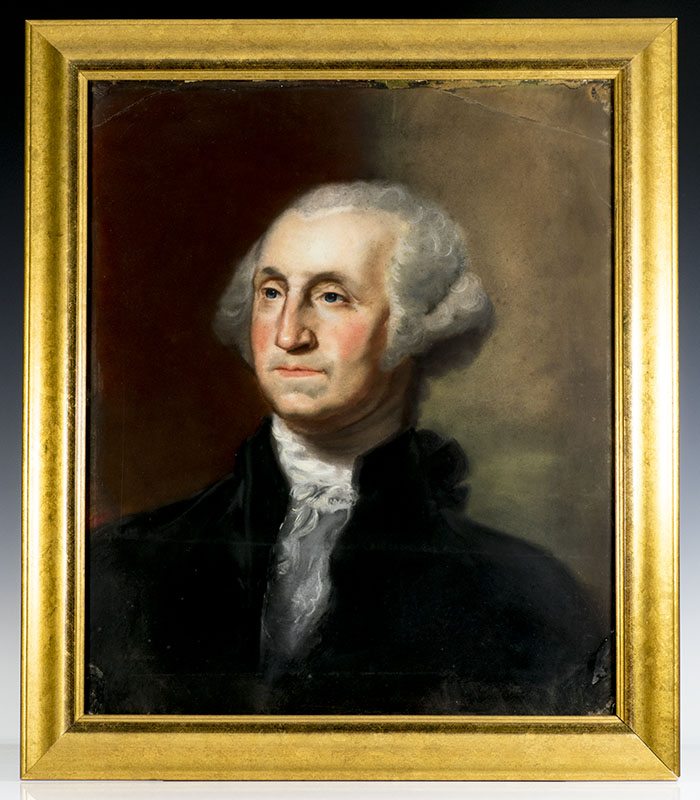
EMILY: It was for charity, I had to bid on something. And I certainly didn’t want another portrait of George Washington. I’ve got four in the attic already.
George Washington (1732-1799), soldier, statesmen, and Founding Father who served as the first President of the United States from 1789 to 1797. Commander of the Continental Army he led the Patriot forces to victory during the American Revolutionary War, and presided over the 1797 convention which established the Constitution of the United States, and its federal government. He has been called “the Father of the Nation” for his leadership during the formative days of the country.
His legacy endures as one of the most influential people in American history, and his birthday has been a federal holiday in the US since 1879, celebrated on the third Monday in February. The Washington Monument in Washington DC is an obelisk built in his honour, his face is one of the four presidents carved into Mount Rushmore, while Washington state is the only US state to be named after a president. George Washington appears on the one dollar bill, and appeared on the nation’s first postage stamps in 1847.
George Washington was the husband of First Lady Martha Washington, previously discussed.
LUKE: And even if he does stay, it’ll be only for another year, and then he’ll go off to college or Attica or whatever, and it’ll just be me again.
Attica Correctional Facility, a maximum security state prison located in the town of Attica, New York. Constructed in the 1930s, it has held some of the most dangerous convicts of the times. Prisoners are often here because of disciplinary problems in other institutions.
Some of its past infamous inmates include serial killer David Berkowitz “Son of Sam”, and Mark Chapman, the assassin of John Lennon (both now held elsewhere). Ironically, John Lennon and Yoko Ono released a 1972 song called “Attica State”, lamenting the loss of life in the 1971 Attica State prison riots, as well as the poor living conditions and humans rights abuses in the US prison system. It appears on the album Some Time in New York City.
This is a very harsh comment from Luke about Jess, even as a joke. Before Jess arrived, Luke seemed to think he was nothing more than a slightly wayward teen only in need of a stable home. After six months, he seems to think it’s a toss-up whether Jess will go to college or prison (perhaps under Lorelai’s influence, who was saying that before she even met Jess). In fact, Jess will do neither.
Interestingly, the historic region of Attica in ancient Greece was the location of the city of Athens, a centre for learning and culture during its Golden Age. Jess will end up working in a job where his mind is put to good use. He’ll also live in an American city with a Greek name!
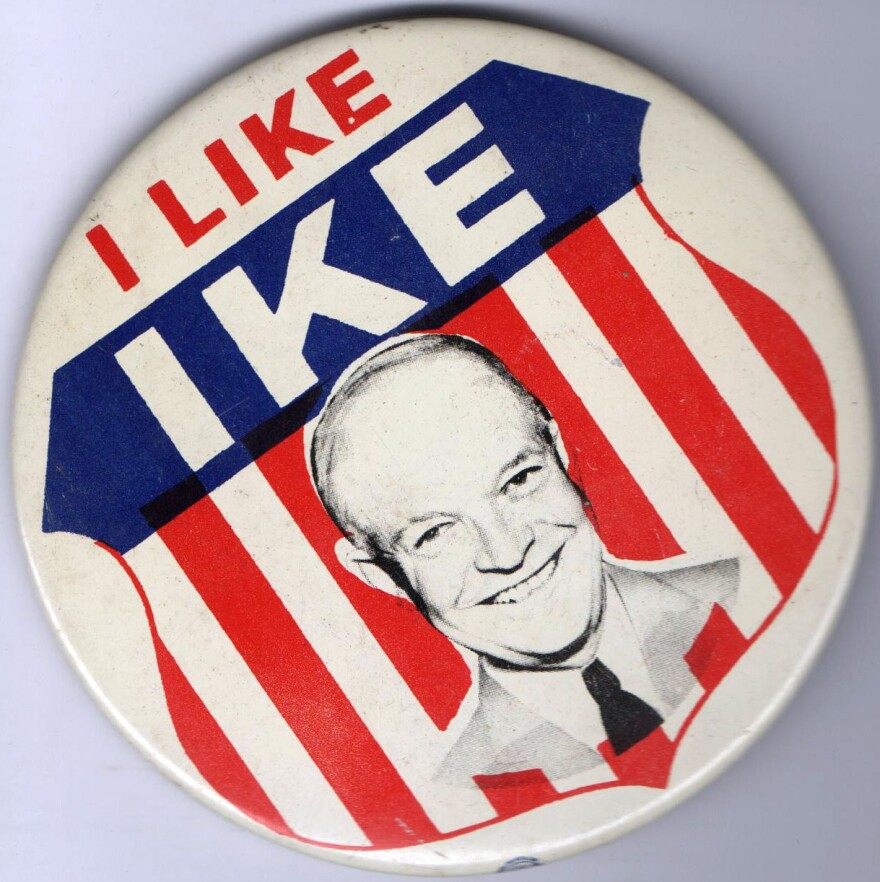
JESS: So when was the last time you had those gutters cleaned? LORELAI: It’s been awhile. JESS: Yeah, I found an ‘I like Ike’ bumper sticker up there.
“I like Ike” was the campaign slogan for the 1952 election campaign of US President Dwight D. “Ike” Eisenhower. He won the election for the Republicans in a landslide victory, and became the country’s 34th president.
Hopefully Jess is joking – not having your gutters cleaned for half a century sounds pretty bad.
Rory buys several books at the fundraiser, but only a couple of the titles are visible. Gypsy the mechanic is volunteering her time to work at the fundraiser, and she points Rory to the astronomy section, as if Rory has an interest in this area, and Gypsy somehow knows about it. Both quite surprising things to learn! The Buy a Book Fundraiser is held outside the library, and may be raising funds for new books.
Inherit the Wind
A 1955 play by Jerome Lawrence and Robert E. Lee, fictionalising the events of the Scopes “Monkey” Trial. This was a legal trial in July 1925 where schoolteacher John Scopes was taken to court by the state of Tennessee for teaching human evolution. There was intense media scrutiny of the case, with publicity given to the high-profile lawyers who had taken the case. The prosecution had former Secretary of State, William Jennings Bryan, while Clarence Darrow defended Scopes – the same lawyer who had defended child murders Leopold and Loeb, previously discussed. Scopes was fined $100, but the case was overturned on a technicality. The case was seen as both a theological contest, and a test as to whether teachers could teach modern science in schools.
The play gives everyone involved in the Scopes Trial different names, and substantially alters numerous events. It is not meant to be a historical account, and is a means to discuss the McCarthy trials of the 1950s, where left-wing individuals were persecuted as Communist sympathisers, under a regime of political repression and a fear-mongering campaign.
Rory might be particularly interested in the play because of the focus it places on the media, with reporter E.K. Hornbeck covering the case for a fictional Baltimore newspaper. He is based on journalist and author H.L. Mencken, previously discussed as one of Rory’s heroes, who gained attention for his satirical reporting on the Scopes Trial for the Baltimore Morning Herald.
Inherit the Wind premiered in Dallas in 1955 to rave reviews, and opened on Broadway a few months later with Paul Muni, Ed Begley, and Tony Randall in the cast. It’s been revived on Broadway in 1996 and in 2007, as well as in Philadelphia, London, Italy, and India.
It was adapted into film in 1960, directed by Stanley Kramer, and with Spencer Tracey starring as the defence lawyer, Dick York as the schoolteacher, and Gene Kelly as the Baltimore journalist. It received excellent reviews and won awards at the Berlin Film Festival. It’s also been made for television in 1966, 1988, and in 1999 (starring George C. Scott, Jack Lemmon, and Beau Bridges). It seems likely that Rory watched the most recent version on television.
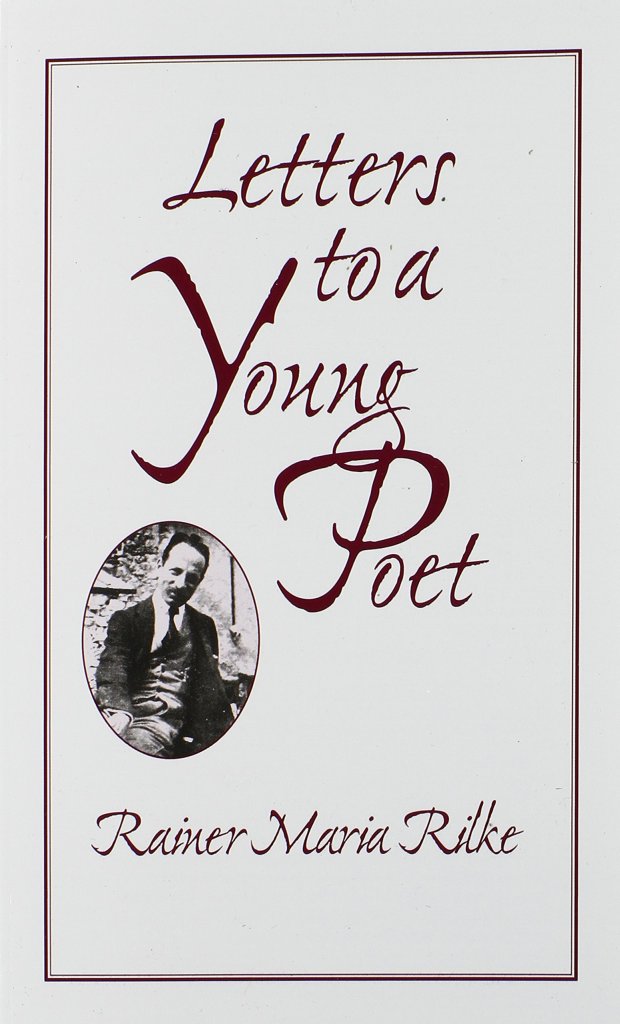
Letters to a Young Poet
A 1929 collection of ten letters written by the Bohemian-Austrian poet Rainer Maria Rilke, to a young officer cadet named Franz Xaver Kappus at the Theresian Military Academy in Wiener Neustadt, Austria between 1902 and 1908.
Kappus had written to Rilke, seeking advice on the quality of his poetry, to help him choose between a literary career, or one as an officer in the Austro-Hungarian Army. Kappus had been reading Rilke’s poetry when he discovered that Rilke had earlier studied at the academy’s lower school in St. Pölten, and decided to write to him for advice.
Rilke gave Kappus very little criticism or suggestions on improving his writing, and said that nobody could advise him or make life decisions for him. Over the course of ten letters, he instead provided essays on how a poet should feel and seek truth in experiencing the world around him. They offer insights into Rilke’s poetic ideas and themes, and his work processes.
Kappus did meet Rilke at least once, and despite his concerns about pursuing a military career, he continued his studies and served for 15 years as an army officer. During the course of his life, he worked as a journalist and reporter, and wrote poems, stories, novels, and screenplays. However, he never achieved lasting fame.
This is a book which features a future journalist – but one who yearns to become a poet. Is it a sign that Rory secretly wishes she could become a creative writer instead? Is she hoping that being successful in journalism will help her become a published author (it’s definitely a help in getting novels published, or at least considered). Is it even a hint that she will become a writer in the future, as she does in A Year in the Life, but is not destined to become famous from her writing? (Most published writers, even quite successful ones, don’t get famous, after all).
And is this correspondence between a poet and a student at a military academy meant to suggest that Rory is still thinking of Tristan, who went away to military school? Are she and Tristan actually writing to each other, or is the show leaving the door open for Tristan to possibly return in a future season, since they didn’t know how long One Tree Hill was going to last?
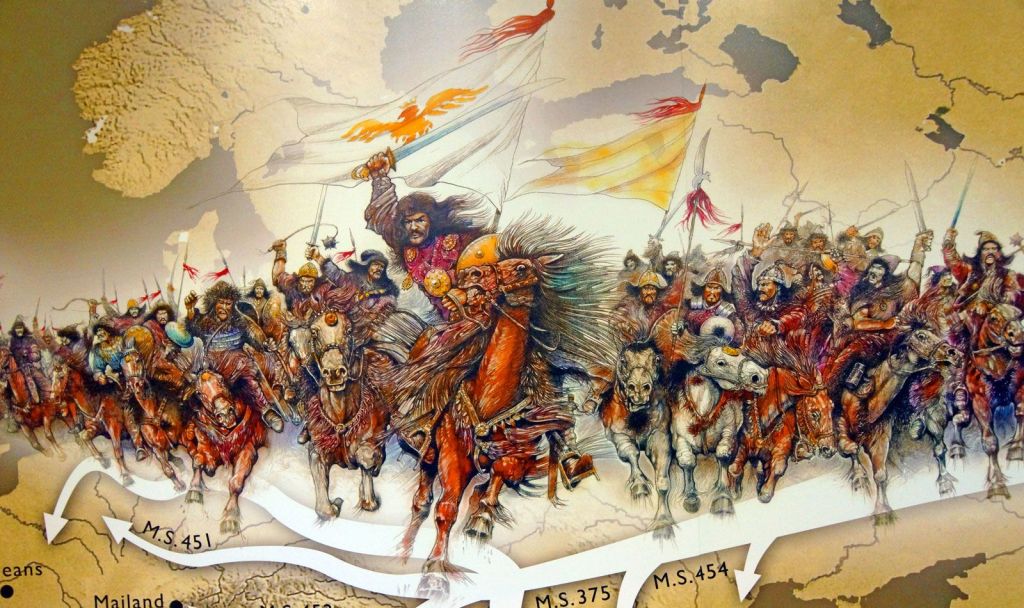
LUKE: Jess? [Luke turns the music off] How can anyone sleep through that? It’s like the Huns are attacking and you’re just – well, you’re oblivious and that’s why you can just lie there while the rest of the world is going – . [he knocks over his little television] Great! Dammit! Dammit! Dammit! Dammit!
The Huns were a nomadic people who lived in Central Asia, the Caucasus, and Eastern Europe between the 4th and 6th centuries. Most likely originating from the Central Asian steppes, Europeans first reported Huns living east of the Volga River, in what was called Scythia at the time. By 430 they had established a vast, if short-lived, dominion in Europe, conquering the Goths and other Germanic tribes, and driving them into Roman territory.
Under their formidable ruler Attila, they made frequent, devastating raids into the East Roman Empire, and invaded Gaul and Italy. After Attila’s death in 453, they ceased to be a major threat to Rome, and lost most of their empire. The Huns may have helped stimulate the massive tribal migrations which were a factor in the collapse of the Western Roman Empire. Memories of them were preserved in the lives of the saints and in Germanic legend, where they appear as the antagonist.
Modern culture popularly considers them as cruel and barbaric, partly because the Huns encouraged this thinking. They were probably no more so than other people of the time, although certainly fearsome in battle.
LANE: I only get five minutes a day of outside phone time but unlimited time to call the Psalm a Day line. A big ripoff, by the way, because Psalm 79 has been on there for three straight days. That’s not in keeping with what their name clearly implies, which is a new psalm per day, every day. Not the same tired one from the previous two days.
Mrs Kim has given Lane unlimited phone privileges to call the Psalm a Day Line, a number where you pay by the minute to hear a psalm each day – the same psalm being up all day.
Psalm 79 is identified in the Old Testament as “a psalm of Asaph”. Asaph was a member of the guild of musicians, and he may have either written, transcribed, or collected the psalms with his name attached, or they were produced by his guild, or written in a style he initiated.
Psalm 79 is a communal lament upon the destruction of Jerusalem, probably by the Babylonian army in 587 BC, and in particular the defilement of the Temple by allowing dead bodies to lie there, without burial.
The psalm expresses some sentiments pertinent to Lane’s situation, in particular asking how long God will remain angry at them and begging for mercy. It mentions hoping the groans of prisoners will help change God’s mind, just as Lane hopes her mother’s anger will eventually soften so that Lane can be released from her prison.
O God, the nations have invaded your inheritance; they have defiled your holy temple, they have reduced Jerusalem to rubble.
They have left the dead bodies of your servants as food for the birds of the sky, the flesh of your own people for the animals of the wild. They have poured out blood like water all around Jerusalem, and there is no one to bury the dead. We are objects of contempt to our neighbors, of scorn and derision to those around us.
How long, Lord? Will you be angry forever? How long will your jealousy burn like fire? Pour out your wrath on the nations that do not acknowledge you, on the kingdoms that do not call on your name; for they have devoured Jacob and devastated his homeland.
Do not hold against us the sins of past generations; may your mercy come quickly to meet us, for we are in desperate need.
Help us, God our Saviour, for the glory of your name; deliver us and forgive our sins for your name’s sake. Why should the nations say, “Where is their God?”
Before our eyes, make known among the nations that you avenge the outpoured blood of your servants. May the groans of the prisoners come before you; with your strong arm preserve those condemned to die. Pay back into the laps of our neighbors seven times the contempt they have hurled at you, Lord.
Then we your people, the sheep of your pasture, will praise you forever; from generation to generation we will proclaim your praise.
LORELAI: I don’t know, hon. In the short amount of time he’s been here, he’s managed to make a lot of enemies. RORY: I’m sorry, when did I move to Salem?
RORY: You’re taking his side? LORELAI: I’m not taking sides here, okay? I’m Swiss, babe.
Switzerland remained neutral during World War II, and managed to remain independent through a combination of military deterrence, concessions to Germany, and good luck.
Jackson is piqued because Sookie hasn’t picked up on his hints he wants to move in with her, and petulantly refuses to bid on her basket. With nobody else making a move, Andrew from Stars Hollow Books puts in a bid for it. At this point, Andrew appears to be single, but it’s unclear whether he wants the delicious basket, or Sookie herself. He certainly doesn’t seem worried about upsetting Jackson.
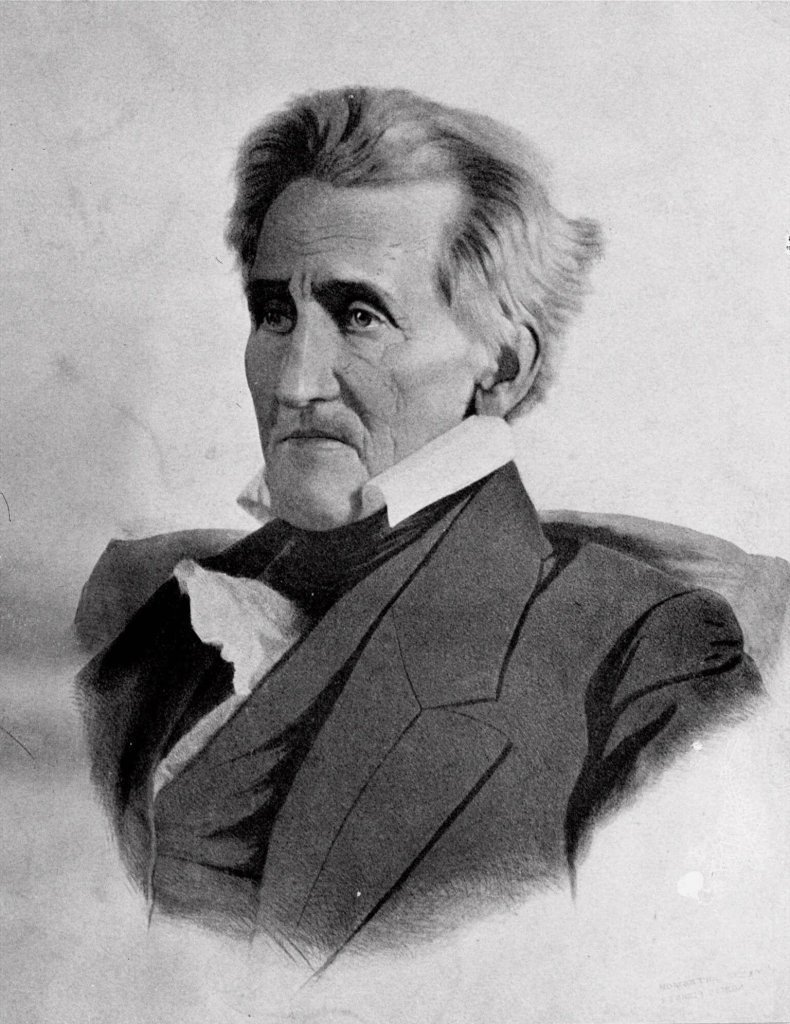
The point where Andrew and Jackson’s names are said together is almost certainly a joking reference to Andrew Jackson (1767-1845), lawyer, soldier, and statesmen who served as the 7th President of the United States, from 1829 to 1837.





 The Annotated Gilmore Girls