Cocktail

LORELAI: Wow, Marty does the jar twirl before putting the salsa in the bag. Impressive, very Cocktail.

Cocktail, 1988 romantic comedy-drama film directed by Roger Donaldson and written by Heywood Gould; the screenplay was based on his 1984 semi-autobiographical novel of the same name.

It tells the story of a young New York business student, played by Tom Cruise, who takes up bartending in order to make ends meet. An older, more experienced barman, played by Bryan Brown, takes him under his wing and teaches him how to flair – that is, to entertain bar patrons using cocktail shakers and liquor bottles like a juggler. Lorelai suggests that Marty the substitute bag boy is “flairing” the groceries to dazzle the customers.

Cocktail was savaged by critics, who called it “brainless”, “empty”, and “banal”, and it won Worst Picture and Worst Screenplay at the Golden Raspberry Awards. It is generally seen as one of the worst films ever made. Despite this, it was a huge success at the box office, and the #8 film of 1988.

Mötley Crüe Book

LORELAI: Uh, you’ve gotta read this Mötley Crüe book. I swear, you get to the point where Ozzy Osbourne snorts a row of ants and you think, it cannot get any grosser, and then you turn the page and oh, hello, yes it can! It’s excellent!

Lorelai is reading The Dirt: Confessions of the World’s Most Notorious Rock Band, a 2001 collaborative autobiography of Mötley Crüe by the band members – Tommy Lee, Mick Mars, Vince Neil, and Nikki Sixx. The gritty tell-all book received rave reviews and was on the New York Times Bestseller List for four weeks. It was made into a film in 2019.

The next page, where it gets “grosser” than snorting ants involves Ozzy Osbourne, from Black Sabbath, licking urine (his own and someone else’s) from the pavement.

Lorelai is a heavy metal fan who loves scandalous and outrageous autobiographies, so this book is a natural fit for her.

Whip It

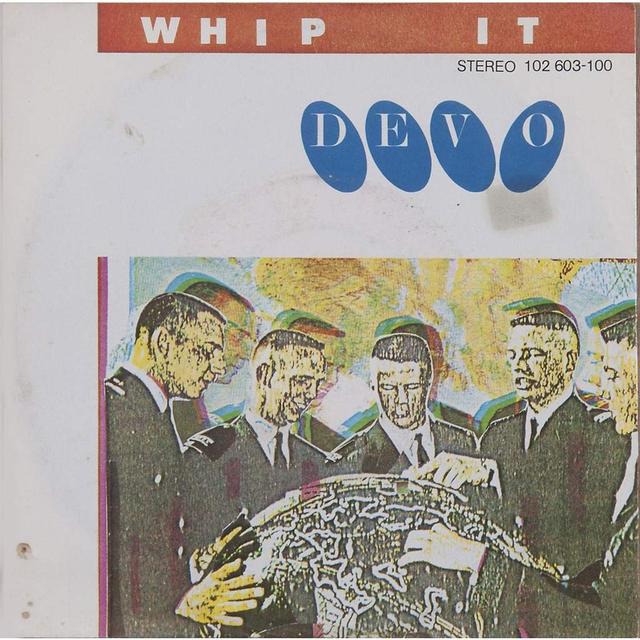
LANE: Hello ma’am, I see you’re eyeing the Whip-o-Matic, nice choice! This baby’s right off the truck, and let me tell you, if you’re looking for something to fulfill all your whipping needs, you’ve come to the right place because as Devo says – if a problem comes along you must whip it, as long as you whip it with a Whip-o-Matic!

“Whip It”, a 1980 new wave song by rock band Devo, from their album Freedom of Choice. The lyrics, at first glance nonsensical, are a mocking collection of motivational cliches, in a satire on American optimism. The inspiration was apparently communist propaganda posters and the 1973 satirical novel Gravity’s Rainbow, by Thomas Pynchon. The music video plays with the idea that “Whip It” has sexual overtones.

Praised for its originality, and seen as a cornerstone of the new wave musical movement, “Whip It” was the band’s most successful song by far. It reached #14 in the US, and was most popular in Canada and New Zealand, at #11.

The cynical view of optimism revealed by “Whip It” that Lane gives voice to chimes in perfectly with Rory’s reading of Candide.

Miss Gilmore and the Vicious Circle

RORY: Would you really have felt guilty?

LORELAI: No, but I would’ve felt guilty about not feeling guilty and you can see how that could just go on forever.

RORY: Miss Gilmore and the vicious circle.

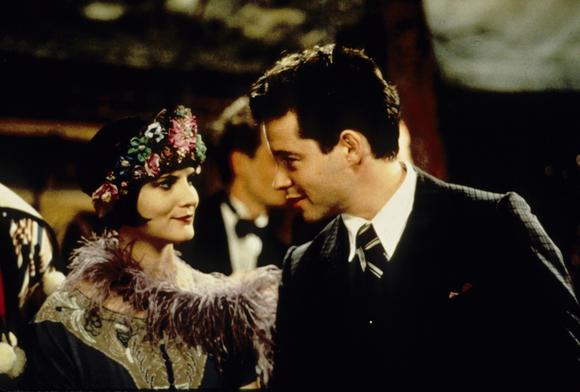
A reference to the 1994 biographical drama film, Mrs. Parker and the Vicious Circle, directed by Alan Rudolph. It stars Jennifer Jason Leigh as the writer and critic Dorothy Parker, and depicts the members of the Algonquin Round Table, otherwise known as the Vicious Circle. The film was a critical success, but not a commercial one.

As a huge Dorothy Parker fan, of course Rory would have watched this film. Matthew Broderick is also in the cast, who is apparently one of Rory’s favourites (or at least was when she was younger).

Candide

RORY: And I finished Candide

Candide is a 1759 satirical picaresque novella by the French philosopher Voltaire. It is about a young man named Candide, living a sheltered life in an Eden-like paradise, taught to live a life of optimism by his mentor, Professor Pangloss, who teaches that we live in “the best of all possible worlds”. This life abruptly ceases, and the story details the slow disillusionment of the simple Candide as he witnesses and experienced terrible hardships. By the end, if he has not exactly rejected optimism, he has cautiously adopted a more pragmatic approach to life.

Sharply witty, insightful, fantastical, bitter, and matter-of-fact, Candide parodies the adventure and romance genres, as well as the coming-of-age novel. It is considered Voltaire’s greatest work, and has been often mimicked and parodied. Considered part of the Western canon, it is often taught in high schools and colleges.

You can see Rory as a parallel to Candide – raised in the sheltered Eden-like paradise of Stars Hollow, with the vivacious Lorelai raising her to believe she can do anything with enough self-belief, hard work, and Gilmore ability to argue that the usual rules don’t apply to her. Will Rory become increasingly disillusioned with the difficulties of the outside world once she leaves Stars Hollow?

Bhagavad Gita

MADELINE: I read slow so I don’t miss anything.

PARIS: It’s not the Bhagavad Gita, Madeline. It’s simple instructions for the business fair.

The Shrimad Bhagavad Gita, literally meaning “the song by God” in Sanskrit, often referred to as Bhagavad Gita, or just the Gita. It’s a 700-verse Hindu scripture that is part of the epic The Mahābhārata, dated to the first millennium BC.

It is the best known of the holy scriptures of Hinduism, presenting a synthesis of Hindu philosophy and yogic ideals. It was a personal inspiration to Mahatma Ghandi, and has been often read, studied, and appreciated by westerners and non-Hindus. Many Christians, Muslims, Buddhists, and atheists have read the Bhagavad Gita for spiritual advice and life lessons.

Madeline’s comment suggests that she isn’t stupid – just slow, thorough, and careful in how she absorbs information.

Mark Twain’s Marginalia

RORY: No, he didn’t vandalize it. He wrote in the margins, thoughts and stuff.

LORELAI: Like what, like play basketball, eat a sandwich – stuff like that?

RORY: No, stuff, like margin stuff. People like Mark Twain wrote in margins.

LORELAI: Pilot a steamboat, write Huckleberry Finn?

Mark Twain, author of The Adventures of Huckleberry Finn, often mentioned. As a young man, Mark Twain trained to be a pilot on a steamboat on the Mississippi River. His pen name comes from the cry “mark twain”, meaning that the river is twelve foot deep, a safe depth for a steamboat to travel in.

Mark Twain is famed for the barbed comments he wrote in the margins of books he read – his own books, I might add. Saratoga in 1901 by Landon D. Melville seems to have drawn his ire; Twain re-named it Saratoga in 1891, or The Droolings of an Idiot, and wrote in the margin that the author was “little-minded”.

Rory’s comment may suggest that Jess’ scribblings in the margins of Howl were likewise of a sarcastic nature.

Jess’ Handwriting

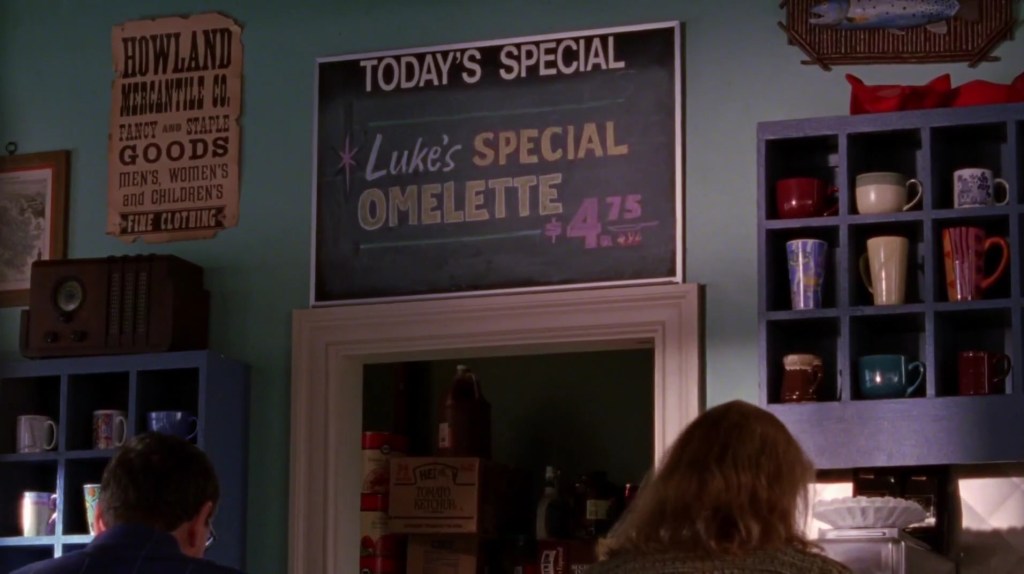
LORELAI: I know. Look how hard he worked on that sign and everything. Look at the handwriting, it’s so precise, so determined. It’s focused-Luke.

RORY: That’s Jess’ handwriting.

LORELAI: Really? How do you know Jess’ writing?

RORY: Oh, well, I lent him a book and he wrote some stuff in it.

Lorelai’s examination of Jess’ handwriting is a sign of how much more careful, focused, and determined Jess really is, deep down. That boy has hidden depths. Is it possible that it was Jess who convinced Luke to put a new special on the board – and if so, was it a tease for Rory, knowing that she usually orders French toast?

Lorelai also discovers that Rory can recognise Jess’ handwriting, and that’s because he wrote in her book – “vandalised it”, as Lorelai says. Rory is careful to say that she “lent” her book to Jess, not that he took it without asking, the very first moment he met her.

Note that the sign next to the chalkboard is for the Howland Mercantile Co., a reminder of Jess writing in the margins of Rory’s copy of Howl and Other Poems.

Surprisingly, Lorelai doesn’t seem to be able to tell Luke’s handwriting from Jess’, even though Luke writes on the chalkboard all the time. Unless Jess and Luke have the same handwriting?

Godot

EMILY: We have not been waiting forever.

LORELAI: Forever. Godot was just here. He said ‘I ain’t waiting for Richard,’ grabbed a roll, and left. It’s been forever.

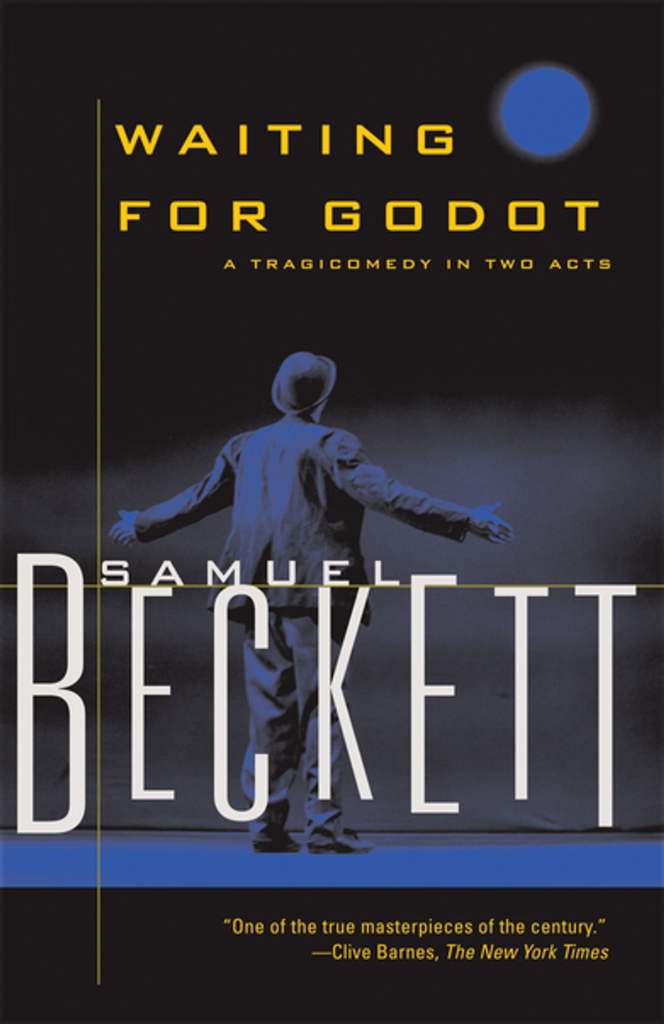
A reference to Waiting for Godot, a play by Irish playwright Samuel Beckett, originally written in French in 1948-49 (title: En attendant Godot). The French play had its premiere in Paris in 1953, and Beckett’s English translation of his own play premiered in London in 1955.

In the play two characters named Vladimir and Estragon engage in a number of discussions and encounters while they wait for the Godot of the title, who never turns up. It has been voted the most significant English language play of the 20th century.