Rory and Jess Picnic On the Bridge

RORY: On the bridge, that’s where we’re gonna eat?
JESS: Yup.

Jess tells Rory that they will be having sharing their picnic on the bridge over the lake, a place in Stars Hollow that he has grown fond of. Later it will become a special place for he and Rory.

The scene of them having a picnic is a homage to the 1958 Southern Gothic comedy-drama film The Long Hot Summer, directed by Martin Ritter. The screenplay is partially based on the 1955 Tennessee William’s play Cat on a Hot Tin Roof, and three works of William Faulkner, one of Rory’s favourite authors (she can’t resist Southern Gothic).

In the film, Paul Newman plays Ben Quick, a crude, magnetic young man with a bad reputation for burning down barns who is expelled from his town and forced to go elsewhere. Joanne Woodward plays his love interest, rich girl Clara Varner, who fights their sexual tension all the way, but eventually falls in love with him. It turns out the enigmatic drifter’s bad reputation is undeserved, and he is actually very ambitious.

The Long Hot Summer received excellent reviews from critics, but didn’t do well at the box office. Paul Newman won Best Actor at the Cannes Film Festival for his role as Ben. It’s been turned into a television series twice, once in the 1960s, then again in the 1980s.

This is another film with a bidding war over a picnic basket, which the masterful Ben wins, itself a homage to the auction in Oklahoma! There is a scene of Ben and Clara sharing their picnic near a bridge, similar to Jess and Rory on the bridge. In the scene, the icy Clara begins to thaw out to Ben, and reveal some of her true self. In the same way, this is the first time that Rory really begins to open up to Jess. Bridges are symbols of transition, showing that Rory and Jess are moving into a new stage of their relationship.

There is a strong hint from the film that Jess is not as black as he has been painted, and there is a foreshadowing of his hidden ambitious streak.

Paul Newman and Joanne Woodward fell for each other on set, and married shortly after the film. Alexis Bledel and Milo Ventimiglia also dated in real life while filming Gilmore Girls.
Bid-on-a-Basket Fundraiser

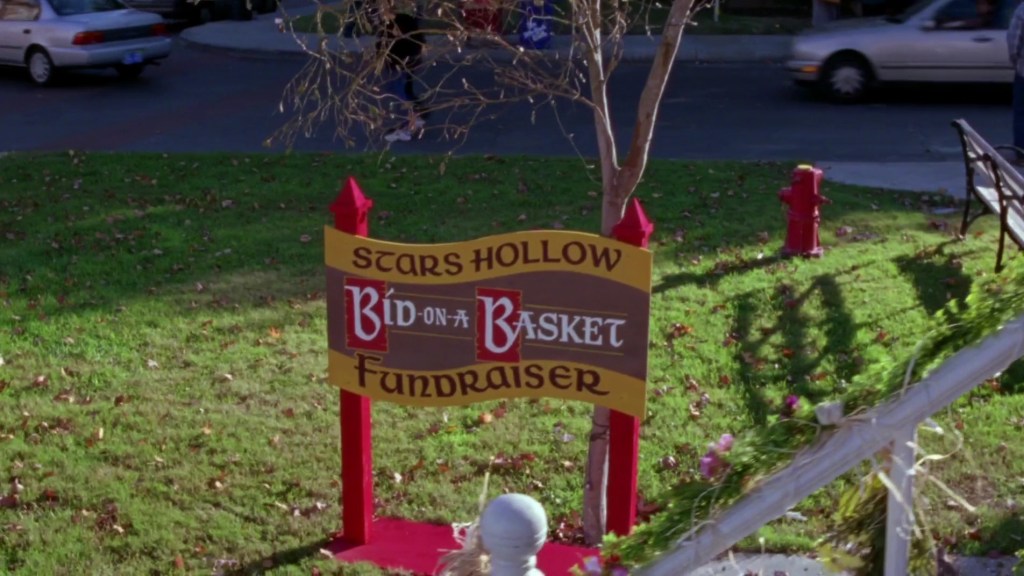
The show opens the day before the Stars Hollow Bid-on-a-Basket Fundraiser, with signs telling the viewer that bidders can win themselves a delicious home-cooked picnic lunch, that it’s held on Sunday at midday, and that all proceeds go to the Stars Hollow Retirement Home (the signs are sponsored by Doose’s Market). Across the street at the market, baskets are on sale, and more signs tell us that it’s also known as the Bid-on-a-Basket Festival. We can see a woman leaving with her new basket.

Inside the market, Lorelai and Rory are shopping for their own baskets, but of course they don’t intend to cook a delicious home-cooked picnic lunch (or even make Sookie do it for them, like they did for the bake sale). They’re just going to put old leftovers in their baskets – as we now know they keep leftovers for a long time, it’s sounding like a Salmonella Festival for anyone bidding on their baskets!

These type of fundraisers are called “box socials” and were common in the 19th century and 1900s, with women cooking the food and packing it into a box or basket, and men bidding for them. Although it was meant to be a “blind” auction, married and attached women would let their husband or sweetheart know which basket was theirs, so they could bid on it – bidding on a woman’s basket was a way to let her know you were interested in more than her home cooking.

Box socials are also low-key dating auctions, with the winning bidder not only getting the basket, but the chance to share the picnic lunch with the lady who provided it. A lunch basket auction of this type features in the 2001 YA novel Flipped by Wendelin Van Draanen (in this case, it is a high school boy who provides the basket, and girls bid on the chance to have lunch with him). This seems like a bit of a coincidence, or perhaps merely zeitgeist.

Although Flipped is set in the 1990s, when it was made into a film in 2010, they set it in the 1960s, as if that scene was deemed too old-fashioned to be believable. They must have agreed with Lorelai, who complained that the concept was “backwards”. In fact there has been a mild resurgence in box socials since the 1990s.

The show never makes it explicit, but according to the timeline, the Bid-on-Basket Fundraiser seems to be held in mid-February, and it would make sense if it was the Sunday after Valentine’s Day. That’s a clear connection with love and romance, although it isn’t practical at all to have a picnic in winter! In real life it would be freezing.

A-Tisket, A-Tasket

The episode is named for an English nursery rhyme, first recorded in the US in 1879 as a children’s game, to be sung while children danced in a circle. One child would run around the circle and drop a handkerchief; the nearest child to them would then pick it up and chase them. If caught, the child who dropped the handkerchief would either be kissed, join the circle, or had to confess the name of their sweetheart.

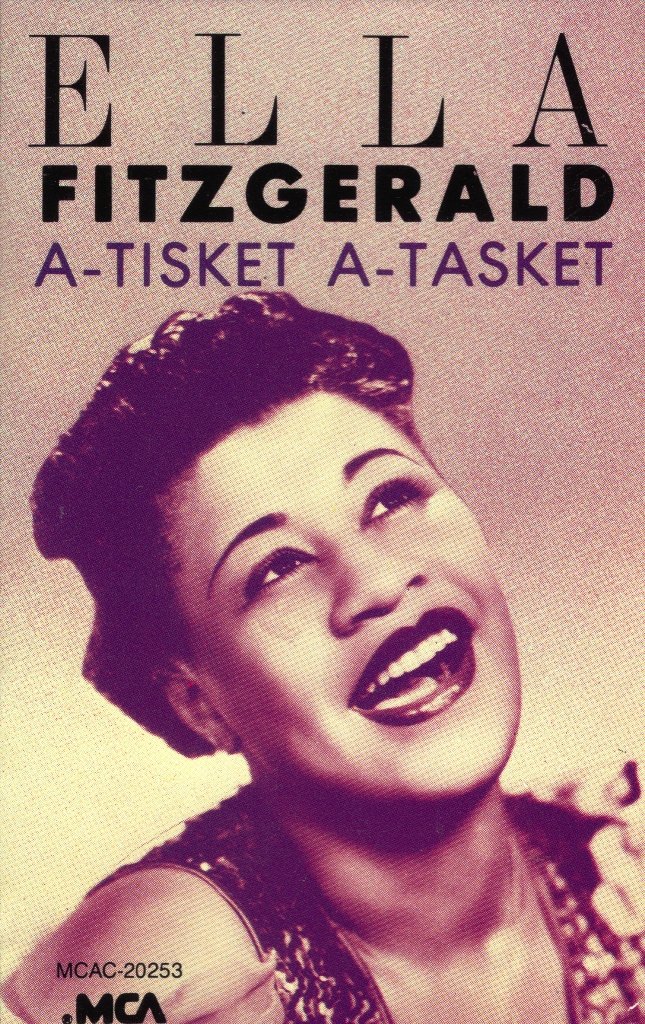
The rhyme was turned into a highly popular 1938 song by Ella Fitzgerald, in conjunction with Al Feldner (later known as Van Alexander). It has since become a jazz standard, often used in film and television soundtracks.

The lyrics to the rhyme are usually given as:

A-tisket, a-tasket
A green and yellow basket
I wrote a letter to my love
And on the way I dropped it,
I dropped it, I dropped it,
And on the way I dropped it.
A little boy he picked it up
And put it in his pocket.

It’s suitable for an episode all about baskets, romance, and miscommunication. The episode will also include something being dropped that a “little boy” picks up.

A Foggy Day (In London Town)

This is the song playing on the stereo when Richard returns home from Stars Hollow. It plays over him looking sad while alone in his study, until the end of the episode.

The opening lyrics are in tune with Richard’s melancholy mood:

I was a stranger in the city
Out of town were the people I knew
I had that feeling of self pity
What to do, what to do, what to do?
The outlook was decidedly blue

A Foggy Day was composed by George Gershwin, with lyrics by Ira Gershwin. It was introduced by Fred Astaire in the 1937 musical comedy film A Damsel in Distress, loosely based on the 1919 novel of the same name by P.G. Wodehouse, and the 1928 stage play written by Wodehouse and Ian Hay. Astaire’s recording was very popular in 1937.

The song has been covered numerous times, and Richard listens to a Frank Sinatra version. Richard may be listening to his 1954 album Songs for Young Lovers, produced by Voyle Gilmore (!), or from the 1961 Ring-a-Ding-Ding! The second one, which was well-reviewed and went to #4 in the charts, seems more likely, as Richard would been about eighteen when it came out.

Bambi, Dumbo, Babe

RORY: The only videos not behind that curtain are Bambi and Dumbo. I mean, they actually had a meeting earlier about whether or not Babe should be behind the curtain so as not to offend people who keep kosher.

Bambi, previously discussed.

Dumbo [pictured], 1941 animated fantasy film produced by Walt Disney. It is about a young circus elephant named Jumbo who is bullied with the nickname Dumbo, and mocked for his very large ears. However, it turns out he can actually fly with the help of his ears. It was a financial success and received positive reviews. It won an Academy Award for its musical score. It was the first Disney movie to be released on home video, in 1981. A live-action remake was released in 2019, directed by Tim Burton.

Babe, 1995 comedy-drama directed by Chris Noonan, produced by George Miller, and written by both, based on the 1983 novel The Sheep-Pig, by Dick King-Smith. The human stars of the film are James Cromwell and Magda Szubanski, and the animal characters are played by real animals and animatronic puppets. Christine Cavanaugh provides the voice of Babe, a pig who can talk to sheep and works as a sheep-dog. The film was a box-office success and critically acclaimed, winning numerous awards internationally. It was initially banned in Malaysia in order to avoid upsetting Muslims, but the ban was overturned a year later. The film helped to increase rates of vegetarianism, with star James Cromwell becoming a vegan himself.

Reese Witherspoon

RICHARD: Who’s going to help her get into Harvard?
LORELAI: Reese Witherspoon.

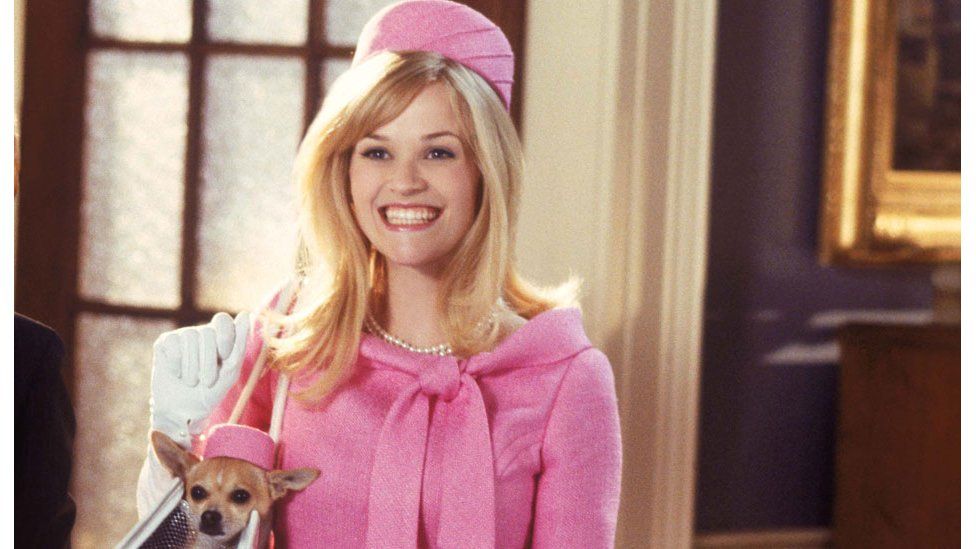
Laura Jeanne Reese Witherspoon (born 1976), multi-award winning actress and producer. She has an Academy Award, two Golden Globes, a BAFTA, a Screen Actors Guild Award, and an Emmy. One of the highest-paid actresses in the world, she has been named one of the most powerful women in the world, and one of the most influential.

Lorelai refers to Witherspoon’s 2001 comedy, Legally Blonde, directed by Robert Luketic, and based on the 2001 novel of the same name by Amanda Brown. Witherspoon plays Elle Woods, a sorority girl who attempts to win back her ex-boyfriend by becoming a Doctor of Law at Harvard University. In the process, she overcomes stereotypes about pretty blondes, and triumphs as a successful lawyer through unflappable self-confidence and fashion/beauty know-how.

Legally Blonde was a box-office hit which led to a sequel, a direct to DVD spin-off, and a stage musical. It received generally favourable reviews, and Reese Witherspoon received the 2002 MTV Award for Best Female Performance. Another film in the series is scheduled for 2022.

Rory’s Bookshelf

When Rory shows Richard her bedroom, he checks out her bookshelf. Here are some of the books we can see:

Summer of Fear

A 1993 serial killer novel by T. Jefferson Parker, who writes bestselling police procedural novels set in California. Parker is a journalist who turned novelist – perhaps a tiny hint of where Rory’s career is eventually headed.

The Scarecrow of Oz

A 1915 children’s book by L. Frank Baum, the ninth in his series of Oz books. The Wizard of Oz is a touchstone for Gilmore Girls, and this seems to be a little nod to the land of Oz. The Scarecrow from the original story is the magical helper (the one who didn’t have a brain, but was actually quite smart), and the human protagonists are a man and a little girl from California.

Contact

A 1985 science novel by scientist Carl Sagan. The heroine is a scientist named Ellie who showed a strong aptitude for science and mathematics from a young age, and has been left emotionally bereft by the loss of her father, with a problematic relationship with her mother. Contact with an alien civilisation allows Ellie a strange chance to reconnect with her memories of her father. It feels like something that would resonate with Rory. Ellie is also from California. The novel was a bestseller, and made into a film in 1997, starring Jodie Foster. The film might have given Rory an interest in reading the novel.

The Apocalyptics: Cancer and the Big Lie

Edith Efron was a journalist who began her career at the New York Times Magazine, became a member of Ayn Rand’s circle and wrote for her magazine, and then became editor of TV Guide at the height of its popularity. She was critical of what she perceived as “liberal bias in the media”, but provided a strong voice on race relations (Efron had a biracial son during 1950s segregation). She later wrote for the libertarian publication, Reason. The Apocalyptics is a 1984 exposé of the cancer industry and a criticism of environmental policy which Efron saw as being based on “bad science” (basically saying Rachel Carson etc were all a bunch of doom-merchants). It’s an obscure, controversial, and extremely heavy-going work. An intriguing insight into Rory’s interests.

Working: People Talk About What They Do All Day and How They Feel About What They Do

A 1974 non-fiction book by oral historian and radio broadcaster Louis “Studs” Terkel. An exploration of what makes work meaningful for people, based on interviews with people from all walks of life. It was a bestseller, and turned into a Broadway musical in 1977, and a graphic novel in 2009.

A book by “Tobias Allcot”

This seems to be a fictional book which would have been created by the props department as a slightly odd joke. Tobias Allcot is the name of a Pulitzer Prize-winning author in the film The Man from Elysian Fields, directed by George Hinkenlooper; James Coburn portrays Allcot. The film wasn’t released until September 2002, but had been shown at the Toronto Film Festival in September 2001.

Frank Capra

PARIS: Nothing, not even a cigarette butt on the ground, I can’t believe it. This town would make Frank Capra wanna throw up.

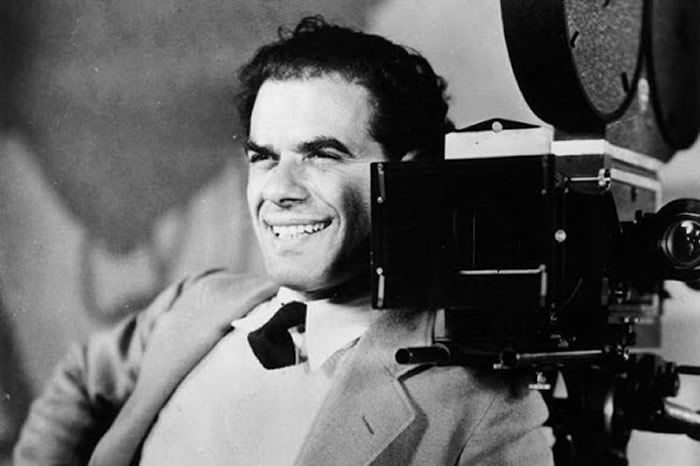
Francesco “Frank” Capra (1897-1991), Italian-born American film director, producer and writer, the creative force behind many of the award-winning films of the 1930s and 1940s. He won six Oscars, and numerous other awards, both in the US and in Italy.

He is perhaps best-known for his 1946 Christmas fantasy drama film, It’s a Wonderful Life, based on the 1943 short story, The Greatest Gift by Philip Van Doren Stern, itself loosely based on Charles Dickens’ novella, A Christmas Carol.

The film stars James Stewart as George Bailey, a man who has given up his own dreams to help others, but is driven to despair one Christmas Eve. His guardian angel saves him from suicide by showing him how he has touched the lives of so many others, and how different life would have been for his wife Mary (played by Donna Reed), and his community of Bedford Falls, should he never have been born.

It’s a Wonderful Life made a loss at the box office, and received lukewarm reviews. The FBI thought it was pro-Communist. However, after becoming a Christmas television staple in the 1970s, it became one of the world’s most beloved movies, and is regarded as one of the greatest, and most inspiring, films of all time. It was Frank Capra’s favourite of his own films, and James Stewart’s favourite film in which he starred.

The wholesome, slightly quirky town of Bedford Falls bears more than a passing resemblance to Stars Hollow, and the Christmas setting seems perfect for Lorelai’s love of snow. Also note that in the film, the kindly George Bailey gives bank loans to people based on their good character, not on their financial status – Lorelai seems to have received a shock when she discovered that bankers don’t actually care how nice you are when she was trying to get a loan.

Ruth Gordon Film Festival

RORY: Ooh, we could do a Ruth Gordon film festival. Harold and Maude, Rosemary’s Baby, and that really great episode of Taxi.

Ruth Gordon Jones (1896-1985), actress, screenwriter, and playwright. She was known for her nasal voice and distinctive personality, and became most successful in later life, being chosen for major screen roles in her 70s and 80s, and winning several awards. She seems to be a favourite of Rory.

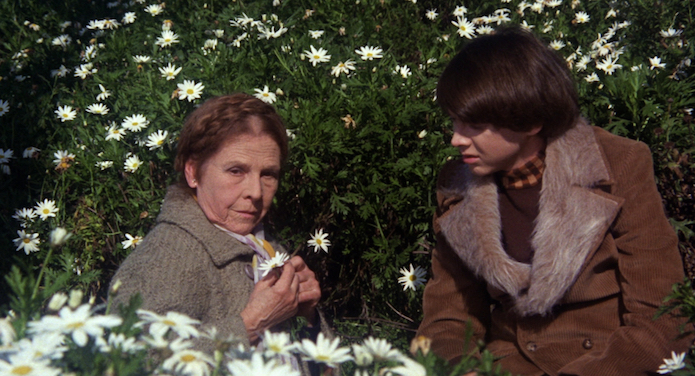
Harold and Maude [pictured], 1971 coming-of-age dark comedy/existentialist drama. Directed by Hal Ashby and written by Colin Higgins, it follows the exploits of Harold (played by Bud Cort), a 19-year-old from a wealthy but emotionally cold family who is obsessed with death. He develops a friendship, later a romance, with 79-year-old Maude (Ruth Gordon), a Holocaust survivor who teaches him about living life to the fullest. It initially received mixed reviews, but became a runaway cult favourite, and is now regarded as one of the best comedies, best romances, and greatest films of all time. Colin Higgins adapted the screenplay into a novel, then a stage play.

Rosemary’s Baby, previously discussed. For this film she won the Academy Award for Best Supporting Actress, as well as a Golden Globe Award and a Kansas City Film Critics Circle Award.

Taxi, award-winning sitcom which aired from 1978 to 1983, focusing on the lives of the employees of the fictional Sunshine Cab Company in Manhattan. Ruth Gordon made a guest appearance in the 1979 episode Sugar Mama, playing a woman who tries to solicit one of the taxi drivers as a male escort. She won an Emmy Award for Outstanding Lead Actress in a Comedy Series.

The Three Faces of Costner, and Tom Petty

LORELAI: The three faces of Costner – Bull Durham, Dances with Wolves, The Postman. Tom Petty playing Tom Petty, that great big speech about “Once upon a time there was a thing called mail”. It’ll make you laugh, it’ll make you cry, it’ll make you wanna mail something.

Kevin Costner (born 1955), award-winning actor and filmmaker. The three faces of Costner seem to be the first big success of his career, the greatest success of his career, and what seemed at the time to be the fading of his career with a failed film. In fact, he was to have renewed success with The Open Range in 2003, and received his star on the Hollywood Walk of Fame that same year, so his comeback was just around the corner.

Bull Durham, 1988 romantic comedy sports film. It’s partly based on writer/director Ron Shelton’s experiences in the baseball minor leagues, and depicts the players and fans of the Durham Bulls from Durham, North Carolina. Kevin Costner plays a veteran catcher brought in to teach a rookie pitcher (played by Tim Robbins) about the game in preparation for moving to the major leagues. It was a commercial and critical success, and was named the #1 sports film ever by Sports Illustrated. It’s also considered one of the best comedies. It helped solidify Costner as an A-list celebrity.

Dances with Wolves, 1990 epic western which stars, and was produced and directed by, Kevin Costner, in his directorial debut. It’s based on the 1988 novel of the same name by Michael Blake, and tells the story of a Union Army Lieutenant who travels to the American frontier to find a military post, and his dealings with a group of Lakota (much of the dialogue is in Lakota with English subtitles). It was a box office hit, and the #4 film of the year. It was also favourably reviewed, and won seven Academy Awards, including Best Picture and Best Director. It is credited with revitalising the western genre in film.

The Postman, 1997 post-apocalyptic action adventure film, which was also produced and directed by Kevin Costner, who plays the lead role. It is based on the 1985 novel of the same name by David Brin. Set in a neo-western version of a disestablished US in the near future of 2013, an unspecified apocalyptic event has led to war and plagues, leaving a huge impact on human civilisation and erasing most technology. A nomadic drifter finds an old uniform of a US Postal Services mail carrier, and unwittingly inspires hope, becoming a national hero. It failed at the box office and was heavily criticised in reviews.

Thomas “Tom” Petty (1950-2017), singer, songwriter, and musician. He was the lead vocalist and guitarist for Tom Petty and the Heartbreakers, formed 1976, and was a member of the supergroup The Traveling Wilburys, as well as performing as a solo artist. He sold more than 80 million records worldwide, making him one of the most successful music artists of all time. He was inducted into the Rock and Roll Hall of Fame in 2002.

He seemingly plays himself as the mayor of Bridge City in The Postman, as Kevin Costner’s character immediately recognises him as a famous person. Tom Petty had a post-apocalyptic themed story in his 1982 song I Got Lucky, and mentioned wanting to have a small part in a futuristic postwar movie. He finally got the chance in this film. [Picture shows Petty as the mayor].