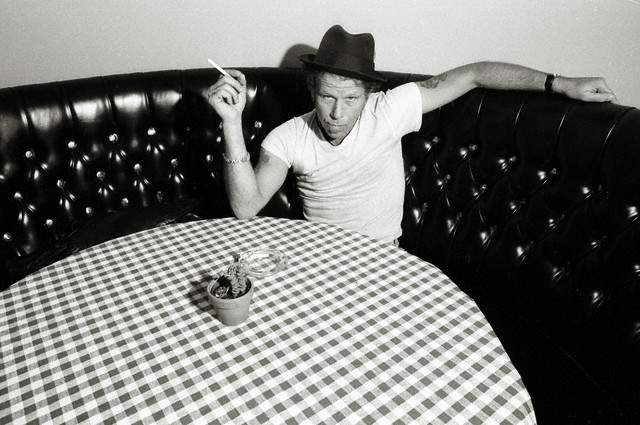
CAROL: I worship [Tom Waits]. I even mildly stalked him once … Last year, I heard he was staying at this hotel so I went there everyday and sat in the lobby, drinking massive amounts of coffee, waiting for him to walk by.
I can barely speculate which hotel Tom Waits could have been staying in the previous year. The only concert he had in 2001 was one in his home town of San Francisco, and he took a trip to Copenhagen in Denmark early in the year. He attended the ASCAP Awards at the Beverly Hilton in May, which might be what Carol is referring to (if so, she was in Los Angeles at the time for some reason – where the Palladinos live, probably not coincidentally).
Like Lorelai, Carol worships Tom Waits and drinks huge amounts of coffee. Her mild stalking of Waits at a hotel is replicated later by Lorelai, who stalks Bono at his hotel in exactly the same way.
A round-robin tournament is one in which each contestant meets with every other contestant, usually in turn. It’s usually the fairest way of deciding an overall winner, but can be very lengthy. They are common in team sports – Darren’s love of sports might have prompted this idea. The word robin in this context is a corruption of the French word ruban, meaning “ribbon”.
Oddly, Marie (played by Anita Finlay, who, like her onscreen husband and children, had also been on Judging Amy) is never shown taking part in the quizzes or being expected to, as if her role is simply to bring out iced tea and say Darren is brilliant. It doesn’t seem very likely – surely Marie is also a college graduate? Perhaps we just never see her have her turn, and she takes her part during the round-robin tournament.
Lorelai looks very unhappy to be roped into the round-robin tournament. Jennifer looks like Christmas has come early, and Jack looks like he’s forcing himself to smile. I get the feeling he’s not quite as into the competitive quizzes as Jennifer. He doesn’t seem to be as good at them.
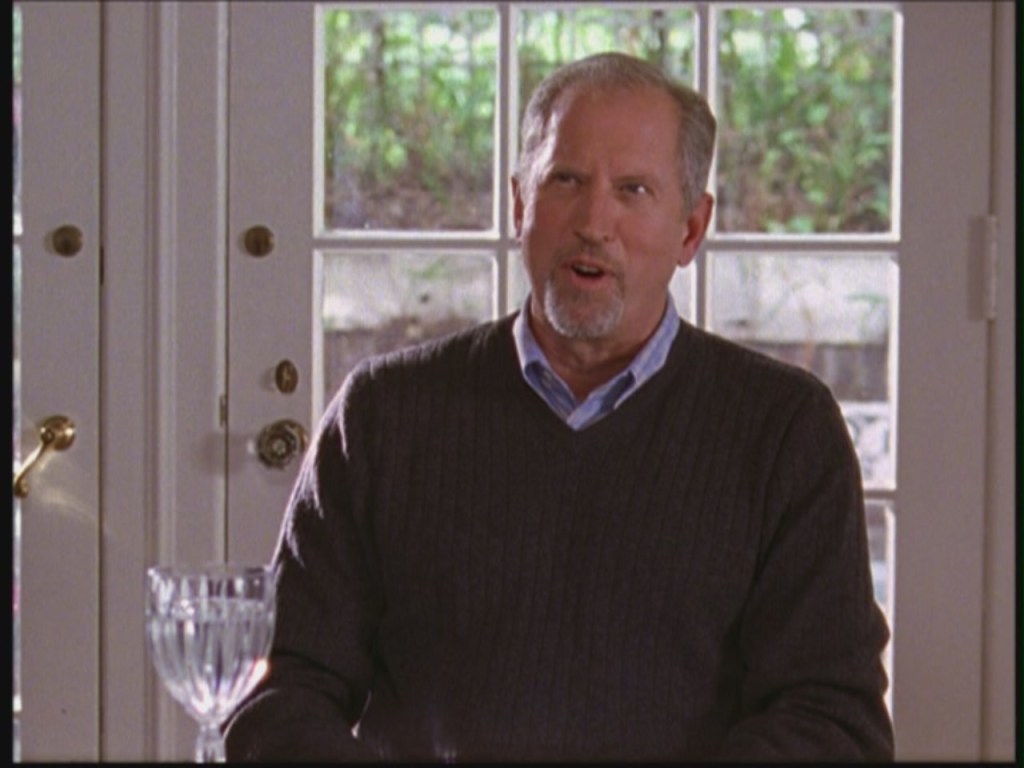
DARREN: One fell swoop, interesting phrase … Origin?
JACK: It was coined in Macbeth and derives from Middle English.
At one fell swoop means “suddenly, in a single action”. The fell part is an archaic word dating to the 13th century meaning “fierce, savage, cruel, ruthless”; it’s the root of the word felon and has gone out of use except for this one instance.
The phrase was first used, and most probably invented, by William Shakespeare, in his play Macbeth, previously discussed. In the play, it is said by Macduff when he hears that all his family and household have been killed:
All my pretty ones? Did you say all? O hell-kite! All? What, all my pretty chickens and their dam At one fell swoop?
The “kite” that Macduff refers to is the bird of prey, commonly used as a hunting bird in Tudor England. You can see that the “fell swoop” is the swoop of the kite as it quickly descends to catch its prey.
Somehow “at one fell swoop” went from meaning something terrible happening all at once, to just anything happening all at once. Darren uses it to mean good thing happening all at once, but I am unable to disassociate it from its original context, and to me it still suggests some fearsome unexpected blow from above. Maybe I read too much Shakespeare!
Jack’s answer is actually pretty inadequate, or even misleading. It’s not certain that Shakespeare coined it, although it’s likely – he should have said that it first appeared in Macbeth, and that Shakespeare has been credited with coining it. The phrase itself is not Middle English, and presumably he means that the word fell in this example goes back to Middle English.
DARREN: In fact, it’s refreshing [that Lorelai doesn’t have an academic background]. It might even be to Rory’s benefit. Good things didn’t come to your family in one fell swoop, you struggled for it.
Darren is suggesting that Rory’s background might be enough to make her stand out from the crowd in the college application process, to make it seem as if she had to struggle for everything she’s attained (it’s really more that Lorelai has had to struggle for most of what Rory’s attained). Lorelai and Rory are carefully leaving Richard and Emily out of the narrative, and not mentioning the financial assistance Rory has had to attend Chilton (a good thing which came in one fell swoop).
You can see that this is the angle Darren himself is probably planning to use in his chat with a Harvard admissions officer – he’ll be putting in a good word for a girl from a middle-class single-parent family in a small town, with a mother who had become pregnant in high school, had to work hard to support them both, and doesn’t have an academic background. Again, the fact that Lorelai went to private school and is from a wealthy upper-middle class family where both parents attended Ivy League universities is not going to be mentioned!
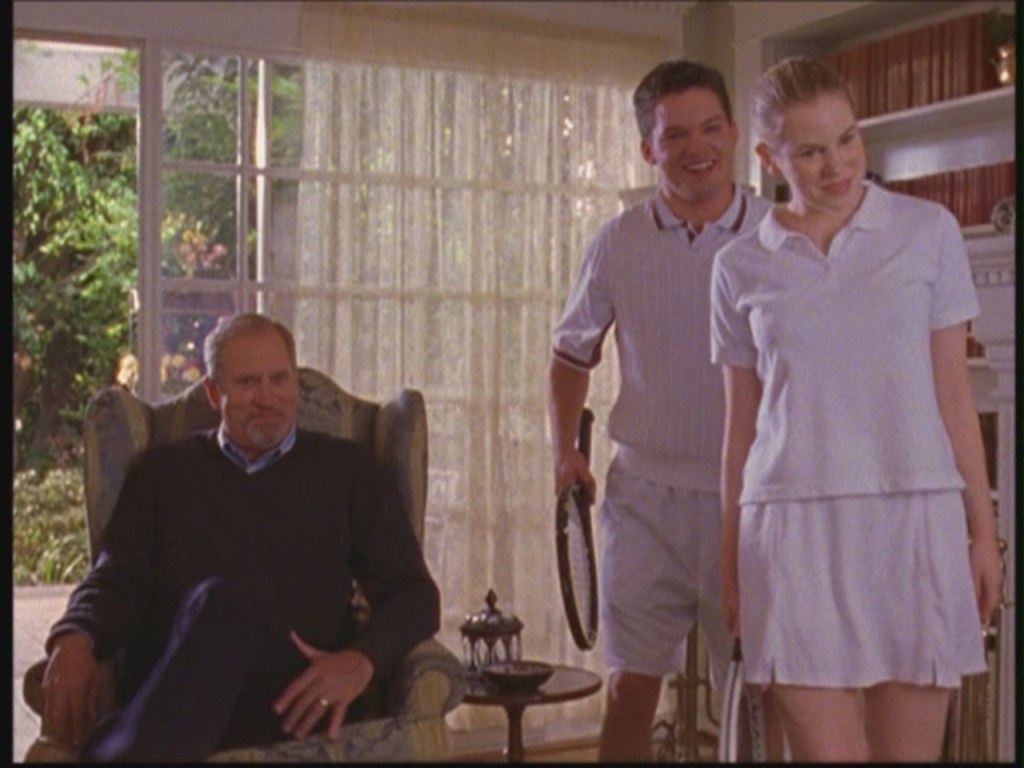
LORELAI: And how is it they just came off the tennis court and they’re not even sweating?
RORY: I don’t know. Maybe when you’re that white, you don’t sweat.
Um … what ethnicity are Lorelai and Rory meant to be? I can’t see how the Springsteens would be any whiter than the Gilmores. And regardless, Lorelai and Rory seem pretty appalling guests in this scene.
DARREN: Jack’s pre-med at Princeton and Jennifer is bound for Harvard, like you Rory.
Jack is in a pre-medical program, an educational track that undergraduate students pursue before they go to medical school and study to become doctors. Their undergraduate studies typically focus on subjects such as biology, chemistry, physics, neuroscience, and behavioural sciences. He is attending the same university that Christopher was supposed to attend.
Jennifer can’t really be bound for Harvard at this point – notifications to applications haven’t been sent out yet. She has already applied, or will apply very soon, and Darren is obviously confident she will get in. He seems very confident Rory will as well, unless he’s just being polite – he hasn’t even seen her transcript yet.
Jack and Jennifer are played by Matt Newton and Jeanette Brox – they had both been in Judging Amy and Family Law, although not in the same episodes. Granville Van Deusen, who plays their father Darren, was also in Judging Amy, and like Jeanette, had been in General Hospital spin-off, Port Charles.
DARREN: I collect memorabilia, too. I’ve got each year’s Harvard team pennant going back to 1927 … It’s all over the walls at the rec room.
LORELAI: See, see, lots of paraphernalia.
Lorelai is crowing because Rory felt upset when she was told that having Harvard paraphernalia on her walls was a sign of being immature and desperate. Now she can see that Darren, a real Harvard graduate, has masses of Harvard memorabilia all over the walls of his recreation room. She had the real Harvard spirit all along!
Of course, Darren waited to graduate before he started collecting Harvard memorabilia – Rory has been putting it on her bedroom walls since she was a young girl. I’m not sure you can say she and Darren are exactly the same, although he is clearly a bit of a Harvard tragic as well.
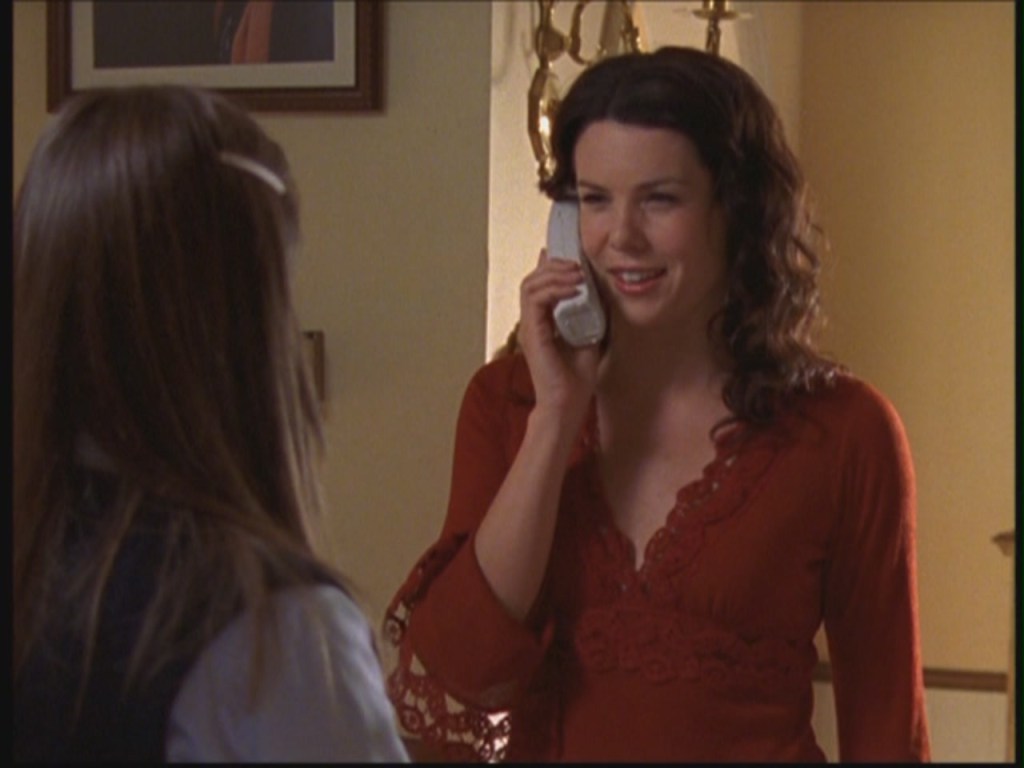
LORELAI: [answers phone in high voice] Hello? Hello, um, this is Rory Gilmore. I believe you were expecting my call . . . Um, oh, well, this is such a wonderful opportunity for me . . . Whatever’s good for you will be great for me . . .
LORELAI: [Headmaster Charleston]suggested setting up a meeting with a Harvard graduate, like a dinner or something. He even gave me the number of someone he knows.
RORY: An alumni dinner?
An “alumni dinner” is actually a dinner given for alumni of a university, not by an alumnus. Harvard holds several alumni dinners each year.
Headmaster Charleston seems to be talking about meetings for prospective students which are set up by institutions such as the Harvard Club – there is a Harvard Club for Southern Connecticut in Wallingford. My understanding is that these are official events, which at least a couple dozen of the best and brightest from each area attend at the same time – not just one student being given a phone number by their school principal, which seems incredibly sketchy.
After meeting with prospective applicants, the alumni association involved (such as the Harvard Club) will then meet with an admissions officer from the university, and put in a good word for the students they think would make great “Harvard material” (or whatever university it is). It sounds like privileged kids getting even more help to be accepted into university, but these associations are apparently very keen to increase diversity, and may advocate strongly for bright, successful students from a variety of backgrounds.
It almost seems as if Headmaster Charleston considers Rory to be one of these “non-traditional” Harvard applicants, who might benefit from some kind of assistance. I’m not sure Rory is actually that non-traditional, but in any case, I’m pretty sure the situation in this episode doesn’t happen in real life – and if it does, it shouldn’t!
Somehow we’ve gone from Rory being special and having the brains and hard work and tenacity to get into Harvard to Rory needing to be shuffled in the backdoor through some shady deal with a Harvard alumnus.
LANE: [on phone] I mean, I contend that you can draw a straight line from Yes to Jethro Tull to The Jam to Nirvana, bing bang boom . . . Who are the Jam? [to Rory and Lorelai] That’s disturbing.
Yes: English progressive rock band formed in 1968 by lead singer and frontman Jon Anderson, bassist Chris Squire, guitarist Peter Banks, keyboardist Tony Kaye and drummer Bill Bruford. It has had numerous lineup changes since then. Yes have explored several musical styles over the years and are regarded as progressive rock pioneers. They had a move towards more commercial, pop-oriented rock, and had their highest-selling album in 1983, 90125, with its #1 single, “Owner of a Lonely Heart”. Yes are one of the most successful, influential, and longest-lasting progressive rock bands, selling tens of millions of records, winning a Grammy, and being inducted into the Rock and Roll Hall of Fame in 2017.
Jethro Tull: British rock band formed in 1967, and forging a signature progressive rock sound. The group’s bandleader, founder, primary composer and only constant member is Ian Anderson (no relation to Jon Anderson), a multi-instrumentalist who mainly plays flute and acoustic guitar, and is also the lead vocalist. Their first commercial success was Stand Up (1969), which went to #1 in the UK, while Thick as a Brick (1972) is regarded as a classic. They have sold 60 million albums, won a Grammy, and are one of the most commercially successful and eccentric progressive rock bands of all time.
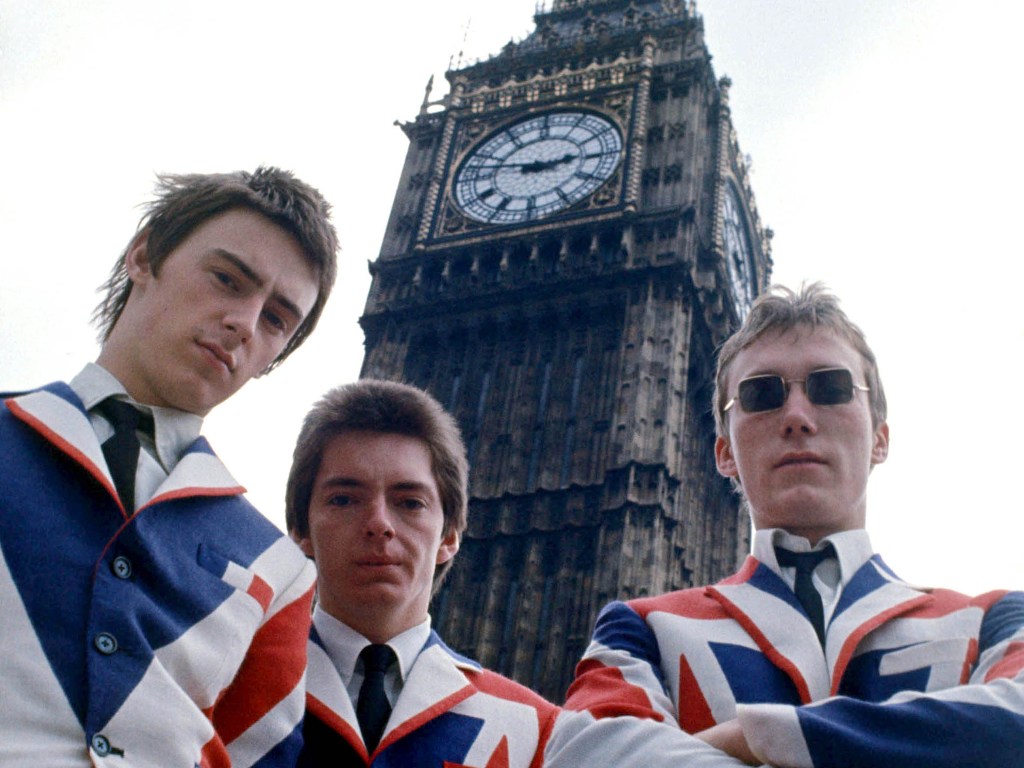
The Jam [pictured]: English mod revival and punk rock band which formed in 1972, led by Paul Weller on bass and lead vocals, and broke up in 1982. While The Jam shared the angry social protest and fast tempo of punk, they wore tailored suits and were influenced by 1960s bands such as The Who and The Kinks, as well as Motown, and were at the forefront of the Mod Revival movement in the UK. They released six studio albums, and had eighteen consecutive Top 40 singles in the UK, of which “Going Underground”, “Start!”, Town Like Malice”, and “Beat Surrender” all went to #1. The guy on the phone hasn’t heard of The Jam, because they broke up twenty years earlier, and were not well known in the US – their biggest hit there was “Town Like Malice”, which got to #31.
Nirvana: Rock band founded in 1987 in Aberdeen, Washington, by lead singer and guitarist Kurt Cobain, previously discussed, and bassist Krist Novoselic; Dave Grohl, previously mentioned, was recruited as drummer in 1990. They established themselves as part of the Seattle grunge scene and found unexpected mainstream success with “Smells Like Teen Spirit”, the first single from their landmark second album Nevermind (1991). Nirvana’s success popularised alternative rock, and they were often referenced as the figurehead band of Generation X. Their music maintains a popular following and continues to influence modern rock culture. Nirvana is one of the best-selling bands in the world, had five #1 hits, received a Grammy Award, and were inducted into the Rock and Roll Hall of Fame in 2014.
You can’t actually draw a straight line from Yes to Jethro Tull to The Jam to Nirvana (the difficulty of drawing one from Yes to Jethro Tull seems quite enough, when Jethro Tull came first!). However, they’d all fit into some sort of Venn diagram with psychedelic rock, so Lane’s bold assertion is incorrect, but not completely crazy.




 The Annotated Gilmore Girls