Tall Lorelai

RUNE: That’s Lorelai?
JACKSON: Yes.
RUNE: Did you see how tall she is?

Lauren Graham (Lorelai) is 1.75 m tall (just under 5 foot 7 and a half inches), while Max Perlich (Rune) is 1.62 m tall (around 5 foot 3). There’s a height difference in Lorelai’s favour – somewhat increased by heels – but Rune ridiculously compares her to a basketball player, an East German maid, and a freak of “bearded lady” proportions.

(The East German comment refers to the decades-long systematic doping of East German athletes with steroids and testosterone for the purposes of cheating, leading to some impressively large and strong athletes. The program ended in 1989 with the fall of communism, but unfortunately the men and women involved – some of whom were only eight years old at the time – are still experiencing physical and mental health disorders because of the doping. Lorelai is in the right age bracket to be an East German maid who was doped as an athlete in the 1980s:  picture shows 1980s East German athlete Marita Koch, who holds the world record for the 400 m, partly due to steroid use).

Lorelai rarely has any trouble attracting men, so having a date openly and constantly insult her physical appearance must be a bizarre experience for her.

“You run directly for president”

LANE: We’ll tell her [Lorelai] that we’re meeting Dean for a movie, and then we go to the movie, and then somebody who just happens to be a friend of Dean’s just happens to be there for the same movie, and so we figure that it would be completely rude for us to not ask said person to come sit with us.
RORY: I say to hell with governor, you run directly for president.
LANE: It’s not that bad.

Many US Presidents have been Governor of their state before making the run for the White House, including George W. Bush, former Governor of Texas, who had only recently (from Rory’s perspective) been sworn in as President, on January 20 2001.

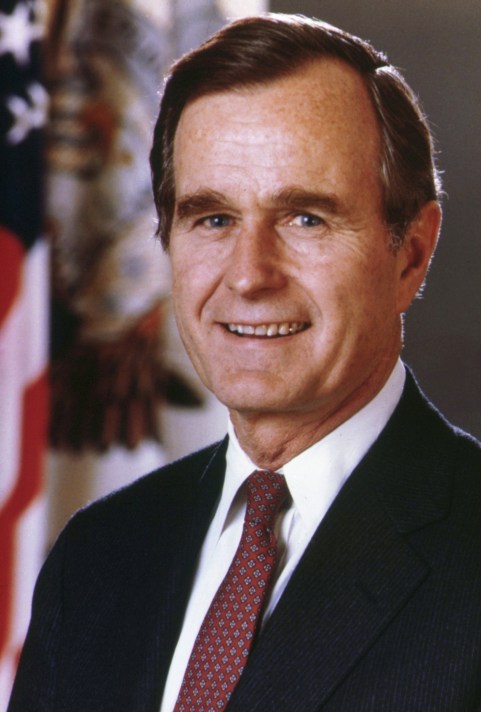
In 2001, the last US President to run for President without standing as a state Governor was George Bush Sr. [pictured], who was a Congressman, Ambassador to the UN, Ambassador to China, then Director of Central Intelligence before his successful presidential campaign in 1988 (sworn in 1989).

Rory is saying that Lane’s lying is on a scale that only a politician at the highest level could come up with. Lane understandably tries to downplay that one.

“Your name wouldn’t be Lithium?”

[Rory sitting on a bench reading. Dean come out, sees her and goes and sits with her]
DEAN: Is there anything in there about me?
RORY: I don’t know. You name wouldn’t be Lithium would it?

Rory is reading The Unabridged Journals of Sylvia Plath, edited by Karen V. Kukil. It was first published in 2000. The American poet, novelist, and short story writer Sylvia Plath (1932-1963) suffered from clinical depression which at times was severe.

Plath was hospitalised in a psychiatric ward for several months while in college, receiving electroconvulsive therapy, and required intermittant psychiatric support for the rest of her life. She died a suicide at the age of 30.

Rory may have been drawn to Sylvia Plath’s life story because she was highly driven academically, and a star student in both high school and college. She easily won prizes for poetry, short story-writing, and journalism, and one of her early writing achievements was being chosen as part of a group of college-aged guest editors for fashion magazine Mademoiselle.

On a darker note, among the several factors that pushed Plath into her first suicide attempt was a rejection from a Harvard summer school writing class. Sylvia Plath is a potent example to Rory of the pressures an ambitious young woman might face at college.

I’m actually not sure what Rory means by her comment, as to my knowledge Sylvia Plath was never treated with lithium. It may be an error by the writer (Amy Sherman-Palladino). In any case, it’s impossible not to feel that her quip is completely wasted on Dean.

Jefferson Suite

LORELAI: OK, put them [the Ruckers] in the Jefferson suite tonight, move them back to their previously booked room tomorrow, and offer them dinner on the house for the inconvenience.

The suite is named after American statesman Thomas Jefferson (1743-1826), one of the Founding Fathers of the United States, and principal author of The Declaration of Independence. He served as the third President of the United States (1801-1809), and was the second Vice-President under John Adams (1797-1801). It is an appropriate name for a suite at the Independence Inn.

Claudine Longet

LORELAI: Who the hell is that anyways?
RORY: Claudine Longet.
LORELAI: The chick who shot the skier?
RORY: Uh, sure, why not.
LORELAI: Wow – Renaissance woman.

Claudine Longet (born 1942) is a French singer, dancer, and actress who was popular during the 1960s and ’70s. In 1976 she was arrested and charged with fatally shooting her boyfriend, the American Olympic skier Vladimir “Spider” Sabich in Aspen, Colorado. She claimed that the gun had discharged accidentally while Sabich was showing her how it worked.

Although the Aspen police gained evidence that Longet had cocaine in her system, and that her relationship with Sabich had become unhappy, they made procedural errors which meant that their evidence could not be used in court. Prosecutors noted that the autopsy report showed that Sabich had been bent over, facing away, and at least six feet (1.8 m) from Longet, which isn’t the usual position you take when showing someone how to handle a gun.

The jury convicted her of negligent homicide, and she was sentenced to pay a small fine and to spend thirty days in gaol in the manner of her own choosing. She chose to serve her sentence as weekend detention, and attracted public censure for going on holiday with her married defense attorney; they eventually married and still live in Aspen.

Longet was sued by the Sabich family, and the case was settled out of court. The conviction essentially ended Longet’s career, and she has lived out of the public eye ever since.

Yoko Ono

LANE: A very misunderstood artist and the Beatles would’ve broken up anyways.
RORY: Have you shared this theory with anyone?
LANE: I know it, Yoko knows it, Sean knows it. Julian’s still in denial but what can you do?

Yoko Ono (born 1933) is a Japanese artist, singer, songwriter, peace activist, performance artist, and film-maker. She is famous for being the second wife of British singer-songwriter John Lennon, one of the Beatles. They met in 1966 and began a relationship while John was still married to his first wife, Cynthia, and were married in 1969.

The Beatles disbanded in 1970, and it is common to blame Yoko Ono as one of the primary causes of the band’s break up. Lennon and Ono spent all their time together, even when The Beatles were recording, which went against the band’s unspoken agreement not to allow wives or girlfriends into the studio. Ono frequently made comments and suggestions on the recording process, encouraged by Lennon, but to the other band members’ irritation.

However, The Beatles had experienced a number of stresses, including the death of their manager Brian Epstein in 1967, and the rise of George Harrison as a composer in his own right, with each member of the band beginning to have solo projects of their own. Although Ono placed further pressure on the band and contributed to feelings of ill-will, Lane is correct that The Beatles would have broken up anyway.

Sean Lennon (born 1975) is the son of John Lennon and Yoko Ono, while Julian Lennon (born 1963) is the son of Lennon and his first wife Cynthia. One reason why Lane says Julian might be “in denial” is that Julian was excluded from his father’s will, with the majority of the estate going to Ono; Julian sued the estate and in 1996 reportedly accepted a settlement of £20 million.

Despite the many factors working against their relationship, Julian is said to be on polite terms with Yoko Ono, and gets on very well with Sean. I’m not sure Julian has ever expressed an opinion on whether Ono broke up The Beatles (and by this stage, probably doesn’t care anyway).

Yoko Ono made several albums in collaboration with John Lennon, while also releasing solo albums – her solo debut album was in 1970. Although critics dismissed her work for many years, in November 2001 she brought out a concept album which was critically acclaimed, so Lane (and the show) was slightly ahead of the trends by recognising her as a misunderstood genius.

Once again, Lane demonstrates a sympathy for creative artists of Asian heritage. Perhaps she can picture herself as another Yoko Ono, bringing out avant-garde pop music with a feminist slant to it.

Rick James and Hugh Grant

RORY: Her [Paris’] dad’s like this big wig at a huge pharmaceutical company and they’re printing all the sordid details about it [his divorce] in the paper.
LORELAI: Ooh how sordid?
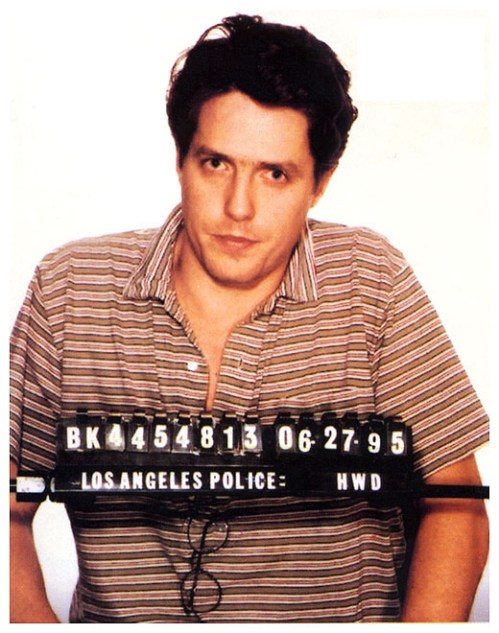
RORY: Well, it’s not the Rick James incident, but Hugh Grant should be feeling pretty good about himself.

American R&B singer Rick James (1948-2004) had several public scandals. In 1991, he and his wife were accused of holding a woman hostage for several days during a cocaine binge, tying her up, and forcing her to perform sexual acts. In 1993, while out on bail, he and his wife were accused of kidnapping and assaulting a female business associate for several hours. He was found guilty in both cases, sentenced to two years prison, and ordered to pay his second victim $2 million in damages in a civil suit. Released from prison in 1996, he was accused of sexually assaulting a woman in 1998, but charges were later dropped. It may be this final “incident” that Rory is alluding to.

British actor Hugh Grant (born 1960) [pictured] was arrested in Los Angeles in 1995 for receiving oral sex in a car from a Hollywood prostitute named Divine Brown. He was fined, placed on two years probation, and ordered to complete an AIDS education program. The incident occurred just before his film Nine Months was released, but he was able to gain public appreciation by speaking honestly about what he’d done and not making any excuses for his behaviour. As a result, no major damage was done to his career or reputation.

Mr. Geller’s scandalous exploits are apparently significantly worse than an encounter with a prostitute, but not as bad as the sexual assault allegations levelled at Rick James. We know that they must be sexual in nature, and of enough public interest to be reported in the newspaper. Other than that, they must be left to our imaginations.

Nancy Kerrigan and Tonya Harding

As they prepare for their ice skating date, Rory identifies herself as Nancy Kerrigan [pictured on the right], while Lorelai says she is Tonya Harding [left].

Nancy Kerrigan (born 1969) is a former figure skater, who became the US Champion in 1993. In 1994 she was clubbed in the knee by an assailant hired by the ex-husband of her rival Tonya Harding (born 1970), in an attempt to break her leg so that she would be unable to compete at the Winter Olympics.

The attack took place at the US Figure Skating Championships, ruling her out of the competition, which was won by Harding. Kerrigan made a good recovery from her injury (her knee was only bruised, not broken), and won silver at the 1994 Winter Olympics, held seven weeks later.

In March 1994, Harding pleaded guilty to conspiring to hinder prosecution of the attackers. She was fined and sentenced to community service, and was also forced to withdraw from the 1994 World Figure Skating Championships and to resign from the US Figure Skating Association. She was later stripped of her 1994 US Championships title and banned for life from participating in professional ice skating events in any capacity.

The fevered publicity generated by the scandal created a boom in professional ice skating, and may have even contributed to Rory’s interest in the skating film Ice Castles; like Lexie in the film, both Kerrigan and Harding came from modest backgrounds.

It is entirely within character that Rory identifies with the pageant-pretty “ice princess” Kerrigan who learned to fit in with the social conventions of the skating world, while Lorelai identifies with Harding – generally seen as an overly-dramatic emotional mess from the wrong side of the tracks. Harding also had issues with her mother, just as Lorelai does with Emily.

Marilyn Monroe-Arthur Miller Syndrome

MADELINE: I bet his [Max’s] girlfriend’s pretty.
LOUISE: I bet she’s dumb.
MADELINE: Why?
LOUISE: Dumb girls crave smart men. It’s that whole Marilyn Monroe-Arthur Miller syndrome.

Hollywood actress Marilyn Monroe and left-wing playwright Arthur Miller married in 1956, after meeting in the early 1950s and dating seriously since 1955. The media saw the marriage as a mismatch, because Monroe’s typecast screen persona was a “dumb blonde”: one headline read Egghead Marries Hourglass. The couple divorced in 1961.

Lorelai and Max do fit the Monroe-Miller stereotype, as Max is written as far more literary and intellectual than the vivacious Lorelai.

Michael Chrichton

LORELAI: Every now and then, I’m seized with an overwhelming urge to say something like, “As Marcel Proust would say …”, but of course I have no idea what Marcel Proust would say so I don’t even go there. I could do, uh, “As Michael Crichton would say ..”, but it’s not exactly the same, you know.

Michael Chrichton (1942-2008) was a best-selling American author, screenwriter, director, and producer. He is best known for his science fiction, thriller, and medical fiction novels. Many of his books have been adapted into action films. Lorelai has apparently read at least one of his books, but it is unclear which one/s, as he was a fairly prolific writer.

In 2001, his most recent novel would have been Timeline (1999), a thriller about time travel to medieval France. This is a rather amusing counterpoint to Proust’s masterwork In Search of Lost Time, which is also set in France and deals with the problem of time in a completely different way.