“Letting chicks into the Augusta Golf Club”

LORELAI: Dad, I explained this to Mom and I’ll explain it to you. I’m not sixteen, I don’t live with you anymore, I’ve been making my own decisions, romantic and otherwise, for a long time now and you can play all the golf you want but the subject better be letting chicks into the Augusta Golf Club because my love life is officially off limits.

Augusta National Golf Club in Augusta, Florida, first opened in 1932. Since 1934, the club has played host to the annual Masters Tournament, one of the four men’s major championships in professional golf, and the only major played each year at the same course. It is considered to be one of the best golf courses in the US.

There was a controversy over the club’s refusal to admit female members to the club. Following the discord, two club members resigned, and pressure on corporate sponsors led the club to broadcast the 2003 and 2004 tournaments without commercials. The controversy was discussed by the International Olympic Committee when re-examining whether golf meets Olympic criteria of a “sport practiced without discrimination with a spirit of friendship, solidarity and fair play”.

The club extended membership to Condoleezza Rice and Darla Moore in 2012, so it now has at least two female members. The Augusta National Women’s Amateur Championship began being co-hosted by Augusta National in 2019.

Palermo

LORELAI: Yes, he sniffed, swirled, swished, and did every other pretentious and borderline-disgusting thing that you can do with a glass of wine in a public place, and he did it all while describing to me the vintage discrepancies and the wood they use for the barrels in Palermo and the grape crop projections for the following year.

Palermo is the capital of Sicily, an island region of Italy. Almost three thousand years old, it is rich in history and culture, and a popular tourist destination for its climate, music, nightlife, and cuisine. There are several vineyards and winemakers in the area.

Amsterdam

LORELAI: He sounds very cool, and not just ’cause he owns his own jet.

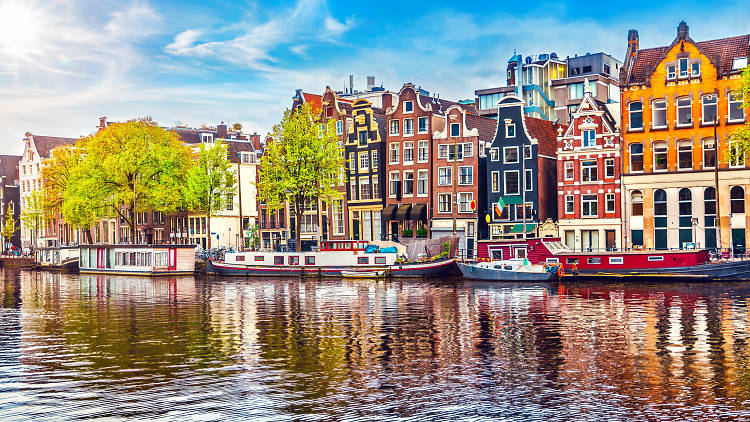
RORY: Well, remember to tell him that the way to get to you is through your daughter, who desperately wants to go to Amsterdam.

Amsterdam, the capital of the Netherlands, famous for its canals, earning it the moniker, “Venice of the North”. Although it has numerous attractions, including the Van Gogh Museum and the Royal Palace, my hunch is that Rory probably most wants to see the Anne Frank House, a museum dedicated to the celebrated Jewish wartime diarist Annelies “Anne” Frank (1929-1945), who hid from the Nazis in an Amsterdam attic for two years, before being arrested with her family and taken to a concentration camp, where she died a few months later.

Not only is Anne Frank’s story tragic and compelling in itself, her dream of becoming a writer was fulfilled when her edited diary was published posthumously in 1947 – in English in 1952, as The Diary of a Young Girl. Rory nearly always seems to be drawn to places which have some literary connection, and I’m guessing that in the case of Amsterdam, it would be the chance to visit the place where lived another bright teenage girl who was a talented writer. In A Year in the Life, Rory becomes a writer herself.

This is now the third city that Rory has said she wants to visit. In Season 1, it was Fez, in Season 2 it was Prague, and now in Season 3, it is Amsterdam.

David Bowie Concert

LORELAI: Well, first, he asked me to the David Bowie concert next week.

David Bowie’s 2002 concert tour was the Heathen tour, promoting his latest album Heathen, which came out in June that year. It opened in New York City on June 11, before going back and forth through Europe and the US.

By October 11, Bowie was back in New York, with the final concert in the city being Sunday October 20 at the Beacon Theatre on Broadway [pictured]. That is the last possible date Lorelai and Peyton could have gone to his concert – and if that was the week after their first date, it suggests that this scene takes place around the second week of October.

There is no way that this tallies with the timeline within the show, way too much has happened for it only to be early October, so it’s probably best to think of it as a fictional concert date. On the rare occasions when real world events are mentioned as impinging on the action, they rarely match up exactly with the dates within the show. But I think it is safe to say it is now late October, so they only seem to be running about two weeks behind the real world.

Maui

LORELAI: [on phone] You just flew back on your jet, huh? . . . From Maui?

Maui is the second largest island of the state of Hawaii, famous for its beautiful beaches, and a very popular tourist destination.

While Lorelai actually says “Maui”, the audio doesn’t seem to quite match up. Apparently, she originally said “Bali”, an island in Indonesia which is also a popular tourist destination. “Eight O’clock at the Oasis” aired on October 22 2002 – just ten days after a bomb attack in Bali which killed 202 people and left 209 injured, on October 12 2002. Because of that, Bali was re-recorded as Maui.

“You like piña coladas”

RORY: You like piña coladas.

LORELAI: And getting lost in the rain.

A piña colada is a cocktail made with rum, pineapple juice, and coconut milk or cream, served either blended or shaken with ice. It may be garnished with a pineapple wedge, a maraschino cherry, or both. The cocktail originated in Puerto Rico, is its national drink, and its name means “strained pineapple” in Spanish. One story is that the cocktail was invented by Puerto Rican pirate, Roberto Confresi in the 19th century; the less exciting but more probable version is that it was invented in 1954 at the Caribe Hilton Hotel in Puerto Rico by bartender Ramón “Monchito” Marrero.

Lorelai refers to “Escape (The Piña Colada Song)”, written and recorded by British-American singer Rupert Holmes, released as a single from his 1979 album Partners in Crime. The song is about a man who is bored with his current relationship, and answers a lonely hearts advertisement in the newspaper which begins, “If you like piña coladas …”. When he meets up with the lady, it turns out to be his partner, who was equally bored in their relationship. They realise they had more in common than they realised, and their relationship is now reinvigorated. It was an international hit, and went to #1 in the US and Canada. Ironically, Rupert Holmes has never drunk a piña colada, and the original lyrics were, “If you like Humphrey Bogart”.

Lorelai gets the words slightly wrong. The lyrics are actually:

If you like piña coladas

And getting caught in the rain

not getting lost in the rain.

Tiki Bar

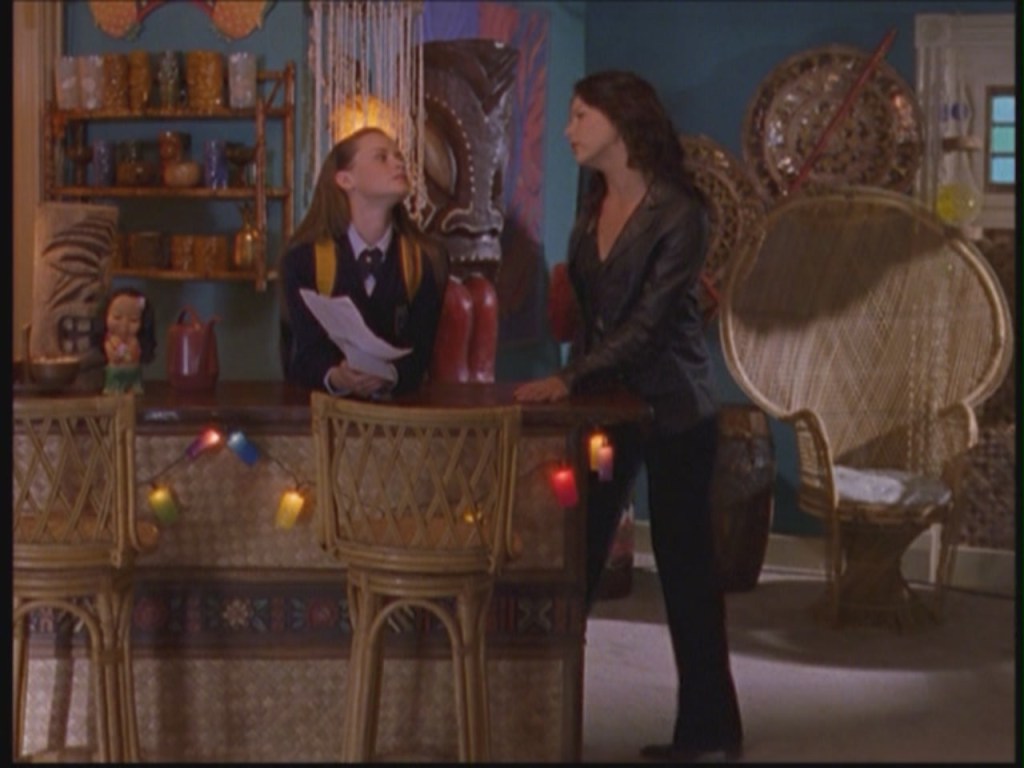
RORY: Hey, how come we don’t have a tiki bar?

Once inside Dwight’s home, which Lorelai has done her best to turn into a place of imagined horrors, the Gilmore girls naturally love it at once. It has the same kitschy taste that they like, and I think they appreciate that Dwight has decorated the house completely for his own comfort and amusement, a design aesthetic that is in harmony with Lorelai and Rory’s own.

Dwight’s home bar is a tiki bar – that is, a bar inspired by tiki culture décor. Tiki culture is an American movement inspired by a romanticised view of tropical island cultures, mostly Polynesian, catering to American views of the South Pacific. The name comes from Tiki, the Māori name for the first human, often represented in the form of a pendant and frequently appropriated by Europeans as a commercialised good luck charm.

Although tiki bars are generally of broadly South Pacific influence, they tend to serve cocktails from the Caribbean. Because of its colonial nostalgia, and the simplistic view of the Pacific taken by the aesthetic, Tiki culture has been perceived as controversial, culturally insensitive, or racist.

Tiki culture became fashionable during the 1930s as a Hollywood-style image of a leisurely, exotic island lifestyle. It had an explosion of popularity after World War II, as American servicemen returned from tours of duty in the South Pacific, often with souvenirs. It began to decline in the late 1970s but there was a revival in the late 1990s and early twenty-first century, so Dwight is surprisingly on trend in owning a tiki bar.

Shamu

LORELAI: Well, I don’t know his name because I only knew him by his nickname . . . Uh, Shamu. We called him Shamu. He was kind of, um, a big guy in high school, but he’s slimmed down quite a bit.

Lorelai tries to find out Peyton’s name by phoning the organisers and pretending he’s an old school friend that she only knows by his nickname, Shamu. Shamu is the name given to several performing orcas at Sea World, previously discussed. It is a cruel nickname sometimes given to people perceived as being overweight, because orcas are also called killer whales (with the implication the person is as as fat as a whale). Despite the name, orcas are actually members of the dolphin family.

Vermont

AUCTIONEER: Next up, we have an occasional table from a distinguished, family-owned company in Vermont, circa 1912.

Vermont, a New England state of the US, bordering New York, Massachussets, New Hampshire, and Canada. It is the only state in New England that does not border the ocean. It is the second-least populated state after Wyoming, and the sixth-smallest by area. The Green Mountains which give the state its name (Ver Mont, or “green mountain” in French) run up the middle of it, and much of the state is forested by hardwoods and conifers. Most of its open land is used for farming.

Vermont is known for its quality furniture-making, which goes back to the 17th century, and as a good place to buy antique furniture. This is due to its heavy forestation and lumber industries, which have given several towns in Vermont their identity as woodworking centres.

Sardi’s

DEBBIE: Well, I felt obligated to tell the other moms about your little performance at school before they heard about it elsewhere.

LORELAI: Really, ’cause usually I like to meet up at Sardi’s after a performance, wait for the reviews. I hope The Times liked me.

Sardi’s, continental restaurant in the theatre district of Manhattan in New York City. It was founded by Vincent Sardi Sr and his wife Jenny Pallera, and first opened in 1927. It is known for the caricatures of Broadway celebrities on its walls, of which there are over a thousand. Sardi died in 1969, and the restaurant declined in the 1980s, being sold in 1986. After closing temporarily in 1990, it reopened with new staff.

The restaurant is considered an institution in Broadway theatre. It’s known as a place to gather before and after the theatre hangout, as well as a location for opening night parties, and was where the idea of the Tony Award was devised. Lorelai sarcastically puts herself in the role of an actor waiting at Sardi’s for the reviews of their performance in the New York Times.