The Twilight Zone

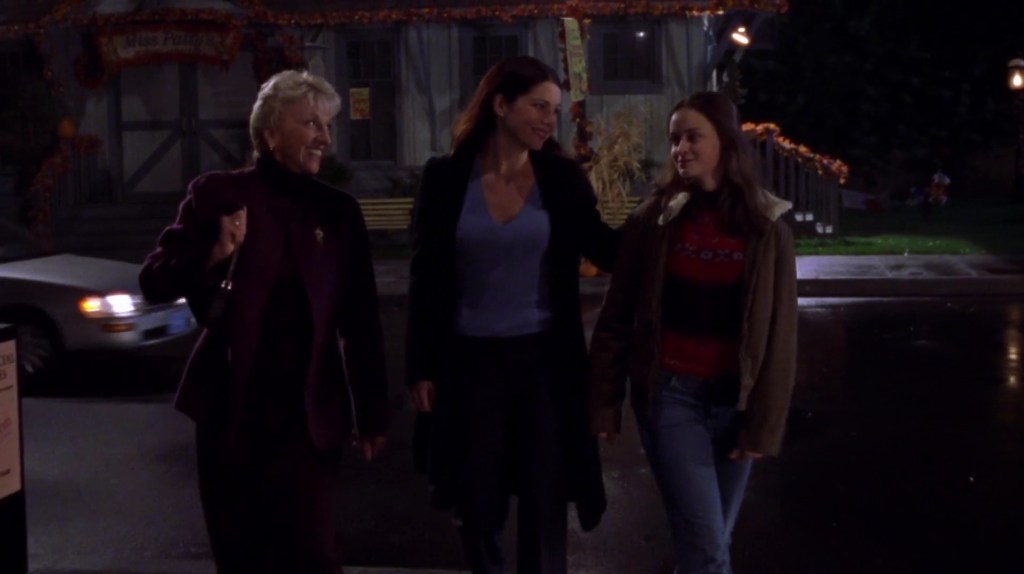
PAUL: I think it’s a conspiracy getting us ready for the day we’re all gonna be raised by machines. No human contact whatsoever.
LORELAI: You know my mother, don’t you?
PAUL: The, uh, Twilight Zone marathon was on all week.

The Twilight Zone, an American media franchise created by Rod Serling. Each episode is in genres such as science-fiction, fantasy, suspense, or horror, often with a macabre or unexpected twist, and usually with a moral attached. The original series ran from 1959 to 1964, and it was revived in 1985, 2002, and 2019, as well as being made into films and a radio show, and inspiring various books, games, and theme park attractions. A popular and critical success, it is considered one of the best television series ever made.

Paul’s theory about being raised by machines with no human contact sounds like something from The Twilight Zone, although I can’t locate an episode with the same plot. It’s a tiny little bit like the 1962 episode I Sing the Body Electric, written by Ray Bradbury, about three children raised by a robot “grandmother”. Far from being a nightmarish scenario, the robot carer is kind and empathetic, and the children love her dearly.

Paul enjoys science-fiction shows, like Lorelai (and like Luke). It must be one of the reasons she feels drawn to him. Although mentioning you have mummy issues before you even get to the first date doesn’t seem like a great idea.
Three-Way Phone Conversation

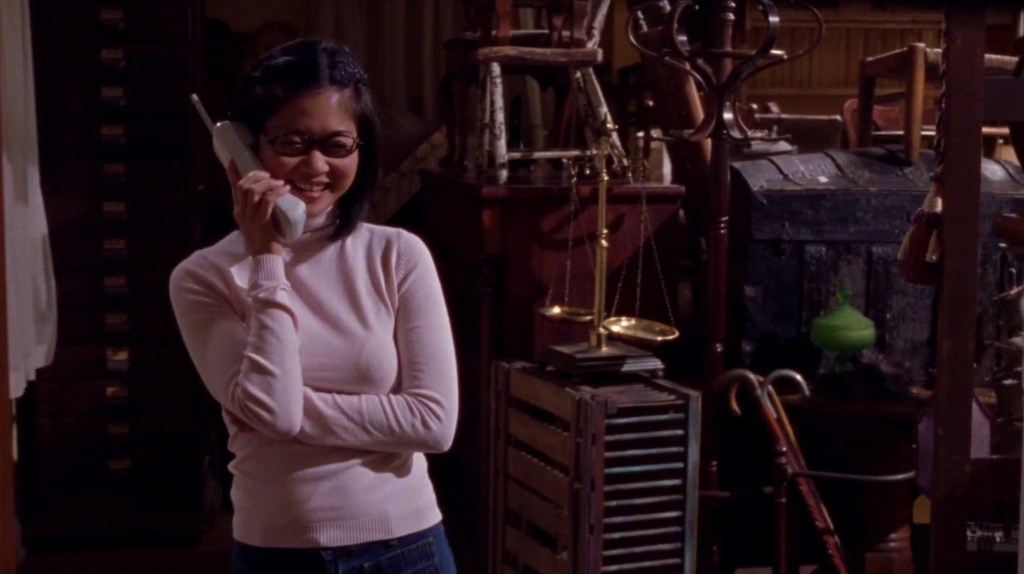
Rory helps Henry organise a three-way or party line conversation so that Lane and Henry can talk, while Mrs Kim believes that Lane is talking to Rory. It was done by calling the first person, then pressing the FLASH button before dialling the next person then pressing FLASH again. It cost extra and showed up on the phone bill. It’s still possible to do on a landline today, as well as a mobile phone.

This is the first thing Rory has done to help Lane and Henry, and it’s pretty minimal. Lorelai seems to be aware of the deception towards Mrs Kim, but doesn’t feel any need to tell her the truth despite her supposed “mom code”. Henry met Lane eight months ago, and must be very keen to be kept interested with occasional five minute phone calls, conducted with some difficulty.

Richard III, The Sonny and Cher Show

PROFESSOR ANDERSON: Last year, we did Richard III. One group did their scene as the Mafiosi. Another set theirs during the Roman Empire. And my favorite, the climactic last scene was set during the final days of The Sonny and Cher Show. Just remember, whatever interpretation you choose should highlight the themes you see in the scene. And if the love of the Bard’s language still doesn’t inspire you, remember this will be fifty percent of your final grade.

Richard III is a historical tragedy by William Shakespeare, probably written around 1593. It is one of the longest of his plays, and is often abridged for performances. It is about King Richard III of England, depicted in the play as an ugly hunchback and an absolute villain. The final scene is set at the Battle of Bosworth, when Richard’s supporters desert him; he is killed by the Earl of Richmond, who claims the throne as Henry VII.

The Sonny and Cher Show was a 1976-77 television variety show with music and comic sketches, which followed on from The Sonny & Cher Comedy Hour (1971-74), The Sonny Comedy Revue (1974), and Cher (1975). Sonny and Cher got divorced, hence the separate shows, but with the bitterness of their divorce behind them, they came back with another show made together, although slightly more subdued in tone. Variety shows were on their way out, and the final few episodes were quickly aired in a late-night Monday evening time slot – this would have been the “final days” of the show. In the last episode, Tina Turner was the guest star.

Emily Post and Martha Stewart

LORELAI: Okay, once again, I bring up the fact that this is a wedding present, and as I am not getting married, neither God’s law nor Emily Post allows me to keep this …
SOOKIE:
[Martha Stewart] said that if it arrives after ten weeks …
RORY: Eight.
SOOKIE: …eight weeks, that you don’t have to return it.

Emily Post and Martha Stewart, both previously discussed. The program that Sookie watched was Martha Stewart Living.

There is, of course, no such “wriggle room” rule in etiquette (Sookie and Rory invented it because they want the ice cream maker). If your wedding is cancelled, you return all the gifts, no matter how late they arrive (unless the sender specifically tells you to keep it, which does sometimes happen).

However, if a gift arrives with no name attached to it, then there is little you can do, because it’s considered even ruder to ring around and ask people if they sent such-and-such (it seems like you’re criticising them for not sending it, and assume they are too dim-witted to attach a name to it). You could try to find out the sender by calling the company who delivered it, but after that there’s not much you can do. If conscience smites you, you can always donate it to charity, or sell it and donate the money.

Lorelai must surely suspect her mother of sending it, yet she’s the one person that Lorelai doesn’t ask, as if she doesn’t want to know.

Sookie says it is more than ten weeks since the wedding was cancelled, and Rory corrects her to more than eight weeks. In fact, it is just over twelve weeks since Lorelai and Max’s wedding was meant to take place.

Women’s Basketball

LUKE: I asked [Sookie] how your plans were going with the new inn, and she very awkwardly changed the subject to women’s basketball … She’s never shown much interest in sports before … What’s going on with that?
LORELAI: Oh well, you know, women’s basketball is getting super popular. That’s good, I think. The tall girls need an outlet.

Rune thought Lorelai was too tall, even referring to her as a basketball player. Here Lorelai is quick to imply she’s not a “tall girl” who needs the “outlet” of playing basketball. (She’s about an inch shorter than average for a female basketball player).

Luke says that women’s basketball is in season and maybe Lorelai and Sookie could go to a game together. I think he must mean the women’s college basketball tournament (NCAA Division 1), which opens in November, as the professional league, the Women’s National Basketball Association, has a season running from May to September.

Blue Book Laws

JESS: I’m not really familiar with the blue book laws in this town, so you can be talking about a lot of things. Dropping a gum wrapper, strolling arm in arm with a member of the opposite sex on a Sunday.

Jess seems to have confused two different things and put them together (perhaps deliberately).

Blue laws are laws designed to restrict activities on a Sunday, such as banning certain retail activities eg buying alcohol. In Puritan times, they were very strict when Connecticut was a colony, which might be what Jess is implying – that Stars Hollow is still stuck in the colonial past. Examples of such old timey strictness include not allowing people to run anywhere, or to walk in their gardens on a Sunday. It’s not common, but some towns in the US do have their own blue laws, even today.

Project Blue Book was the code name for the study of UFOs by the US Air Force from 1952 to 1969. Did Jess make a simple error, a Freudian slip of the tongue, or is he saying that he feels like an “alien” being studied by the townsfolk of Stars Hollow?

(I have actually seen people make this same error in regard to “blue book laws”, so I don’t discount the idea that the writer, Daniel Palladino, may have had the same misunderstanding).

“He’s been scraping that outline off the cement for two days”

RORY: Hey, I’m gonna go check on Dean. He’s been scraping that outline off the cement for two days now.

You might think that chalk would wash straight off pavement, but actually water only removes most of the chalk. Little particles get into all the tiny crevices and pores in the cement that require vigorous scrubbing. Yes, Taylor is that fussy! 99.5% clean is not good enough!

He also seems to be making Dean clean the pavement in the dark and after the store is closed, which surely can’t be legal, and certainly isn’t practical. I can’t help thinking this episode did not endear Jess to Dean even before jealousy entered the picture.

Glitter

LORELAI: I heard [Jess] controls the weather and wrote the screenplay to Glitter.

Glitter is a 2001 romantic drama musical film directed by Vondie Curtis Hall, and starring Mariah Carey, previously discussed. The screenplay was written by Kate Lanier. The film is about a club dancer who aspires to be a professional singer, and falls in love with a nightclub DJ who helps her in her career.

The film came out on September 21, so Lorelai would have seen it in the cinema only recently. It was heavily panned by critics, with Mariah Carey’s acting efforts considered amateurish, and it failed at the box office. It has been called the worst film ever made. Even before the film was released, Mariah Carey was hospitalised with a breakdown, much later revealed to be bipolar disorder. Carey herself expressed a lot of regret over, and disappointment in, the film.

Amy Sherman-Palladino was one of the many people who hated Glitter, which is probably why it gets mentioned here as Lorelai’s joke about the “evil crimes” of Jess. Lorelai doesn’t like Jess, but even she thinks the town is going too far in their treatment of him. She has the good sense not to offer her own issues with Jess (stole beer, talked back to her, prowled around her daughter), as grist for the mill at the meeting.

CEO of IBM

MIA: You marched up to me, looked me right in the eye and said, ‘I’m here for a job. Any job.’
LORELAI: Well, IBM had turned me down for the CEO slot, so I was desperate.

IBM is an acronym for the International Business Machines Corporation, a tech company headquartered in Armonk, New York, founded in 1911 by businessman Charles Ranlett Flint as the Computing-Tabulating-Recording Company, receiving its current name in 1924. It is nicknamed Big Blue.

One of the largest companies in the world, IBM produces and sells computer hardware and software, and provides hosting and consulting services in areas ranging from mainframe computers to nanotechnology. It’s also a major research organisation, which has invented such things as the automatic teller machine, the floppy disc, the hard drive, magnetic stripe cards, and barcodes. IBM employees have been awarded five Nobel Prizes, six Turing Awards, ten National Medals of Technology, and five National Medals of Science.

When Lorelai was job-hunting in 1986, the CEO of IBM was John Fellows Akers (1934-2014), a Yale alumnus who had only been in the role a year. In 2001, the CEO of IBM was businessman Lou Gertsner (born 1942), who took the role in 1993. He is largely credited with turning the company’s fortunes around, and was the first to be hired from outside the company.