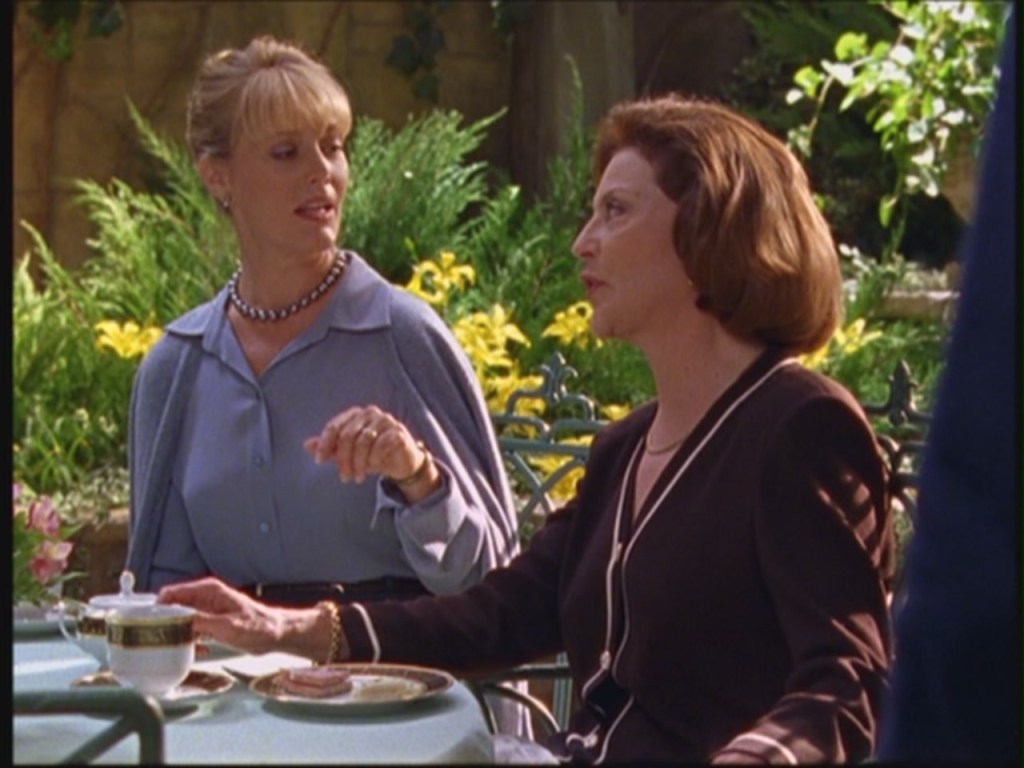
VIVIAN LEWIS: Why don’t you present Rory there? EMILY: Oh . .. uh . . . Well, I don’t know. Isn’t it a little late? SUNNY: Oh please. For Emily Gilmore, I’m sure they’ll bend the rules.
Generally you’d need to apply for a debutante ball several months in advance, and commit to a ten to twelve week course of dancing and etiquette lessons in preparation. It’s more than a “little late”, and they won’t be “bending” the rules for Emily Gilmore, they’ll be smashing them to pieces!
Naturally rules are only for mere mortals, not for the glorious Gilmore girls. In this case, it’s practical for the show, because it cuts down months of ball preparation (snigger) into less than two weeks.
The Daughters of the American Revolution really do hold debutante balls. They are often held on patriotic dates, and as this episode takes place in September, the ball might be held around the date of Constitution Day, which is September 17. In 2001, it was a Monday, but the ball could be held the following Saturday. This is also around the date of the Fall Equinox, giving the ball a Harvest Festival feel, as if the young girls are ready to be “gathered” or “picked”.
In real life, the DAR chapter for Hartford is called the Ruth Wylls Chapter. It was founded in 1892, making it one of the oldest chapters. It has over 50 members.
We already know that Emily is a member of the DAR, which means that she is a direct descendant of someone involved in the American Revolution, meaning Lorelai and Rory are eligible to join too. In real life, the easiest way to join the DAR is to have a blood relative who’s already a member, as your ancestry is proven. This becomes a plot point later in the show.
Founded in 1982, it provides clothing, games, and deliveries directly to hospitalised children through a network of more than 700 children’s hospitals and medical centres in the US, Canada, the UK, and Australia.
Emily has been the co-chair on its board for the past eight years, which seems unlikely – the foundation’s headquarters are in Los Angeles, it doesn’t have co-chairs, and its board is made up people with high profiles in medicine, finance, and media. I think we are meant to assume this is a (fictional) local fundraising branch for Hartford.
The Black and White Ball is their main fundraising event. This is a masquerade ball in which everyone is dressed in either black or white. They are intended to be extremely glamorous and exclusive events, with high ticket prices.
Hartford Zoological Silent Auction
A fictional organisation of which Emily is a board member. Hartford doesn’t actually have a zoo. The nearest Zoological Society is in Bridgeport, Connecticut, to support Beardsley’s Zoo.
A silent auction is one where bidders write their bids down on a sheet of paper, with the highest bid winning. They are common at charity events.
The Mark Twain House Restoration Fund
The Mark Twain House is a museum in Hartford, once the home of the author of Huckleberry Finn. Restoration began on the house in 1963, and its fundraising arm is the Friends of the Mark Twain House and Museum. They’ve been fundraising since 1954. This must be the organisation that has Emily as a board member, and is holding the charity luncheon Emily has been forced to turn down.
Harriet Beecher Stowe Literacy Auction
Harriet Beecher Stowe (1811-1896) was an American author and abolitionist, best known for her 1852 anti-slavery novel, Uncle Tom’s Cabin. The Harriet Beecher Stowe House & Center is in Hartford, next door to the Mark Twain House and Museum. Emily seems to be on the board of both these museums.
Emily’s strong community involvement, which is the major part of her social life, is very much like Lorelai’s enthusiastic support of every festival and celebration in Stars Hollow, right down to a cat’s wake. The apple didn’t fall far from the tree in this case.
Kabbalah is an esoteric discipline in Jewish mysticism, containing a set of teachings explaining the relationship between God and the universe. It dates to around the 12th century and originated in Spain and southern France. There are different traditions and streams of thought within it, that might focus on theosophy, meditative practices, or (more controversially) white magic. It has been a strong influence on Jewish philosophy and mysticism.
Since the 1960s, universalist schools have opened up which teach Kabbalah to people of all faiths and ways of life, one of the contributors to New Age spirituality. You can also sign up for six week courses in introductory Kabbalah, making it very accessible. Possibly such courses are held in Stars Hollow, although it is slightly surprising Luke knows about them and approves, as he doesn’t seem the most mystical person. The show did seem to just give random Jewishness to characters whenever it felt like it.
Freeway (a mistake for highway????) beautification projects
Community groups often sponsor a section of highway in the US in order to maintain it, and provide volunteers to work on it. Such projects might include planting trees, shrubs and ground cover plants, mowing grass, weeding, mulching, and removing roadside litter. It seems like something Taylor would almost certainly organise for a highway near Stars Hollow.
Color Me Mine pottery painting
A chain of studios, founded in 1996, where people can paint their own pottery and ceramics. In real life, there aren’t any Color Me Mine studios in Connecticut (but plenty in California, where the writers live).
Humorously, Luke’s suggestions of social activities he might approve don’t sound like anything most teenage boys would be interested in.
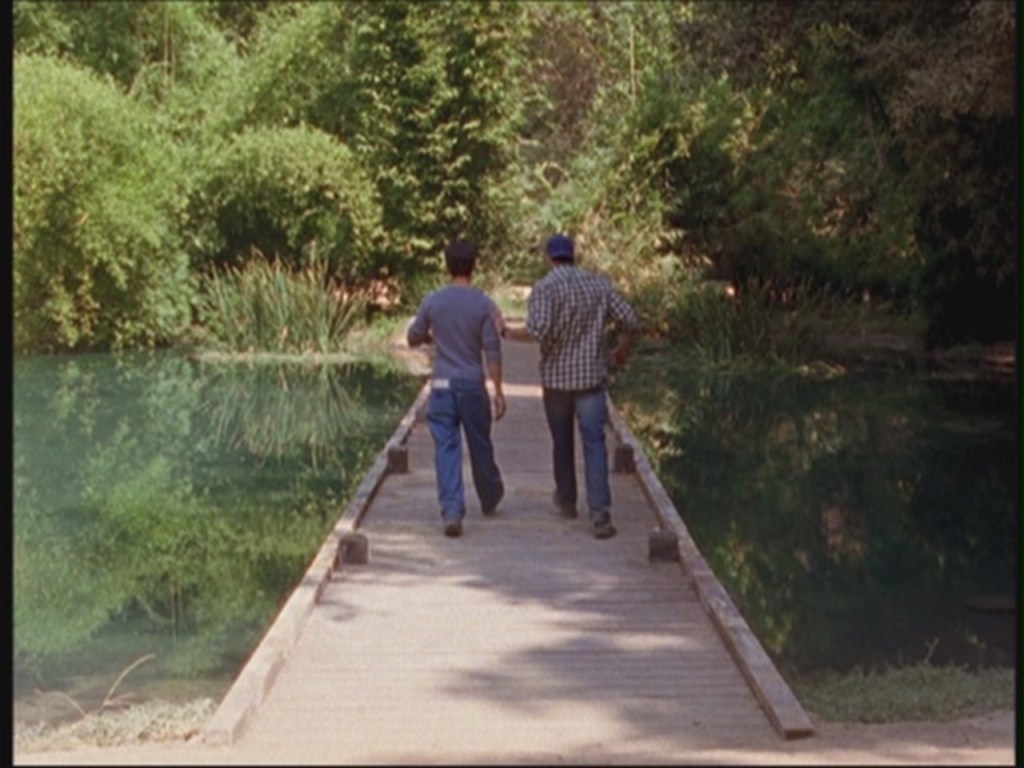
Luke waits for Jess after school, then as they walk home, confronts Jess about taking money from the donation cup for the bridge repair fund at Doose’s Market. Jess tells Luke to leave him alone, and in frustration, Luke pushes Jess off a low bridge (more of a walkway) into a lake. It’s the #1 fan favourite scene in this episode, with good reason.
It feels as if this should be the bridge that Jess stole money from, as a sort of karmic punishment. However, if the bridge needed to be repaired (an ongoing community project, it seems), then why is it still safe to walk on? Or is the money for future repairs?
Also, in an earlier episode, a poster is shown for the bridge fundraiser the previous year, and it says it is an old bridge over Muddy River. This bridge doesn’t look old, and it’s said to be over a lake, not over a river, let alone a muddy one. It doesn’t look like the arched bridge with a handrail in the picture. Then again, props people don’t have access to canon – they got Rory’s birthday wrong on her invitation, after all.
Luke tells Lorelai that he pushed Jess into “a lake”, rather than “the lake”, suggesting that Stars Hollow has several lakes (there is one behind The Independence Inn). In real life, the area around New Milford and Washington Depot has several small lakes and ponds surrounding it.
This scene was filmed at the Jungle Pond on the Warner Bros lot in Burbank, California, used in numerous Warner Bros films and TV series. It is the same set used for all lakes and ponds in the show.
JESS: You bring me here to this place, you put me in a school that says the Pledge of Allegiance in six different languages, two of which I’ve never heard of before.
The Pledge of Allegiance expresses loyalty to the United States flag and the nation that it represents. A pledge was first composed in 1887 by Captain George Thatcher Balch, a former Union Army Officer during the Civil War who later taught patriotism in schools. The current pledge was mostly composed by a Christian socialist minister and author Francis Bellamy in 1892, based on the one by Balch. It was formally adopted by Congress in 1942.
The Pledge of Allegiance is recited at the start of Congressional sessions, many local government meetings, and often even in private organisations. Most states, including Connecticut, require the pledge to be recited regularly, usually every day, at public schools. However, a student legally cannot be compelled to recite the pledge, or punished for failing to do so.
The Pledge of Allegiance
I pledge allegiance to the Flag of the United States of America, and to the Republic for which it stands, one Nation under God, indivisible, with liberty and justice for all.
It is recited while standing to attention, facing the flag with the right hand over the heart (non-religious headgear is removed for the pledge by males). Those in uniform remain silent for the pledge, but give a military salute to the flag.
Sometimes schools in the US have recited the pledge in different languages, but it tends to not go down well, and be considered unpatriotic. Stars Hollow High School is apparently not afraid to celebrate its diversity, even though its student population isn’t very diverse. Six languages seems extremely unusual though.
What the six languages were, two of which Jess had never heard of before, is open to speculation. I am going to guess, based on languages spoken in Connecticut, according to the census:
English
Spanish (the most common non-English language in the US)
French (we know this language is taught at Stars Hollow High)
Korean (Mrs Kim can be very persuasive?)
Tagalog (the language of the Philippines, which Jess might not have heard of?)
Urdu (the national language of Pakistan, which Jess might not have heard of?)
Other possibilities I considered: German (Stars Hollow once had an ill-fated German Club), Portuguese (second most common non-English language in Connecticut), Polish (very commonly spoken in the nearby Hartford area), Hebrew or Yiddish (we later learn Stars Hollow has a vibrant Jewish community), Algonquin (the Native American language spoken by Connecticut tribes), Esperanto (a created universal language), American Sign Language for the deaf.
RORY: Because it’s Tuesday night in Stars Hollow. There’s nowhere to bail to. The 24-hour mini-mart just closed twenty minutes ago. JESS: So we’ll walk around or sit on a bench and stare at our shoes.
A confirmation that it is now Tuesday, and the previous day was Monday, which doesn’t actually make much sense. Also, we’ve gone from Stars Hollow being the small town that never sleeps andgets up super early, to having a 24-hour mini mart that closes at 7 pm.
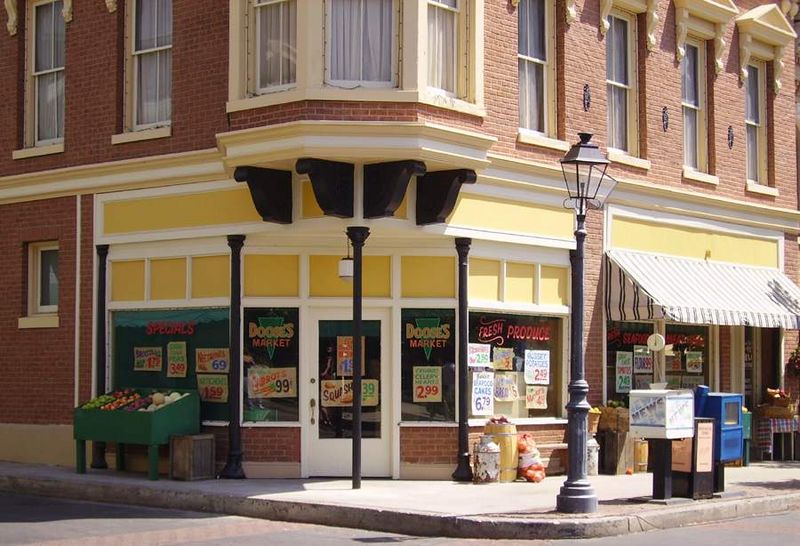
Is the 24-hour mini mart a joke, just referring to Doose’s Market? Because Taylor only seems to fear competition from supermarkets in neighbouring towns, so presumably there is nowhere else to shop in Stars Hollow.
By the way, one of the most befuddling essays I’ve read on Gilmore Girls is one categorically stating that a grocery store like Doose’s Market couldn’t possibly survive in a town of only 9000 odd people, with graphs and pie charts and so on to prove its economic unfeasibility. This is despite the fact that Washington Depot, the real life original inspiration for Stars Hollow, only has about 3000 people, yet has managed to maintain a successful grocery store (Washington Depot Food Market) much like Doose’s for decades.
SOOKIE: That is a great lemon. JACKSON: Try it, it’s a Meyer.
A Meyer lemon is not a true lemon. It’s a cross between a citron and a mandarin/pomelo hybrid. Hardy and easy to grow, Meyer lemons have a sweeter flavour than lemons.
Native to China, it was introduced to the US in 1908 by agricultural explorer, Frank Meyer. It became popular as a food item in the 1970s as part of the rise in Californian Cuisine, and was later championed by Connecticut-based Martha Stewart.
Meyer lemons need a greenhouse in cooler climates like Connecticut, and generally have mature fruit in winter. Jackson already has one fruiting in early September, no doubt because it’s from a greenhouse.
PARIS: This is The Franklin, a newspaper that’s been around for almost a hundred years. There have been at least ten former editors of The Franklin that have gone on to work at the New York Times. Six have gone onto the Washington Post. Three are contributing editors at the New Yorker. I think one even went on to win the Pulitzer Prize.
The Washington Post is a daily newspaper published in Washington DC, with a large national readership. Founded in 1877, it is famous for the printing of The Pentagon Papers, which helped spur opposition to the Vietnam War in 1971, and for breaking the news of the Watergate scandal, which led to the resignation of President Richard Nixon in 1974. It has won 69 Pulitzer Prizes, second only to The New York Times.
The Pulitzer Prize was established in 1917, and awards achievements in journalism, literature, and musical composition, in various categories. There is a huge list of past winners, one of which apparently went to Chilton.
The New Yorker, previously discussed. Paris says that three former editors of The Franklin are current contributing editors at The New Yorker. Of those born in the US, in 2001 they could only be either Michael Agger, Roger Angell, Ben Greenham, Robert Gottlieb, Hendrik Hertzberg, Robert Mankoff, or Amy Davidson Sorkin. Roger Angell is the only one who attended a private school in Connecticut.
According to Paris, about twenty percent of The Franklin’s editors went on to achieve journalistic greatness, which seems very high. The message is clear: working on The Franklin can be a stepping stone to success in journalism.
RORY: What’s [Jess] like? LORELAI: Well, he’s not gonna be subbing for the new dodo on the Regis show any time soon, let’s put it like that.
A reference to the talk show hosted by Regis Philbin, previously discussed. His co-host since 1988 was Kathie Lee Gifford, when it was called Live! With Regis and Kathy Lee. After Gifford’s last show in 2000, Regis spent six months auditioning possible co-hosts live on air. In February 2001, he chose dancer and actress Kelly Ripa, and the show’s name was changed to Live! With Regis and Kelly.
Kelly Ripa seems to be “the new dodo” (the new idiot) Lorelai is referring to. She’d been co-host for nearly seven months at this point, but I guess that’s still new for someone who is used to Kathy Lee Gifford.
“Subbing” is short for “substituting, so Lorelai is saying that Jess isn’t suitable to fill in for a talk show host (i.e., he isn’t chatty).






 The Annotated Gilmore Girls