LUKE: We don’t live in a fascist country. TAYLOR: Oh, this isn’t about the fascists – who, by the way, had their faults but their parks were spotless.
Lorelai has already accused Taylor of being a fascist, now Luke does so. It turns out that Taylor does in fact have some admiration for fascists and their “spotless parks”, meaning that Lorelai and Luke are somewhat justified in their name calling.
LORELAI: Luke, as long as you’re in that apartment, you’re gonna have a single bed. Don’t you want the possibility of more? Come on Luke, it’s time. Make a move, take a shot, entertain the possibility of a non-Unabomber existence.
LORELAI: A big, pretty dish of lovin’ with a spoon made especially for you.
This sounds like a reference to the rock band The Lovin’ Spoonful, founded in Greenwich Village in 1965 by singer John Sebastian and guitarist Zal Yanovsky. Their hits include Do You Believe in Magic? (1965), Summer in the City (1966), and Daydream (1966). The band broke up in 1969, but have had a few revivals and reunions over the years. An influence on British bands such as The Beatles and The Kinks, they were inducted into the Rock and Roll Hall of Fame in 2000, and into the Vocal Group Hall of Fame in 2006.
The band’s name is taken from a line in the song Coffee Blues, by blues singer Mississippi John Hurt, a tribute to Maxwell House Coffee. There is a link in blues songs between a “spoonful” of something and sex (sometimes drugs); it has been conjectured that the “lovin’ spoonful” in the song refers to the amount of ejaculate in a typical male orgasm.
This connection between coffee, sex, and love seems very apt for Lorelai! It’s as if the coffee Luke makes for her is a metaphor for something else that’s hot and wet.
LUKE: And even if he does stay, it’ll be only for another year, and then he’ll go off to college or Attica or whatever, and it’ll just be me again.
Attica Correctional Facility, a maximum security state prison located in the town of Attica, New York. Constructed in the 1930s, it has held some of the most dangerous convicts of the times. Prisoners are often here because of disciplinary problems in other institutions.
Some of its past infamous inmates include serial killer David Berkowitz “Son of Sam”, and Mark Chapman, the assassin of John Lennon (both now held elsewhere). Ironically, John Lennon and Yoko Ono released a 1972 song called “Attica State”, lamenting the loss of life in the 1971 Attica State prison riots, as well as the poor living conditions and humans rights abuses in the US prison system. It appears on the album Some Time in New York City.
This is a very harsh comment from Luke about Jess, even as a joke. Before Jess arrived, Luke seemed to think he was nothing more than a slightly wayward teen only in need of a stable home. After six months, he seems to think it’s a toss-up whether Jess will go to college or prison (perhaps under Lorelai’s influence, who was saying that before she even met Jess). In fact, Jess will do neither.
Interestingly, the historic region of Attica in ancient Greece was the location of the city of Athens, a centre for learning and culture during its Golden Age. Jess will end up working in a job where his mind is put to good use. He’ll also live in an American city with a Greek name!
Mary, the agent showing Luke the apartment he’s considering, assumes Lorelai is Luke’s wife. This is a common trope from sit-coms and rom-coms, showing that the couple must be meant for each other, because everyone else can see it.
Lorelai looks very happy and comfortable pretending to be Luke’s wife. Luke’s expression is somewhere between “deer trapped in headlights” and “please don’t get an erection”.
While Lorelai checks the car to see if the bracelet is there, we see Jess outside, staring at the bracelet with a look of unhappy disillusionment. All this time he has been cherishing it as a memento of Rory, something which has actually touched her skin. He must feel such a fool when he discovers he’s been unwittingly sighing over something Dean made for her, and probably concerned when he realises that losing it has upset Rory and caused her to worry about Dean’s reaction.
Jess is actually wearing the bracelet on his wrist, so he has made no effort to conceal that he has it, and both Rory and Lorelai have seen it without realising its significance. Jess wears several leather bracelets, so it doesn’t stand out, although he has been careful to wear Rory’s bracelet on a different wrist from the others. Talk about hiding in plain sight!
RORY: I don’t know where it is! LORELAI: Where what is? RORY: My bracelet – it’s gone.
Rory runs home in a panic to tell Lorelai that her bracelet is missing. Jess is listening in the background, and he now discovers that Rory’s bracelet was made by Dean, and given to Rory as a gift. Jess has a good poker face, but you can tell this does not come as welcome news.
Jess also learns that Rory thinks Dean will be angry when he finds out the bracelet is gone, and she appears frightened of his temper. This seems like such a red flag – why isn’t Lorelai concerned that her teenage daughter is actually scared of her boyfriend? Instead she soothes Rory, reassuring her that Dean won’t be angry, and he can easily make Rory another bracelet.
Despite Dean apparently being so great and understanding, Lorelai never suggests that Rory be honest with him and tell him the bracelet is missing. Why not, if there is nothing to fear from Dean’s temper? And why doesn’t Dean deserve to know the truth?
Under pressure from Rory, both Lorelai and Jess make an effort to be polite to each other. It is the only time these two characters are ever shown having a civil conversation, which is a shame, because they have a lot in common. They get each other’s references, they both love Luke but love to rag on him, and they are capable of making allowances for each other’s quirks. This scene is a real “what might have been” moment.
DEAN: You go look at the astronomy section, we’ll go see Lord of the Rings, and on the way home we’ll rent Autumn in New York and mock it for the rest of the afternoon.
Autumn in New York is a 2000 romantic drama directed by Joan Chen, and starring Richard Gere as a middle-aged womaniser who falls in love with a sweet young woman who is terminally ill, played by Winona Ryder.
The film received negative reviews, being judged as sappy with no chemistry between the two romantic leads, although Chen’s direction did receive some praise. It was nonetheless a success at the box office. The film was released on DVD in January 2001.
Although I think Rory would mock the film roundly, it has enough parallels with her relationship with Jess to also be uncomfortable viewing for her. The main characters share a love of poetry, just as she and Jess share an interest in literature, and there are references to Rory’s favourite poets, Emily Dickinson, Dorothy Parker, and Edna St. Vincent Millay.
There is a major plot point in the film where the young woman takes her lover’s watch as a keepsake, telling him she will return it when he no longer notices it is gone. This is quite similar to Jess taking Rory’s bracelet, and returning it – except he will return it when Rory notices it is missing.
Dean has proposed what sounds like an exhaustingly lengthy afternoon: hours looking at books, a three hour movie at the cinema, and then a 90 minute video “for the rest of the afternoon”. Just how long is this afternoon? It’s early spring, it gets dark early!
Dean’s plan apparently comes to nothing when he notices that Rory isn’t wearing her bracelet. Instead of simply telling him the truth, that she didn’t notice it had fallen off, she tells him a silly lie about having a rash on her wrist, possibly caused by her Spanish mid-terms (!), and needing to temporarily remove the bracelet.
Even though this version of events wouldn’t stop Rory watching movies, she instead spends the afternoon searching the entire town for her bracelet. Again, it would have made more sense for her to have been honest, said that she lost the bracelet somewhere (for all she and Dean know, it fell off that very day), and needs to look for it.
It’s never said how she managed to cancel all her plans to spend the day with Dean to look for her bracelet without confessing it was lost, or raising his suspicions.
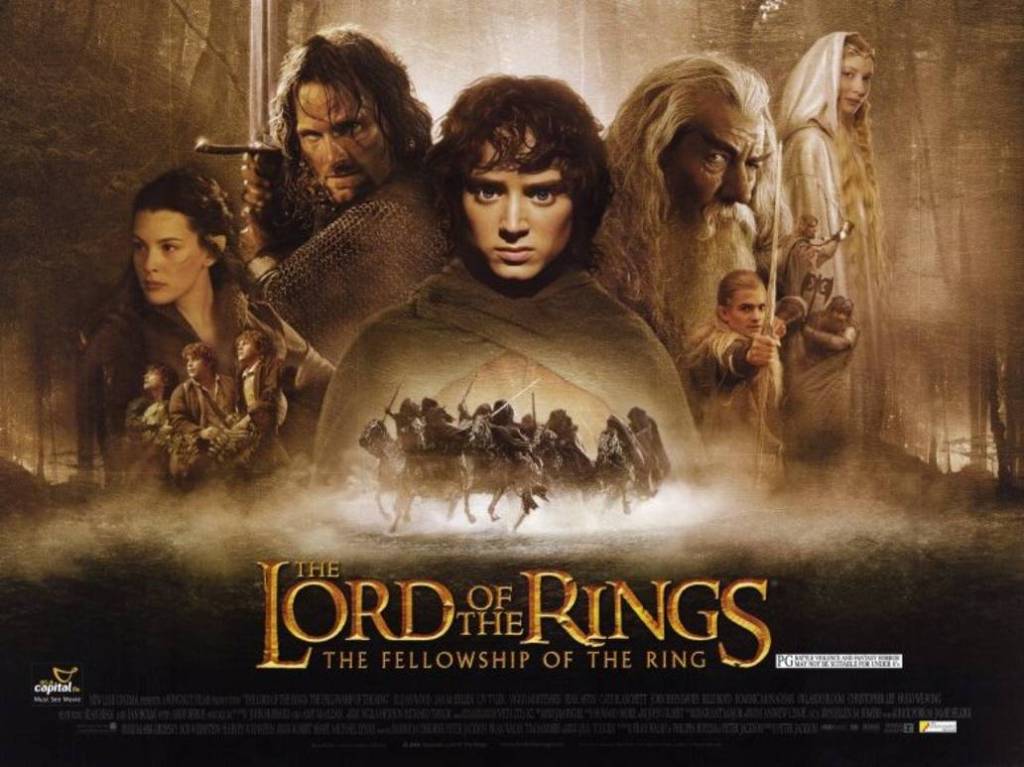
After the book fundraiser, which was something Rory was interested in, Dean suggests they go and watch The Lord of the Rings at the cinema, which is something he wants to do. They have already seen the film three times together in the past three months, and even though Rory enjoyed it, she isn’t enthusiastic about seeing it again.
They can only be talking about the first film in the trilogy, The Lord of the Rings: The Fellowship of the Ring, which was released in December 2001. Directed by New Zealander Peter Jackson, it’s based on the novel, The Fellowship of the Ring by British author J.R.R. Tolkien, the first volume in The Lord of the Rings.
An epic fantasy adventure film featuring an ensemble cast, filmed and edited entirely in New Zealand, the story is set in Middle-Earth and tells of the Dark Lord Sauron who seeks the One Ring, which contains part of his soul, in order to return to power. The fate of Middle-Earth hangs in the balance as a young hobbit named Frodo Baggins (played by Elijah Wood) must take the Ring to be destroyed in the land of Mordor, accompanied by a fellowship of eight other companions.
The film was acclaimed by critics and fans alike, considering it a landmark in filmmaking, and the fantasy genre in particular, and was praised for its fidelity to the source material. It was the #2 film of 2001, and the fifth-highest grossing film of all time upon its release. It won numerous awards, including four Oscars and three BAFTAs, which included Best Film and Best Direction.



 The Annotated Gilmore Girls