EMILY: You have to take your father …Tomorrow, for the whole day, just take him. LORELAI: Take him where? EMILY: I don’t care – the zoo, the mall, Rhode Island, just get him out of my house!
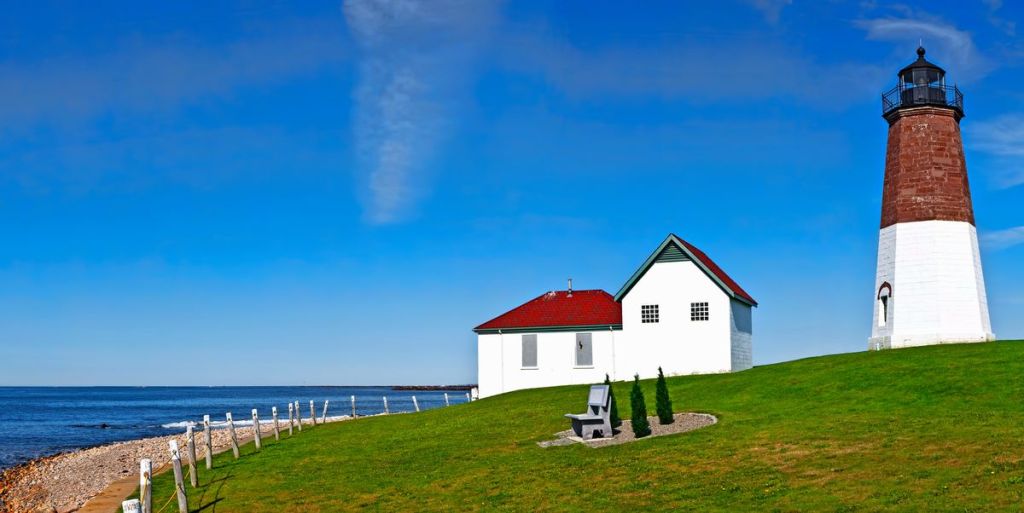
Rhode Island is a state in New England, the smallest state in the US. It takes its name from an island in Narragansett Bay, although most of the state is actually on the mainland. There are many beachside towns here, making it a common place for people to come for vacations, and there is a strong maritime culture. It would take about 90 minutes to drive to Rhode Island from Hartford.
The mention of Rhode Island may be a nod to animated sitcom Family Guy, which is set in Rhode Island, and which Daniel Palladino worked on.
PARIS: The Oppenheimer Award for Excellence in school journalism is not a contest. It’s a statement. It says you’re the best. The best writers, the best reporters, the best editors. It says that you have crushed all others who have dared to take you on. It says that every other single school in the United States of America is feeling nothing but shame and defeat and pain because of the people who won the Oppenheimer plaque. I wanna be those people, I wanna cause that pain.
The Oppenheimer Award for Excellence seems to have been named in honour of Jess Oppenheimer (1913-1988) [pictured], the creator, producer, and head writer of the sitcomI Love Lucy, starring Lucille Ball. Lucille Ball called him “the brains” behind Lucy, and he was the creative driving force of the show. (Jess may also be named after Oppenheimer!).
In real life, there are the National Pacemaker Awards in student journalism, which has a category for high school newspapers. They are administered by the National Scholastic Press Association. Founded in 1927, they are the student equivalent of the Pulitzer Prizes, and for that category the deadline is in June. There is no plaque handed out as a prize.
We never discover whether The Franklin won the award, but it is never mentioned again, suggesting that it didn’t.
EMILY: We’ve never really been home at the same time. I mean, we got married, we went to Europe, we came back, he went to work, and it’s been that way ever since.
Confirmation that Richard and Emily spent their honeymoon in Europe – it feels as if them travelling to Europe every two years in the fall is an attempt to revisit their honeymoon.
EMILY: You did not see me twitching. LORELAI: Mom, when Dad was talking about the vase, you were pulling a full-on Tabitha.
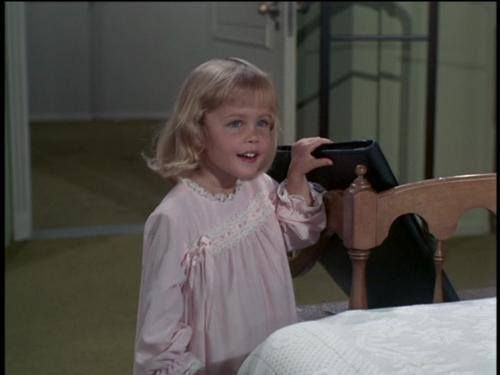
A reference to the sitcom Bewitched, broadcast 1964-1972, and continuously televised in syndication since then. It stars Elizabeth Montgomery as Samantha, a witch married to a mortal named Darrin, who vows to lead the life of an ordinary suburban housewife. However, her disapproving family often meddle in their lives, forcing Samantha to use her magic to fix the situations they get them into it.
Popular for its snappy dialogue, great cast, and special effects, it offered a critique of women’s roles as well as providing an example of a happy and successful mixed marriage during the era of segregation. Many episodes touch on issues around prejudice against race and religion, and it can also be read as an allegory of closeted homosexuality, or anyone unable to be their real self. Samantha’s meddling mother Endora, played by Agnes Moorehead, is not a million miles away from Emily herself.
Tabitha is the daughter and eldest child of Samantha and Darrin, who went from a baby to a toddler, then a young child during the series run. She has supernatural powers, and could perform magic by twitching her nose (like her mother). Her parents would tell her, “Mustn’t twitch”, in an effort to teach her to control her magic.
Unlike with other references that Emily doesn’t get, she knows who Tabitha is. Perhaps she and Lorelai even watched it together during Lorelai’s childhood.
RICHARD: You know what else I noticed? RORY: What? RICHARD: A first edition Flaubert, mint condition, shoved behind several of my Churchill biographies.
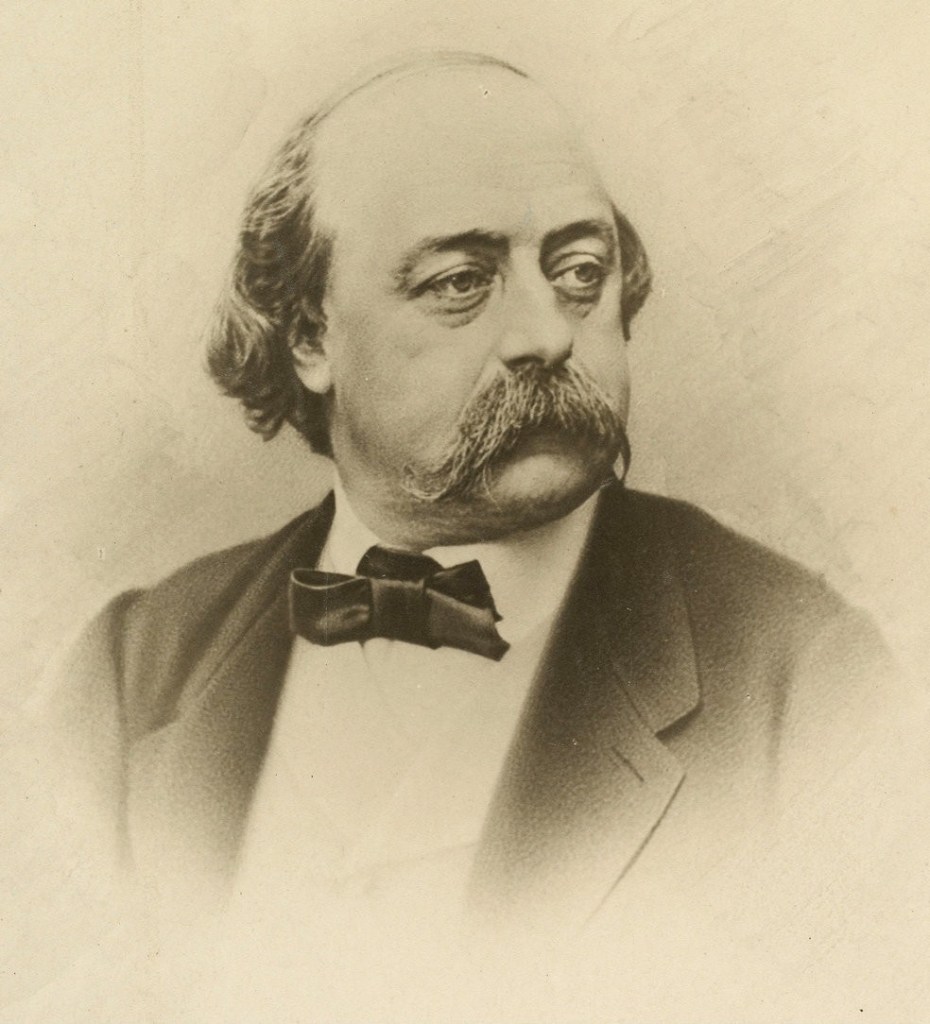
Gustave Flaubert (1821-1880), French novelist [pictured]. Highly influential, he is considered the leading exponent of literary realism in France. He is especially famous for his debut novel, Madame Bovary (1857), previously discussed.
Richard never specifies which book he has a first edition of, but fans often assume it is Madame Bovary, since Rory likes it. A first edition of even the English translation would cost tens of thousands of dollars, making this very unlikely. However, the first edition of the English translation of Three Tales (1877), published by Chatto and Windus in 1923, can be picked up for as little as $50, and is a very handsome volume. This would be my pick for Richard’s first edition.
Sir Winston Churchill (1874-1965), British statesman who served as Prime Minister from 1940 to 1945, and then again from 1951 to 1955. He is especially famous for his inspiring wartime speeches, and is considered one of the most significant figures of the twentieth century.
Richard does not say whether he means biographies by Churchill or about him, but probably the latter, since Churchill only wrote two biographies (not several, although Richard could have multiple copies of each).
LORELAI: Oh, oh. Well, uh . . . ugh, why don’t we move Aunt Cecile? She was always so annoying at parties. She loved the knock-knock jokes. RORY: Mom! … You can’t just kick out Aunt Cecile. LORELAI: Knock-knock. Who’s there? Pineapple. Pineapple who? That’s where it ended. Never fully grasped the knock-knock concept. EMILY: She was a complete idiot. Okay, it’s decided – Cecile goes.
Aunt Cecile is one of the deceased Gilmores currently in the mausoleum, and is almost unanimously voted out to the annex as the least popular corpse, due to her habit of telling incomplete knock-knock jokes. I assume she is the sister of either Trix, or Richard’s father.
Cecile, an Anglicised French form of Cecily, was most common around the turn of the twentieth century, although it has never been very popular in the US. By the mid-twentieth century it was fairly rare.
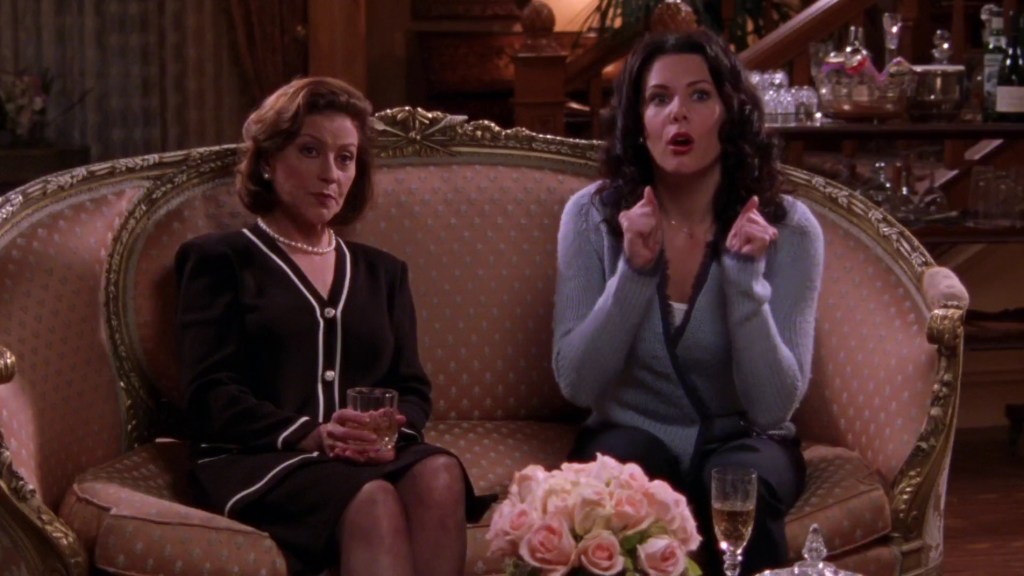
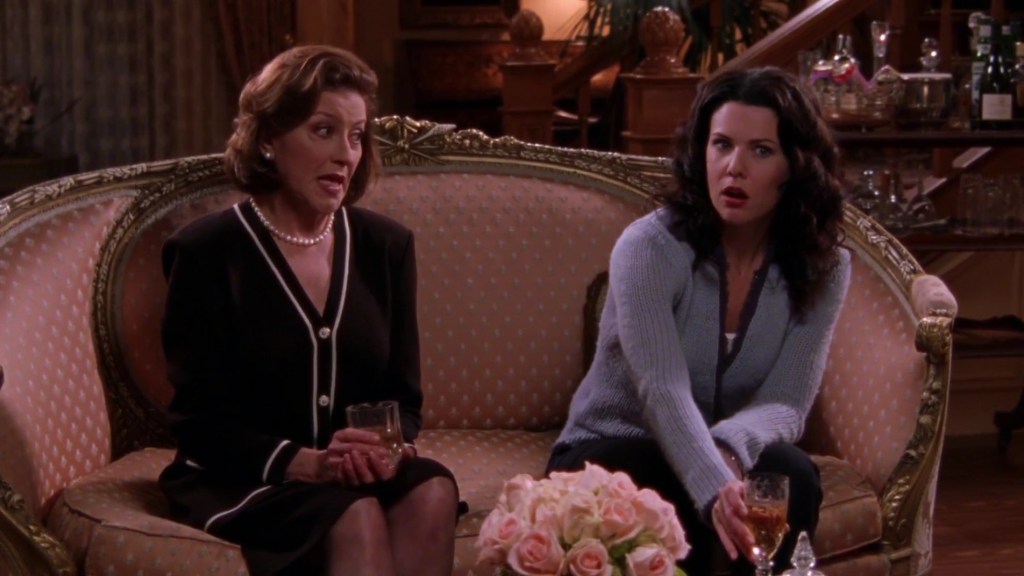
Note that Emily is dressed in black, suitable for her role discussing death and burial.
EMILY: So I went inside and looked around and it occurred to me that there’s a very limited space there … Now of course there’s a slot open for me and Richard and you and Rory, but after the two of you – that’s it. No more room for anyone else.
Apparently the Gilmore family mausoleum is now almost full, and only has four spaces left. Emily is very concerned about Lorelai getting married, because there would be nowhere for her husband, but she never seems to consider that Rory could very well marry one day, and married or not, both of them are capable of having children (or further children, in Lorelai’s case). Where they are meant to go is never even discussed, and it really sounds as if the Gilmores’ mausoleum has pretty much seen its quota filled by now.
Lorelai suggests that she and Rory could be buried in the same space – a callback to them sharing a bed in the potting shed, and a sign that she really sees Rory as an extension of herself. Rory pleads for more boundaries by saying she’d prefer her own space. Even in death, Lorelai wants to keep Rory enmeshed with her, rather gruesomely.
Emily says the cemetery offered them the opportunity to buy an “annex” for extra family members. I don’t think this is an option in real life, although they have two public mausoleums at Cedar Hill where future generations of dead Gilmores could be stashed. Richard’s mother Trix dies during the series run, and surely other elderly Gilmores as well – how long are those extra four spaces going to last, and how long can they keep kicking existing Gilmores into the annex, which is also of finite space?
In A Year in the Life, Richard Gilmore dies and is buried in a plot with a headstone, not in a mausoleum. Maybe they really did run out of space?
Emily goes to to the kitchen to get more bread (wherever is the cook or the maid during these dramatic kitchen scenes? Do they just happen to be on a break in the middle of a meal, or in the toilet? Is there another food preparation or storage room somewhere? Even weirder, are they just out of shot and actually present the whole time?).
Lorelai apologises to Emily for not trusting her motives in helping, saying that she isn’t used to people doing things without strings attached. Emily immediately realises that Lorelai is talking about her and Richard, but Lorelai continues thanking her, saying she didn’t have anywhere to turn and was all out of ideas, and that she doesn’t know what she would have done without Emily. Hm, maybe she needs to thank and apologise to Rory as well now?
Emily thanks Lorelai, and then gives her parting shot – with a wicked smile, she tells her the DAR will be holding all their meetings at the Independence Inn from now on. She leaves, seemingly without the bread she supposedly came in for. Emily wasn’t joking either. A year later, there is mention of the DAR meetings still being held at the inn.
Of course, the DAR would have been free to book the Independence if they wanted to anyway, and Emily has organised things so that the inn Lorelai manages gets more business. It’s up to the viewer whether she has really taken revenge on Lorelai, or is trying to give her even more help. Or both!
Note how beautifully this scene is composed and shot, and that here is the colour red again to indicate strong emotion. Lorelai in red with a red light on her hair, vase of red flowers, red strawberries on the cake, little red desserts, red grapes, a red pepper in the fruit bowl (slightly oddly). Only Emily remains in cool blue and silver, her emotions under control.
Rory and Lane make up their fight very quickly, with Rory saying that cheerleading seems fun, and that she can see that Lane is stamping her own personality on the team, rather than giving up her personality in order to fit in (which is possibly what Rory feared). Lane assures Rory she is the same person she always was, and they go for coffee.
I wonder if Lane really is unchanged, though? She went through a pretty rough time after Rory went to a new school and got a boyfriend, and she actually seems happier and more confident since starting cheerleading.
MILES: Oh, you’ve taken out two previous loans on this house? LORELAI: Um, yes.
This explains the difficulties Lorelai has been having in getting a loan – she has already taken two previous loans against her house, and is presumably in the process of paying them back (maybe cut down on the junk food buying?).
It doesn’t explain how she got turned down by a loan shark (fictionalised by Lorelai as Jacko’s Loans and Stuff), as the more desperate and in trouble you are, the more likely they are to loan you money at an exorbitant rate to make you suffer even more. I’d like to think Lorelai herself turned down the loan shark, knowing it was financially irresponsible.




 The Annotated Gilmore Girls