SUNNY: She looks just like Lorelai, doesn’t she? NATALIE SWOPE: The eyes. VIVIAN LEWIS: The nose. SUNNY: Walk around sweetie … I just wanna see the walk. Lorelai had such a specific walk.
VIVIAN LEWIS: Fast.
Emily’s friends eagerly examine Rory, this seems to be first time they have seen Lorelai’s daughter, at least for many years. It’s also the first mention by another character of Lorelai’s fast paced walking, possibly one of the factors helping her stay slim. (I don’t think Rory has inherited it, to me her walking seems normal paced, or even slightly slow for a young healthy person).
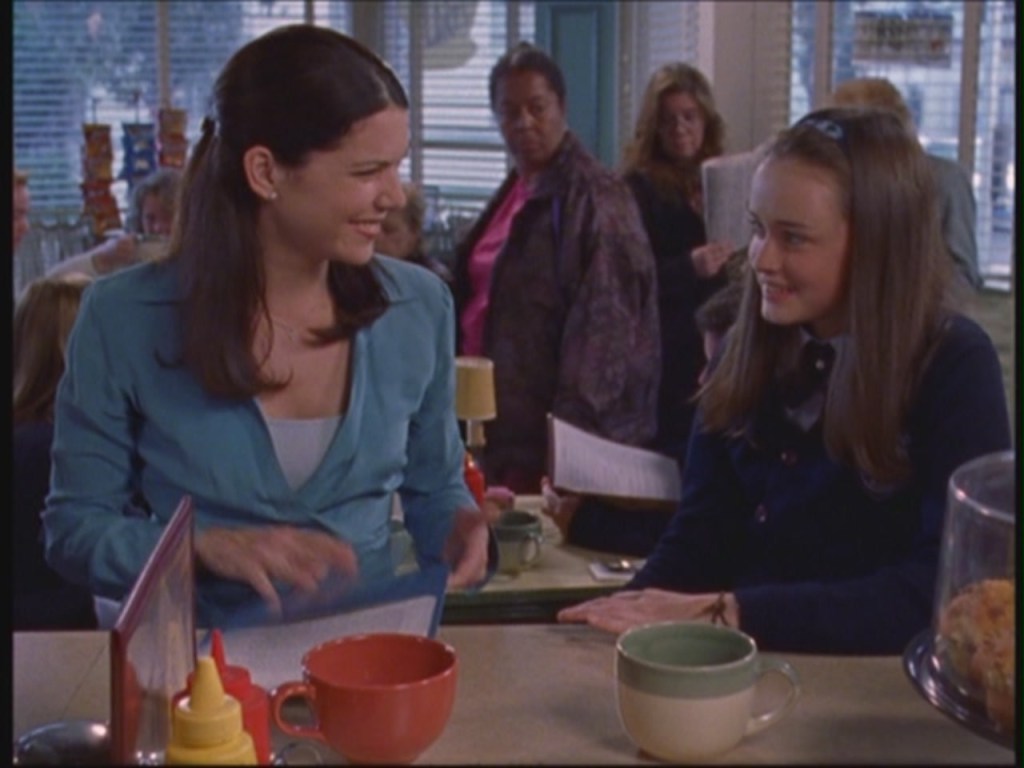
LORELAI: A-plus. RORY: You’re my mom. LORELAI: Is anything higher than an A-plus? RORY: You have to say that. LORELAI: It’s an A-plus with a crown and a wand. RORY: This is not how you raise a child. You don’t send them out there with a false sense of pride, because out there, in the real world, no one will coddle you. I’d rather know right now if I’m gonna be working at CNN, or carrying a basket around its offices with sandwiches in it.
Rory says she wants honest feedback on her work, but when she’s later given a critique of her abilities and an assessment of her career options, she has a complete breakdown and is unable to continue. In this case, she is happy to receive confirmation that she’s doing great, and to enjoy being coddled a while longer.
I don’t think it’s really Lorelai’s job to provide Rory with an assessment of her abilities and suggest a grade she deserves to receive. She’s not a teacher, a journalist, or a writer. She doesn’t have academic credentials or training. Surely as a mother, all she can do for Rory is support and encourage her, as she is trying to do.
At this point, Rory shouldn’t need any harsher criticism than she’s already receiving, because Chilton is supposedly a strict school with high academic standards. Is it possible she already feels that the teacher supervising The Franklin staff is too easy on her?
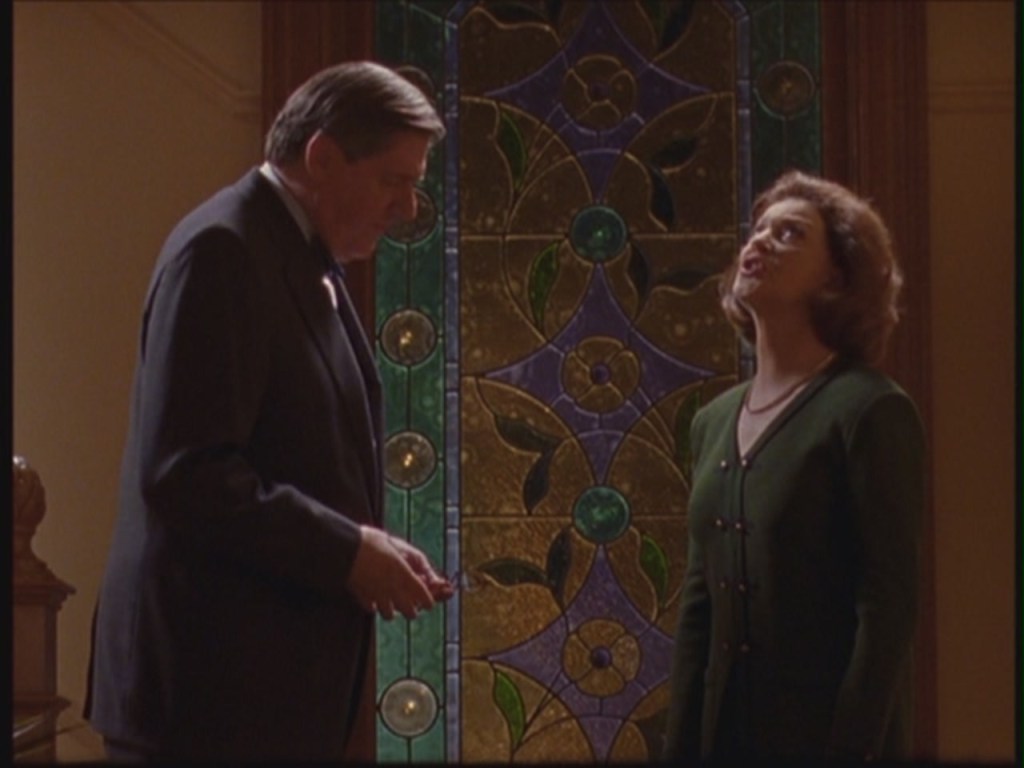
The episode open with Lorelai and Rory stumbling into Richard and Emily having a disagreement with raised voices. This is the first time we have seen Richard and Emily together since the night that Lorelai announced her engagement, back in June. Apparently things haven’t been going well since then.
Richard has always been shown to be very preoccupied with his job, and even had an angina attack from the stress. Since then, he hasn’t slowed down, and has spent a lot of time travelling for work. Now it’s seemingly taking up so much of his time, he is unable to escort to Emily to her many charity events. I’m not sure why Emily is unable to go alone, or with a friend. Perhaps it would excite gossip that her marriage was on the rocks or something.
This has left Emily not only out of the loop socially, and no doubt lonely and bored, but feeling deeply unappreciated. Richard refers to her charity work as “social engagements” – which they are – but to Emily they are so much more. They are her life’s work, and her power base, which she has worked on achieving just as hard as Richard does at his job. For Emily to keep skipping events would be like Richard missing work, and you can feel her fear of her life slipping away from her.
It turns out in this episode that Emily sits on the boards of so many organisations that it seems unbelievable it has never caused any conflicts until now. In fact, it’s quite an unbelievable amount of boards in itself, to drive home the point that Emily Gilmore is one of the people who “run” Hartford.
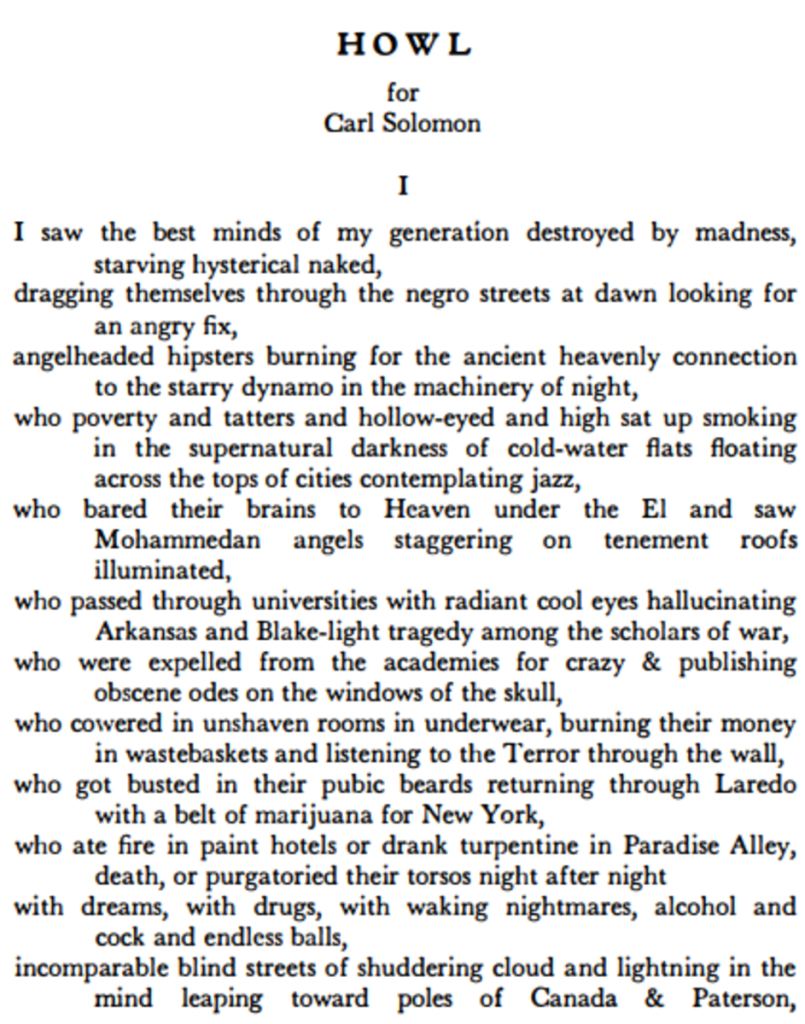
The book which Jess secretly took from Rory’s bookshelves, even though she had earlier offered to lend it to him.
It’s a poetry collection by American Beat poet Allen Ginsberg, first published in 1956. It contains his most famous poem, “Howl”, a biographical poem originally inspired by a terrifying peyote vision. The publisher of the book, Lawrence Ferlinghetti, another Beat poet, was subsequently arrested and charged with obscenity, but found not guilty at his 1957 trial.
Jess now reveals that even though he said he didn’t read “much”, he has read Howl and OtherPoems about forty times. He smoothly implies that “much” is a relative term, after all.
He has also written notes in the margin for Rory to read. The viewer will now either a) be horrified that he took her book without asking and defaced it, or b) sigh over the fact that he took the opportunity to bond with Rory over literature, sharing his innermost thoughts. It is definitely intended as an intimate, seductive move.
It’s interesting to wonder what thoughts Jess had about “Howl”. It’s an intense poem about madness, rebellion, drug-taking, and sex, which could lead to some interesting observations. If Jess knew a lot about the Beats, he might also be able to pick out those parts of the poem which were taken from real life experiences.
Then again, much of the poem is set in New York, and possibly Jess simply compared his own experiences in the locations mentioned. I can definitely imagine Jess taking a day or a weekend to visit all the places around New York in the poem.
Kabbalah is an esoteric discipline in Jewish mysticism, containing a set of teachings explaining the relationship between God and the universe. It dates to around the 12th century and originated in Spain and southern France. There are different traditions and streams of thought within it, that might focus on theosophy, meditative practices, or (more controversially) white magic. It has been a strong influence on Jewish philosophy and mysticism.
Since the 1960s, universalist schools have opened up which teach Kabbalah to people of all faiths and ways of life, one of the contributors to New Age spirituality. You can also sign up for six week courses in introductory Kabbalah, making it very accessible. Possibly such courses are held in Stars Hollow, although it is slightly surprising Luke knows about them and approves, as he doesn’t seem the most mystical person. The show did seem to just give random Jewishness to characters whenever it felt like it.
Freeway (a mistake for highway????) beautification projects
Community groups often sponsor a section of highway in the US in order to maintain it, and provide volunteers to work on it. Such projects might include planting trees, shrubs and ground cover plants, mowing grass, weeding, mulching, and removing roadside litter. It seems like something Taylor would almost certainly organise for a highway near Stars Hollow.
Color Me Mine pottery painting
A chain of studios, founded in 1996, where people can paint their own pottery and ceramics. In real life, there aren’t any Color Me Mine studios in Connecticut (but plenty in California, where the writers live).
Humorously, Luke’s suggestions of social activities he might approve don’t sound like anything most teenage boys would be interested in.
Work in the diner after school until the diner closes
Homework will be done between the diner closing and bedtime
Weekends are for chores and pre-approved social outings
I wonder whether Luke’s plan of only allowing Jess to attend school, work at the diner, do homework at night, and chores on weekends, is an indication of how his father brought him up. It certainly gave Luke a strong work ethic, although it also drove Liz away. It might explain why Luke seems to lead a rather joyless existence, with a distrust or even dislike of having any fun.
Jess’ response is to immediately make like his mother and leave, and when Luke asks where he is going, he says, “Out”. Yes, he’s done a Liz and gone off to do “God knows what”.
Luke mutters, “Well, at least I asked”, showing that he’s not expecting to become the world’s best parental substitute overnight.
(Note that Jess is wearing a completely different outfit in this scene – because his other clothes got wet when Luke pushed him into a lake).
In this episode, Luke is dismayed to learn Jess has been indulging in petty theft. Is this the “trouble” he was headed for in New York, or is this something Jess is doing for attention, in defiance of being sent to Stars Hollow, or out of boredom?
Or is it a sort of one-sided joke or prank, where he fulfils the image the town has of him as a criminal by performing mildly illegal acts that do little harm, just to see how upset the townsfolk will become?
Another possibility: Jess only seems to start stealing after he meets Rory. Is he trying to make himself a notorious figure, spoken of everywhere, so she cannot ignore or forget him? After all, there’s no such thing as bad publicity …
It’s also interesting to see where Jess steals from in this episode. He is first caught stealing beer from Lorelai’s fridge. Next he steals a few coins from the bridge repair fund – the same community project that Lorelai and Rory worked on (in a town as gossipy as Stars Hollow, it wouldn’t be hard for the quiet, watchful Jess to learn of that). Then he steals a garden gnome from Babette, Lorelai and Rory’s next door neighbour. Later it transpires that the first thing he took without asking was one of Rory’s books.
The thefts don’t seem to have random victims – they are all connected with Lorelai and Rory. Are they a bit of payback for Lorelai, for trying to give him advice, or are they are an attempt to keep himself within Rory’s orbit, by fair means or foul?
JESS: You bring me here to this place, you put me in a school that says the Pledge of Allegiance in six different languages, two of which I’ve never heard of before.
The Pledge of Allegiance expresses loyalty to the United States flag and the nation that it represents. A pledge was first composed in 1887 by Captain George Thatcher Balch, a former Union Army Officer during the Civil War who later taught patriotism in schools. The current pledge was mostly composed by a Christian socialist minister and author Francis Bellamy in 1892, based on the one by Balch. It was formally adopted by Congress in 1942.
The Pledge of Allegiance is recited at the start of Congressional sessions, many local government meetings, and often even in private organisations. Most states, including Connecticut, require the pledge to be recited regularly, usually every day, at public schools. However, a student legally cannot be compelled to recite the pledge, or punished for failing to do so.
The Pledge of Allegiance
I pledge allegiance to the Flag of the United States of America, and to the Republic for which it stands, one Nation under God, indivisible, with liberty and justice for all.
It is recited while standing to attention, facing the flag with the right hand over the heart (non-religious headgear is removed for the pledge by males). Those in uniform remain silent for the pledge, but give a military salute to the flag.
Sometimes schools in the US have recited the pledge in different languages, but it tends to not go down well, and be considered unpatriotic. Stars Hollow High School is apparently not afraid to celebrate its diversity, even though its student population isn’t very diverse. Six languages seems extremely unusual though.
What the six languages were, two of which Jess had never heard of before, is open to speculation. I am going to guess, based on languages spoken in Connecticut, according to the census:
English
Spanish (the most common non-English language in the US)
French (we know this language is taught at Stars Hollow High)
Korean (Mrs Kim can be very persuasive?)
Tagalog (the language of the Philippines, which Jess might not have heard of?)
Urdu (the national language of Pakistan, which Jess might not have heard of?)
Other possibilities I considered: German (Stars Hollow once had an ill-fated German Club), Portuguese (second most common non-English language in Connecticut), Polish (very commonly spoken in the nearby Hartford area), Hebrew or Yiddish (we later learn Stars Hollow has a vibrant Jewish community), Algonquin (the Native American language spoken by Connecticut tribes), Esperanto (a created universal language), American Sign Language for the deaf.
When Rory is interviewing Max, this book is on the desk between them, in a pile of other books that includes Anna Karenina, previously discussed.
The Brothers Karamazov is a 1880 novel by Russian novelist Fyodor Dostoevsky about the sons of a buffoon named Fyodor Karamazov; he has three sons from two marriages, and it is rumoured that his servant is actually an illegitimate son. Fyodor takes no interest in his sons, who are raised apart from each other and their father. A passionate philosophical novel, it delves deeply into questions of God, free will, morality, faith doubt, and reason, involving a plot about patricide. It is acclaimed as one of the great works of modern literature, and has influenced many great authors and thinkers. It was Einstein’s favourite novel, Freud considered it the greatest work of literature, while Franz Kafka felt indebted to it as a influence on his own work.
We know that Russian literature is the first component of the English Literature course in the sophomore year at Chilton, and this must be on the curriculum. On Rory’s first day at Chilton, the teacher talked about how they had studied Dostoevsky the week before. We can feel pretty confident that Rory would have read this novel in her efforts to catch up with her schoolmates, and it may have helped give her an interest in the works of Kafka.
LORELAI: Ugh, Jess, let me give you a little advice. The whole ‘my parents don’t get me’ thing, I’ve been there. JESS: You have, huh?
Lorelai follows Jess again, and for the third time finds him doing something in her house on the sly. This time, it’s taking a beer from her fridge.
Lorelai handles this awkward situation rather neatly, and it’s only after Jess balks at coming in to dinner and mocks her cosy small-town life (“Well geez, Ms. Gilmore … that sounds plum crazy”) that she starts handing out unsolicited advice. It’s (mostly) well-intentioned and she is genuinely trying to help Luke if not Jess, but it goes down very badly.
It’s hard not to have some sympathy with Jess here, because Lorelai is very patronising saying that “she’s been there”. Yes, she was a smartass, misunderstood, and misbehaving teenager like Jess, but their lives were hardly parallel.
Lorelai grew up in a wealthy, privileged household, her father didn’t leave them, her mother wasn’t unreliable and impractical. Nor did her mother give up on her and basically throw her out to live with a relative she barely knows in a small town hours away from her home. In fact, it was Lorelai who rejected her parents and ran to the sanctuary of Stars Hollow.
Lorelai has the rare experience of taking someone on who is intelligent enough to match her in wits, and confident enough to stand up to her. It obviously comes as a shock, and by the end of the argument, Jess has made a crude yet insightful attack on the possible sexual relationship between she and Luke, and Lorelai has sunk to playground levels of retaliation, showing that she hasn’t grown up much since being a teenager.
It is Lorelai who retreats inside while giving a parting shot, so it’s round one to Jess, but Lorelai gets the last word.
NOTE: Edited with the kind assistance of helpful reader Daniel A Huth, who stopped me from imagining a fridge which wasn’t there.



 The Annotated Gilmore Girls