RORY: Right, so Tristan, he’s in our group, so that means he’s in …well, and Dean lives here, so this sucks. LORELAI: Okay, you know what Vanna? I’m gonna need a few more vowels here.
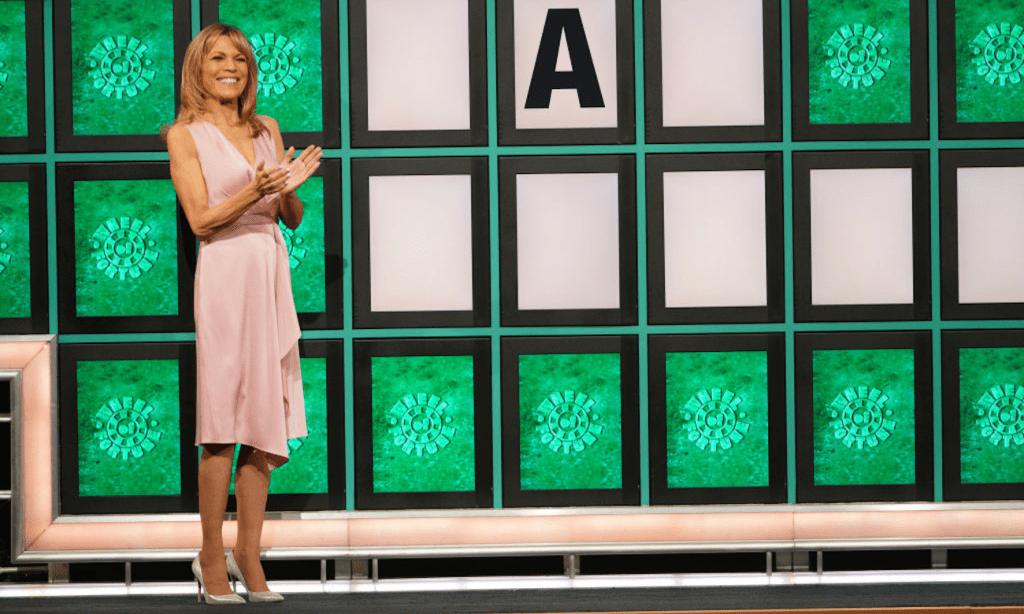
Vanna White (born Vanna Rosich, born 1957), famous since 1982 for being the hostess of Wheel of Fortune, previously mentioned.
When solving the word puzzles, contestants can ask Vanna for the chance to “buy a vowel” to give them extra help. Lorelai feels that she also needs some assistance to decipher Rory’s barely comprehensible statement.
RORY: Hey. MADELINE: Hey. LOUISE: We’re the Monkees.
The opening words to the theme song of The Monkees television show, a sitcom running from 1966 to 1968, starring the American pop group, The Monkees, as four young men trying to make it as a rock and roll band. The verse says:
Hey hey, we’re The Monkees
And people say we monkey around
But we’re too busy singing
To get anybody down
The show utilised a number of innovative new wave film techniques to the sitcom format, and won two Emmy Awards, including Outstanding Comedy Series. Even after its run ended, it continued its popularity thanks to reruns, in particular a massive resurgence after 1986, when it was shown on MTV.
Note that this is essentially the same joke used in regard to Fat Albert in Like Mother, Like Daughter.
PAUL: I think it’s a conspiracy getting us ready for the day we’re all gonna be raised by machines. No human contact whatsoever. LORELAI: You know my mother, don’t you? PAUL: The, uh, Twilight Zone marathon was on all week.
The Twilight Zone, an American media franchise created by Rod Serling. Each episode is in genres such as science-fiction, fantasy, suspense, or horror, often with a macabre or unexpected twist, and usually with a moral attached. The original series ran from 1959 to 1964, and it was revived in 1985, 2002, and 2019, as well as being made into films and a radio show, and inspiring various books, games, and theme park attractions. A popular and critical success, it is considered one of the best television series ever made.
Paul’s theory about being raised by machines with no human contact sounds like something from The Twilight Zone, although I can’t locate an episode with the same plot. It’s a tiny little bit like the 1962 episode I Sing the Body Electric, written by Ray Bradbury, about three children raised by a robot “grandmother”. Far from being a nightmarish scenario, the robot carer is kind and empathetic, and the children love her dearly.
Paul enjoys science-fiction shows, like Lorelai (and like Luke). It must be one of the reasons she feels drawn to him. Although mentioning you have mummy issues before you even get to the first date doesn’t seem like a great idea.
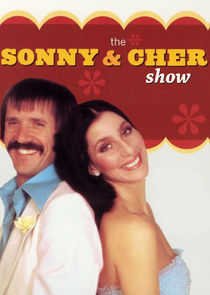
PROFESSOR ANDERSON: Last year, we did Richard III. One group did their scene as the Mafiosi. Another set theirs during the Roman Empire. And my favorite, the climactic last scene was set during the final days of The Sonny and Cher Show. Just remember, whatever interpretation you choose should highlight the themes you see in the scene. And if the love of the Bard’s language still doesn’t inspire you, remember this will be fifty percent of your final grade.
Richard III is a historical tragedy by William Shakespeare, probably written around 1593. It is one of the longest of his plays, and is often abridged for performances. It is about King Richard III of England, depicted in the play as an ugly hunchback and an absolute villain. The final scene is set at the Battle of Bosworth, when Richard’s supporters desert him; he is killed by the Earl of Richmond, who claims the throne as Henry VII.
The Sonny and Cher Show was a 1976-77 television variety show with music and comic sketches, which followed on from The Sonny & Cher Comedy Hour (1971-74), The Sonny Comedy Revue (1974), and Cher (1975). Sonny and Cher got divorced, hence the separate shows, but with the bitterness of their divorce behind them, they came back with another show made together, although slightly more subdued in tone. Variety shows were on their way out, and the final few episodes were quickly aired in a late-night Monday evening time slot – this would have been the “final days” of the show. In the last episode, Tina Turner was the guest star.
LORELAI: Okay, once again, I bring up the fact that this is a wedding present, and as I am not getting married, neither God’s law nor Emily Post allows me to keep this … SOOKIE: [Martha Stewart] said that if it arrives after ten weeks … RORY: Eight. SOOKIE: …eight weeks, that you don’t have to return it.
Emily Post and Martha Stewart, both previously discussed. The program that Sookie watched was Martha Stewart Living.
There is, of course, no such “wriggle room” rule in etiquette (Sookie and Rory invented it because they want the ice cream maker). If your wedding is cancelled, you return all the gifts, no matter how late they arrive (unless the sender specifically tells you to keep it, which does sometimes happen).
However, if a gift arrives with no name attached to it, then there is little you can do, because it’s considered even ruder to ring around and ask people if they sent such-and-such (it seems like you’re criticising them for not sending it, and assume they are too dim-witted to attach a name to it). You could try to find out the sender by calling the company who delivered it, but after that there’s not much you can do. If conscience smites you, you can always donate it to charity, or sell it and donate the money.
Lorelai must surely suspect her mother of sending it, yet she’s the one person that Lorelai doesn’t ask, as if she doesn’t want to know.
Sookie says it is more than ten weeks since the wedding was cancelled, and Rory corrects her to more than eight weeks. In fact, it is just over twelve weeks since Lorelai and Max’s wedding was meant to take place.
BOOTSY: This goes way beyond the Jess matter, Taylor. Luke’s been on my case since the first grade when he wrongfully accused me of sabotaging a clay imprint that he made of his hand. LORELAI: Ooh! Think hard, was he dressed like Sulu?
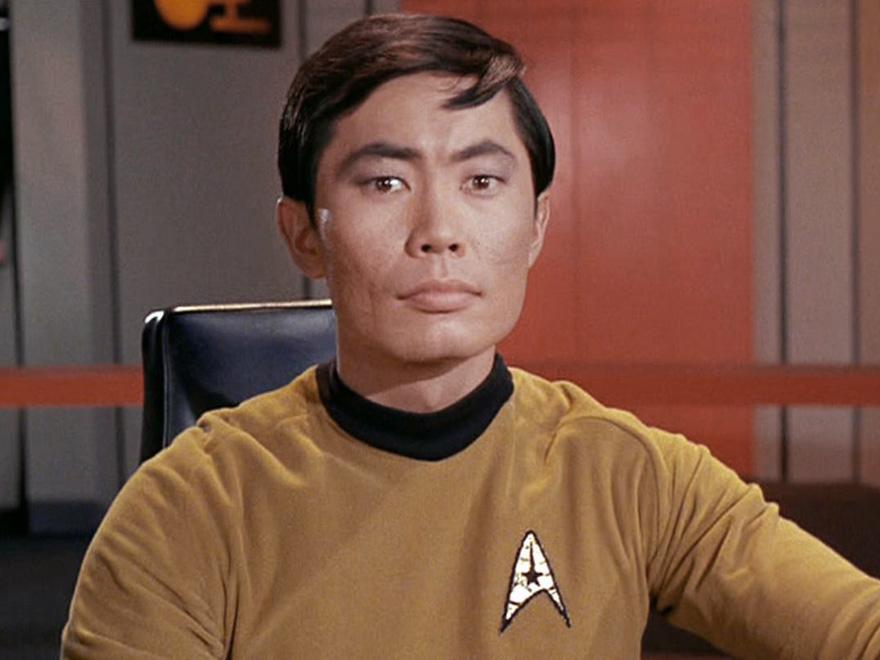
Lieutenant Hikaro Sulu is a character in Star Trek, played by George Takei in the original series. He is the ship’s physicist, third officer, and senior helmsman. He wears the same uniform as everyone else, so I’m not sure what Lorelai means about “dressed like Sulu”, unless she means “dressed like a Star Trek crew member”.
We now learn that as well as having an antagonistic relationship with Taylor, Luke also has a long-standing problem with Bootsy, his former classmate, going back to first grade. How many enemies does Luke really need?
LORELAI: Aha! LUKE: Geez! Don’t sneak up on me like that. LORELAI: Yeah boy, I was lucky you had your phasers on stun, huh?
Phasers are the standard weapon (and tool) of choice in the Star Trek universe, apparently giving off some kind of “beam” of pulsed energy. They can be set to stun, rather than kill, so that an opponent or threat is simply shocked, rather than vaporised.
MIA: There was a phony murder? LORELAI: Yeah, the town’s too dull to work up a real murder. RORY: But you’re one ‘beam me up Scotty’ reference away from being the victim of one.
“Beam me up, Scotty” is a catchphrase associated with the original series of Star Trek, from the command Captain Kirk gives chief engineer Montgomery Scott (“Scotty”) when he needs to be transported back to the Enterprise.
In fact, the phrase was never actually used on the show, although similar lines were said, such as, “Scotty, beam us up”, and “Mr Scott, beam us up”.
RORY: You were a Trekkie? LUKE: I was not a Trekkie. LORELAI: Uh uh, I do believe that denying you were a Trekkie is a violation of the Prime Directive. RORY: Indubitably, captain.
Trekkie: a fan of the Star Trek franchise. Many serious fans dislike the term, preferring “Trekker”. Long stereotyped as hyper-obsessive supernerds, and even satirised by Star Trek itself.
Prime Directive: in Star Trek, the Prime Directive is a guiding principle that prohibits its members from interfering with the natural development of alien civilisations.
“Indubitably, captain”: Possibly the sort of thing Rory thinks that Mr Spock would say to Captain Kirk. The closest thing to it is a piece of dialogue from the 1987 series, Star Trek: The Next Generation, when Data says, “Indubitably, sir. Indubitably” to Captain Picard.
Lorelai is an arch-hypocrite to characterise Luke as a Star Trek nerd because he wore a Star Trek tee-shirt, and make fun of him: she is a huge fan of the show herself, and has made numerous references to it, including to Luke. In fact, she uses Star Trek lingo to make fun of Star Trek, something everyone, but most of all Luke, should have picked her up on.
Also note that Rory has done the same thing in regard to Lane’s erstwhile crush, Rich Bloomenfeld – she made a snarky comment about him wearing the same Star Trek tee shirt every day when he was younger. It’s essentially the same joke as this, with Luke wearing a Star Trek tee-shirt when he was younger. Like Lorelai, Rory is a hypocrite; she has made references to watching Star Trek herself.
Fun fact: the name Lorelei appears in the animated series of Star Trek (1971-present). In the 1973 episode, The Lorelei Signal, a compelling musical signal lures the Enterprise to a remote planet, where the female inhabitants drain the male crew of their life force. During the process, the men’s judgement is affected as they experience euphoric hallucinations – rather like the way men behave around the two Lorelais in Gilmore Girls! In the episode, it is up to the female crew members of the ship to take command and rescue the men, so it’s a real girl power instalment.
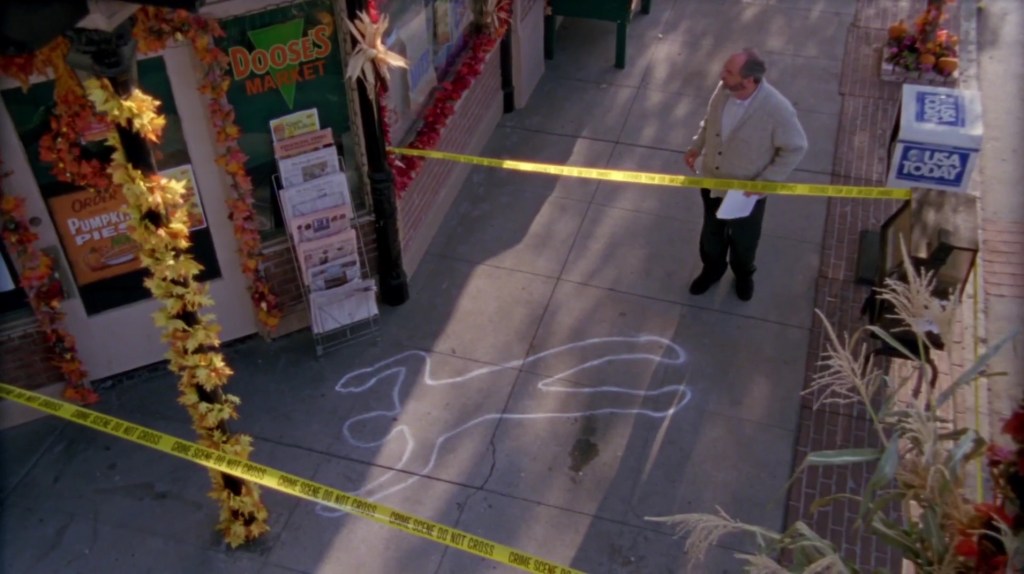
When Rory and Lane walk past Doose’s Market, there is a chalk outline of a person’s body drawn on the pavement outside the store, marked off with police tape. A crowd has gathered, and Taylor is having a fit, being calmed down by a local policewoman.
What the police officer should have told him is that a chalk outline to show where somebody has died is a trope which mostly exists in film and television (first shown in a 1958 episode of Perry Mason). In real life, police don’t usually draw a chalk outline to mark the place where someone was killed. The trope goes back to the days when police did so – not for the public, but to give crime reporters something they could photograph without showing an actual dead person.
She could have at least told Taylor that, in universe, the police did not draw the chalk outline!




 The Annotated Gilmore Girls