“Pink makes my head look small”

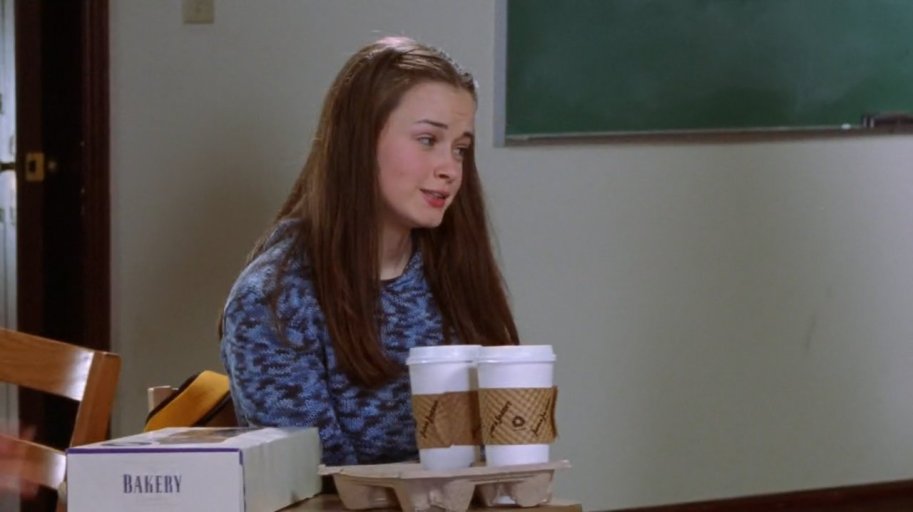
RORY: What about this? [holding up pink blouse]
PARIS: My mother says the color pink makes my head look small.

Later in this season we learn that Emily thinks Lorelai’s head is a little too big – in the Gilmore Girls universe, difficult mothers think their daughters’ heads are the wrong size.

Paris must have got over her mother’s odd belief, as she is seen wearing pink outfits from time to time throughout the show, and her head doesn’t look any smaller than usual.

“I can’t wear your mother’s clothes”

PARIS: I can’t wear your mother’s clothes.
RORY: Yes you can, I do it all the time.

Surely the reason Paris can’t wear Lorelai’s clothes is that they are different heights – Liza Weil is about 5 inches shorter than Lauren Graham. Oddly enough, Rory gives Paris one of Lorelai’s mini dresses to wear, and it is very short on Paris as well, even though when a short person borrows a tall person’s clothes they will inevitably be a lot longer on them.

Bat Mitzvah and Menorahs

RORY: [examining Paris’ clothes] This is your entire wardrobe?
PARIS: Yes.
RORY: Nothing’s left at home?
PARIS: Nothing but my Chilton uniform and my bat mitzvah dress which has menorahs on the collar.

The bat mitzvah is the female version of the bar mitzvah, a coming of age ceremony in Judaism, after which the person becomes responsible for their own actions under Jewish law, and can fully participate in Jewish community life.

For boys, the bar mitzvah is age 13, while for girls the bat mitzvah it is age 12 in Orthodox and Conservative Judaism, and age 13 in Reform Judaism.

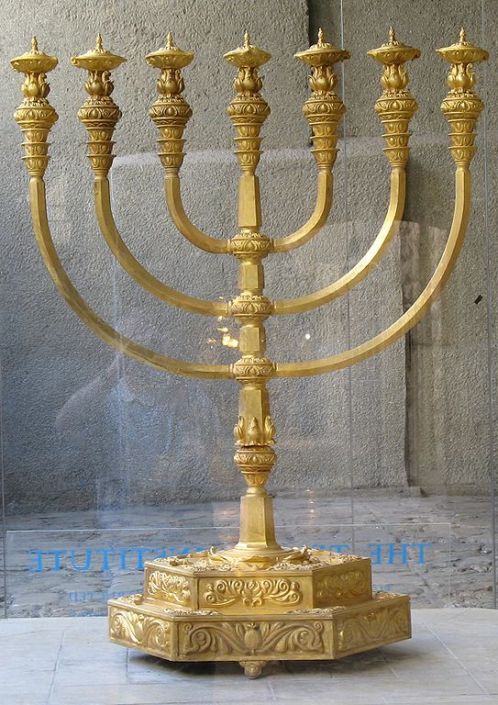
A menorah [pictured] is a seven lamp, six branch lamp-stand which has been a symbol of Judaism since ancient times; it is the emblem on Israel’s coat of arms. According to the Bible, the instructions for the design of the menorah were handed down to Moses by God. Traditionally lit with oil, modern ones may be candlesticks instead.

Paris wore a nice outfit to Madeline’s party recently, so I’m not sure it’s really believable that she doesn’t have any clothes to wear, and can’t dress herself.

“Why didn’t you go to Madeline or Louise?”

RORY: Why didn’t you go to Madeline or Louise about this? [the date with Tristan] I mean, they seem to get that “fabulous little top” thing.
PARIS: Oh yeah, that they get. The whole supportive, “You’re going to be fine, and not throw up twelve times on the way to his car” thing – that they don’t get.

From this we can see that Madeline and Louise aren’t true friends to Paris, and that she has sought out Rory for advice and comfort over them, even though it means driving half an hour each way before her date. Paris clearly wants Rory to be her best friend, although the show will throw spanner after spanner in the works of that desire.

The Tower

LORELAI: Are you sure you can’t come? [to a family dinner with Trix]
RORY: Yeah, I’m sure. If I’m not prepared tomorrow, Paris is gonna have me sent to the Tower.

Rory means the Tower of London, more correctly Her Majesty’s Royal Palace and Fortress of the Tower of London. It’s a historic castle on the River Thames in the City of London, and was built by William the Conqueror in 1066 as part of the Norman Conquest of England. Today it is one of the most popular tourist attractions in Lodnon.

Although the Tower of London’s original primary purpose was to be a palace and royal residence, it has been used as a prison from 1100 to 1952. Its peak period as a prison was the 16th and 17th centuries, when “being sent to the Tower” meant you were going to prison. Queen Elizabeth I spent time there before she was queen.

Pink Ladies makeover

LOUISE: Tristan usually likes his girls bad.
MADELINE: Looks like we’re going to have to do the Pink Ladies makeover on you [Paris].
LOUISE: We’ll turn you from a sweet Sandy to a slutty Sandy. Dancing at the school fair with high heels, black spandex, and permed hair.

Madeline and Louise are referring to the 1978 romantic comedy musical film Grease, directed by Randal Kleiser and based on the 1971 stage musical of the same name by Jim Jacobs and Warren Casey. Set in the late 1950s, it is about the relationship between a “greaser” named Danny Zuko (John Travolta) and a “good girl” named Sandy Olsson (Olivia Newton-John).

In the film, Danny and Sandy are genuinely in love, but their relationship keeps hitting problems because Sandy isn’t well accepted by Danny’s friends. The Pink Ladies are a group of popular girls at the local high school who give Sandy a “bad girl makeover” to turn her into a greaser’s dream date for Danny, just as Louise describes.

Grease was a massive box office success, and the #1 film of 1978; at the time it was the highest-grossing musical. It gained good reviews for being fun and imaginative, and is considered one of the best musicals of all time, as well as one of the best high school movies.

Nietzsche and Dawson

LOUISE: Those who simply wait for information to find them, spend a lot of time sitting by the phone. Those who go out and find it themselves, have something to say when it rings.
RORY: Nietzsche?
LOUISE: Dawson.

Rory is referring to Friedrich Nietzsche (1844-1900), a German philosopher whose work has been profoundly influential on Western philosophy. Since the 1960s his work has been a major focus in existentialism, postmodernism, art, literature, psychology, politics, and popular culture.

Louise is referring to Dawson Leery (James Van Der Beek), the central character on the teen drama series Dawson’s Creek, which aired on television between 1998 and 2003. I cannot verify if Louise’s quote is genuinely from the show, but it sounds like the sort of thing Dawson might have said.

This is a rather unsubtle example of how much more intellectual Rory is compared to Louise.