
“Neither a borrower nor a lender be”

TRIX (to Lorelai): You know Shakespeare once wrote, “Neither a borrower nor a lender be”.

The quote Trix refers to is from Shakespeare’s play Hamlet, earlier mentioned. In the play, Polonius is giving advice to his son Laertes, including this maxim. In fact Shakespeare doesn’t seem to be endorsing Polonius’ views, as he’s portrayed as a boring old windbag who’s wrong about pretty much everything.

Spanish Inquisition

PARIS: Those [cards in her jacket pocket] are notes for tonight.
RORY: Notes?
PARIS: Yeah. Just some reference points really – you know, subjects to bring up in case the conversation lags.
RORY: Well, can I suggest that you leave this one about the Spanish Inquisition out?

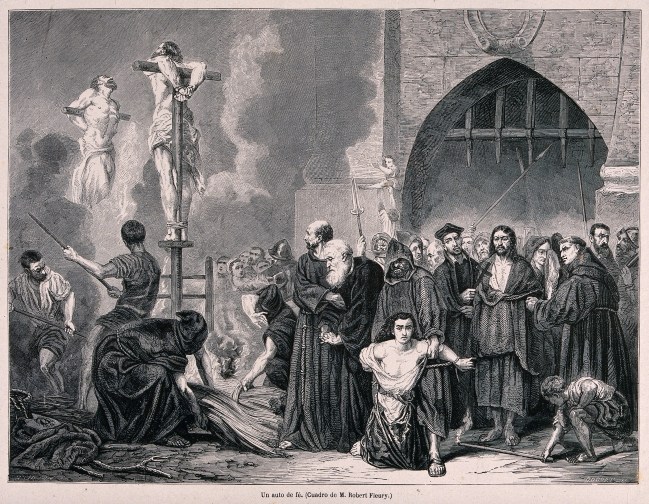
The Tribunal of the Holy Office of the Inquisition, commonly known as the Spanish Inquisition, was established in 1478 by Ferdinand II and Isabella I.

Intended to establish Catholic orthodoxy through Spain and its territories, its main purpose was to identify heretics among those who converted to Catholicism from Judaism and Islam and to test their sincerity. As Jews and Muslims were forced to either convert to Christianity or leave the country, it was little wonder their conversions might not have always been genuine.

Around 3000 to 5000 people were executed under the Spanish Inquisition, and it wasn’t officially abolished until 1834, although its influence had declined steadily for centuries.

Trophy wife

PARIS: Tristan asking me out? Why would he do that?
RORY: Why would he not do that?
PARIS: Because he’s gorgeous and experienced and only dates those most likely to become a trophy wife.

Trophy wife is the term for a woman believed to be only chosen by her wealthy husband as a status symbol, usually because she’s young(er) and attractive. It is derogatory to both people in the marriage; the inference being that the man can only attract women because of his money, and that the woman has nothing to offer except her appearance. The term dates to perhaps the 1950s, but became popularised in the 1980s.

“Pink makes my head look small”

RORY: What about this? [holding up pink blouse]
PARIS: My mother says the color pink makes my head look small.

Later in this season we learn that Emily thinks Lorelai’s head is a little too big – in the Gilmore Girls universe, difficult mothers think their daughters’ heads are the wrong size.

Paris must have got over her mother’s odd belief, as she is seen wearing pink outfits from time to time throughout the show, and her head doesn’t look any smaller than usual.

“I can’t wear your mother’s clothes”

PARIS: I can’t wear your mother’s clothes.
RORY: Yes you can, I do it all the time.

Surely the reason Paris can’t wear Lorelai’s clothes is that they are different heights – Liza Weil is about 5 inches shorter than Lauren Graham. Oddly enough, Rory gives Paris one of Lorelai’s mini dresses to wear, and it is very short on Paris as well, even though when a short person borrows a tall person’s clothes they will inevitably be a lot longer on them.

Bat Mitzvah and Menorahs

RORY: [examining Paris’ clothes] This is your entire wardrobe?
PARIS: Yes.
RORY: Nothing’s left at home?
PARIS: Nothing but my Chilton uniform and my bat mitzvah dress which has menorahs on the collar.

The bat mitzvah is the female version of the bar mitzvah, a coming of age ceremony in Judaism, after which the person becomes responsible for their own actions under Jewish law, and can fully participate in Jewish community life.

For boys, the bar mitzvah is age 13, while for girls the bat mitzvah it is age 12 in Orthodox and Conservative Judaism, and age 13 in Reform Judaism.

A menorah [pictured] is a seven lamp, six branch lamp-stand which has been a symbol of Judaism since ancient times; it is the emblem on Israel’s coat of arms. According to the Bible, the instructions for the design of the menorah were handed down to Moses by God. Traditionally lit with oil, modern ones may be candlesticks instead.

Paris wore a nice outfit to Madeline’s party recently, so I’m not sure it’s really believable that she doesn’t have any clothes to wear, and can’t dress herself.

“Why didn’t you go to Madeline or Louise?”

RORY: Why didn’t you go to Madeline or Louise about this? [the date with Tristan] I mean, they seem to get that “fabulous little top” thing.
PARIS: Oh yeah, that they get. The whole supportive, “You’re going to be fine, and not throw up twelve times on the way to his car” thing – that they don’t get.

From this we can see that Madeline and Louise aren’t true friends to Paris, and that she has sought out Rory for advice and comfort over them, even though it means driving half an hour each way before her date. Paris clearly wants Rory to be her best friend, although the show will throw spanner after spanner in the works of that desire.