House on Haunted Hill

This is the movie that Lorelai takes Max to see at the movie theatre run by the Black-White-Read Bookstore in Stars Hollow.

House on Haunted Hill is a 1959 horror film directed by William Castle. It stars Vincent Price as an eccentric millionaire who invites five people to a haunted house he has rented; each person will receive $10 000 if they stay the entire night in the house. Made on a shoestring budget, it was a huge success and is still regarded as a horror classic.

Amusingly, Max will soon be staying the entire night in Lorelai’s house.


Pager

In this episode we see that Rory has a pager, which Lane contacts her on. In a later episode it is possible to see that it is an American Online (AOL) pager.

A pager is a wireless telecommunications device that receives and displays messages, or receives voice messages sent from a telephone. They came into use in the 1950s, and became widespread during the 1980s. Their use declined markedly during the 2000s with the rise of mobile phones that allow text messaging and voicemail.

Bellevue

MAX: So possibly I’m crazier than you are.
LORELAI: Again, very possible.
MAX: A match made in heaven.
LORELAI: Or in Bellevue.

Bellevue Hospital in Manhattan was founded in 1736 and is the oldest public hospital in the US. Its psychiatric hospital opened in 1931, and became a byword for medical neglect and maltreatment of recovering alcoholics and the mentally ill. The name “Bellevue” soon became applied to any psychiatric facility.

The old psychiatric hospital closed in 1984, and part of it is used as a homeless shelter. The new psychiatric unit at Bellevue Hospital is now regarded as one of the best in the country.

Bank of America

Max tells Lorelai that his former fiancee now lives in Thailand, working for the Bank of America.

The Bank of America is the second largest financial institution in the US, and was founded in 1904, existing under its present name since 1930. It has branches in all states of the USA, and more than 40 countries worldwide. The Bank of America has a branch in Bangkok, Thailand, near the US Embassy.

Florence the Cook

Emily is annoyed to discover that their cook du jour, Florence, won’t be able to come to work because of the storm. At the start of the show Emily seemed to have both a cook and a maid (and couldn’t hang on to either for long), but later episodes show the maid doing the cooking as well as her other duties. For some reason this cook-maid is never referred to as a housekeeper.

“What’s up, Teach?”

MAX: Well, well, well.
LORELAI: What’s up, Teach?

Probably a play on “What’s up, Doc?”, the famous catchphrase of Bugs Bunny in the Warner Brothers cartoons. It was first used in the 1940 animated film A Wild Hare, and director Tex Avery chose it as a common phrase used at the time in his native Texas.

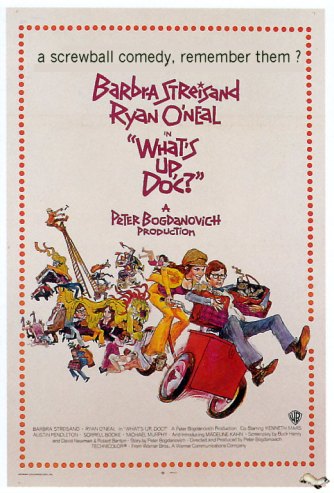
It’s also very possible Lorelai is thinking of the film What’s Up, Doc?, a 1972 screwball comedy directed by Peter Bogdanovich, and starring her favourite, Barbra Streisand. The #3 movie of 1972, it is considered one of the greatest comic films of all time.

The movie ends with the lovers kissing as they watch the 1950 Bugs Bunny film, What’s Up, Doc? Maybe Lorelai is already thinking of kissing Max at the movies, as she is just about to take him to one.

Fairy godmother


LORELAI: When I was five, I had a really bad ear infection and I had been home in bed for a week and I was very sad. So I wished really hard that something wonderful would happen to me, and I woke up the next morning and it had snowed. And I was sure that some fairy godmother had done it just for me. It was my little present.

Little Lorelai was thinking of the fairy godmother in fairy tales such as Cinderella and Sleeping Beauty. This story explains Lorelai’s love of snow. It also lets us know that when she unexpectedly sees Max in her town, she is thinking that this is another miraculous gift from her “fairy snowmother”.

Musket

TAYLOR: Who’s stepping on my musket?
KIRK: That’d be me.

A musket is a long gun with a flintlock mechanism, fired over the shoulder, and with musket balls as the ammunition rather than bullets. They were in use from the 17th century, and were the weapon of choice in the American Revolutionary War.

They weren’t very accurate as they didn’t have a sight on them, and took ages to reload. Nonetheless if they did hit their mark they could be deadly, and leave a larger and more complex wound than a modern gun (not to mention the lower standard of medical care victims would have received in the 18th century). Muskets were superseded by the rifle in the 19th century.