Sunnyside

RORY: I called the Sunnyside home. Do they need any volunteers? And believe it or not, they don’t, but they do need an accordion player for their Friday night polka party.

Sunnyside Nursing Centers are a chain of aged care nursing and rehabilitation homes in the United States. In real life, there is more than one Sunnyside nursing home in the Wallingford area, where Stars Hollow appears to be located, although none of them are actually called The Sunnyside Home (that may just be what people in Stars Hollow call it, rather than its actual name).

Apart from trying the Fireflies and Sunnyside, Rory also calls the Stars Hollow library, which apparently only has twelve books (surely an exaggeration), and the Chilton tutoring program, who are just taking names at present.

Rory seems to have amassed an enormous amount of brochures for various organisations within a few hours, late in the day. How she managed to do this is something of a mystery

Fireflies

RORY: I called the Fireflies. Do they need troop leaders? Yes. Good, I’ll be a troop leader. Great. The only catch is, it’s summer. Camping season. I need wilderness skills. Why did you never take me camping?
LORELAI: Camping? Are you kidding? I couldn’t get you to step on wet grass until you were three.

The Fireflies are a fictional organisation, perhaps based on the Camp Fire Girls, founded in 1910 as a sister organisation to the Boy Scouts of America. In 1975 it became for both boys and girls, and is now just called Camp Fire. It teaches camping and wilderness skills, just like the Fireflies, and Lauren Graham was a member when she was young. In real life, there are no Camp Fire groups in Connecticut.

The 1997 black comedy film Wag the Dog , with screenplay by Amy Sherman-Palladino’s favourite playwright, David Mamet, uses The Firefly Girls as a replacement for the Camp Fire Girls. This could be an homage (and a slightly naughty one, as in the film the young Firefly Girl receives inappropriate advances from the President in the Oval Office).

If Rory would not step on wet grass until she was three, no doubt that’s from Lorelai’s example – she notoriously hates nature and the great outdoors..

Rory’s Fight With Dean

DEAN: Wait a minute. I thought we were gonna spend some time together.
RORY: We are.
DEAN: When?
RORY: I don’t know. Tomorrow maybe?

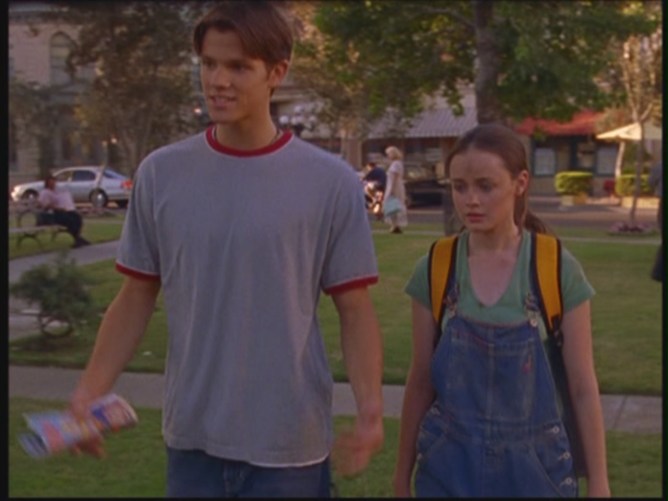
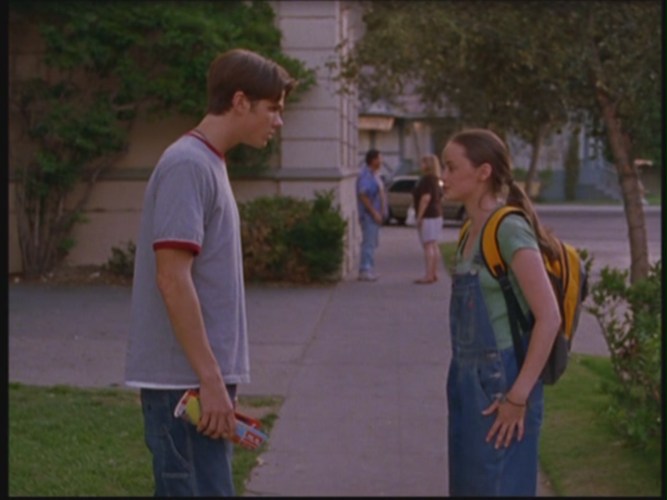
Rory and Dean now enter their third serious fight together, in a relationship which has only lasted around six months.

You can definitely see Dean’s point of view. He wanted to spend the day with Rory, but she was busy (and didn’t tell him about that beforehand), so they agreed to spend the evening together instead. But when he turns up for that, Rory tells him that now she has to spend the evening alone, planning her future. When he asks when he can see her again, she’s not sure and says the next day – maybe.

Dean is right that Rory is dismissing him from her life as if he doesn’t matter, and he is also right that her behaviour is absurd. She can’t possibly catch up on all the volunteering she thinks she has to do in one night, and she can’t even organise volunteer work for herself on a Saturday night when everything is shut. She possibly has an hour or so to make calls, and then she could spend the evening with Dean.

On the other hand, Dean is clearly jealous of the time Rory spends away from him, and makes very little attempt to understand Rory or help her feel less stressed out. If Rory had perhaps been more honest with him from the start as to how much of her summer would be taken up with classes, homework, and volunteer work, rather than springing it on him as it happens, he might have taken the news better.


“I need to find a retarded kid”

DEAN: Well, Rory, it’s summer. I mean, summer’s the time to hang out and kick back.
RORY: I can’t hang out or kick back. I need to find a retarded kid and teach him how to play softball. Oh God, listen to me. I am horrible. I am under qualified and horrible.

This is the girl that Lorelai calls “the sweetest kid in the world”. Either Lorelai has rose-coloured glasses when it comes to her only child, or Rory has already been corrupted by her zeal to get into Harvard. Maybe both.

“I thought that was enough”

RORY: I’ve been studying my butt off my whole life and I really thought that that was enough, but then Paris tells me that everyone makes good grades and it’s the extras that put you over the top. And I thought that she was messing with me like she always does, but she’s right. I mean, it makes total sense.
DEAN: What does?
RORY: Good grades aren’t enough. I need to do things. I need to volunteer. I need to work for charity, I need to help the blind, the orphans, I don’t know. I just need to do something.

Rory has been truly naive in thinking that all she needed to do to get into Harvard is to study hard and get good grades. Her teachers should have given her far greater guidance on getting into college; it seems as if they are leaving it all until senior year. Both Rory’s grandparents went to university and could have given more help, but then again, their knowledge of college applications is out of date.

Rory herself has not given the reality of college much thought at all, so going to Harvard is almost purely a fantasy for her, where she strolls around historic buildings and gets to feel smart and important. At some point, surely when she started at a private school, she should have come to realise what would be needed to get into college.

Because of this gap in her knowledge, Rory believes Paris implicitly that she needs thousands of hours of volunteer work to apply to Harvard, and panics. She should have at least checked with her teacher and her mother’s boyfriend, Max Medina before freaking out, or done a bit of research on the subject.

Mother Teresa

RORY: I’m like ten years behind on my extracurriculars.
DEAN: What are you talking about?
RORY: Paris has been accumulating these things since she could walk. I mean, she has a list of good deeds that could bump Mother Teresa off the Harvard list.

Mother Teresa, born Anjezë Bojaxhiu (1910-1997) was an Albanian-born Roman Catholic nun and missionary who lived most of her life in India, caring for the poor. In 1950 she founded the Missionaries of Charity, which cares for the sick, and manages soup kitchens, orphanages, and schools.

Mother Teresa won numerous awards during her life, including the Nobel Peace Prize in 1979. Sh was canonised as a saint in 2016, and in 2017 named one of the patrons of the Roman Catholic Diocese of Calcutta.

Barbarella

RORY: Long day. Long long day.
DEAN: The day is over. Let’s talk about the night. Uh, there’s a 7:30 showing of Barbarella, and I thought you can bring your mom’s purse, you know the one with that monkey face and we’ll sneak in some burgers and …

Barbarella is a 1968 science-fiction film directed by Roger Vadim, based on the comic series of the same name by Jean-Claude Forest, and starring Jane Fonda in the title role. The story is about a space adventurer named Barbarella finding a scientist named Durand Durand, who has created a weapon that could destroy humankind.

Barbarella was especially popular in the UK, and received mixed reviews from critics because of its lush cinematography and weak story. The film has become a cult classic, and Barbarella herself  an iconic sex goddess.

Paris and Volunteering

PARIS: When you apply to an Ivy League school, you need more than good grades and test scores to get you in. Every person who applies to Harvard has a perfect GPA and great test scores. It’s the extras that put you over the top. The clubs, charities, volunteering. You know.
RORY: Oh yeah, I know.

Paris explains to Rory what she should already know – to get into a top university like Harvard, you need something to set you apart from all the other excellent candidates.

Paris has been volunteering since she was about nine, and began by handing out cookies at the local children’s hospital (possibly the Connecticut Children’s Medical Center in Hartford). By the age of ten she was running a study group for teenagers, probably through Chilton. She has also been a counsellor for a children’s summer camp, organised a literacy program for seniors, worked at a suicide prevention hotline (a truly terrifying thought), and a residential centre for runaways and homeless youth.

She has also adopted dolphins (you just send money to an organisation like The Oceanic Society), taught American Sign Language (perhaps through the American School for the Deaf in Hartford), and trained guide dogs (volunteers raise puppies and give them socialisation and basic training before handing them back so they can be trained as guide dogs; Paris may have done this through Guiding Eyes in Hartford.) We know Paris likes dogs, because her dog Skippy is said to have had a litter of puppies on Lorelai’s mini-dress that she borrowed: weirdly (or perhaps lazily by the writers) her dog has the same name as Rory’s unfortunate hamster.

Paris has done an insane amount of volunteering for a 16-17 year old girl, but in fact choosing this as a good method of getting into Harvard is almost certainly wrong. Colleges don’t seem to be really be that impressed by you doing huge amounts of random volunteer work (probably because anyone with half a brain and no life can rack up hours of unpaid work fairly easily).

What they really want to see is how your extracurricular activities demonstrate the kind of person you are, and the unique skills and interests that you have. For example, Paris wants to work in medical research, so the children’s hospital was a great start, but she didn’t stick with it. It would have been better to continue volunteering with just one or two organisations, and demonstrate that she had gained a leadership role and given real help to the community – maybe even won an award of some kind. Paris’ volunteering CV looks as if she’s desperately taken any role offered (and sending money to dolphins doesn’t look impressive to anyone).

Furthermore, it depends on the university how highly they rank volunteer work when assessing applications. It doesn’t seem to be extremely important for Harvard, which makes Paris’ efforts even more pointless.


Bob Vila

RORY: Funny. I never pictured you as a Bob Vila kind of girl.
PARIS: Rebuilding Together is an extremely prestigious and respected organization. I’ve been volunteering for them for years.

Robert “Bob” Vila (born 1946) is an American home improvement television host. He was the host of This Old House, previously mentioned, from 1979 to 1989, and hosted Home Again With Bob Vila from 1990 to 2005.

Paris seems to have been volunteering for Rebuilding Together since she was at least 14, quite possibly younger.

Grub axe

RORY: It’s [the wall Paris built] very impressive.
PARIS: I’ve done it a million times before. It’s no big deal. Louise! What did I just tell you? Use a grub axe for that!

A grub axe is another word for a mattock, a versatile hand tool used to dig up roots and shrubs, and otherwise clear ground for building and planting.