High Fidelity

JESS: There’s a record store you should check out. It’s run by this insane freak who’s like a walking encyclopedia for every punk and garage-band record ever made. Catalog numbers . . . it’s crazy. The place is right out of High Fidelity.

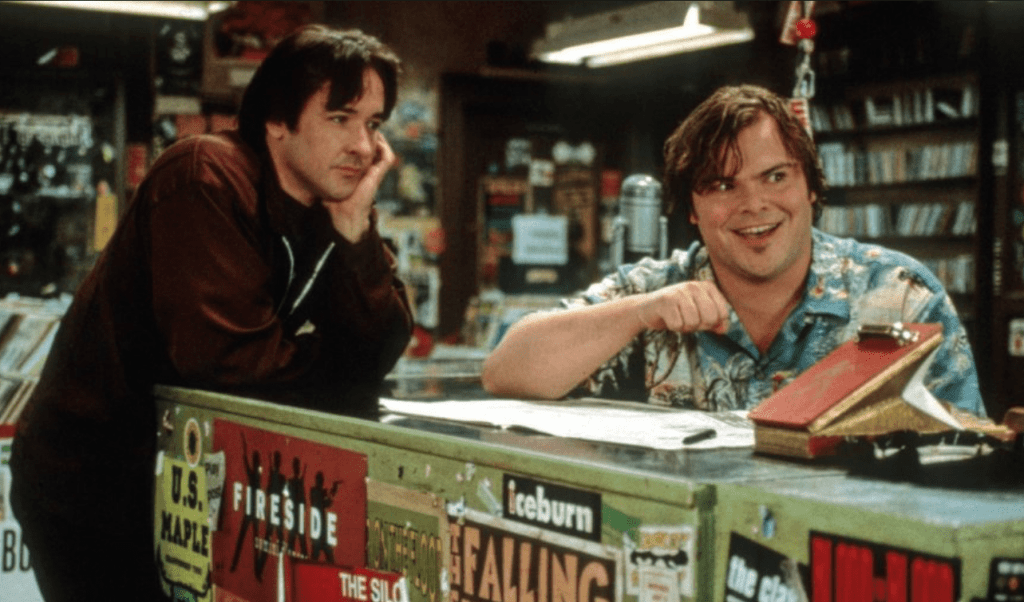
High Fidelity, 2000 romantic comedy-drama film directed by Stephen Frears, based on the 1995 British novel of the same name by Nick Hornby, with the film’s action moved from London to Chicago, but otherwise faithful to the book.

The film stars John Cusack as a music-lover named Rob with little understanding of women who owns a record store called Championship Vinyl. He and his employees Dick and Barry (played by Todd Louiso and Jack Black), armed with an encyclopedic knowledge of music, compile “Top 5” lists for every occasion, and openly mock their customers’ tastes. Eventually, Rob is able to produce a mixtape to please his girlfriend, Laura (played by Iben Hjejle).

High Fidelity was a commercial and critical success, receiving praise for its witty dialogue, strong performances and solid soundtrack. It’s been voted one of the best romantic comedies, and one of the greatest films of all time. It was made into a 2020 television series.

It’s interesting that Jess compares the record store he is taking Rory to with one out of a romantic comedy – especially one where a smart but emotionally obtuse young man learns to express his feelings.

EDIT: Thank you to High Fidelity fan Alisa for supplying the correct name of the actress playing Laura.

Hot Dogs

Hot dogs are grilled or steamed sausages served in the split of a partially sliced bun. The sausage used is a wiener (Viennese sausage) or a frankfurter (Frankfurter sausage). In the US hot dogs are often topped with ketchup or mustard, and might be garnished with onions, chilli, or pickles.

The sausages used in hotdogs were imported by Germans, and allegedly, the first hot dogs in the US were sold on the streets of St. Louis, Missouri by an immigrant from Frankfurt called Feuchtwanger in the late 19th century. A competing origin story is that they were first sold by Charles Feltman at Coney Island, in 1867.

Hot dogs were always a working class street food sold at stands and from carts, closely connected with baseball. They have a particular connection with New York City, but are ubiquitous throughout the US.

Jess takes Rory to a hot dog stand for lunch; it’s where Jess eats every day. Although Jess seems a bit apprehensive that it won’t be “fancy” enough, Rory immediately declares it as “perfect”. Like Luke, Jess has quickly got the idea that a big part of keeping a Gilmore Girl happy is to make sure she’s well-fed! Jess has taken Rory for an iconic New York City lunch.

“A friend to all of us dispossessed”

JESS: [Looks at Rory’s cast.] I like this Emily chick. Friend of yours?

RORY: She’s a friend to all of us dispossessed.

Jess refers to the sticker of Emily the Strange, previously discussed.

Rory refers to both herself and Jess as “dispossessed”, deprived of what they deserve, of their birthright. It’s the first time that Rory hints at any possible resentment that Lorelai removed her from Richard and Emily’s world, the world of wealth and privilege she had been born into.

She is also identifying both Jess and herself as having been literally de-possessed, cast off by one or more parents. Apart from literature, this is the main thing that binds Jess and Rory together. The casual way she says this to Jess suggests that they might have talked about it previously.

And more generally, Rory and Jess are both part of that “dispossessed” generation of the 1990s, the Millennials who would later be jeered at by A Year in the Life. You can see the emo-esque Emily the Strange as one of their unofficial spokespeople.

“I’ve been hurt before”

JESS: Oh, come on, let me see your withering stare.

RORY: It’s dangerous. I could hurt you.

JESS: I’ve been hurt before.

A serious statement masquerading as a joke. Jess truly has been hurt by life, and he’s probably also been hurt by Rory, and her efforts to keep him at bay and continue seeing Dean, even as it became increasingly clear that she didn’t really want him any more. Jess comes this close to saying, “You’ve hurt me before”. Don’t worry Jess – Rory has more emotional pain in store for you!

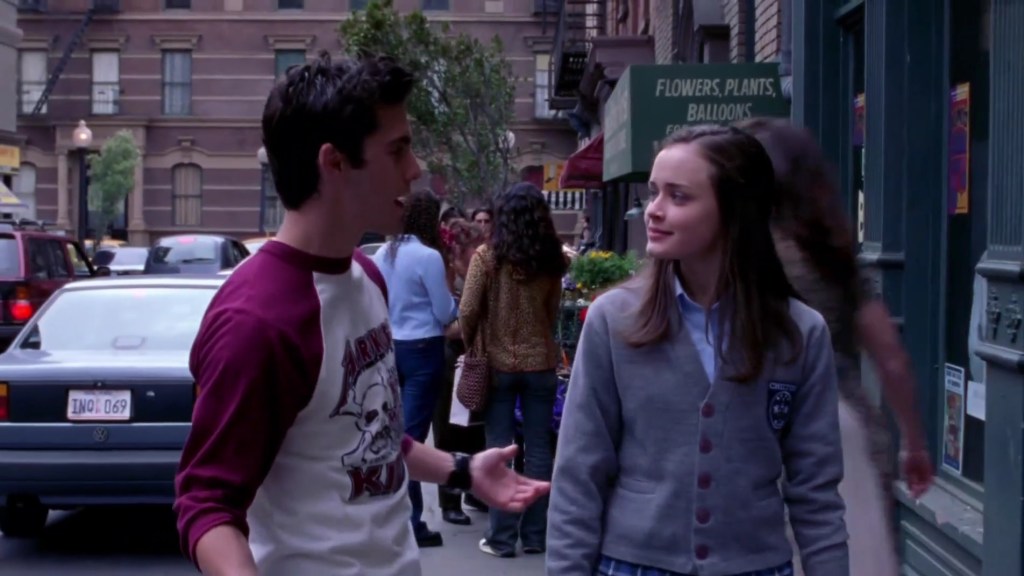
Note that Jess and Rory walk past a florist’s, a romantic symbol, but it’s selling balloons – condoms can also be used as balloons. The car driving past has a licence plate of INQ 069 – ink + 69, as if writing and sexual attraction is what’s drawing Rory and Jess together. Sex, romance, reading; the holy trinity of Rory and Jess!

(This is the second licence plate ending with 69 I’ve noticed, so it might be a running joke, although last time it could have been highlighting the sexual attraction between Lorelai and Christopher).

The Big Apple

RORY: I’m just saying I’m no stranger to the Big Apple.

JESS: You are if you’re calling it the Big Apple.

The Big Apple is a nickname for New York City, first popularised in the 1920s by John FitzGerald, a sports writer for The New York Morning Telegraph. Its popularity since the 1970s is mostly due to a promotional campaign by the city’s tourism authorities to boost the city during a fiscal crisis.

Although Rory says she’s been to New York a few times, she only mentions The Bangles concert in 2001 and a 2000 shopping trip where she didn’t even get out of the car. This could very well be her third trip to New York (and the second where her feet touched the ground!).

Hummel

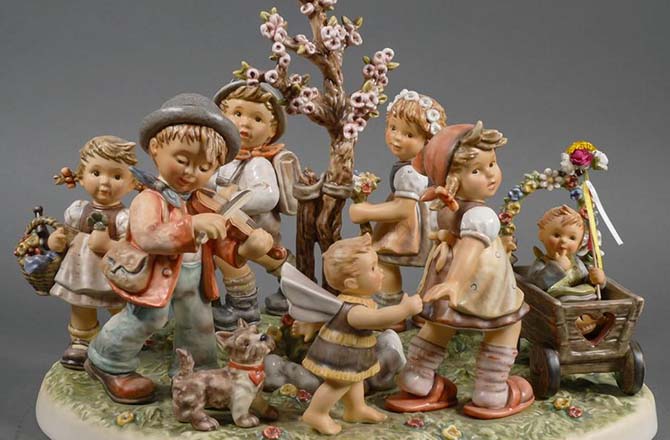
RORY: And a couple years ago Mom drove us in to shop, and she couldn’t find a good parking place and all of the parking lots were a total rip-off, so she kept making U-turns and cutting off taxis and we were being screamed at in so many different languages that we just turned around and drove home and bought a Hummel at the curio store in Stars Hollow.

Hummel figurines, often just called Hummels, are a series of porcelain figurines based on the drawings of Sister Maria Innocentia Hummel, a German nun from the Franciscan Order. These sketches began to appear in Germany and Switzerland during the 1930s, mostly pastoral scenes of children.

Porcelain-maker Franz Goebel acquired the rights to turn the sketches into figurines, the first line produced in 1935. Introduced at the Leipzig Trade Fair, they quickly found American distributors. The popularity of Hummels grew after World War II as American soldiers stationed in West Germany began sending them home as gifts.

Nostalgia was a big factor in the figurines becoming popular, and they were commonly purchased during European travel as souvenirs. During the 1970s, prices began to skyrocket, and the M.I. Hummel Club was founded in 1977. Today a genuine Hummel would cost over $100 for a small piece, to more than $1000 for a larger and more elaborate one.

Lorelai bought a Hummel in 2000, presumably before the show opens in September of that year. Although I can see how Lorelai would appreciate the kitschy appeal of these collectables, I cannot recall actually seeing a Hummel on display in their house.

“We saw The Bangles here”

JESS: How well do you know Manhattan?

RORY: I’ve been here a few times. We saw The Bangles here.

JESS: When was that, twenty years ago?

The Bangles, previously discussed.

Rory refers to “Concert Interruptus”, when she saw The Bangles on their reunion tour in New York, in February 2001. Jess is polite about it when he knows Rory thinks they’re great, although he can’t possibly think they match his idea of what’s “cool”.

O’Oh

This is the song which plays while Rory and Jess walk through the streets of New York to get a hotdog and then go to the subway. It’s a 1992 song by Yoko Ono, first released on Onobox, a comprehensive 6-disc collection of Yoko Ono’s work from 1968 to 1985. It included 20 previously unreleased songs, of which “O’Oh” is one.

The lyrics are about a couple enjoying the Fourth of July celebrations in Central Park together, so it’s a song about New York. Some of the lyrics are:

I never knew we could be so nice to each other

I never thought we’d be laughing together

I never knew life could be sweet and simple

I never thought that was possible

Not only does the song suit the setting they are in (although it’s May, not July, and a different park), but the lyrics are about how Rory feels about Jess. The surprise of finding that being with him is not only sweet, but simple – you can feel how easily the two of them get along, how effortlessly they laugh together.

Rory finally gets to meet Jess away from Stars Hollow, and he’s not surly, not bitter, not sarcastic – he’s sweet, he’s nice, he’s funny, in a way she never thought possible. She has taken any number of practical, physical, and emotional risks to come to New York to see him, and she gets the softest of landings, as Jess finally opens up to her, now that he’s received unexpected proof of how much Rory cares for him.

There is a real flipside feeling to the choice of song, because when Rory had her sweetest and most romantic experience with Dean (sitting in the car wreck on their anniversary), the song chosen to accompany it was by John Lennon. Now her sweetest and most romantic scene with Jess is accompanied by a Yoko Ono song. (Both songs have Oh in the title, also).

It is as if Jess and Dean are her Yin and Yang – Dean the Yang which complements her, and Jess the Yin which matches her. With Dean, there is an attraction of opposites; with Jess, an attraction of like minds, or twin souls.

The Electric Kool-Aid Acid Test

This is the book that Jess is reading in the park when Rory finds him. It’s a 1968 non-fiction book by Tom Wolfe, a popular example of the New Journalism literary style. It’s a firsthand account of the novelist Ken Kesey and his followers, called The Merry Pranksters, who travelled around the US in a colourfully painted school bus called Further, whose name was painted as the destination sign. The bus was driven by Neal Cassady, the inspiration for Dean Moriarty from Kerouac’s On the Road.

Kesey and his Pranksters became famous for their use of psychedelic drugs such as LSD (“acid”), often added to the drink Kool-Aid at Acid Test parties. Kesey becomes idolised as a hero of the countercultural movement, and almost a priest of a transcendent new religion or cult. He forms friendships with the Hell’s Angels, and crosses paths with other countercultural icons, such as The Grateful Dead and Allen Ginsberg, but is unsuccessful in his attempts to meet psychologist Timothy Leary, who worked with psychedelic drugs. The Pranksters meet Jack Kerouac, who finds them overwhelming and resents them, a symbol of the hippies overtaking the Beat generation as the new counterculture. Eventually, the law catches up with them.

The book received modest critical acclaim, and is regarded as a faithful and sober account of Kesey’s activities, although it has also received plenty of criticism for Wolfe’s idolisation of Kesey, and his glorification of rampant drug abuse. Kesey himself noted that Wolfe was only with him for three weeks, and used no recording devices at all, but provided a reasonably factual account.

This book makes perfect sense for Jess to read – an updated On the Road, with a similar vibe to Fear and Loathing in Las Vegas. It shows his interest in journalism as a literary art form.

Rory Finds Jess

[Jess is reading on a bench as Rory walks up behind him]

RORY: Hi.

JESS: How ya doing?

After all the effort Rory has made to come to New York, apparently on a whim, she seemingly just walks in a side gate of Washington Square Park and finds Jess straight away (Rory is looking pretty fresh for someone who’s been on a bus for hours and just had a long walk). He’s sitting helpfully on a prominent park bench right at the entrance. It is now presumably somewhere between midday and 12.30 pm.

I know Jess was very lucky, phoning Rory when Lorelai was drunk and had the stereo on loudly so they could talk in private, but it’s nothing to Rory’s luck in finding Jess! All she had to go on was that he often hung out in Washington Square Park, and without making any plans to meet at a particular day, place, or time, it looks as if she turns up and Jess is right there. I mean, even if Jess was in the park, it’s ten acres – it could take hours to search for him. And lucky he hadn’t gone to the toilet or to lunch just as she arrived!

It would have been more believable if Rory and Jess had some sort of agreement to meet in New York, but that would have made Rory much more sneaky, treacherous, and selfish. It has to seem completely spontaneous, so that the relationship between Rory and Jess can remain innocent.

None of the scenes in this episode were actually filmed in New York – they were all shot at the Warner Bros lot in California. This scene takes place in New York Park, Burbank. There is no side gate such as the one Rory walks through, and if she approached Washington Square Park straight down Fifth Avenue, she would come to the main entrance, with the famous archway. Needless to say, it doesn’t look like Washington Square Park, and the real park is far more crowded, especially on a sunny spring afternoon around lunchtime.