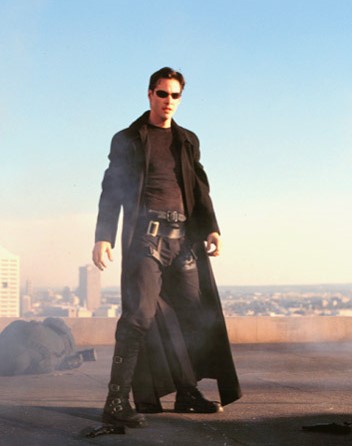
LORELAI: I told him that he was completely out of line with this treatment of you, that you are not a loner freak, you have plenty of friends, and you don’t own a long black leather Matrix coat, and they should fall down on their kneesocks everyday that you deign to show up at that loser school.
The Matrix, previously discussed. The hero Neo wears a long black leather trench coat.
Also, how does Rory have “plenty of friends”? She has one friend, Lane! Getting along well with your mother’s social circle doesn’t make them your friends, as Lorelai seems to think. Lorelai has trouble accepting that she and Rory aren’t one person, but two.
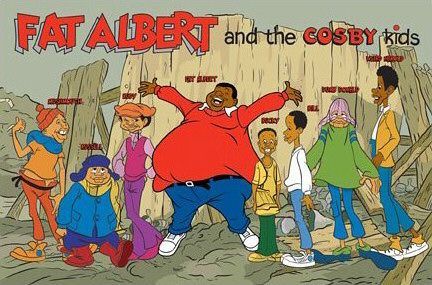
RORY: Hey. LORELAI: Hey. RORY: Hey. LORELAI: Yeah, look Fat Albert. Get me a soda, will you?
Lorelai is referring to the hero of the animated children’s television show, Fat Albert and the Cosby Kids (1972-1985). It was created by comedian Bill Cosby and inspired by his own childhood gang in Philadelphia, and his friend Albert Robertson. In the show, Fat Albert is wise beyond his years, and serves as the conscience of the gang to maintain its integrity. The lead singer of their band, Fat Albert is also athletic and loves sports, despite his weight.
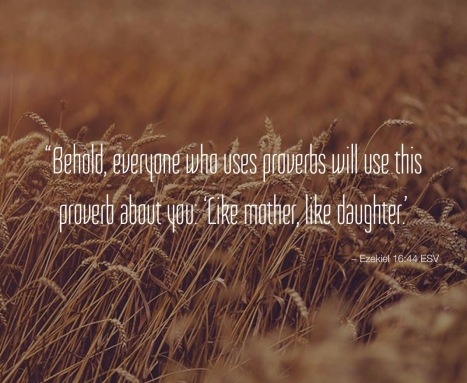
HEADMASTER: Like mother, like daughter. LORELAI: Okay, hold on. HEADMASTER: Ms. Gilmore, active participation in Chilton activities for a parent is vitally important.
The phrase “like mother like daughter” can be found in the Bible, in Ezekiel 16:44. There, it specifically refers to the city and people of Jerusalem, who are said to have the Hittites as their “mother”. It isn’t complimentary, meaning that Jerusalem has taken on the same disgusting practices as earlier cultures, despite the love and protection of God. The proverb seems to have been well-known even in Old Testament times.
You can see Headmaster Charleston in the role of disappointed God, having offered the love and protection of Chilton to Rory, only to find that she has inherited her mother’s appalling habits!
Indignant that the school has dared to suggest her daughter is less than perfect, Lorelai marches into the headmaster’s office in high dudgeon to put him straight on the Gilmore Girl philosophy of not doing anything you don’t feel like.
Headmaster Charleston pulls the wind from her sails by immediately getting out her file (really? Schools keep files on parents? What kind of school is this?). The file is worryingly thin, denoting a lack of parental involvement. Lorelai has only been to one bake sale a year ago, and was observed to not stay afterwards to talk to other parents. Seriously, how does he know all this stuff? Why does he care?
Perhaps tactfully, Headmaster Charleston does not bring up the fact that Lorelai got rather too involved in the school by having a serious relationship with Rory’s teacher. That’s all forgiven and forgotten, but failing to hang out after a bake sale? That’s on your permanent record, Missy!
Now, usually when Lorelai is told to do something, she gets stroppy and calls everyone a Fascist, but this is Rory’s future, so after a few futile attempts to explain she’s too busy, she meekly leaves with a list of organisations at Chilton she might join.
Just as the school wouldn’t listen when Rory was slightly late to a test because she lives out of town and got hit by a deer, there is no attempt to understand that Lorelai is a single mother who works and studies, and is also doing about a million volunteer jobs in Stars Hollow already. Do fathers have to do any of this volunteer stuff for Chilton, or are their lives considered far too busy and worthwhile to be called upon in this way? If so, one of the more realistic things in the show!
This is the song which Rory listens to while she reads in the dining hall at lunchtime.
Know Your Onion! is a 2002 single by American indie rock band The Shins, a release from their critically-acclaimed 2001 debut album, Oh, Inverted World.
The lyrics are from the perspective of a suitably angry and frustrated loner who’s been shut out of a society they can see through with devastating clarity – a comment on the theme of this episode. It suggests Rory isn’t as content with her lonely position at Chilton as she might appear.
These lines seem especially pertinent:
The songs that I heard The occasional book Were the only fun I ever took And I got on with making myself
Rory spends her lunchtime reading and listening to music because it’s her only authentic choice for doing something she enjoys.
RORY: I’m jumpy. On the Fourth of July, forget it, I’m a wreck. And when the Stars Hollow orchestra begins to play in the gazebo, the guy banging the cymbals, I’m . . . it drives me nuts.
Fourth of July is the date of Independence Day, and often used colloquially as its name. It’s a federal holiday in the US, commemorating the signing of the Declaration of Independence from Britain on July 4th 1776. A day of patriotic display, music, fireworks, and mid-summer picnics and barbecues.
We never get to see the Fourth of July in Stars Hollow, but of course they would have the same sort of celebrations as elsewhere. Presumably it is the fireworks which make her “jumpy”. Rory tells us that there is a town orchestra who plays in the gazebo on this date – which means the orchestra must be small, that they all fit in the gazebo.
Rory listens to music on her Walkman while she reads, a brand of portable media player made by Sony since 1979 (originally it played cassettes). A prestige model was released in 1999 for the anniversary of its release. The name Walkman is now often used to refer to any similar product, just like Kleenex.
Mrs Verdinas, Rory’s guidance counsellor at Chilton, speaks to her about her lack of socialising at school, which Headmaster Charleston told her about a few weeks ago. Mrs Verdinas is her new guidance counsellor; the previous year it was Mr Summers, who we never saw.
This means that only a short time into the academic year, Headmaster Charleston, who is running an entire school, has decided the big problem he needs to address is Rory reading at lunchtime. How he knows about this is a bit of a mystery, unless he spends his free time stalking students in the dining hall.
In a school with hundreds of students, Mrs Verdinas and Headmaster Charleston have been keeping such a close watch on Rory that they’re bothered she’s been spending her lunch times reading and listening to music. Even though she’s getting good grades, works on the school paper, and interacts well with other students on class projects, none of that counts because she doesn’t have any friends at school.
Apparently colleges don’t accept “loners” (really?), and Chilton isn’t going to write a good letter of recommendation for Rory (have they never heard of simply telling some vaguely-worded white lies?). And friends in class doesn’t count, they have to be friends to eat lunch with. Mrs Verdinas never even checks what Rory is reading – perhaps reading Gore Vidal at lunch is better preparation for college than gossiping with Madeline and Louise?
It isn’t even a matter of Mrs Verdinas having a quiet chat to Rory to suggest she might try socialising a little more outside class, she more or less threatens to ruin Rory’s academic future unless she gets some lunch friends, stat!
Yes, it’s all pretty unbelievable, but that is the plot of this episode.
Rory has trouble packing the books she’s reading into her backpack, which is already filled with school textbooks.
Savage Beauty: The Life of Edna St. Vincent Millay
A 2001 biography by American writer Nancy Milford. It examines the life of the American poet, an icon of the Jazz Age who was an influence on Dorothy Parker, who Rory has already read. She has almost certainly read Millay’s poetry as well. This is the book Rory reads on the bus.
The Sound and the Fury
A 1929 novel by American author William Faulkner. Written from the perspectives of several characters, and utilising stream of consciousness, it is both Modernist (like James Joyce and Virginia Woolf) and Southern Gothic (like Eudora Welty). It seems like a natural progression in Rory’s reading, and is her second book to read on the bus, in case she doesn’t feel like reading biography.
The Last Empire: Essays 1992-2000
A 2001 collection of essays by American writer and intellectual, Gore Vidal, written between the presidency of Bill Clinton and the electoral crisis of 2000. A provocative look at the history, politics and culture of America, including a revisionist look at Mark Twain. An indication of the type of journalism Rory is most interested in, Gore Vidal was the one who promoted the work of Dawn Powell, making it seem as if Rory is allowing each book to open her up to a wider selection of literature. This is her book to read at lunch.
The Collected Stories of Eudora Welty
A 1980 collection of short stories by Eudora Welty, previously discussed. The 1983 paperback edition won a US National Book Award. Rory obviously enjoyed the novel by Eudora Welty enough to try her short stories. It’s never said what the stories are for; presumably it’s an alternative lunchtime read, or an alternative bus book.






 The Annotated Gilmore Girls