Richard Nixon

LANE: Quaker College was a delightful surprise, with its special appeal to Richard Nixon, who’s dead but still deeply involved in campus recruiting.

Richard Nixon, former US president, previously and frequently mentioned. He was born into a evangelical Quaker family in California in 1913, and brought up in Quaker ways of the time, such as abstaining from dancing, alcohol, and swearing. He largely left his religion behind in his pursuit of political power, and doesn’t seem to have attended Quaker meetings or events in adulthood.

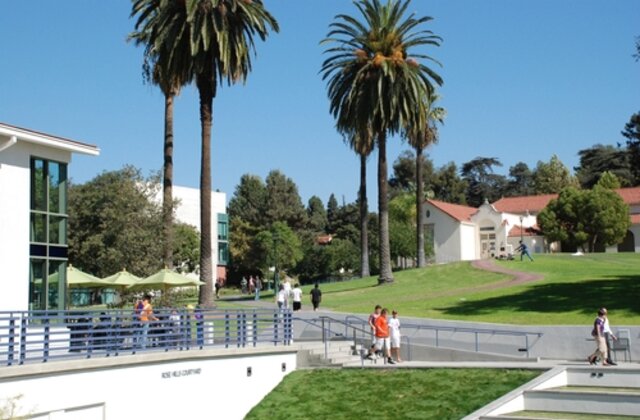
Nixon was offered a scholarship to Harvard, but chose to remain close to home instead and attended Whittier College in Whittier, California from 1930 to 1934, graduating with a BA in History. Although named after the Quaker poet John Greenleaf Whittier, the college hasn’t been officially affiliated with the Society of Friends since the 1940s. A liberal arts college, Latino students make up half the population, and 75% of the students are people of colour. If Richard Nixon is recruiting students from beyond the grave, his policy is perhaps slightly unexpected.
Quaker College

LANE: Quaker College was a delightful surprise …

Quakers belong to the religious movements known as the Religious Society of Friends. Members usually share a belief that every person can experience the light of Christ within themselves. They avoid doctrines, creeds, and hierarchies, and some Quakers are non-theists, so beliefs can be very diverse. The movement arose in Britain in the 17th century, stressing a personal relationship with Christ through reading and studying the Bible. They tend to follow a simple, truthful, peaceful, and sustainable lifestyle. There are many Quaker organisations devoted to peace and humanitarian causes.

There are fourteen Quaker colleges and universities in the US. The best known is probably Bryn Mawr College, a women’s liberal arts college in Bryn Mawr, Pennsylvania. It’s an elite institution, and many famous women have attended, including Katharine Hepburn, poets Hilda Doolittle and Marianne Moore, and Korean-American pop star Michelle Zauner. I think Lane would be extremely lucky to go there, but I doubt her parents can afford it.

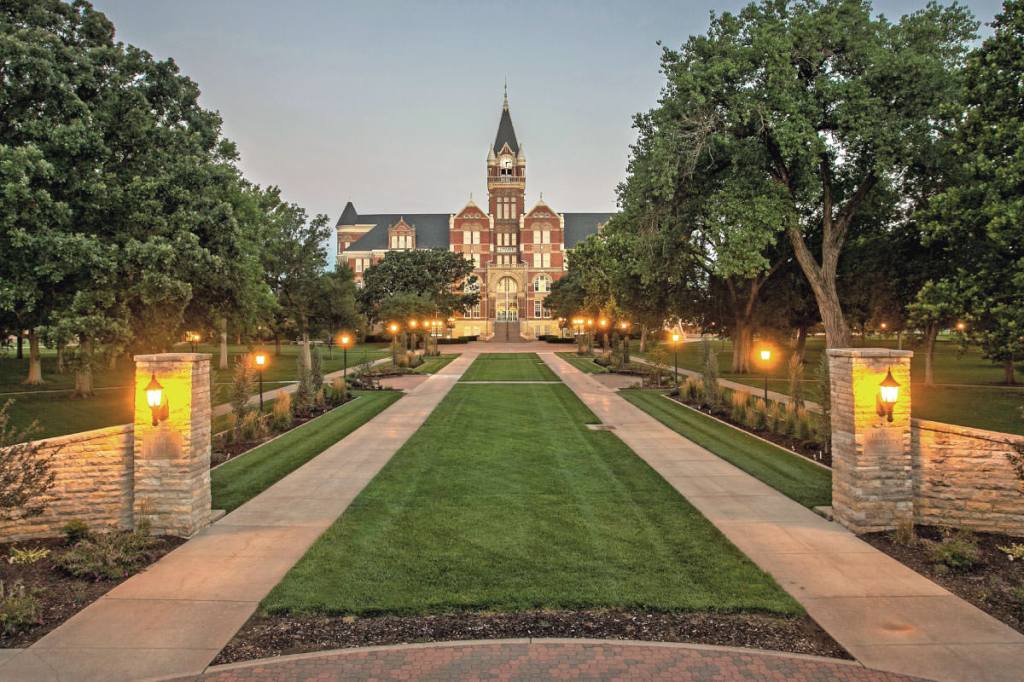
There isn’t anywhere called Quaker College – the closest would be Friends University in Wichita, Kansas [pictured]. It has an attractive campus, a strong track record of producing contemporary artists, and its choir travels the world. Again, it sounds like a pretty great option for study. Presumably Lane isn’t giving its name, but designating it as a Quaker-run college.

Seventh Day Adventist Schools

RORY: Out of twenty-three schools, there wasn’t one that you might want to go to?

LANE: It depends on what I’m looking for. Of course, all the great Seventh Day Adventist schools were represented, with their ban on dancing, gum chewing and bowling.

There are twelve Seventh Day Adventist colleges and universities in the US, and one in Canada. The closest one to Connecticut is probably Washington Adventist University, in the suburbs of Washington DC. If Lane had to apply to all of them, that leaves at least ten more she applied to that weren’t Seventh Day Adventist.

Seventh Day Adventists really do disapprove of secular dancing, seeing it as worldly and immoral. Chewing gum isn’t forbidden, but it isn’t seen as part of a healthy diet, and some older Seventh Day Adventists prefer that gum not be chewed in public.

Back in the day, I think bowling was considered an unsuitable entertainment, along with anything else that was a competitive pastime, but these days it can seen as a wholesome activity, and there are even Seventh Day Adventist bowling teams.

Wimple

RORY: She made you apply to every one [of the colleges]?

LANE: And measured my head for a wimple.

Wimple, a medieval form of female headcovering, formed of a large piece of cloth worn draped around the neck and chin, covering the top of the head. Its use developed in early medieval Europe; in medieval Christianity it was unseemly for a married woman to show her hair. Today a plain wimple is worn by the nuns of certain orders who retain a traditional habit.

Once again, the show (or Lane?) somehow conflates Mrs Kim’s Seventh Day Adventism with Catholicism, something that seems to happen a lot.

Hello, Dolly!

The song that Lorelai sings in a Louis Armstrong voice to annoy Luke.

“Hello, Dolly!” is the title track to the popular 1964 musical of the same name, the song was written by Jerry Herman. It was first sung by Carol Channing in the original Broadway production, which opened to great success. Louis Armstrong‘s recording of the song was released shortly afterwards, which reached #1 in the US, ending The Beatles‘ streak of three chart-topping hits over fourteen weeks.

“Hello, Dolly!” is Louis Armstrong’s most commercially successful song. It won the Grammy Award for Song of the Year in 1965, and Armstrong received the Grammy for Best Vocal Performance, Male. Louis Armstrong performed the song with Barbra Streisand in the 1969 film version of Hello, Dolly! [pictured]

“Three years of going there”

LUKE: I hate that building.

LORELAI: What, the school?

LUKE: Three years of going there, I have no good memories.

Luke attended Stars Hollow High School for three years, meaning he didn’t complete the full four years of high school available in the US. He may have dropped out of school (sixteen was the legal age for this in Connecticut at the time), or done his last year of education at a trade school. From a conversation Luke had with the school principal, the second one seems the more likely.

If Luke regrets not doing four years of high school, then it might explain why he is so insistent that Jess remains at school. There is some irony in the thought he is forcing Jess to attend the school that he himself supposedly hated, when Jess is miserable there.

Party Schools

MRS. KIM: They’re all good religious programs, and I’ve already thrown out the ones that let boys and girls sit in the cafeteria together, the party schools.

Party school, a college or university with a reputation for heavy drinking and drug use, or a general culture of licentiousness at the expense of educational credibility and integrity. It’s a term mostly used in the US, and The Princeton Review publishes a list of “party schools”. The University of Connecticut is on it.

Mrs Kim considers any college where boys and girls are permitted to sit together to eat a “party school”. In real life, Seventh Day Adventist colleges and universities often do have restrictions on contact between male and female students, but nothing so extreme as not letting them eat together, that I have heard about.

Reverend Melmin

MRS. KIM: College applications … Every one in this pile approved by me and Reverend Melmin.

Last season Lane mentioned “the reverend” who takes them for Bible study class on Saturday morning plays handball. Now we discover his name is Reverend Melmin, who must be the pastor of the Seventh Day Adventist congregation in Stars Hollow. In real life, Seventh Day Adventist pastors aren’t actually addressed as “Reverend”, I think he would be “Pastor Melmin”.

Sultan of Brunei

DEBBIE: Uh, well, we’ve had some suggestions, but do you know anyone?

LORELAI: Well, you know, my friend the Sultan of Brunei is so hard to pin down.

The Sultan of Brunei is the head of state and head of government as prime minister in Brunei, a country on the north coast of the island of Borneo in South East Asia, almost completely surrounded by the Malaysian state of Sarawak. It regained its independence from the UK in 1984.

The Sultan of Brunei since 1967 is Hassanal Bolkiah (born 1946), the 29th Sultan. He is one of the last absolute monarchs in the world. He has been ranked as one of the wealthiest people in the people, with a net worth of around $20 billion. Since the death of Queen Elizabeth II, he is the second-longest reigning current monarch.

Larry King

LORELAI: I’m a success, who’d have thought? … From rags to riches . . . I wonder why Larry King hasn’t called.

Larry King, born Lawrence Zeiger (1933-2021), award-winning television and radio host. A radio interviewer in the Miami area in the 1950s and ’60s, he gained prominence in 1978 as the host of The Larry King Show, an all-night nationwide call-in radio program. From 1985 to 2010 he hosted the nightly interview TV program, Larry King Live on CNN. He continued hosting TV interview shows until his death at the age of 87.

Lorelai hasn’t really gone from rags to riches … she’s gone from riches to rags to a moderately comfortable independent existence.

[Picture shows Larry King on CNN in 2002 with former president Bill Clinton]