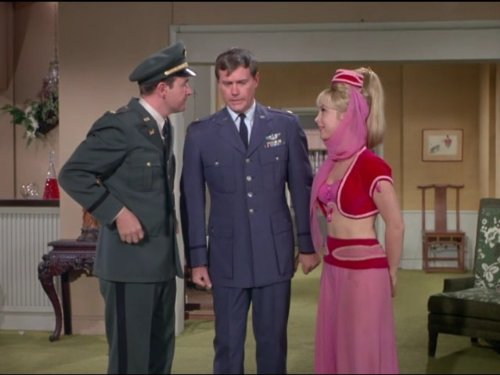
Jeannie and Major Healey

JESS: I’m in the middle of something.

RORY: Just assume that Jeannie’s gonna get Major Healey out of whatever scrape he’s in.

As the theme music playing tells us, Jess is watching I Dream of Jeannie, a fantasy sitcom created by Sidney Sheldon, starring Barbara Eden as a 2000-year-old genie named Jeannie, and Larry Hagman as Major Tony Nelson, the astronaut she falls in love with. Bill Daily played Tony’s best friend, Major Roger Healey, who was girl-crazy and often entered into get-rich-quick schemes, requiring Jeannie’s assistance to sort everything out. The show was originally broadcast from 1965 to 1970, but but often shown in reruns.

I Dream of Jeannie was created as a deliberate rival to Bewitched, both having pretty blonde magical beings as the focus of the show. It is amusing that Jess apparently prefers I Dream of Jeannie, while Lorelai seems to be a fan of Bewitched.

The classic theme music which you hear Jess listening to was composed by Hugo Montenegro with lyrics by Buddy Kaye. It replaced the original Season 1 theme music, a jazz waltz composed by Richard Weiss. Carole King and Gerry Goffin wrote a theme for the show, but it was never used.

(The show is set in Florida, the same place Louie retired to).

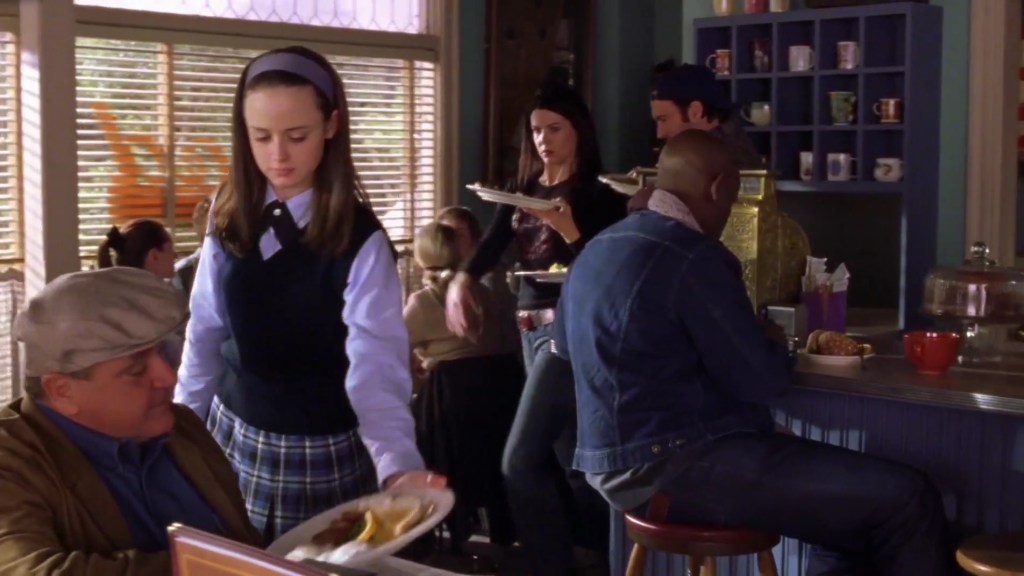
Jehovah’s Coffee Girl

LUKE: Not everybody likes it that strong.

LORELAI: Well, then I shall convert them. I am the Jehovah’s coffee girl.

Jehovah’s Witnesses is a non-mainstream Christian denomination which emerged from the Bible Study Movement founded in the 1870s by Charles Taze Russell; after his death, a breakaway group headed by Joseph Franklin Rutherford took control and chose the name Jehovah’s Witnesses in 1931.

Jehovah’s Witnesses are probably best known for their door-to-door preaching, distributing evangelical literature. Lorelai sees herself as similarly working to convert people to strong coffee.

Cathy Coffee, Mrs Folger, and Juan Valdez

LORELAI: We’re running out of coffee … I got it.

LUKE: Do you know how?

LORELAI: Do I . . . ugh . . . I am Cathy Coffee, mister, the bastard offspring of Mrs. Folger and Juan Valdez.

Cathy Coffee

I think a fictional coffee mascot that Lorelai has invented and is now personifying.

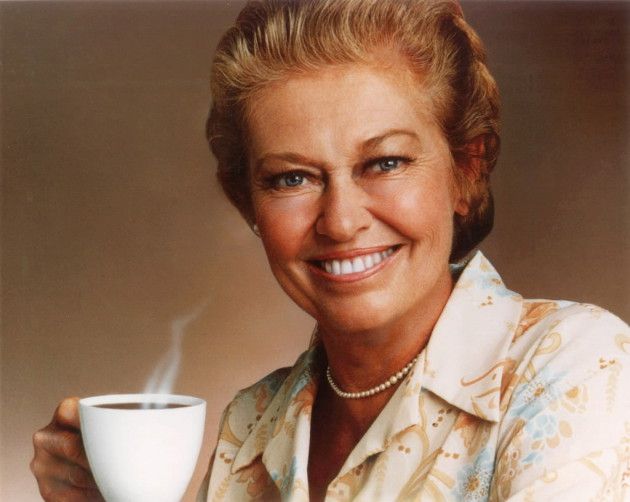
Mrs Folger [pictured]

Mrs Olson, or “The Folgers Coffee Woman” was in a string of television commercials for Folgers Coffee during the 1960s and ’70s. Mrs Olson was a Swedish neighbour who always recommended a cup of Folgers Coffee to other people in the commercial. She was played by an actress named Virginia Christina, born Virginia Ricketts (1920-1996).

Juan Valdez

A fictional character who has appeared in advertisements for the National Federation of Coffee Growers in Colombia since 1958. He is an icon for both coffee and Colombia. He was portrayed by a Cuban actor named José F. Duval until 1969, then by Colombian actor Carlos Sánchez. Since 2006, Juan Valdez has been portrayed by Carlos Castañeda, a coffee grower from a small town in Colombia.

Crank

RORY: Where should the poached eggs go?

LUKE: Crank in the hat.

Crank is a term to refer to someone with an unshakeable belief in something that most of their contemporaries believe to be false. The term was popularised in 1872, being applied to Horace Greeley in his campaign for the US presidency. He believed in the settlement of the Old West and a magnanimous Reconstruction of the American South, and was a proponent of socialism, vegetarianism, agrarianism, feminism, and temperance. Cranks today can take comfort in the fact that all Greeley’s cranky ideas were proven very sensible, and are mainstream today.

In North American, a crank can also be slang for a bad-tempered person. I’m not sure which one Luke was applying to Cy, the “crank in a hat”, but Cy seems to believe it’s the second one, because he makes a spirited defence by saying that Luke is the crank – he’s well known around town for being grumpy.

Jerry Lewis in “The Diner Guy”

LUKE: Yeah, I can’t serve and be on the phone.

LORELAI: But your reenactment of Jerry Lewis in The Diner Guy is gonna wow the critics.

Jerry Lewis, born Joseph Levitch (1926-2017), comedian, director, actor, screenwriter, singer, humanitarian and producer. Nicknamed “The King of Comedy”, Lewis is regarded as one of the most significant American cultural figures of the 20th century, was widely known for his “kid” and “idiot” persona and his contributions to comedy and charity, making him a global figure in popular culture over an eight-decade career. He debuted professionally in 1946 working with Dean Martin as Martin and Lewis, and they performed together until 1956.

Although Jerry Lewis never did a film called The Diner Guy, several of his films had titles such as The Geisha Boy, The Ladies Man, and The Errand Boy, so The Diner Guy would actually fit right in.

Wake Me Up Before You Go-Go

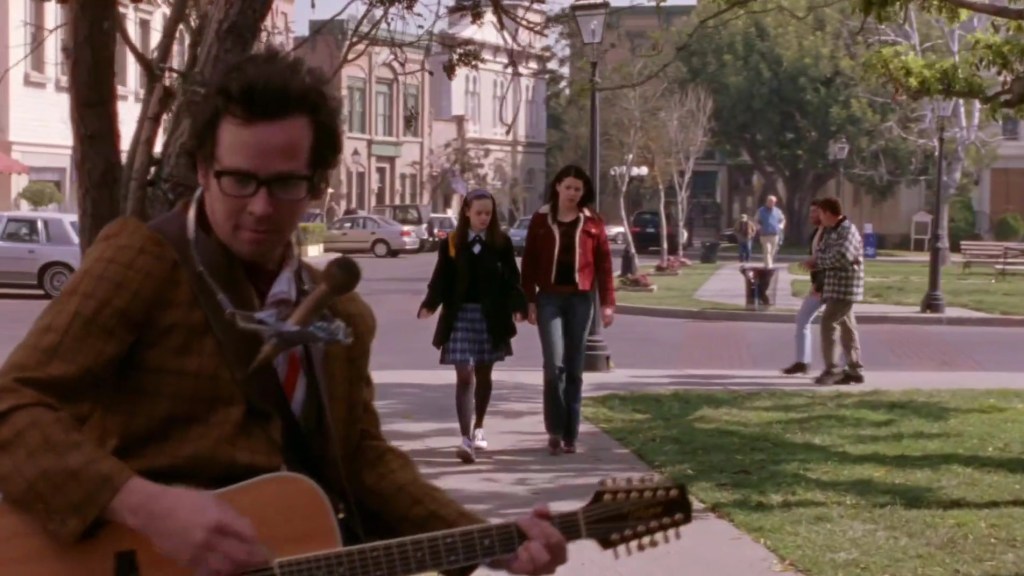
This song is sung by the Town Troubadour as Lorelai and Rory walk to the diner, talking about Luke’s news about his uncle’s passing.

Wake Me Up Before You Go-Go is a 1984 song by British pop duo Wham! Written and produced by George Michael, it was their first #1 UK and US hit, a world-wide smash, going to #1 in many countries, and went Platinum in the US.

The music video shows George Michael and Andrew Ridgeley wearing Katharine Hamnett tee-shirts with CHOOSE LIFE emblazoned on them – a bit of a message for this episode which focuses on death. Apart from that, the Troubadour seems to singing it as an early morning song, to show that people are just starting to wake up and get ready for the day.

Louie Danes

Luke’s Uncle Louie has died shortly before this episode opens, at the age of 85. Louie was the brother of Luke’s father, William Danes, and lived in Stars Hollow until he retired and moved to Florida. This episode focuses on Luke’s efforts to organise Louie’s funeral.

(The episode never says this, but it seems possible that Luke was given the name Lucas because it sounds similar to his uncle’s name of Louis).

Tetherball

LORELAI: Oh, no, it’s kind of slow here. So slow, in fact, that Michel and I were about to get the tetherball out.

Tetherball is a playground game where two players use their hands to hit a volleyball tethered to a metal pole by a rope. The game ends when one player manages to wind the ball all the way around the pole so that it is stopped by the rope. It must not bounce. An early variation was described in 1909, and the game was especially popular in the 1970s.

Cult Deprogrammers

LORELAI: I’m gonna have to be deprogrammed by cult deprogrammers to get that Tuesday out of my brain.

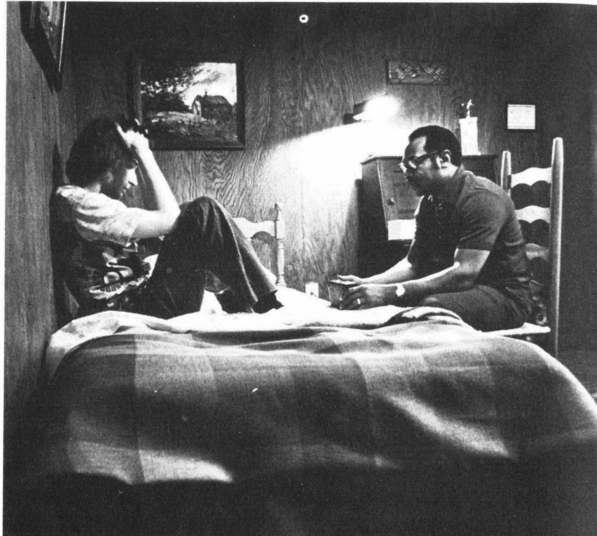
Cult deprogramming claims to assist people who have been “brainwashed” by new religious movements. Deprogramming was introduced in the 1970s by a high school dropout named Ted Patrick, who, despite having no qualifications or training, convinced people that he could rescue their loved ones from organisations and groups for $10 000. He had experience, having already removed his own son from the Children of God.

Essentially, deprogramming involves abducting the new convert, isolating him, physically restraining him and hitting him with a barrage of continuous arguments and attacks against his new religion, threatening to hold him forever until he agrees to leave it. Ted Patrick was tried and convicted of multiple felonies, such as kidnapping and unlawful imprisonment.

There is no evidence that deprogramming works – in fact, there is a higher rate of success from people naturally getting bored and dropping out of religious movements than there is from deprogramming. Members of the Church of Unification were particularly targeted by deprogramming efforts in the 1980s.

[Picture shows Ted Patrick trying to deprogram a young member of the Children of God].