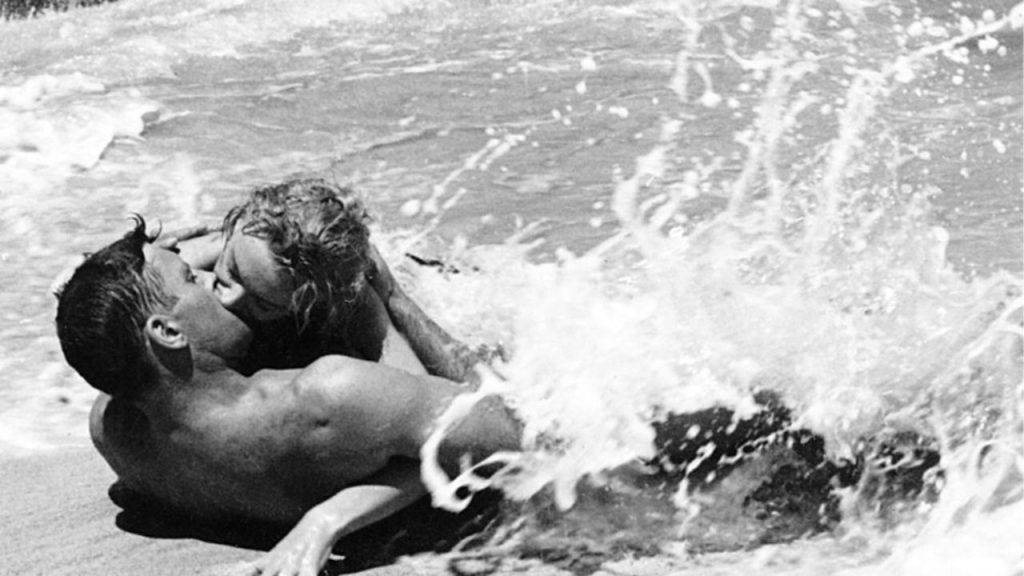
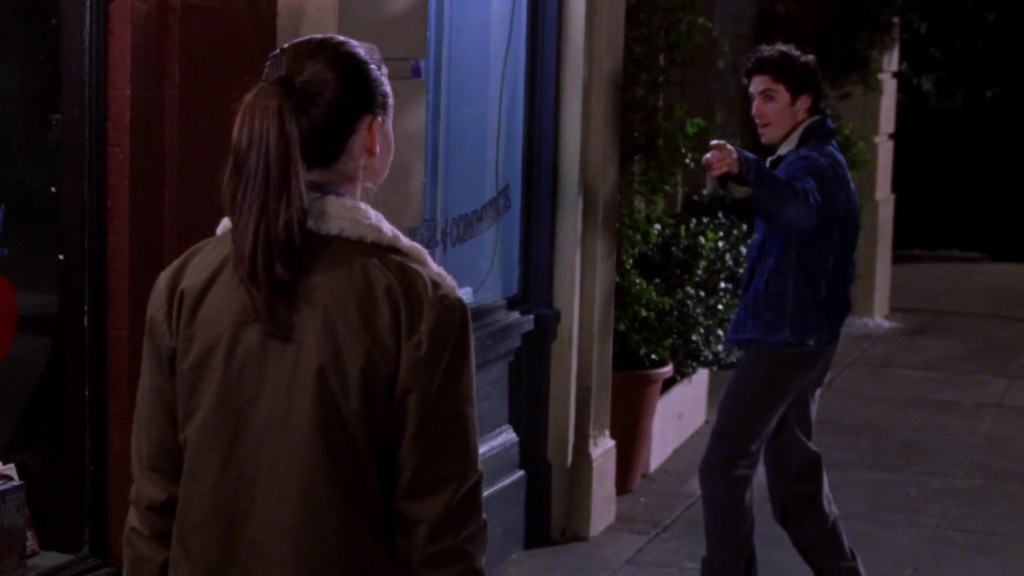
JESS: Sorry to intrude. DEAN: Then why did you? JESS: Well, you’re having your vertical From Here to Eternity moment right in front of the super glue.
From Here to Eternity, 1953 drama-romance war film directed by Frank Zinneman, based on the 1951 novel of the same name by James Jones. The film focuses on three US Army Soldiers, played by Burt Lancaster, Montgomery Clift, and Frank Sinatra, stationed in Hawaii in the months leading up to the attack on Pearl Harbor in 1941. Deborah Kerr and Donna Reed play the women in their lives.
From Here to Eternity was the #3 film of 1953 and won eight Academy Awards, including Best Picture and Best Director (Frank Sinatra and Donna Reed won awards for their supporting roles), as well as numerous other awards. Critics praised it to the skies, but it didn’t go down well with the army and navy. It is considered one of the greatest films ever made.
Jess is referring to the iconic kissing scene where Burt Lancaster and Deborah Kerr roll around on a beach together wearing only swimsuits, as the waves crash over them in mimicry of an orgasm. It’s torrid stuff, made more titillating by the fact that she’s in the role of his commanding officer’s wife.
LORELAI: Ugh, every great relationship has its obstacles. You’d know that if you weren’t dating Andy Hardy.
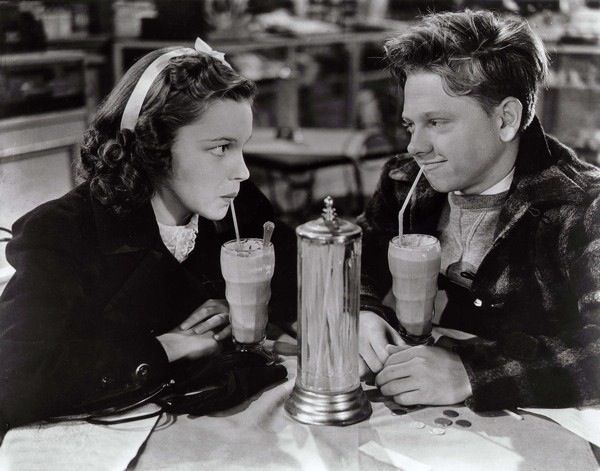
Andrew “Andy” Hardy, fictional character played by Mickey Rooney in 16 films made by Metro-Goldwyn between 1937 and 1946 (and another in 1958, trying unsuccessfully to continue the series). The Hardy films, enormously popular in their day, were sentimental comedies set in a Midwestern town, celebrating ordinary American life.
The Hardy family first appeared in the 1928 play Skidding by Aurania Rouverol, with Charles Eaton as Andy. The first film was A Family Affair, based on the play, with Mickey Rooney as Andy, and he continued in the role from the ages of 16 to 25.
Andy Hardy soon became the central character, with the films focusing on the relationship between he and his father, Judge Hardy (a bit like Gilmore Girls focusing on Rory and Lorelai). The plot typically involved Andy getting in trouble with money or girls because of selfishness or trying to fudge the truth. He would then have a man-to-man talk with his father, a man of absolute integrity, and end up doing the right thing (very different to Gilmore Girls).
Lorelai seems to be teasing Rory about Dean, suggesting that she’s dating a wholesome, inexperienced teenage boy from the Midwest, like Andy Hardy. Meanwhile, Lorelai is looking for a real man, like William Holden.
Interestingly, the cast of A Family Affair were plucked straight from the 1935 comedy, Ah, Wilderness! The plot involves a well-read teenage boy named Richard (played by Eric Linden) from a Connecticut town, graduating as valedictorian and going to Yale, just like Rory. The film also features a box social!
[Picture shows Mickey Rooney and Judy Garland in Love Finds Andy Hardy, 1938].
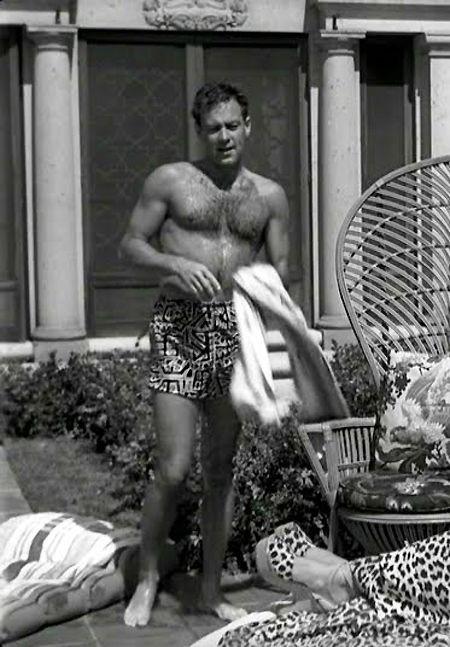
LORELAI: So I’ve decided I’m saving myself for William Holden … Sunset Boulevard was on last night, and I don’t know…I’ve known him for years – Sabrina, Stalag 17 – and yet last night something snapped.
William Holden, born William Beedle (1918-1981), actor who was one of the biggest box-office draws of the 1950s. Winner of an Academy Award and an Emmy for Best Actor, he starred in some of Hollywood’s most popular and highly-acclaimed films. He was named as one of the biggest stars of the year six times between 1954 and 1961, and is considered one of the greatest male stars of Classic Hollywood Cinema.
Sunset Boulevard, 1950 black comedy film noir directed by Billy Wilder, starring William Holden as a screenwriter and Gloria Swanson as a former silent film star, who draws him into her demented fantasy world where she dreams of making a triumphant return to the screen. A commercial success, the film was praised by critics and won three Academy Awards. It is regarded as one of the greatest films ever made. William Holden wears a swimsuit in the film [pictured] which has made many others interested in him – it’s not just Lorelai!
Sabrina, 1954 romantic-comedy drama directed by Billy Wilder, starring William Holden as a thrice-married playboy who is the lifelong crush of a young woman named Sabrina, played by Audrey Hepburn. She finds love with his brother, played by Humphrey Bogart. Backstage, it was Holden and Hepburn who got hot and heavy. Sabrina was a box-office success, and won an Academy Award for Best Costumes.
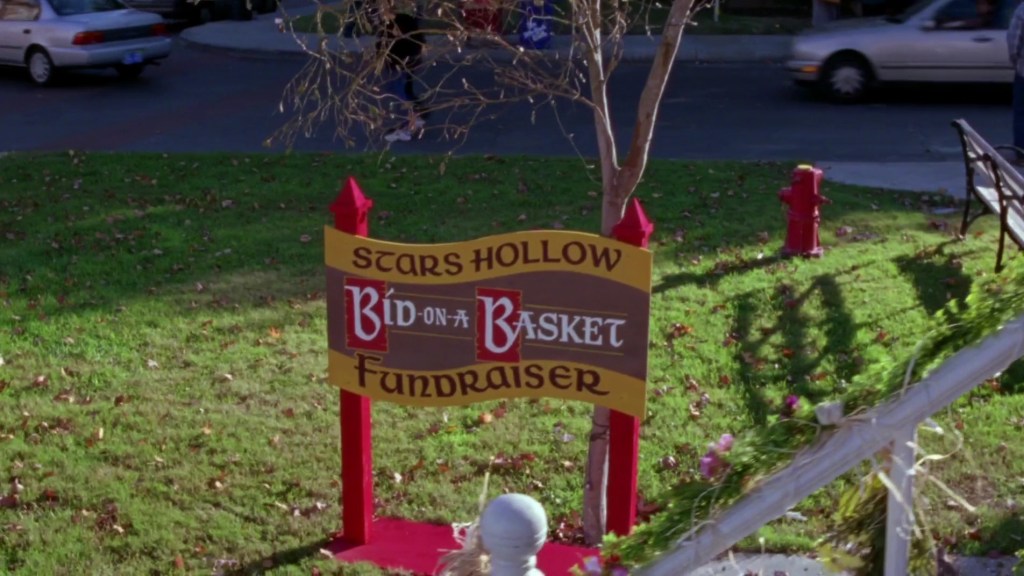
The show opens the day before the Stars Hollow Bid-on-a-Basket Fundraiser, with signs telling the viewer that bidders can win themselves a delicious home-cooked picnic lunch, that it’s held on Sunday at midday, and that all proceeds go to the Stars Hollow Retirement Home (the signs are sponsored by Doose’s Market). Across the street at the market, baskets are on sale, and more signs tell us that it’s also known as the Bid-on-a-Basket Festival. We can see a woman leaving with her new basket.
Inside the market, Lorelai and Rory are shopping for their own baskets, but of course they don’t intend to cook a delicious home-cooked picnic lunch (or even make Sookie do it for them, like they did for the bake sale). They’re just going to put old leftovers in their baskets – as we now know they keep leftovers for a long time, it’s sounding like a Salmonella Festival for anyone bidding on their baskets!
These type of fundraisers are called “box socials” and were common in the 19th century and 1900s, with women cooking the food and packing it into a box or basket, and men bidding for them. Although it was meant to be a “blind” auction, married and attached women would let their husband or sweetheart know which basket was theirs, so they could bid on it – bidding on a woman’s basket was a way to let her know you were interested in more than her home cooking.
Box socials are also low-key dating auctions, with the winning bidder not only getting the basket, but the chance to share the picnic lunch with the lady who provided it. A lunch basket auction of this type features in the 2001 YA novel Flipped by Wendelin Van Draanen (in this case, it is a high school boy who provides the basket, and girls bid on the chance to have lunch with him). This seems like a bit of a coincidence, or perhaps merely zeitgeist.
Although Flipped is set in the 1990s, when it was made into a film in 2010, they set it in the 1960s, as if that scene was deemed too old-fashioned to be believable. They must have agreed with Lorelai, who complained that the concept was “backwards”. In fact there has been a mild resurgence in box socials since the 1990s.
The show never makes it explicit, but according to the timeline, the Bid-on-Basket Fundraiser seems to be held in mid-February, and it would make sense if it was the Sunday after Valentine’s Day. That’s a clear connection with love and romance, although it isn’t practical at all to have a picnic in winter! In real life it would be freezing.
The episode is named for an English nursery rhyme, first recorded in the US in 1879 as a children’s game, to be sung while children danced in a circle. One child would run around the circle and drop a handkerchief; the nearest child to them would then pick it up and chase them. If caught, the child who dropped the handkerchief would either be kissed, join the circle, or had to confess the name of their sweetheart.
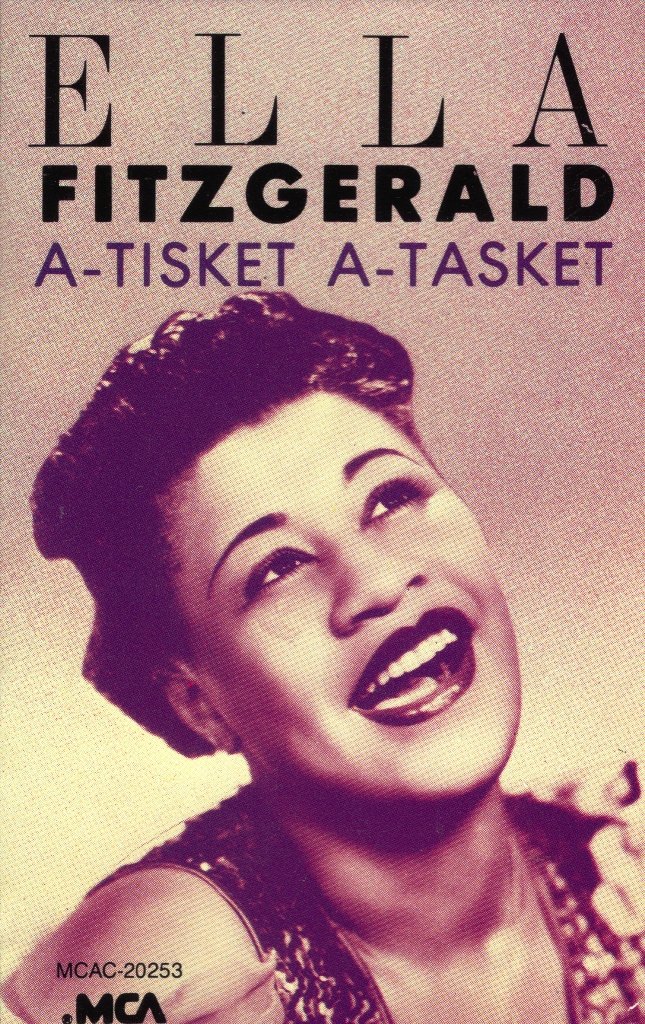
The rhyme was turned into a highly popular 1938 song by Ella Fitzgerald, in conjunction with Al Feldner (later known as Van Alexander). It has since become a jazz standard, often used in film and television soundtracks.
The lyrics to the rhyme are usually given as:
A-tisket, a-tasket A green and yellow basket I wrote a letter to my love And on the way I dropped it, I dropped it, I dropped it, And on the way I dropped it. A little boy he picked it up And put it in his pocket.
It’s suitable for an episode all about baskets, romance, and miscommunication. The episode will also include something being dropped that a “little boy” picks up.
This is the song playing on the stereo when Richard returns home from Stars Hollow. It plays over him looking sad while alone in his study, until the end of the episode.
The opening lyrics are in tune with Richard’s melancholy mood:
I was a stranger in the city Out of town were the people I knew I had that feeling of self pity What to do, what to do, what to do? The outlook was decidedly blue
A Foggy Day was composed by George Gershwin, with lyrics by Ira Gershwin. It was introduced by Fred Astaire in the 1937 musical comedy film A Damsel in Distress, loosely based on the 1919 novel of the same name by P.G. Wodehouse, and the 1928 stage play written by Wodehouse and Ian Hay. Astaire’s recording was very popular in 1937.
The song has been covered numerous times, and Richard listens to a Frank Sinatra version. Richard may be listening to his 1954 album Songs for Young Lovers, produced by Voyle Gilmore (!), or from the 1961 Ring-a-Ding-Ding! The second one, which was well-reviewed and went to #4 in the charts, seems more likely, as Richard would been about eighteen when it came out.
She doesn’t eat grapefruit with breakfast (she has a banana instead)
She doesn’t wear sensible shoes to work
She doesn’t dress appropriately for work (how does Lorelai not have a jacket? It’s winter!)
She didn’t have any tablecloths in the dining room due to an issue with her linen delivery
She spoke flirtatiously to her linen delivery guy in order to get better service
She got out of the car before it had completely come to a stop
She ordered Chinese food that wasn’t authentically Chinese
She buys more food for dinner than she can eat in one sitting (they eat leftovers)
She pushed Rory into wanting to go to Harvard without even investigating Yale
She allowed Rory’s seventeen-year-old boyfriend to rebuild her an old car
A few of Richard’s criticisms are reasonable. The ones about Rory are instigated by genuine concern for his granddaughter, and wanting her to be safe. Many of them are based on an old-fashioned view of the workplace, and a complete lack of understanding of the hospitality industry and female management styles. Some of his criticisms are ridiculous and extremely petty.
None of them are appropriate for him to share with Lorelai on a day that he is coming to visit her home and workplace as her guest. She is a woman in her thirties with a teenage daughter, her own home and car, and a good job. No matter what Richard’s opinions are, he shouldn’t berate Lorelai for her lifestyle choices, and especially not in front of her colleague, Michel.
The show focuses especially on Lorelai’s fraught relationship with Emily, but Richard and Lorelai certainly have their issues.
RORY: I’ll give you an eggroll. JESS: Yes? RORY: What did you do? JESS: Nothing much. Just wanted to make sure whoever rented Dumbo or Bambi gets a little surprise.
One of Jess’ more icky pranks – putting (presumably) pornographic films inside the cases for children’s movies. Rory complained about young boys seeing a bit of leg, now toddlers watching porn doesn’t seem to bother her too much!
RORY: The only videos not behind that curtain are Bambi and Dumbo. I mean, they actually had a meeting earlier about whether or not Babe should be behind the curtain so as not to offend people who keep kosher.
Dumbo [pictured], 1941 animated fantasy film produced by Walt Disney. It is about a young circus elephant named Jumbo who is bullied with the nickname Dumbo, and mocked for his very large ears. However, it turns out he can actually fly with the help of his ears. It was a financial success and received positive reviews. It won an Academy Award for its musical score. It was the first Disney movie to be released on home video, in 1981. A live-action remake was released in 2019, directed by Tim Burton.
Babe, 1995 comedy-drama directed by Chris Noonan, produced by George Miller, and written by both, based on the 1983 novel The Sheep-Pig, by Dick King-Smith. The human stars of the film are James Cromwell and Magda Szubanski, and the animal characters are played by real animals and animatronic puppets. Christine Cavanaugh provides the voice of Babe, a pig who can talk to sheep and works as a sheep-dog. The film was a box-office success and critically acclaimed, winning numerous awards internationally. It was initially banned in Malaysia in order to avoid upsetting Muslims, but the ban was overturned a year later. The film helped to increase rates of vegetarianism, with star James Cromwell becoming a vegan himself.
JESS: I don’t know, bet you have a lot of supporters on this. Pat Buchanon, Jerry Falwell, Kathie Lee Gifford.
Patrick “Pat” Buchanan (born 1938), right-wing political commentator, politician and broadcaster. He was an assistant and consultant to Presidents Richard Nixon, Gerald Ford, and Ronald Reagan, and one of the original hosts of CNN’s current events program, Crossfire. He has expressed sympathy for Nazi war criminals and support for eugenics, denied the Holocaust, and called for the lynching and horse-whipping of the young men of colour wrongly convicted in the Central Park jogger case. In 1990, he argued the case for music censorship in a debate on Crossfire.
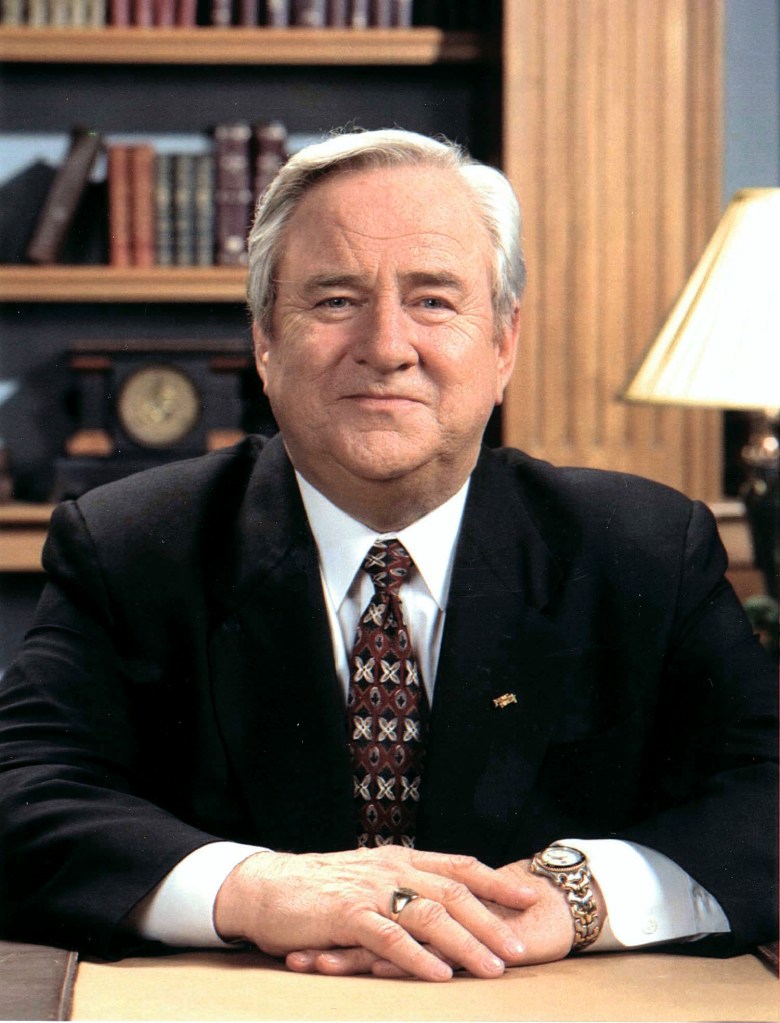
Jerry Falwell Sr (1933-2007) [pictured], Southern Baptist pastor, televangelist, and conservative activist. He was pro-segregation and pro-apartheid, and a supporter of Anita Bryant’s campaign to oppose equal rights for gay people (he denounced Tinky Winky from the Teletubbies as a gay icon). He sued both Penthouse and Hustler magazine in the 1980s for an article and an advertisement that he believed had defamed him or caused him distress; the courts ruled in favour of free speech.
Kathie Lee Gifford (born Kathryn Epstein in 1953), television presenter, singer, songwriter, and author. She is best known for her fifteen-year run as co-host of Live! With Regis and Kathie Lee. She became a born-again Christian at the age of 12, and was a secretary/babysitter to Anita Bryant. I’m not actually aware of any censorship she has advocated for.