Energizer Bunny

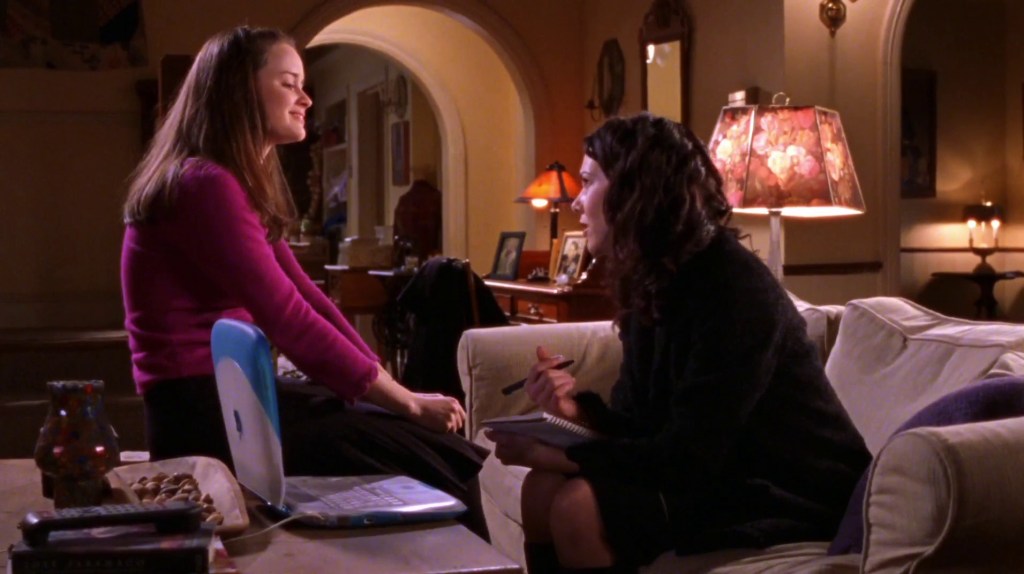
LORELAI: Again, yes, just like the pink bunny with the drum. Uh, anyway, I was wondering if, um, you have had a chance to reconsider my loan? . . . Uh, no, I think it’s Energizer . . .

The Energizer Bunny is the marketing mascot of Energizer batteries. It’s a fluffy pink mechanical rabbit that beats a drum. It began as a parody of the Duracell Bunny (the mascot for Duracell batteries), which first appeared in commercials in 1973. The trademark had lapsed by 1988, so that Energizer were free to use a similar concept.

The Energizer Bunny is promoted as a toy which is able to last much longer than others, because he’s powered by Energizer batteries. In the same way, Mr Rygalski sees Lorelai as indefatigable in her attempts to get a loan. When she corrects him by saying it’s called the Energizer Bunny, Mr Rygalski, being older than Lorelai, was probably thinking of the earlier Duracell Bunny.

Mr Rygalski

[Lorelai walks through the lobby talking on the phone]
LORELAI: Hi Mr. Rygalski, it’s Lorelai Gilmore.

Amy Sherman-Palladino’s friend Helen Pai is married to a man named Dave Rygalski. Later on, Lane (based on Helen), has a boyfriend named Dave Rygalski. There may be a hint here that Mr Rygalski at the bank is Dave’s father.

“Stubborn like my mother”

RORY: You were saying that I’m stubborn just like my mother.
DEAN: I was saying that in addition to all of the wonderful amazing qualities that the two of you share there is possibly, on occasion, a similar tendency to dig your heels in.

Rory isn’t that stubborn, being keen to please others as much as possible. If Lorelai and Rory were both equally stubborn, they would fight much more than they do. It’s worrying that Dean considers a meek girl like Rory to be “stubborn” – just how much of a doormat does he actually want?

Robert Benchley at The Algonquin

RORY: Fine, but we have a real problem here.
LORELAI: Oh, you think I don’t know that? You think I sit around all day swapping witticisms with Robert Benchley at The Algonquin? No! I am thinking and worrying and using the computer, and I hate using the computer!

Robert Benchley (1889-1945), a humorist best known as a newspaper columnist and film actor. He began writing for The Harvard Lampoon while at Harvard University, before writing for Vanity Fair, and most famously, The New Yorker, where his absurdist essays proved highly influential. He made several appearances in films, and his 1935 film How to Sleep, won an Academy Award in the Short Film category.

The Algonquin Hotel is a historic hotel in Manhattan, which first opened in 1902. It had a reputation for hosting a number of literary and theatrical celebrities, including The Algonquin Round Table (or as they called themselves, “the Vicious Circle”). This group of New York writers, critics, actors, and wits met for lunch each day at The Algonquin from 1919 to 1929, engaging in witticisms which were disseminated across the country through their newspaper columns.

Robert Benchley was one of its most prominent members, and Lorelai is probably referencing the writer and critic Dorothy Parker, previously discussed. Dorothy Parker was a close friend of Robert Benchley, and one of the founding members of The Algonquin Round Table.

[Picture shows a painting of Dorothy Parker at The Algonquin Round Table by Carl Purcell]

Lorelai and Rory Fight

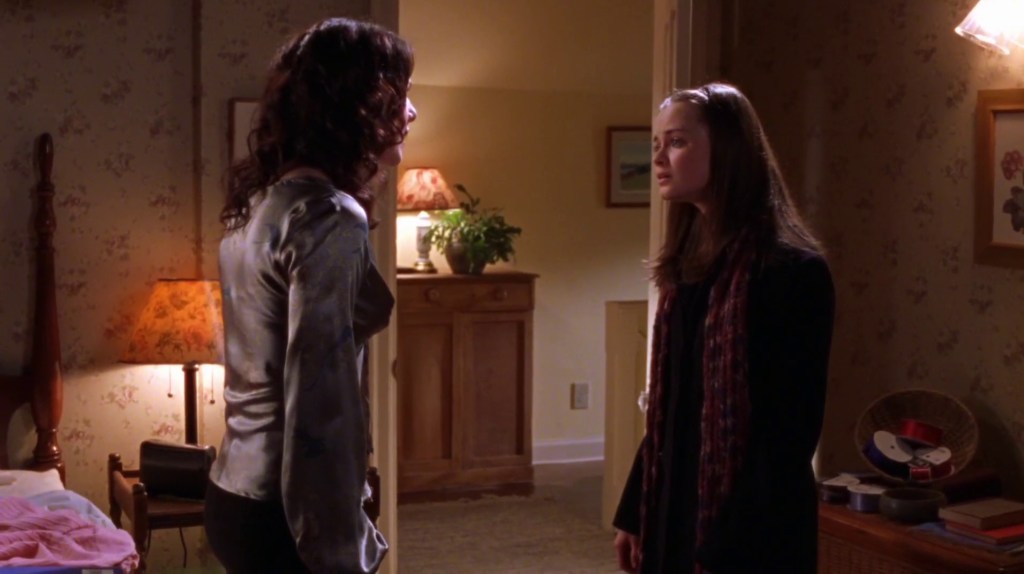
Against Lorelai’s wishes, Rory tells Emily that their house is infested with termites, and they have no way to pay for the necessary repairs. Emily immediately gets out her cheque book, only asking to know how much money is needed. Lorelai turns her offer down, and afterwards freezes Rory out, refusing to speak to her or even look at her – this is a foreshadowing of how other, more serious arguments between them will play out.

This again shows how dishonest Lorelai was with Rory when she said they were a “team” and a “democracy” – but with Lorelai able to play the “mom card” whenever she likes, and Rory forced to obey her. Their fight ends with Rory being sent to bed like a naughty child, even though they have Friday Night Dinner at 7 pm. Considering that Lorelai was in no mood to hang around after dinner, it can’t be more than about 9.30 pm.

Consumption, The Vapours, Leeching

LORELAI: Actually … I’m sick.
EMILY: I knew it, what’s wrong?
LORELAI: Consumption with a touch of the vapors. I’m going for a leeching tonight after coffee.

Consumption: a 19th century word for tuberculosis, an infectious disease mostly affecting the lungs. It was seen as a romantic disease affecting artists, poets and composers, whose creative talent would somehow be amplified. In real life, it was primarily a disease of the urban poor, due to their cramped conditions.

The vapours: an old word, dating to antiquity but still used in the 19th century, for a variety of medical issues which might include depression, anxiety, bipolar disorder, fainting, or PMS. It was only ever used towards women, and ascribed to female hysteria.

Leeching: from ancient times, leeches were used medically, becoming especially popular in the medieval and early modern period to take blood from a patient, which was thought to balance the “humours” of the body. Although this went out of fashion, leeches began to be used in the 1970s, as it was realised the proteins in their saliva had numerous medical benefits, and they were classified as a medical device in the US in 2004.

“I’ve got nothing left to give”

RORY: I think they would say yes.
LORELAI: Of course they would say yes. And that yes would be followed by, ‘Okay, okay, enough already. My God, please stop. I’m a shell, I’ve got nothing left to give.’
RORY: That’s not true.

Rory is correct – this simply isn’t true. Richard and Emily have never hesitated to give money when it’s needed, and seem to go out of their way to never make Lorelai and Rory feel like a burden, or imply there isn’t enough money to go around. It would be more accurate to say they always want something in return for their support, but for some reason Lorelai doesn’t say this, even though it would make sense given how the episode plays out.

White Slavery

RORY: You know Mom, I hate to bring this up, but I think there’s a really obvious solution to our problem …
LORELAI: I think if I sold you into white slavery, I would miss you.

“White slavery” is a term for sex trafficking dating to the 19th and early 20th centuries, which came to become a blanket term for prostitution, especially that of minors. The name comes from the accounts of white women captured and enslaved in Middle Eastern harems, the so-called “Circassian beauties” from the Caucasus.

“I’ll think about it tomorrow – at Tara”

LORELAI: I won’t think about it tonight. I’ll think about it tomorrow – at Tara.

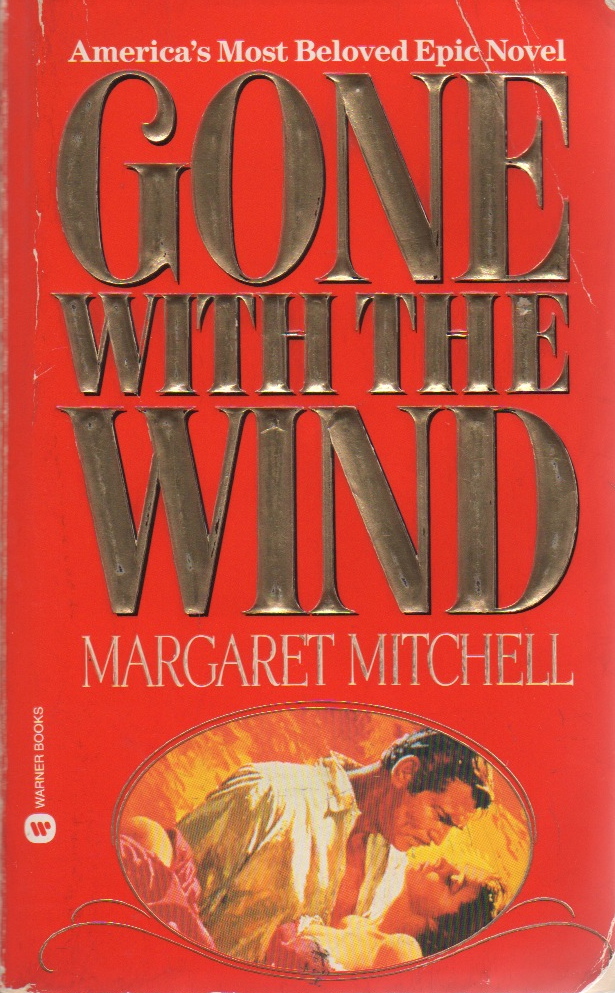
Lorelai slightly misquotes from the 1936 novel Gone with the Wind, by Margaret Mitchell, previously mentioned. Set in the American South at the time of the Civil War and subsequent Reconstruction, the novel’s protagonist is a beautiful, wilful Southern belle named Katie Scarlett O’Hara who is willing to do anything to claw her way out of poverty and save her plantation, named Tara, even while her heart is breaking over her numerous relationship disasters. It takes her too long to discover that the scandalous Rhett Butler is the only man who ever truly loved her.

The full quote is: “I’ll think of it tomorrow, at Tara. I can stand it then. Tomorrow, I’ll think of some way to get him [Rhett] back. After all, tomorrow is another day.” They are the last lines of the novel.

Gone with the Wind was a runaway success, a bestseller before the first reviews of it were even published. Margaret Mitchell won the Pulitzer Prize and the National Book Award, and it was turned into a box-office smash film in 1939, starring Vivien Leigh as Scarlett O’Hara (the film slightly alters the quote from the book). It is the second favourite book of American readers, only beaten by the Bible. It is considered controversial because of its derogatory depiction of African-Americans and romanticisation of white supremacists.

Scarlett O’Hara seems like a forerunner of Lorelai Gilmore – a beautiful, headstrong brunette with a powerful will to survive, and a tendency to mess up all her chances at romantic happiness. Lorelai wanted to give her house a name, like a Southern plantation, and is as deeply attached to it as Scarlett is to Tara. As in Gilmore Girls, blondes tend to be the antagonists in Gone with the Wind. One of the girls at Chilton even suggested to Rory that Lorelai was a Southern belle name. It’s not hard to imagine a teenaged Lorelai reading this novel and identifying with the feisty, rebellious Scarlett.