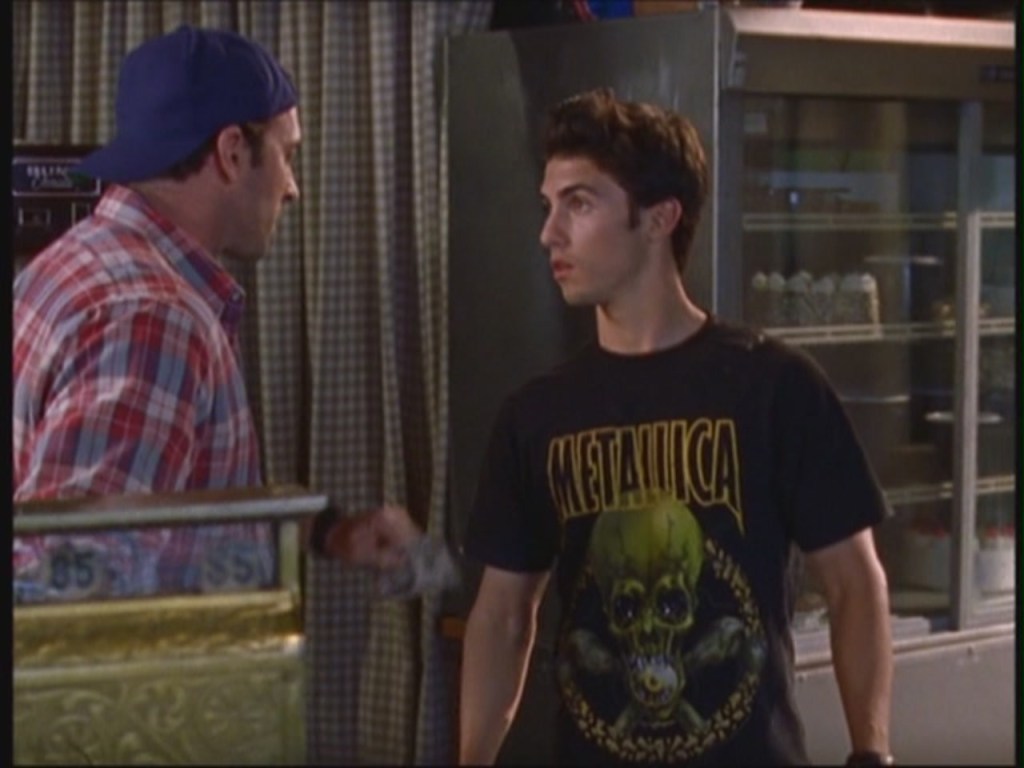
LUKE: Hey, part of the deal of you staying here is that you work here, and when you work here you will wear proper work attire, and that is not proper work attire. Now go upstairs and change into something that won’t scare the hell out of my customers. JESS: Whatever you say, Uncle Luke. [goes upstairs] LORELAI: Gross shirt … good band.
Luke has made good on his promise of Jess having to work in the diner when not at school. Jess is obliging, but still teases Luke by wearing one of his heavy metal tee-shirts to work. This is the Metallica tee-shirt that Jess joked wouldn’t get along with his Tool tee-shirt.
Lorelai immediately makes a note of the fact that she and Jess share a favourite band, both being fans of heavy metal.
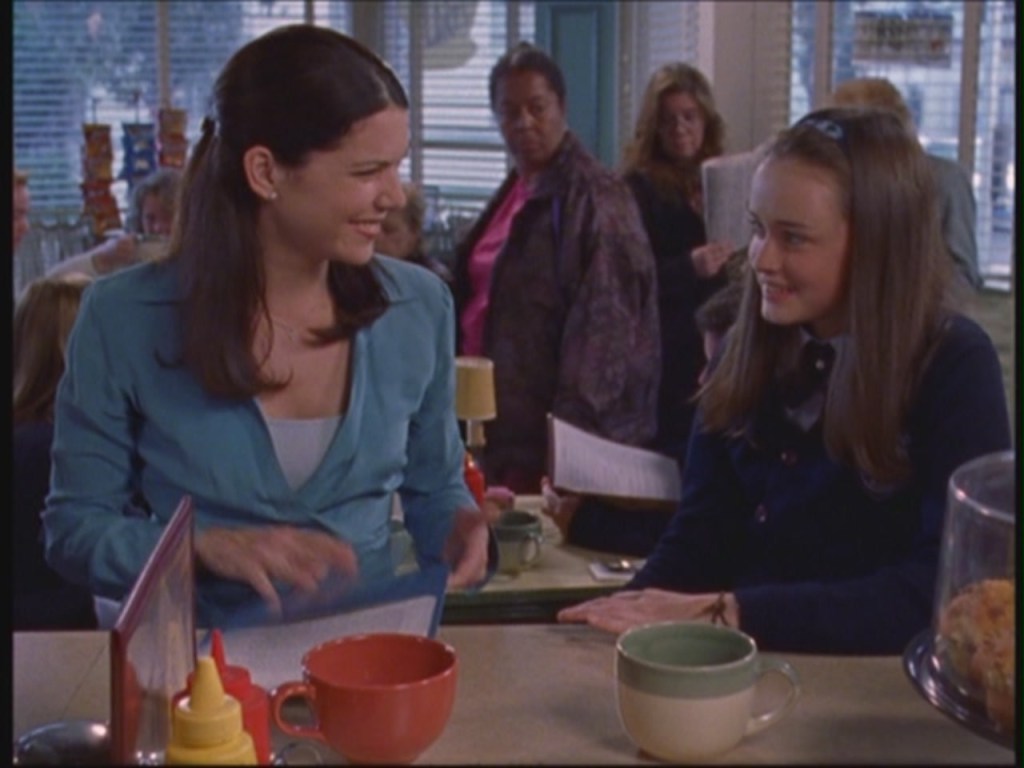
LORELAI: A-plus. RORY: You’re my mom. LORELAI: Is anything higher than an A-plus? RORY: You have to say that. LORELAI: It’s an A-plus with a crown and a wand. RORY: This is not how you raise a child. You don’t send them out there with a false sense of pride, because out there, in the real world, no one will coddle you. I’d rather know right now if I’m gonna be working at CNN, or carrying a basket around its offices with sandwiches in it.
Rory says she wants honest feedback on her work, but when she’s later given a critique of her abilities and an assessment of her career options, she has a complete breakdown and is unable to continue. In this case, she is happy to receive confirmation that she’s doing great, and to enjoy being coddled a while longer.
I don’t think it’s really Lorelai’s job to provide Rory with an assessment of her abilities and suggest a grade she deserves to receive. She’s not a teacher, a journalist, or a writer. She doesn’t have academic credentials or training. Surely as a mother, all she can do for Rory is support and encourage her, as she is trying to do.
At this point, Rory shouldn’t need any harsher criticism than she’s already receiving, because Chilton is supposedly a strict school with high academic standards. Is it possible she already feels that the teacher supervising The Franklin staff is too easy on her?
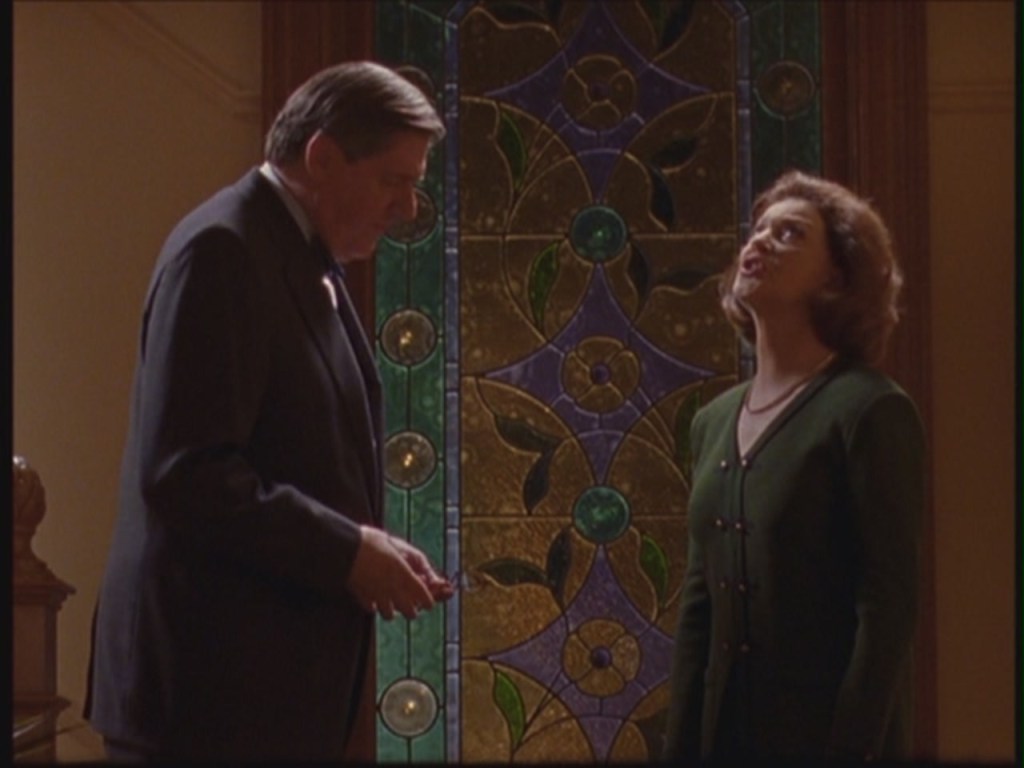
The episode open with Lorelai and Rory stumbling into Richard and Emily having a disagreement with raised voices. This is the first time we have seen Richard and Emily together since the night that Lorelai announced her engagement, back in June. Apparently things haven’t been going well since then.
Richard has always been shown to be very preoccupied with his job, and even had an angina attack from the stress. Since then, he hasn’t slowed down, and has spent a lot of time travelling for work. Now it’s seemingly taking up so much of his time, he is unable to escort to Emily to her many charity events. I’m not sure why Emily is unable to go alone, or with a friend. Perhaps it would excite gossip that her marriage was on the rocks or something.
This has left Emily not only out of the loop socially, and no doubt lonely and bored, but feeling deeply unappreciated. Richard refers to her charity work as “social engagements” – which they are – but to Emily they are so much more. They are her life’s work, and her power base, which she has worked on achieving just as hard as Richard does at his job. For Emily to keep skipping events would be like Richard missing work, and you can feel her fear of her life slipping away from her.
It turns out in this episode that Emily sits on the boards of so many organisations that it seems unbelievable it has never caused any conflicts until now. In fact, it’s quite an unbelievable amount of boards in itself, to drive home the point that Emily Gilmore is one of the people who “run” Hartford.
“Incoming” is a stock phrase often used in film or television that is called out by one character to alert others to danger, commonly in battle scenes to mean something is about to fall on them. It originates from military usage.
Lorelai is telling to Rory to be quiet and stay out of the way, since they are witnessing a “battle” between Richard and Emily, and risk getting the middle of it.
Founded in 1982, it provides clothing, games, and deliveries directly to hospitalised children through a network of more than 700 children’s hospitals and medical centres in the US, Canada, the UK, and Australia.
Emily has been the co-chair on its board for the past eight years, which seems unlikely – the foundation’s headquarters are in Los Angeles, it doesn’t have co-chairs, and its board is made up people with high profiles in medicine, finance, and media. I think we are meant to assume this is a (fictional) local fundraising branch for Hartford.
The Black and White Ball is their main fundraising event. This is a masquerade ball in which everyone is dressed in either black or white. They are intended to be extremely glamorous and exclusive events, with high ticket prices.
Hartford Zoological Silent Auction
A fictional organisation of which Emily is a board member. Hartford doesn’t actually have a zoo. The nearest Zoological Society is in Bridgeport, Connecticut, to support Beardsley’s Zoo.
A silent auction is one where bidders write their bids down on a sheet of paper, with the highest bid winning. They are common at charity events.
The Mark Twain House Restoration Fund
The Mark Twain House is a museum in Hartford, once the home of the author of Huckleberry Finn. Restoration began on the house in 1963, and its fundraising arm is the Friends of the Mark Twain House and Museum. They’ve been fundraising since 1954. This must be the organisation that has Emily as a board member, and is holding the charity luncheon Emily has been forced to turn down.
Harriet Beecher Stowe Literacy Auction
Harriet Beecher Stowe (1811-1896) was an American author and abolitionist, best known for her 1852 anti-slavery novel, Uncle Tom’s Cabin. The Harriet Beecher Stowe House & Center is in Hartford, next door to the Mark Twain House and Museum. Emily seems to be on the board of both these museums.
Emily’s strong community involvement, which is the major part of her social life, is very much like Lorelai’s enthusiastic support of every festival and celebration in Stars Hollow, right down to a cat’s wake. The apple didn’t fall far from the tree in this case.
The episode begins with a quick flurry of theatrical references at a Friday Night Dinner, suitable for one with the dramatic title, “Presenting Lorelai Gilmore” (as if Rory is the star of the show). We can tell straight away that this episode will be all about presentation, staging, and image – the face shown to the public, and how that contradicts the private, backstage life.
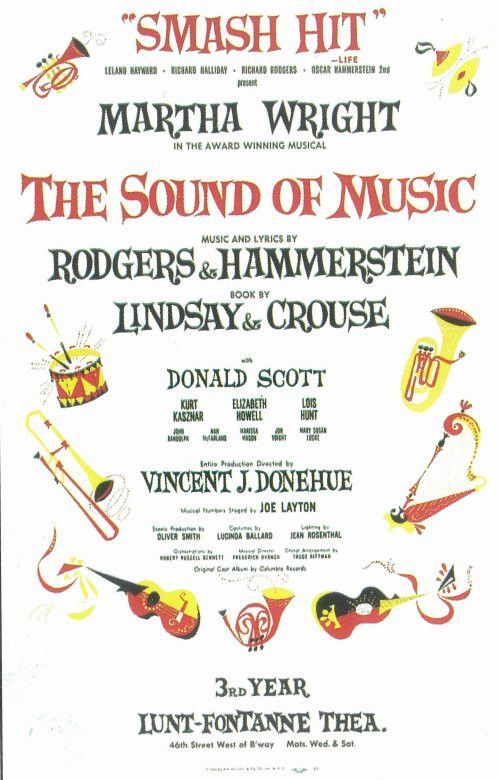
The Sound of Music
The new maid introduces herself as Liesl, which is the name of one of the von Trapp children in The Sound of Music. Lorelai tells the maid that she is Brigitta, and Rory is Gretl, two of the other children (the others are Friedrich, Louisa, Kurt, and Marta).
The Sound of Music is a musical with music by Richard Rodgers and lyrics by Oscar Hammerstein., book by Howard Lindsay and Russell Crouse. Based on the 1949 memoir by Maria von Trapp, The Story of the Trapp Family Singers, it is set in Austria just before it was annexed by the Nazis in 1938. Many of the details of the von Trapps’ real life were altered to make the the story more dramatic, and the names of all the children were changed.
The original Broadway production opened in 1959 with Mary Martin and Theodore Bikel in the lead roles. It won five Tony Awards, including best musical, and the first London production opened in 1961. A film version was made in 1965, starring Julie Andrews and Christopher Plummer, which won five Academy Awards, including Best Picture.
Who’s Afraid of Virginia Woolf?
Lorelai compares her arguing parents with George and Martha, from Who’s Afraid of Virginia Woolf?, previously discussed. In the play, George and Martha invite a young couple to their home, and then use their dramatically cruel arguments as a display for them. Lorelai is suggesting that she and Rory are in the role of the other couple.
The Lion King
After suggesting that her parents are providing them with “dinner theatre”, and wishing she had popcorn to enjoy with the show, Lorelai then likens Richard and Emily’s fight to “The Lion King without the puppet heads”. The climax of The Lion King contains a dramatic fight to the death between two lions.
The Lion King is a musical based on the 1994 animated Disney film of the same name, with music by Elton John, lyrics by Tim Rice, and book by Rogers Allers and Irene Mecchi. The musical features actors in animal costumes, as well as giant hollow puppets.
The Lion King made its debut in 1997, first opening in Minneapolis before moving to Broadway. It is still running after more than 9000 performances, is the third longest running musical in history, and has grossed more than $1 billion, making it the highest-grossing Broadway production of all time. The show opened in the West End in 1999, and is still running after more than 7500 performances. The musical has made than $8.1 billion overall.
The Lion King musical and the film are the top-earning titles in box-office for both stage and screen.
Terrence McNally
After cheekily giving her mother a “Brava! Encore!”, Lorelai says, “Does Terrence McNally know about you two?”.
Terrence McNally (1938-2020) was a multi award-winning American playwright, librettist, and screenwriter. Known as “the bard of American theatre”, McNally won five Tony Awards, including a Lifetime Achievement Award. Inducted into the American Theater Hall of Fame in 1996, he won Lifetime Achievement awards from the Dramatists Guild and the League of Off-Broadway Theatres and Producers. In 2018 he was inducted into the American Academy of Arts and Letters, the highest recognition of artistic merit in the US. His career spanned six decades, and he was vice-president of the Council of the Dramatists Guild.
At one time, he was the partner of Edward Albee, who wrote Who’s Afraid of Virginia Woolf?.
This 1996 song by Northern Irish pop-rock band Ash plays at the end of the final scene, as Jess walks away from Rory. It was written by the band’s main lyricist, Tim Wheeler, when he was sixteen, and was performed on British music show Top of the Pops just two weeks after their final school exams. From their debut album 1977, it was the band’s first Top 40 single, going to #11 in the UK and #16 in Ireland.
The song is about a girl the narrator had an intense experience with one night playing cards, and has been unable to get out of his system, with the repeated lines: I still dream of you/I still love you, girl from Mars.
Just in case there are any doubts as to how Jess thinks of Rory!
Oliver Twist, or the Parish Boy’s Progress, is a 1838 novel by English author Charles Dickens. The titular protagonist is a poor orphan boy who is born in a workhouse and apprenticed to an undertaker. He escapes to London, where he meets the “Artful Dodger”, a boy who belongs to a gang of juvenile pickpockets. It’s an unromantic portrayal of criminals and their sordid lives, and exposes the cruel treatment of orphans in the 19th century.
Rory jokingly refers to Jess as the Artful Dodger, a boy thief who is known for his great skill and cunning as a pickpocket. It’s something of both an insult and a compliment. More interestingly, the Artful Dodger attempts to seduce the innocent Oliver into a life of crime, as if Rory instinctively sees Jess as a corrupting influence.
Rory is not only teasing Jess, she is setting him a little test. Does he only read the Beat poets, or is he also familiar with classic novels? You know, proper literature, as studied at school? Jess passes the test with flying colours, and Rory beams, as if she has found a kindred spirit.
The book which Jess secretly took from Rory’s bookshelves, even though she had earlier offered to lend it to him.
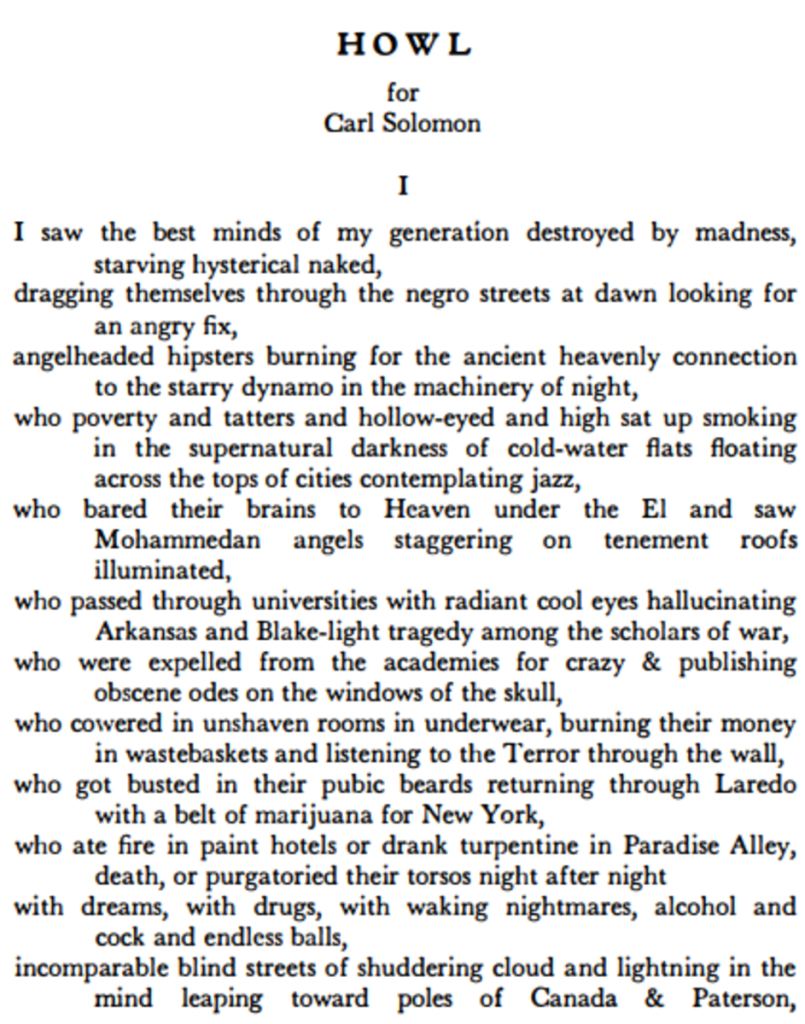
It’s a poetry collection by American Beat poet Allen Ginsberg, first published in 1956. It contains his most famous poem, “Howl”, a biographical poem originally inspired by a terrifying peyote vision. The publisher of the book, Lawrence Ferlinghetti, another Beat poet, was subsequently arrested and charged with obscenity, but found not guilty at his 1957 trial.
Jess now reveals that even though he said he didn’t read “much”, he has read Howl and OtherPoems about forty times. He smoothly implies that “much” is a relative term, after all.
He has also written notes in the margin for Rory to read. The viewer will now either a) be horrified that he took her book without asking and defaced it, or b) sigh over the fact that he took the opportunity to bond with Rory over literature, sharing his innermost thoughts. It is definitely intended as an intimate, seductive move.
It’s interesting to wonder what thoughts Jess had about “Howl”. It’s an intense poem about madness, rebellion, drug-taking, and sex, which could lead to some interesting observations. If Jess knew a lot about the Beats, he might also be able to pick out those parts of the poem which were taken from real life experiences.
Then again, much of the poem is set in New York, and possibly Jess simply compared his own experiences in the locations mentioned. I can definitely imagine Jess taking a day or a weekend to visit all the places around New York in the poem.
JESS: Oh this? Nothing. [does an illusion with a coin] Just another little disappearing act.
We now learn that Jess knows at least one basic magic trick, showing that he must be dexterous and quick with his hands. (Something that would be very handy playing poker, as well).
It’s a reminder that he makes other things disappear with his quick hands – books, beer, money, gnomes … And no doubt a major foreshadowing of what is to come.
Clever Jess has already learned how to hook a girl’s attention: make himself unavailable by disappearing (as he did at the dinner). He is careful not to hang around and chat like some regular person after giving Rory her book back, either, but mysteriously pads off into the twilight.





 The Annotated Gilmore Girls