LUKE: He’s adjusting. He just got here. He probably just went out and realised there are twelve stores in this town devoted entirely to peddling porcelain unicorns. I’ve lived in this town my entire life, I still can’t believe it.
I have trouble believing it too. It sounds like an exaggeration, but Luke and Lorelai appear to accept it as known fact. Stars Hollow does seem to have some very niche gift shops. I don’t think we ever see any of these unicorn stores.
LORELAI: You know, you should meet my daughter. She’s about your age. She can show you where all the good wilding goes on . . .
“Wilding” is an American term which gained media use in the 1980s and ’90s to describe gangs of teenage gangs committing violent acts. It is no longer often used.
The word has an ugly history, coined during the Central Park jogger case of 1989, after a white female jogger was assaulted and raped in Manhattan’s Central Park. Five black and Latino juveniles were convicted of the crime, police contending that the boys said they were “wilding” in the park, the police taking this to mean committing violence.
This has been disputed as a (wilful?) misunderstanding by the police. Other theories are that the boys were repeating the lyrics to the Tone Loc song, “The Wild Thing”, or that they said they were “wiling”, meaning “hanging out, whiling away the time”.
The boys served sentences of between six to twelve years, and all later had their charges vacated after a serial rapist and murderer confessed to the crime while in prison. This was in 2002, so after this episode aired (Lorelai doesn’t know she is referencing falsely imprisoned schoolboys).
So far, Lorelai has linked Jess with prisoners and the Mafia, and joked that he may be going out to hold up a liquor store. Once she actually meets him, she connects him with violent gang rape. At this point, her “jokes” about Jess have become openly hostile, and quite nasty.
As Lorelai has joked about a violent gang rape, and used a word with a racist history to Jess, I wonder if this is when he decided he didn’t like Lorelai very much?
Tuesday is the next day, suggesting that Chilton starts their academic year on the Monday after Labor Day. I don’t know why Paris doesn’t simply say “on my desk tomorrow”, which has a more urgent feeling. Perhaps she’s hoping to confuse Rory again, so that she hands it in a week late.
Also, there is no way that the school magazine would publish a thousand word article about a repaved parking lot. Rory’s article would be more likely to be around 200-250 words.
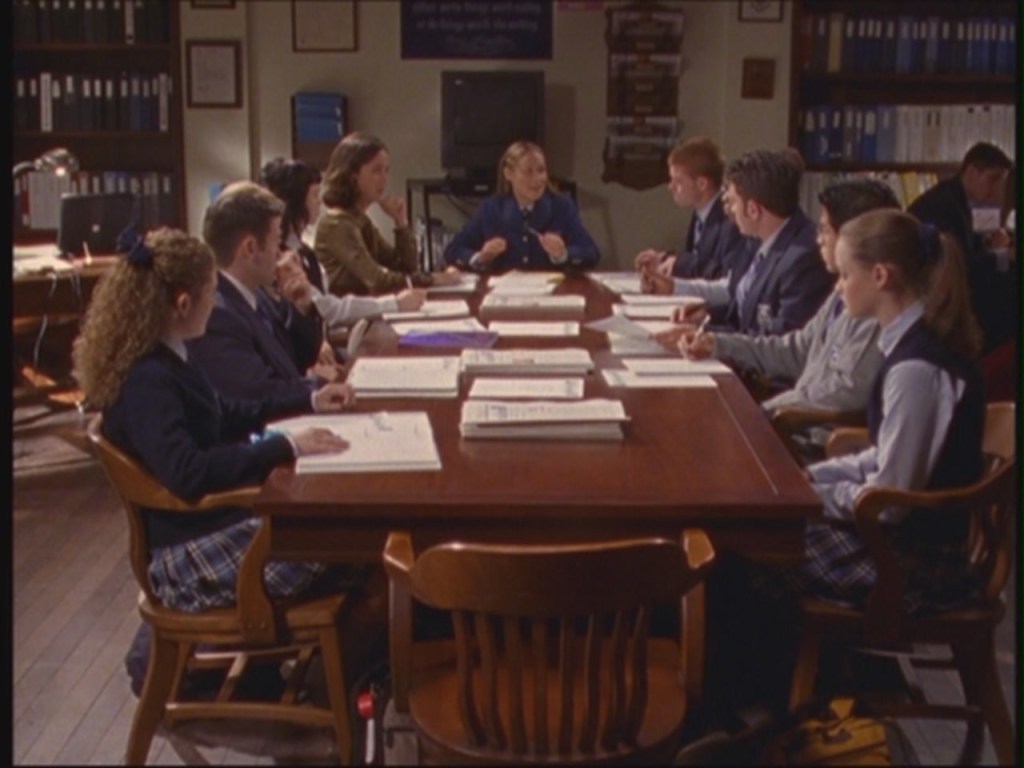
There is a meeting at the end of the school day for all those students interested in working on Chilton’s magazine, The Franklin, previously discussed.
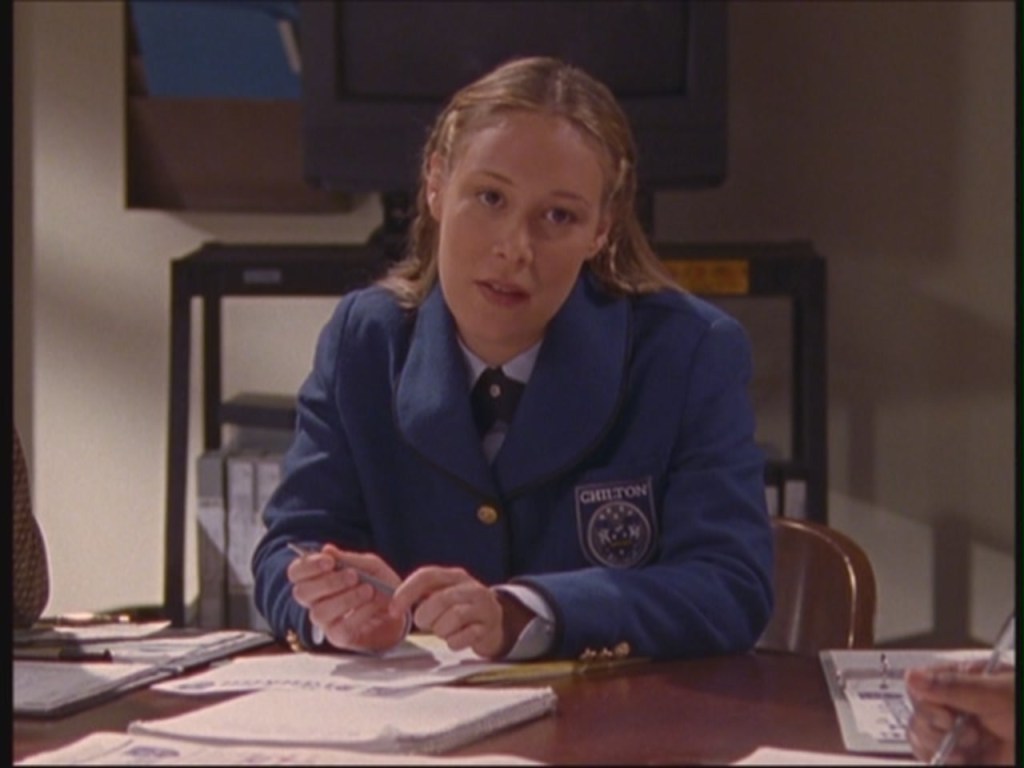
Paris has been chosen as the editor, and plans to use her position to make Rory’s life miserable. She tells Rory the meeting is at 4 pm, but it actually began at 3:15 pm, so that Rory arrives very late (a handy writing technique, so that we don’t see all the boring part of a meeting where everyone introduces themselves and the teacher makes a welcoming speech).
Paris’ evil yet simple scheme of giving the wrong time is one often utilised in film and television, yet would have trouble working in real life. For one thing, the school day ends at 4.05 pm, so the meeting seems to actually take up class time. Wouldn’t Rory have needed permission from a teacher to attend the meeting, and wouldn’t that be a clue it wasn’t after school?
And Rory is so obsessive about schedules and timetables, is it really possible she had no other way of knowing the time of the meeting? There were no flyers on the wall, she couldn’t check with another student, the teacher in charge didn’t mention it? It’s meant to make Paris look like a villain, but in fact it makes Rory look sloppy and careless, or as if she has been so busy learning her new timetable and locker location that she forgot to make a note of the meeting time. At the very least, she’s dopily naïve to trust someone she knows is working against her.
Paris has been chosen as editor, despite being in her junior year, in the first year she is eligible to work on the magazine at all. Wouldn’t a senior year student be chosen as the editor? Or is there a tradition that only juniors work on The Franklin, as seniors have more important things to do? If so, that’s a lot of responsibility to be given when you have no experience. But that seems to be the Chilton way – throw students into the deep end and watch them either sink or swim.
Paris gives Rory the assignment she threatened to as soon as she was named editor – a story on re-paving a parking lot. How she knew such a story would be available four months later is a mystery. If it’s not a coincidence, perhaps she already knew about the re-paving in advance, and had been given a heads-up it would be one of the first stories covered when the new school year began. That she managed to manipulate the situation so that Rory was the only student possible to do the story is a testament to her genius.
This is the book that Rory reads while she thinks she’s waiting for The Franklin meeting to start.
Dawn Powell (1896-1965) was an award-winning American novelist, playwright, screenwriter, and short story writer. Known for her acid-tongued prose, her work was highly praised, and Powell was a friend and colleague to many of the leading lights of the New York literary scene. She fell into obscurity, but interest in her was revived in 1987 when Gore Vidal praised her in an editorial in The New York Review of Books. This selection of her letters was edited by Tim Page, and published in 1999.
Jess is carrying this 1957 book by American Beat writer Jack Kerouac, previously discussed, when he leaves the diner. It looks as if Jess might be looking for a quiet spot to read, just as Rory likes to do.
It immediately establishes Jess as a reader, something which will surely pique Rory’s interest, as she was always trying to get Dean to enjoy great literature (with unsatisfying results). It is also an obvious symbol of Jess’ journey to small town America, and possibly a foreshadowing that Jess does not intend to stick around.
Jess leaves Luke, after the briefest tour of their living quarters, refusing to say where he is going. For Luke, this must remind him of Liz, who was always “off doing God knows what”. Slightly worryingly, Jess claims he doesn’t need keys to get in, suggesting Lorelai’s idea of him as a petty criminal may not be so wrong.
He steps outside the diner to be confronted with a typically charming Stars Hollow street scene. Townsfolk carry sheaves of wheat to the harvest festival in the park, while volunteers decorate lamp posts with garlands of autumn leaves. In the bright sunshine, happy couples stroll together, families walk in harmony, children skip merrily.
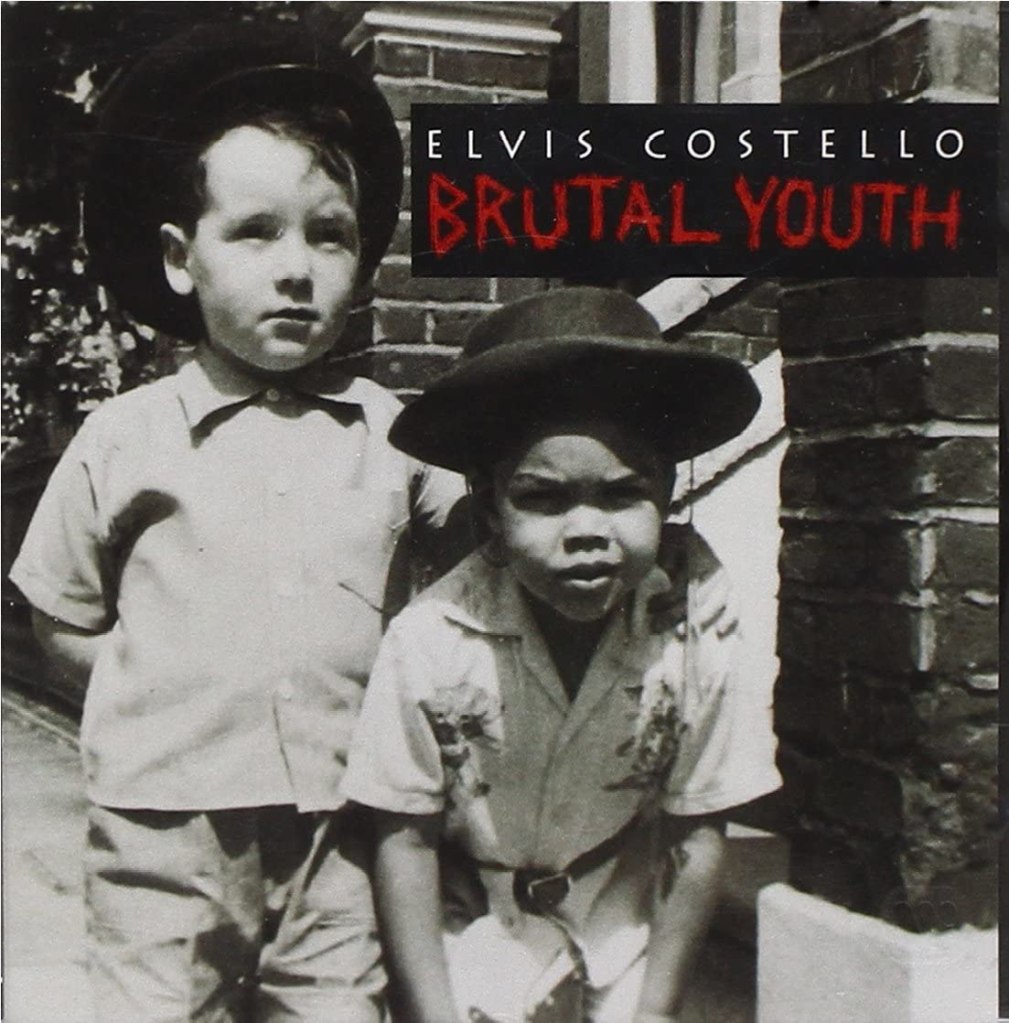
Yet this song by Elvis Costello plays, with the lyrics, This is hell, this is hell/I am sorry to tell you/It never gets better or worse/But you get used to it after a spell/For heaven is hell in reverse. Stars Hollow in early autumn looks like heaven, but to Jess, it is a season in hell.
The song is from Costello’s critically acclaimed 1994 album, Brutal Youth.
Jess Mariano is Luke’s seventeen-year-old nephew, the son of his sister Liz. He was introduced in Season Two as a romantic interest for Rory, and as a contrast with her boyfriend Dean. Jess is the “bad boy” that Lorelai feared Rory would be attracted to, in the same way she was when she was a teenager.
Jess is introduced when he steps off the bus, the modern teenage equivalent of the mysterious stranger riding into town. The bus says it is going to Hartford, and Jess boarded it in New York, so Stars Hollow must be on the bus route between these points. In real life, the bus route from New York to Hartford goes through Danbury and Waterbury, which doesn’t seem that implausible as far as Stars Hollow’s possible location goes. The bus trip takes about two and a half hours, and we later learn the bus got in at 10 am.
Jess and Luke greet each monosyllabically by simply saying each other’s names. The mirroring is a sign that Jess and his uncle share at least one characteristic – neither of them are particularly talkative.
There has already been a character named Jess in Gilmore Girls – the college boys that Madeline and Louise got with at The Bangles concert in Season 1 were named Jess and Sean. Maybe Jess seemed like a very “New York bad boy” sort of name? Or the writers really like the name Jess?
Both Rory and Jess have unisex names, or names more common on the opposite sex. It’s interesting that the name Jess Mariano has the same rhythm as Dan Palladino, and they’re obviously both of Italian heritage.
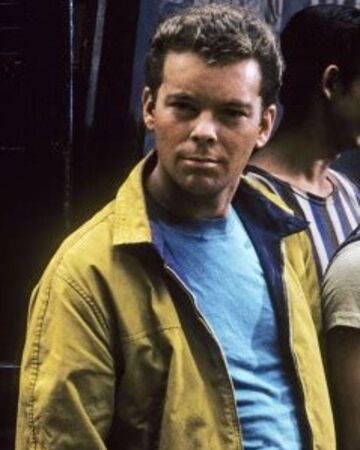
Riff (Russ Tamblyn) is the leader of the The Jets gang in West Side Story, previously discussed. The loyal muscle to former member Tony, he urges Tony to fight, so that Tony becomes a murderer.
Rory sees Louise as Paris’ henchman and attack dog, who eggs her on. In the film, Riff is killed in a gang fight he helped instigate – perhaps a bit of wishful thinking from Rory!





 The Annotated Gilmore Girls