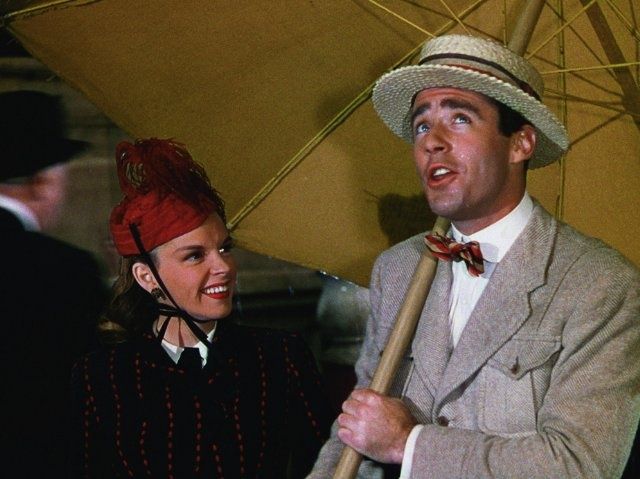
LORELAI: Yeah, they’re mean. RORY: Except for Don Rickles. LORELAI: Totally except for Rickles.
Donald “Don” Rickles (1926-2017), stand-up comedian and actor. He became known primarily for his insult comedy. He was a regular roaster on The Dean Martin Celebrity Roast, and was the host of the final special, when Dean Martin himself got roasted.
LORELAI: It’s like a Dean Martin Roast. RORY: Those are never funny to me. LORELAI: Yeah, they’re mean.
The Dean Martin Celebrity Roast is a series of television specials hosted by entertainer Dean Martin, airing from 1974 to 1984. For a series of 54 specials and shows, Martin and his friends would “roast” a celebrity. Roasting means to joke about and insult a celebrity, while also honouring them. The roasts were patterned after the roasts held at the New York Friars’ Club.
The specials were released on DVD, which is presumably how Rory was able to watch them. I find it unbelievable they would buy DVDs they didn’t find funny, or that they dislike “mean jokes” – Lorelai and Rory are both pretty cruel when it comes to humour. I can only think this is a little act they are putting on for Emily.
LORELAI: Hey, you know what Gran needs? … A fella. RORY: With or without an umbrella.
Rory references the song, “A Fella With an Umbrella”, written by Irving Berlin and sung by Judy Garland in the film Easter Parade, previously discussed. This suggests the film is one that Lorelai and Rory have watched together several times.
EMILY: And then she just brushed me off with a wave of her regal hand. Not even a word, just a . . . like I’m her cabana boy. Next thing you know, instead of just walking out of the room, she’ll make me bow and back out. Imperious attitude, she never gives it a rest. I schlepped her to the doctor the other day – by command, not request – and the elevator operator there greeted us nice and friendly. Her doctor’s on the second floor and by the time we got there, that operator was in tears.
In North America, a cabana is a hut, cabin, or shelter at beach or swimming pool, often part of a resort. They can be quite elaborate or luxurious. The word comes from the Spanish for “hut, cabin”. A cabana boy [pictured] is a young male attendant who serves guests from the cabana – typically, these young men are treated like servants by the wealthy, and will be willing to do many little tasks for them in the hopes of receiving tips or favours in return.
Schlepped: Informal American English, meaning “walked or proceeded somewhere in a reluctant manner, typically in the fulfilment of some unwanted burden or duty”. It is from the Yiddish shlepn, meaning “pull, drag”.
Trix moved back to her house in Hartford in January 2003, citing health concerns. It’s only early February, and she is already driving Emily up the wall, treating her like a servant.
Note that Trix had a doctor’s appointment, as a reminder that her health needs monitoring. By the way, Trix previously said that she couldn’t abide women driving, so how did Emily transport her to the doctor’s office?
A swan song is the final performance or activity in a person’s career, because according to folklore, swans sing beautifully just before they die.
Although this episode does have swans in it, they don’t sing, nor does it involve anyone dying, doing a performance, or ending their career. However, this is the source of the episode title.
The episode ends with a close up of the painting that holds pride of place in the Gilmore mansion – a family portrait over the mantlepiece. It is a young Lorelai with her parents, aged perhaps twelve or so, and it is a picture of the Gilmores before Lorelai became a rebellious teenager, and before their family was torn apart in circumstances that have never quite healed. It is a very poignant moment.
Lorelai sings the theme song to the film Easter Parade, previously discussed, as she starts setting up the new DVD player for Emily – perhaps partly to block out Emily’s complaints!
The song “Easter Parade” was written by Irving Berlin in 1933 – the melody was written in 1917, and was originally for a song called, “Smile and Show Your Dimple”, intended to cheer up girls who had to send their husbands and sweethearts off to war. A 1918 recording by Sam Ash had modest success.
The Easter lyrics for the tune were written in 1933 for a Broadway musical called As Thousands Cheer, first sung by Marilyn Miller and Clifton Webb. It has featured in several films, including Holiday Inn, while the film Easter Parade is constructed around the song, and performed by Judy Garland and Fred Astaire. Several artists have had hits with the song, including Bing Crosby and Liberace.
In the final flashback, we see Emily and Richard coming downstairs, ready to go out. Emily comments that for the first time in a year, she hasn’t tripped over Rory’s baby stroller, which Lorelai never puts away. Emily finds a note on the hall table and begins to cry – it is obviously the note that Lorelai wrote when she left home, taking Rory with her.
It’s interesting to speculate as to where this flashback comes from. It can’t be Lorelai’s memory, because she never saw this happen. Is it Emily’s memory? Or is it Lorelai’s imagining what must have happened, based on what she knows? Or is it somehow an objective picture from the past of that moment?
The seven flashbacks in this episode encapsulate the central conflict in Gilmore Girls – that Lorelai got pregnant as a teenager, and then left home with her baby, leaving only a note.
It seems clear during the episode that Lorelai, through Sherry’s birthing of Georgia, gets to relive and re-examine some of her past behaviour and choices. We get to see that Richard and Emily may not have been perfect parents, but they are by no means monsters who deserved to be abandoned and shunned by their daughter.
Emily was a staunch advocate for Lorelai when she discovered she was pregnant, and stood up for her against the cruel insults of Christopher’s parents. Richard and Emily never rejected Lorelai, or kicked her out. She still had a home with them, and they continued supporting her and baby Rory.
Obviously Lorelai was very unhappy, and wanted to make a life for herself, but in retrospect, some of her decisions seem cruel – I think even to herself. She left for the hospital to give birth by herself, not allowing her parents any role in that, and she left home the same way, leaving only a note.
We already know that Emily was so devastated by Lorelai’s leaving that she was confined to bed for a month, and much of the coldness and harshness that we see from Emily and Richard in the present stem from this rejection by their daughter, which they have never really got over.
I think Lorelai’s generous and thoughtful gift of the DVD player and nine musicals on DVD that are a combination of Emily’s favourites and hers is her way of trying to … not to erase the past, but to make a kind gesture to her mother and to try to connect with her by sharing something they both enjoy, in recognition that Emily’s life is far lonelier than Lorelai’s.
1952 musical romantic comedy film, directed and choreographed by Gene Kelly and Stanley Donen, and starring Gene Kelly, Donald O’Connor and Debbie Reynolds.It offers a lighthearted depiction of Hollywood in the late 1920s, about performers caught up in the transition from silent films to “talkies”. The film was only a modest hit when it was first released, but has now reached legendary status, often considered the greatest musical ever made.
1949 musical film, directed by Charles Walters, with music by Irving Berlin, and starring Judy Garland and Fred Astaire. The story revolves around a Broadway actor trying to turn an ordinary dancer into a star. A critical and commercial success, Easter Parade was the highest-grossing musical film of 1948, and the second-highest grossing MGM musical of the 1940s.
An American in Paris
1951 musical comedy film, inspired by the 1928 orchestral composition An American in Paris, by George Gershwin. Directed by Vincente Minnelli, it stars Gene Kelly and Leslie Caron in her film debut. The film is set in Paris, and is about an American World War II veteran trying to succeed as an artist. The music is by George Gershwin, with lyrics by his brother Ira Gershwin. The film was the #8 film of 1951 and won Best Picture at the Academy Awards, but its reputation today is of being pleasant and attractive, rather than a really good film.
In the hospital, Lorelai shows Christopher his daughter Rory, who is a newborn in the nursery – a clear parallel with Christopher showing her Georgia in 2003. Christopher says that Rory is “pretty”, which Lorelai firmly corrects to “perfect”, in parallel to Christopher saying Georgia is perfect in the present day scene, with Lorelai saying she is “beautiful”, but a “solid second” to Rory.
Although slightly insulting, Georgia literally is Christopher’s second daughter after Rory – it’s as if Lorelai is keen to remind Christopher that Rory comes first.
We already know that Christopher proposed marriage to Lorelai, and she turned it down – a point of conflict between she and her parents, and something Christopher continued to feel aggrieved about well int adulthood. In this flashback, we actually see the proposal. Christopher uncertainly says, “So, I guess we should get married”, and then the scene ends.
We never see Lorelai turn this half-hearted non-proposal down, but can understand why she does so. It’s hardly the stuff of romance, and it’s clear that Christopher doesn’t really want to, and isn’t committed to the idea. Richard’s plan of Lorelai and Christopher marrying and living with the elder Gilmores comes to nothing.
Apparently Christopher was only going to be given a job at Richard’s company once he was married, as that never happens either. Richard feels resentful about his “plan” not working out, and continues to blame Lorelai for that right up to the present day.